


Lebanon's 'Zombie Banks' Downsize to Weather Crisis

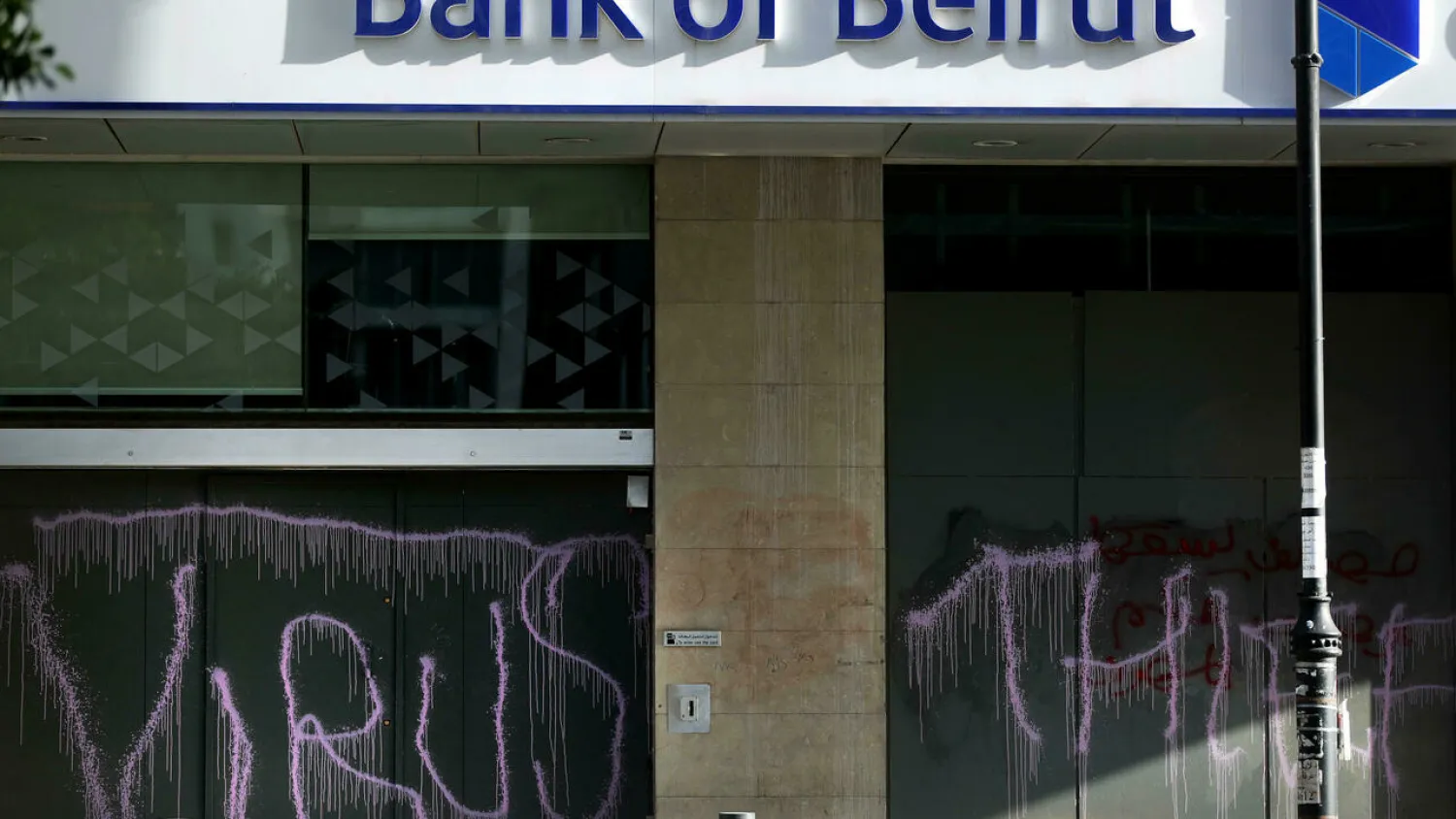
Graffiti dubbed on the exterior of a Bank of Beirut branch; Lebanese lenders are widely blamed by citizens for the country's devastating financial crisis. PATRICK BAZ AFP/File
TT

Lebanon's 'Zombie Banks' Downsize to Weather Crisis

Graffiti dubbed on the exterior of a Bank of Beirut branch; Lebanese lenders are widely blamed by citizens for the country's devastating financial crisis. PATRICK BAZ AFP/File

Once the economy's crown jewel, Lebanon's banks are shutting branches and laying off employees in droves, resizing to the bleak reality of a crisis they are widely blamed for.

Before the onset in 2019 of a financial collapse deemed one of the world's worst since the 1850s by the World Bank, the small Mediterranean country had an oversized but prosperous banking sector.

The capital Beirut was a booming regional financial hub, attracting savers keen to profit from high interest rates and banking secrecy laws.

But more than two years into the crisis, the reputation of Lebanese lenders has been shredded, AFP reported.

A dizzying currency collapse, coupled with banks imposing strict withdrawal limits and prohibiting transfers abroad, has left ordinary depositors watching on helplessly as their savings evaporate.

And yet bankers stand accused of bypassing those exact same capital controls -- stoking the crisis by helping the political elite squirrel billions of dollars overseas. 

Their trust destroyed, citizens now keep new income well away from the banks, which in turn are deprived of money they could lend.

"The whole banking system today is made up of zombie banks," said economic analyst Patrick Mardini.

"They don't work as banks anymore -- they don't give loans, they don't take new deposits."

- 'Abandoned country' -
As a result, the industry has been forced to scale back its operations. 

In 2019, Lebanon ranked second in the region for bank branches per 100,000 people, according to the World Bank, and held a total of around $150 billion in deposits. 

Deposits by Arab investors and Lebanese expatriates propelled the banking sector to peak at three times the value of national economic output. 

But more than 160 branches have closed since the end of 2018, leaving a total of 919 branches operating across the country, according to the Association of Banks in Lebanon (ABL).

The number of employees has dropped by around 5,900, reducing the sector's workforce to roughly 20,000 late last year.

"Lebanon is an abandoned country," ABL chief Salim Sfeir told AFP, referring to negligence by the nation's authorities. 

The association claims the sector has been "forced to adapt to the contraction of the economy," even as others blame the banks for overall economic activity plunging by more than half since 2019.

The Lebanese pound, officially pegged at 1,507 to the greenback since 1997, has lost more than 90 percent of its value on the black market.

The slide has prompted banks to adopt a plethora of exchange rates for transactions even though the official rate remains unchanged. 

Those who hold dollar accounts have mostly had to withdraw cash in Lebanese pounds and at a fraction of the black market rate.

"If we apply international accounting standards, almost all Lebanese banks are insolvent," investment banker Jean Riachi said. 

- 'Exit the market' -
Lebanon's government defaulted on its foreign debt in 2020, stymying the country's hopes of quickly securing new international credit or donor money to stem the crisis. 

The ruling elite, beset by internal rifts that have repeatedly left the country without a government, has yet to agree on an economic recovery plan with international creditors.

Disagreements between the government, the central bank and commercial banks over the scale of financial sector losses have dogged talks with the International Monetary Fund that first started nearly two years ago.

In December, the government of Prime Minister Najib Mikati set financial sector losses at around $69 billion in a crucial step towards advancing IMF talks.  

But while the global lender said early this month that efforts to agree on a rescue package have progressed, it made clear more work was needed, especially in terms of "restructuring of the financial sector".

The analyst Mardini said bank restructuring proposals have been discussed by several governments.

Central bank chief Riad Salameh has said banks that are unable to lend must "exit the market".

But meaningful progress on restructuring has been impeded by a political elite who maintain large shares in some of the main banks, according to Mardini. 

For out-of-pocket depositors, the details of any restructuring arrangements are a secondary concern.

"I just want to recover my savings," said Hicham, a businessman who asked to use his first name only over privacy concerns.

"All the parties concerned must assume their responsibilities."


Israel Military Says Soldier Killed in Gaza 

A drone view shows the destruction in a residential neighborhood, after the withdrawal of the Israeli forces from the area, amid a ceasefire between Israel and Hamas in Gaza, in Gaza City, October 21, 2025. (Reuters)
TT

Israel Military Says Soldier Killed in Gaza 

A drone view shows the destruction in a residential neighborhood, after the withdrawal of the Israeli forces from the area, amid a ceasefire between Israel and Hamas in Gaza, in Gaza City, October 21, 2025. (Reuters)

The Israeli military announced that one of its soldiers had been killed in combat in southern Gaza on Wednesday, but a security source said the death appeared to have been caused by "friendly fire".

"Staff Sergeant Ofri Yafe, aged 21, from HaYogev, a soldier in the Paratroopers Reconnaissance Unit, fell during combat in the southern Gaza Strip," the military said in a statement.

A security source, however, told AFP that the soldier appeared to have been "killed by friendly fire", without providing further details.

"The incident is still under investigation," the source added.

The death brings to five the number of Israeli soldiers killed in Gaza since a ceasefire took effect on October 10.


Syria: SDF’s Mazloum Abdi Says Implementation of Integration Deal May Take Time

People sit outdoors surrounded by nature, with the Tigris river flowing in the background, following a long atmospheric depression, near the Syrian-Turkish border in Derik, Syria, February 16, 2026 REUTERS/Orhan Qereman
TT

Syria: SDF’s Mazloum Abdi Says Implementation of Integration Deal May Take Time

People sit outdoors surrounded by nature, with the Tigris river flowing in the background, following a long atmospheric depression, near the Syrian-Turkish border in Derik, Syria, February 16, 2026 REUTERS/Orhan Qereman

Mazloum Abdi, commander of the Syrian Democratic Forces, said the process of merging the SDF with Syrian government forces “may take some time,” despite expressing confidence in the eventual success of the agreement.

His remarks came after earlier comments in which he acknowledged differences with Damascus over the concept of “decentralization.”

Speaking at a tribal conference in the northeastern city of Hasakah on Tuesday, Abdi said the issue of integration would not be resolved quickly, but stressed that the agreement remains on track.

He said the deal reached last month stipulates that three Syrian army brigades will be created out of the SDF.

Abdi added that all SDF military units have withdrawn to their barracks in an effort to preserve stability and continue implementing the announced integration agreement with the Syrian state.

He also emphasized the need for armed forces to withdraw from the vicinity of the city of Ayn al-Arab (Kobani), to be replaced by security forces tasked with maintaining order.


Israeli Far-Right Minister to Push for ‘Migration’ of West Bank, Gaza Palestinians 

A Palestinian man checks leather belts as people prepare for Ramadan, in the old city of Hebron in the Israeli-occupied West Bank, February 17,2026. (Reuters)
TT

Israeli Far-Right Minister to Push for ‘Migration’ of West Bank, Gaza Palestinians 

A Palestinian man checks leather belts as people prepare for Ramadan, in the old city of Hebron in the Israeli-occupied West Bank, February 17,2026. (Reuters)

Israel's far-right Finance Minister Bezalel Smotrich said he would pursue a policy of "encouraging the migration" of Palestinians from the occupied West Bank and Gaza Strip, Israeli media reported Wednesday.

"We will eliminate the idea of an Arab terror state," said Smotrich, speaking at an event organized by his Religious Zionism Party late on Tuesday.

"We will finally, formally, and in practical terms nullify the cursed Oslo Accords and embark on a path toward sovereignty, while encouraging emigration from both Gaza and Judea and Samaria.

"There is no other long-term solution," added Smotrich, who himself lives in a settlement in the West Bank.

Since last week, Israel has approved a series of measures backed by far-right ministers to tighten control over the West Bank, including in areas administered by the Palestinian Authority under the Oslo Accords, in place since the 1990s.

The measures include a process to register land in the West Bank as "state property" and facilitate direct purchases of land by Jewish Israelis.

The measures have triggered widespread international outrage.

On Tuesday, the UN missions of 85 countries condemned the measures, which critics say amount to de facto annexation of the Palestinian territory.

"We strongly condemn unilateral Israeli decisions and measures aimed at expanding Israel's unlawful presence in the West Bank," they said in a statement.

"Such decisions are contrary to Israel's obligations under international law and must be immediately reversed.

"We underline in this regard our strong opposition to any form of annexation."

UN Secretary-General Antonio Guterres on Monday called on Israel to reverse its land registration policy, calling it "destabilizing" and "unlawful".

The West Bank would form the largest part of any future Palestinian state. Many on Israel's religious right view it as Israeli land.

Israeli NGOs have also raised the alarm over a settlement plan signed by the government which they say would mark the first expansion of Jerusalem's borders into the occupied West Bank since 1967.

The planned development, announced by Israel's Ministry of Construction and Housing, is formally a westward expansion of the Geva Binyamin, or Adam, settlement situated northeast of Jerusalem in the West Bank.

The current Israeli government has fast-tracked settlement expansion, approving a record 52 settlements in 2025.

Excluding Israeli-annexed east Jerusalem, more than 500,000 Israelis live in West Bank settlements and outposts, which are illegal under international law.
