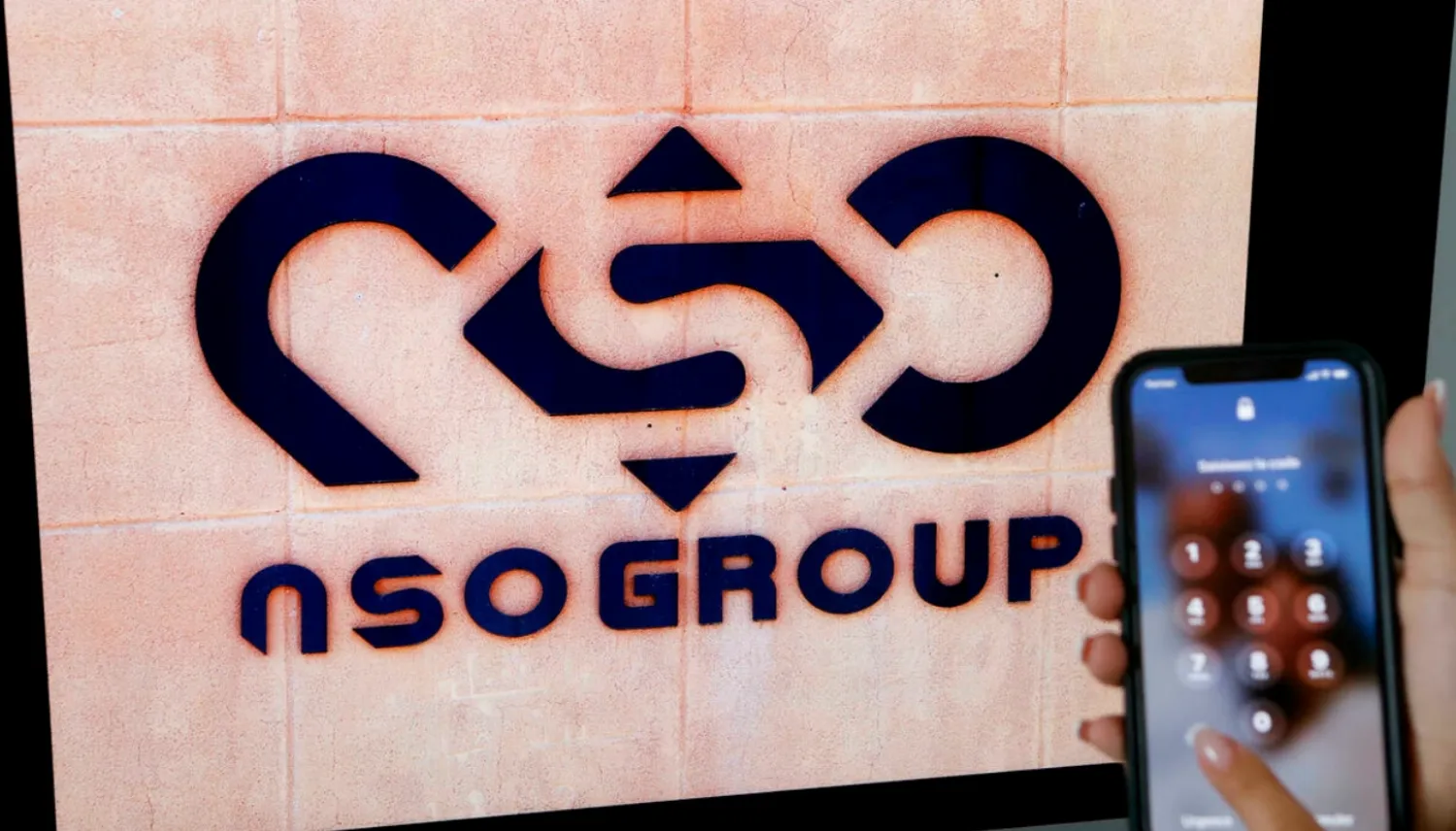
Battle Over Future of Israeli Spytech Firm NSO

Israeli spytech firm NSO's Pegasus phone-hacking software has stirred global outrage -JACK GUEZ AFP
TT

Battle Over Future of Israeli Spytech Firm NSO

Israeli spytech firm NSO's Pegasus phone-hacking software has stirred global outrage -JACK GUEZ AFP

A court fight within Israeli spytech firm NSO Group has shed new light on the crisis engulfing the company, including tensions over whether to keep selling malware to autocrats to stay afloat.

NSO was already mired in debt before an investigation revealed last year that its Pegasus phone-hacking software had been used to spy on hundreds of journalists, dissidents and activists worldwide.

Now the surveillance tech giant is teetering, especially after being banned by the United States.

AFP has reviewed hundreds of pages of court documents from a dispute involving NSO, its creditors and the Berkeley Research Group (BRG), majority shareholders of NSO's parent company.

The documents suggest creditors have sought to push NSO, based in the Tel Aviv suburb of Herzliya, to continue selling Pegasus to "elevated risk" countries with questionable human rights records, in order to maintain revenues.

But Berkeley Research has demanded a halt to suspect sales without more internal reviews, citing an "absolute need for [NSO] to address the underlying issues" that saw it blacklisted.

The tensions surfaced in a Tel Aviv court case where BRG is seeking to force the spinoff of three subsidiaries, including a maker of anti-drone equipment, arguing the smaller companies risk being brought down by the Pegasus scandal.

The legal battle lines unveil a broader fight over the company's future, with implications for the global cyber-surveillance industry.

"NSO is a flagship company. They are sort of the case study right now," Danna Ingleton, deputy director of Amnesty Tech, told AFP.

What happens to NSO, she said, could signal a "seismic shift in the regulation of this industry".

Pegasus can remotely switch on a mobile phone's camera and microphone and suck up data.

The company says the software has helped security forces in many countries thwart crime and stop attacks.

NSO has not identified its customers, but reporting has revealed Pegasus was used by several states with poor democratic credentials and histories of suppressing dissent.

In a letter released with court documents, lawyers for NSO's creditors charge that BRG's approach "foreclosed the Company from accepting any new customers".

A source familiar with NSO said BRG wanted the company "to shut down, or to stop some of the activities that we have with customers".

"We said we have legal obligations that we cannot do it unless they misuse the system," the source told AFP, requesting anonymity.

BRG's lawyers countered that "since the Pegasus Project disclosures the only new potential customer bookings" for Pegasus are from "elevated risk customers".

A source from BRG's legal team told AFP it opposed those sales.

"If they want to sell the system to democratic countries, I don't think somebody will block them," the source said also requesting anonymity.

NSO was reportedly valued at $1 billion in 2019, when co-founders Shalev Hulio and Omri Lavie announced they acquired the firm from California-based Francisco Partners, with backing from London-based Novalpina Capital.

To fund the acquisition, Novalpina borrowed $500 million and placed the debt in a holding company above NSO.

It stood out among tech companies who usually rely on investment banks or investors, said Israeli tech attorney Dan Or-Hof, of the Privacy Protection Council advising the justice ministry.

"Taking $500 million worth of loans, I would say, would be an irregular event for a tech company here in Israel," he said.

The debt was staggering, but so were NSO's revenues, estimated at $250 million in 2018. However, fortunes turned fast.

Since the Pegasus Project revelations emerged in July, the US banned NSO, saying it enabled foreign governments to "maliciously target" people.

Ratings agency Moody's downgraded NSO, citing low revenues and a risk that new sales "can become increasingly difficult given the actions taken against NSO".

Apple sued the company for targeting its users, following a similar suit by Meta's WhatsApp.

Novalpina's investors, who hold 70 percent of the shares of NSO's parent company, appointed BRG Asset Management to take over as investment managers.

Throughout, NSO has stressed its foreign sales are licensed by Israel's defense ministry and that it does not control how its customers use Pegasus.

Israel's defense establishment has said it is reviewing its export approval process.

The company's debt has increased the pressure to maintain revenues.

In a December letter, lawyers for the creditors said they understood "the need for caution given the global attention" but that BRG's "blunt-instrument approach ... has deepened the Company's current liquidity crisis".

BRG's lawyers countered the lenders were "demanding that our clients blindly sanction the sale" of Pegasus to "elevated risk" customers without appropriate internal reviews.

NSO has also been criticized in Israel after reports claimed police used Pegasus against dozens of citizens, including senior government officials and activists, though a government investigation has so far undercut the allegations.

NSO said in a statement to AFP that it "is considering the best way for its natural growth in terms of new markets and products".

In January, Delaware-based Integrity Labs sent a letter of interest to NSO's chief executive Hulio, proposing to inject $300 million, take control of the company and trim its customers to the US, Britain, Canada, Australia and New Zealand.

It is one of "a few options on the table," the NSO source told AFP.


Le Pen Says France Will No Longer Aid Ukraine ‘Financially’ if Elected

Marine Le Pen (C), the far-right National Rally (RN) party's candidate for the 2027 French presidential election, visits the "Made in France" fair at the Porte de Versailles exhibition center in Paris, France, 13 November 2026. (EPA)
TT

Le Pen Says France Will No Longer Aid Ukraine ‘Financially’ if Elected

Marine Le Pen (C), the far-right National Rally (RN) party's candidate for the 2027 French presidential election, visits the "Made in France" fair at the Porte de Versailles exhibition center in Paris, France, 13 November 2026. (EPA)

Marine Le Pen on Monday said that France would provide no further financial aid to Ukraine if she is elected president next year, after a meeting with Kyiv's ambassador in Paris.

"The state of France's public finances would no longer allow the country to provide financial assistance to Ukraine in the coming months," Le Pen said in a statement, while insisting France would honor existing commitments, including toward a 90-billion-euro ($100-billion) European Union loan.

Le Pen is currently ahead in polls in the race to succeed President Emmanuel Macron next year, as the war sparked by Russia's 2022 full-scale invasion of Ukraine grinds towards its fifth anniversary.

She has faced criticism over past links to Russia, which included a 2017 meeting in the Kremlin with President Vladimir Putin and her party taking a loan from a Russian bank that it paid off in full in 2023.

But she has opposed the invasion and, at her talks in Paris with Ukrainian ambassador Vadym Omelchenko, Le Pen made clear her "unwavering support for Ukraine since the beginning of the conflict".

The statement said the talks -- the first such between Le Pen and the Ukrainian ambassador -- were "cordial".

While financial aid would be cut, Le Pen told the ambassador that "France would continue to support Ukraine through donations of equipment, humanitarian aid and much more active diplomacy".

The statement said there was a "frank discussion" on the future of the conflict, with Le Pen stressing that "the pursuit of peace -- though a difficult goal to achieve -- must remain a priority for all".

She also asked the ambassador to tell President Volodymyr Zelensky she is ready to meet in "either Paris or Brussels". However, there was no mention of the candidate making the journey to Kyiv after Zelensky invited her to visit the Ukrainian capital.

Le Pen's opponents have expressed alarm that by emphasizing the importance of ending the war swiftly, she could force Ukraine to capitulate on unfavorable terms.

"If Russia imposes its will on a European nation through brutality, all of Europe is weakened," Macron wrote on Facebook at the weekend.

Taking aim at Le Pen, he said: "Let us be clear: those who seek to limit the resources available to Ukraine are, in effect, pushing for an unjust peace -- one that would leave Ukraine permanently vulnerable, and, by extension, leave Europe vulnerable as well."


Trump Says He Might Meet with North Korea’s Kim Jong Un in China

US President Donald Trump and North Korean leader Kim Jong Un shake hands before their one-on-one chat during the second US-North Korea summit at the Metropole Hotel in Hanoi, Vietnam February 27, 2019. (Reuters)
TT

Trump Says He Might Meet with North Korea’s Kim Jong Un in China

US President Donald Trump and North Korean leader Kim Jong Un shake hands before their one-on-one chat during the second US-North Korea summit at the Metropole Hotel in Hanoi, Vietnam February 27, 2019. (Reuters)

US President Donald Trump said on Monday he might meet with North Korean leader Kim Jong Un in China this week, an announcement that could dramatically reshape his upcoming trip through East Asia if it occurs.

The president, who met the North Korean leader several times during his 2017-2021 term, including once in the Korean Demilitarized Zone, has previously expressed ‌interest in ‌another meeting during his current term. Senior ‌US ⁠officials, however, have previously ⁠said he has no immediate plans to do so.

Moreover, Trump has repeatedly previewed meetings with Kim that never took place, including during a trip to Asia last year. North Korea, whose mission to the United Nations did not immediately respond to a ⁠request for comment, has publicly indicated it ‌has no intention of ‌meeting with the US president at this time.

Trump told reporters ‌while departing the White House en route to ‌the Philippines and China that any meeting would occur in China, and that the North Korean leader's presence was ultimately up to Chinese President Xi Jinping.

"(Xi) was here a ‌month ago, and we're also going to meet with (Russian) President Putin, and we ⁠may ⁠meet with Kim Jong Un also," Trump said.

"So that'll be good. We have a chance to accomplish a lot."

Trump has indicated he will meet with Putin and Xi during his trip, but US officials and analysts have played down the possibility of a meaningful agreement emerging from any trilateral sit-down.

Among the possible topics of conversation, Trump and others have said, are Russia's invasion of Ukraine, counterproliferation and the war in Iran.


Third US Aircraft Carrier Arrives in Middle East

This US Navy handout photograph released by US Naval Forces Central Command on November 4, 2026, shows the Nimitz-class aircraft carrier USS Theodore Roosevelt (CVN 71) sails alongside Royal Australian Navy Supply-class replenishment oiler HMAS Stalwart (A304). (AFP / NAVCENT Public Affairs / US Navy)
TT

Third US Aircraft Carrier Arrives in Middle East

This US Navy handout photograph released by US Naval Forces Central Command on November 4, 2026, shows the Nimitz-class aircraft carrier USS Theodore Roosevelt (CVN 71) sails alongside Royal Australian Navy Supply-class replenishment oiler HMAS Stalwart (A304). (AFP / NAVCENT Public Affairs / US Navy)

The USS Theodore Roosevelt aircraft carrier arrived in the Middle East on Sunday, media reports said, bringing the number of American carrier strike groups in the region to three.

The deployment, which was reported by the National News and Axios journalist Barak Ravid, comes as fighting reignites in the region, with Iran claiming a drone attack on Bahrain on Sunday, ending a lull in strikes in the war.

Iran also fired drones at Bahrain on Friday -- the first strikes since September against countries in the energy-rich Gulf, which has been targeted several times in the conflict that erupted in February.

US President Donald Trump plans to discuss the war at a trilateral meeting with his Chinese and Russian counterparts Xi Jinping and Vladimir Putin this week, an official said Friday.

Months of diplomacy have failed to resolve the war, which began with US-Israeli strikes that killed Iran's supreme leader Ali Khamenei.