


Biden and Europe Waiting on One Key Sanction against Russia

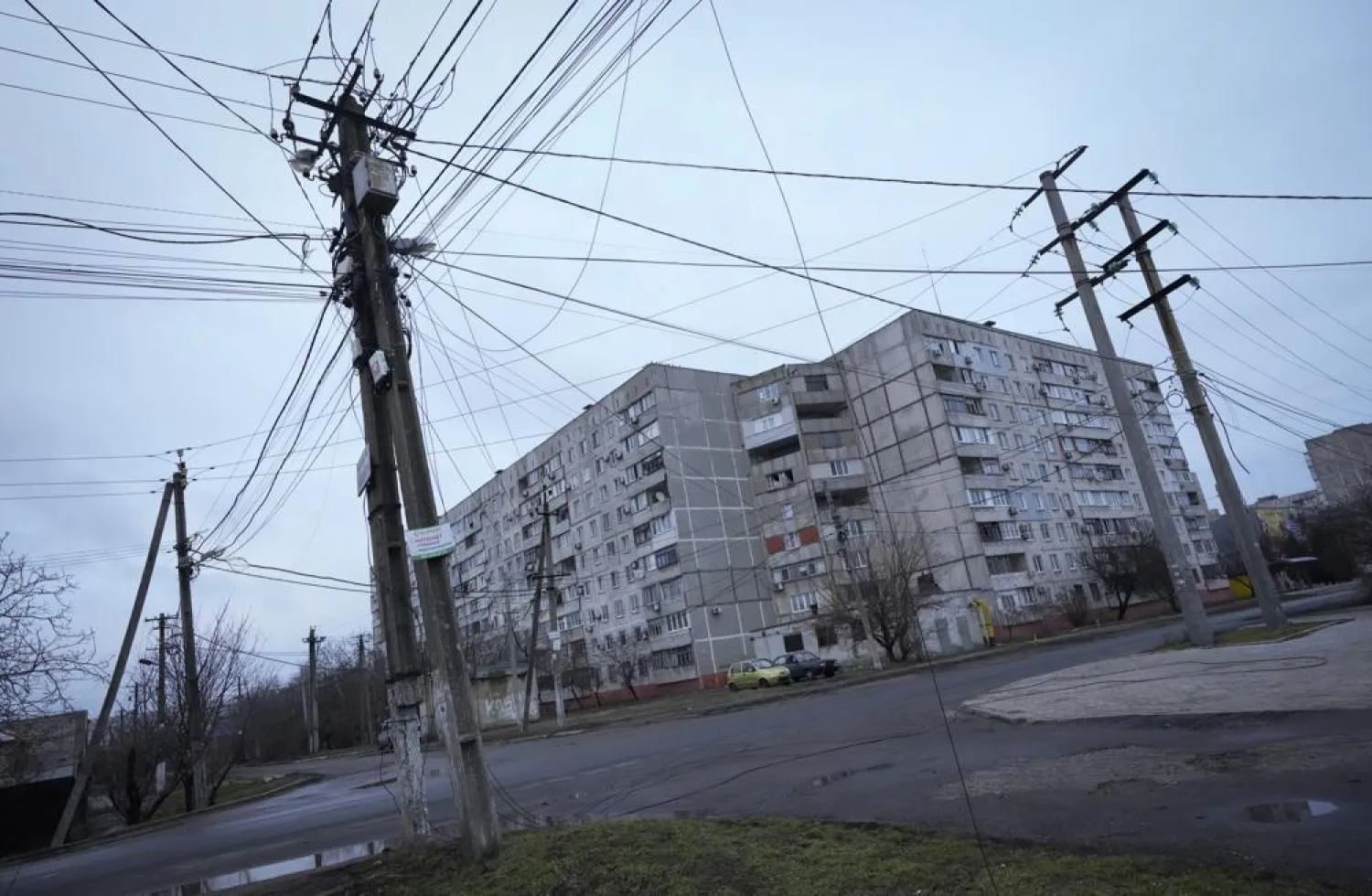
Empty streets seen following Russian shelling in Mariupol, Ukraine, Thursday, Feb. 24, 2022. (AP)
TT

Biden and Europe Waiting on One Key Sanction against Russia

Empty streets seen following Russian shelling in Mariupol, Ukraine, Thursday, Feb. 24, 2022. (AP)

US and European officials are holding one key financial sanction against Russia in reserve, choosing not to boot Russia off SWIFT, the dominant system for global financial transactions.

The Russian invasion of Ukraine caused a barrage of new financial sanctions Thursday. The sanctions are meant to isolate, punish and impoverish Russia in the long term. President Joe Biden announced restrictions on exports to Russia and sanctions against Russian banks and state-controlled companies.

But Biden pointedly played down the need to block Russia from SWIFT, saying that while it's “always” still an option, “right now that's not the position that the rest of Europe wishes to take.” He also suggested the sanctions being put in place would have more teeth.

“The sanctions we’ve imposed exceed SWIFT,” Biden said in response to a question Thursday. “Let’s have a conversation in another month or so to see if they’re working.”

Still, some European leaders, including in the United Kingdom, favor taking the additional step of blocking Russia from SWIFT, the Belgium-headquartered consortium used by banks and other financial institutions that serves as a key communications line for commerce worldwide. The SWIFT system averaged 42 million messages daily last year to enable payments. The name is an acronym for the Society for Worldwide Interbank Financial Telecommunications, and about half of all high-value payments that cross national borders go through its platform.

Ukraine has sought for Russia to be excluded from SWIFT, but several European leaders would prefer to stay patient because a ban could make international trade more difficult and hurt their economies.

“A number of countries are hesitant since it has serious consequences for themselves,” said Dutch Prime Minister Mark Rutte, who believes a ban should be a last resort.

The British government says Prime Minister Boris Johnson pushed at a virtual meeting of the Group of Seven world leaders Thursday for Russia to be kicked out of SWIFT. It said there was “no pushback” but it was agreed that more discussion was needed. UK officials would not confirm Germany was resisting.

US lawmakers have called on Biden to deploy every available financial sanction, with Senate Republican Leader Mitch McConnell saying Thursday that America should “ratchet the sanctions all the way up. Don’t hold any back. Every single available tough sanction should be employed and should be employed now.”

But Sen. Jim Risch of Idaho, the top Republican on the Senate Foreign Relations Committee, said the SWIFT ban would be complicated and time-consuming in part because the US doesn't have control over the decision.

The problem is that banning Russia from SWIFT might not cut it off from the global economy as cleanly as proponents think. Also, there could be blowback in the form of slower international growth. And rival messaging systems could gain users in ways that erode the power of the US dollar — all of which has left SWIFT as a sanction waiting to be deployed.

“It’s a communications platform, not a financial payments system," said Adam Smith, a lawyer who worked in the Obama administration. "If you remove Russia from SWIFT, you’re removing them from a key artery of finance, but they can use pre-SWIFT tools like telephone, telex or email to engage in bank-to-bank transactions.”

The other risk is that countries could migrate their institutions to platforms other than SWIFT, such as a system developed by China. This would increase the friction in global commerce — hurting growth — and make it harder to monitor the finances of terrorist groups.

“By politicizing SWIFT you give incentive for others to develop alternatives,” said Brian O'Toole, a senior fellow at the Atlantic Council and former Treasury official. “SWIFT also is an important partner in US-European counterterrorism efforts. It shares data with US Treasury related to counterterrorism issues that has proven to be enormously valuable.”

The sanctions announced Thursday would still accomplish much of what would happen if Russia lost access to SWIFT, said Clay Lowery of the Institute of International Finance.

“Cutting off these financial institutions from utilizing the dollar, euro, pound sterling is still a pretty significant step," Lowery said. “You’re really having the same impact on certain subsections of the Russian economy through sanctions.”

Iran was blocked from the SWIFT system in 2014 because of its nuclear program. In 2019, then-Russian Prime Minister Dmitry Medvedev said losing access to SWIFT would be akin to a declaration of war against Russia. The statement by Medvedev is a sign that Russia viewed the platform as a vulnerability and developed workarounds to limit any economic damage.

"I think it will be harmful in the immediate term and psychological as well, but I’m not sure it’ll impact the economy in ways that make it worthwhile,” Smith said.

Russia has already prepared for ways to evade sanctions, including those imposed this week, experts say.

Ari Redbord, a former Treasury senior adviser, said he expects Russia’s leadership to bypass financial penalties that limit its ability to engage in the global financial system through the increased use of cryptocurrency.

He said this is a risk “especially when there are actors like Iran, China and North Korea” that will continue to trade with Russia outside of the formal financial system, Redbord said.

“If Russian banks are entirely cut off from the US and European financial system, that will be very debilitating to those banks and the Russian economy,” he said. But the Russian government will use alternative means to trade with countries “even if there are debilitating" sanctions from the European Union and US.



US Judge Blocks Deportation of Columbia University Palestinian Activist

Mohsen Mahdawi at a press conference in Vermont last year - Photo by Alex Driehaus/AP
TT

US Judge Blocks Deportation of Columbia University Palestinian Activist

Mohsen Mahdawi at a press conference in Vermont last year - Photo by Alex Driehaus/AP

A US immigration judge has blocked the deportation of a Palestinian graduate student who helped organize protests at Columbia University against Israel's war in Gaza, according to US media reports.

Mohsen Mahdawi was arrested by immigration agents last year as he was attending an interview to become a US citizen.

Mahdawi had been involved in a wave of demonstrations that gripped several major US university campuses since Israel began a massive military campaign in the Gaza Strip.

A Palestinian born in the occupied West Bank, Mahdawi has been a legal US permanent resident since 2015 and graduated from the prestigious New York university in May. He has been free from federal custody since April.

In an order made public on Tuesday, Judge Nina Froes said that President Donald Trump's administration did not provide sufficient evidence that Mahdawi could be legally removed from the United States, multiple media outlets reported.

Froes reportedly questioned the authenticity of a copy of a document purportedly signed by Secretary of State Marco Rubio that said Mahdawi's activism "could undermine the Middle East peace process by reinforcing antisemitic sentiment," according to the New York Times.

Rubio has argued that federal law grants him the authority to summarily revoke visas and deport migrants who pose threats to US foreign policy.

The Trump administration can still appeal the decision, which marked a setback in the Republican president's efforts to crack down on pro-Palestinian campus activists.

The administration has also attempted to deport Mahmoud Khalil, another student activist who co-founded a Palestinian student group at Columbia, alongside Mahdawi.

"I am grateful to the court for honoring the rule of law and holding the line against the government's attempts to trample on due process," Mahdawi said in a statement released by his attorneys and published Tuesday by several media outlets.

"This decision is an important step towards upholding what fear tried to destroy: the right to speak for peace and justice."


Fire Breaks out Near Iran's Capital Tehran, State Media Says

Smoke rises from a fire caused by an explosion in Tehran (File photo - Reuters)
TT

Fire Breaks out Near Iran's Capital Tehran, State Media Says

Smoke rises from a fire caused by an explosion in Tehran (File photo - Reuters)

A fire broke out in Iran's Parand near the capital city Tehran, state media reported on Wednesday, publishing videos of smoke rising over the area which is close to several military and strategic sites in the country's Tehran province, Reuters reported.

"The black smoke seen near the city of Parand is the result of a fire in the reeds around the Parand river bank... fire fighters are on site and the fire extinguishing operation is underway", state media cited the Parand fire department as saying.


Pakistan PM Sharif to Seek Clarity on Troops for Gaza in US Visit

US President Donald Trump looks at Pakistan's Prime Minister Shehbaz Sharif speaking following the official signing of the first phase of the Gaza ceasefire agreement between Israel and Hamas, during a world leaders' summit on ending the Gaza war, in Sharm El-Sheikh, Egypt, October 13, 2025. REUTERS/Evelyn Hockstein/File Photo
TT

Pakistan PM Sharif to Seek Clarity on Troops for Gaza in US Visit

US President Donald Trump looks at Pakistan's Prime Minister Shehbaz Sharif speaking following the official signing of the first phase of the Gaza ceasefire agreement between Israel and Hamas, during a world leaders' summit on ending the Gaza war, in Sharm El-Sheikh, Egypt, October 13, 2025. REUTERS/Evelyn Hockstein/File Photo

Before Pakistan commits to sending troops to Gaza as part of the International Stabilization Force it wants assurances from the United States that it will be a peacekeeping mission rather than tasked with disarming Hamas, three sources told Reuters.

Pakistan's Prime Minister Shehbaz Sharif is set to attend the first formal meeting of President Donald Trump's Board of Peace in Washington on Thursday, alongside delegations from at least 20 countries.

Trump, who will chair the meeting, is expected to announce a multi-billion dollar reconstruction plan for Gaza and detail plans for a UN-authorized stabilization force for the Palestinian enclave.

Three government sources said during the Washington visit Sharif wanted to better understand the goal of the ISF, what authority they were operating under and what the chain of command was before making a decision on deploying troops.

"We are ready to send troops. Let me make it clear that our troops could only be part of a peace mission in Gaza," said one of the sources, a close aide of Sharif.

"We will not be part of any other role, such as disarming Hamas. It is out of the question," he said.

Analysts say Pakistan would be an asset to the multinational force, with its experienced military that has gone to war with arch-rival India and tackled insurgencies.

"We can send initially a couple of thousand troops anytime, but we need to know what role they are going to play," the source added.

Two of the sources said it was likely Sharif, who has met Trump earlier this year in Davos and late last year at the White House, would either have an audience with him on the sidelines of the meeting or the following day at the White House.

Initially designed to cement Gaza's ceasefire, Trump sees the Board of Peace, launched in late January, taking a wider role in resolving global conflicts. Some countries have reacted cautiously, fearing it could become a rival to the United Nations.

While Pakistan has supported the establishment of the board, it has voiced concerns against the mission to demilitarize Gaza's militant group Hamas.