

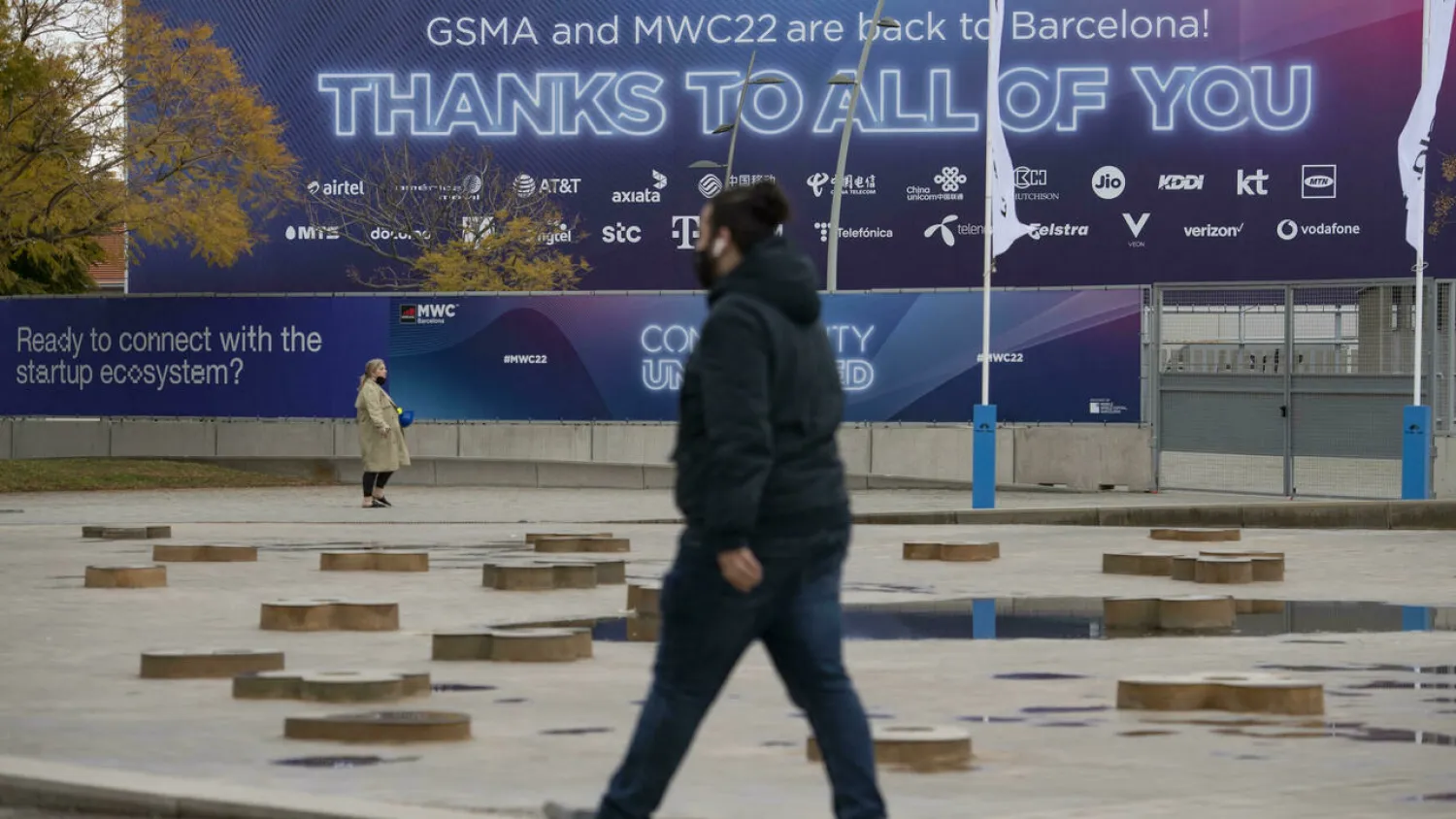

Tech Firms Flock to Spain Trade Show in Shadow of Russia War

Organizers hope to return to a full-scale event after two years of disruption caused by the coronavirus pandemic Josep LAGO AFP
TT

Tech Firms Flock to Spain Trade Show in Shadow of Russia War

Organizers hope to return to a full-scale event after two years of disruption caused by the coronavirus pandemic Josep LAGO AFP

One of the technology industry's biggest annual get-togethers is set to kick off in the Spanish city of Barcelona on Monday, under the shadow of Russia's invasion of Ukraine.

The Mobile World Congress, where smartphone and telecoms companies show off their latest products and reveal their strategic visions, is expected to welcome more than 40,000 guests over its four-day run.

Organizers hope to return to a full-scale event after two years of disruption caused by the coronavirus pandemic, AFP said.

But Russia's invasion of Ukraine has hampered preparations for this year's edition, with organizers forced to remove the country's dedicated pavilion.

Industry body GSMA, which stages the annual event, said in a statement it was complying with all sanctions and policies regarding Russia.

It confirmed, however, that Russian firms may still be able to participate.

The invasion has sparked wider jitters, with the industry assessing sanctions slapped on Russia by the United States and Europe and a likely shortage of key raw materials caused by the conflict.

- Pandemic woes -
The MWC was cancelled at the last minute in 2020 as the pandemic spread from China to Europe, and last year's edition was drastically scaled down.

The pandemic continues to cast its shadow with big names like Sony, Asus and Lenovo pulling out or participating "virtually".

But organizers are bullish, with GSMA director general Mats Granryd saying 95 percent of speakers will be in Barcelona.

Among the tech giants confirming their attendance are smartphone behemoth Samsung, as well as Nokia, Ericsson, Google, Huawei and Verizon.

Focuses of this year's event include the rise of 5G, the opportunities offered by the Internet of Things (IoT), the metaverse and the impact of tech on the environment.

Few new products are expected to be unveiled by the major players, many of whom have showcased their latest releases in the weeks leading up to the get-together.

- 'No shelter' -
The show will, however, provide Chinese phone makers such as Oppo, Xiaomi and Vivo with a "coming out party", according to Ben Wood of CCS Insight.

"It's the first time they will be able to flex their muscles at a big Western trade show," he told AFP, pointing out that they have all become much bigger during the pandemic.

They are filling a void left by Huawei, which has been hobbled by sanctions imposed by the US in 2019 over accusations its wireless systems could allow spying by Chinese state entities.

The entire industry will now need to reckon with sanctions over the Ukraine invasion, with the US already announcing restrictions on technology exports to Russia.

"The smartphone market, and other technology product markets, are unlikely to remain sheltered from the impact of the crisis in Ukraine, given the economic and geographic significance of both Russia and Ukraine," said Marina Koytcheva of CCS.

Both countries supply raw materials such as neon and palladium used to manufacture smartphone components.

And the conflict could lead to shortages of many other products and rising prices, which could in turn hit demand for phones, she said.

The smartphone market grew by 5.7 percent last year, with 1.35 billion devices sold worldwide, according to analyst firm IDC.

Samsung sold the most phones followed by Apple and Oppo.


Microsoft to Invest $10 bn for Japan AI Data Centers

Microsoft's Vice Chair and President Brad Smith (4th L) and (L-R) Sakura Internet Inc President and CEO Kunihiro Tanaka, SoftBank Corp. President and CEO Junichi Miyakawa, Microsoft Japan President Miki Tsusaka, hold a meeitng with Japan's Prime Minister Sanae Takaichi (2nd R) and Vice Minister of Economy, Trade and Industry Toshiro Ino (R) at the Prime Minister's Office in Tokyo on April 3, 2026. Kazuhiro NOGI / POOL/AFP
TT

Microsoft to Invest $10 bn for Japan AI Data Centers

Microsoft's Vice Chair and President Brad Smith (4th L) and (L-R) Sakura Internet Inc President and CEO Kunihiro Tanaka, SoftBank Corp. President and CEO Junichi Miyakawa, Microsoft Japan President Miki Tsusaka, hold a meeitng with Japan's Prime Minister Sanae Takaichi (2nd R) and Vice Minister of Economy, Trade and Industry Toshiro Ino (R) at the Prime Minister's Office in Tokyo on April 3, 2026. Kazuhiro NOGI / POOL/AFP

Microsoft said Friday it will invest $10 billion in Japan over the next four years to build artificial intelligence data centers and related infrastructure.

Power-hungry data centers -- warehouse-like facilities that power AI tools from chatbots to image generators -- are springing up worldwide, and the sector is growing particularly fast in Asia.

Microsoft President Brad Smith met Japanese Prime Minister Sanae Takaichi at her office on Friday to announce the investment, said AFP.

Smith said in a statement that it was a "response to Japan's growing need for cloud and AI services".

Businesses in Japan, the world's fourth-largest economy, are keen to get ahead in the fast-moving AI field.

But data centers expansion there is constrained by limited space and relatively expensive electricity.

The US tech giant will collaborate with Japan's SoftBank Group and Sakura Internet to expand domestic tech infrastructure, it said in a press release.

It follows a $2.9 billion two-year investment Microsoft announced in 2024 to bolster the country's push into AI and strengthen its cyber defenses.

The investment unveiled Friday also includes funds to enhance cybersecurity partnerships with Japanese government agencies, and to train one million engineers in cooperation with telecom and tech giants NTT and NEC.

A rush to build data centers in the Asia-Pacific region, especially in India and Southeast Asia, has sparked concerns over the facilities' environmental impact.

That includes increased demand on electricity grids that are often reliant on fossil fuels, and on local water supplies used to cool the hot servers inside.

Microsoft says it has pledged to become carbon negative, zero-waste and "water positive" by 2030.

On Tuesday, the company announced plans to invest more than $1 billion in cloud and AI data center infrastructure and operations in Thailand over the next two years.


Kia to Sell Lower-priced Electric Vehicle in US

A KIA logo on an electric vehicle is seen on display at the Canadian International AutoShow in Toronto, Ontario, Canada, February 13, 2025. REUTERS/Carlos Osorio
TT

Kia to Sell Lower-priced Electric Vehicle in US

A KIA logo on an electric vehicle is seen on display at the Canadian International AutoShow in Toronto, Ontario, Canada, February 13, 2025. REUTERS/Carlos Osorio

Kia said Wednesday it will begin selling a lower-priced electric vehicle in the United States later this year as automakers work to recharge EV sales.

The Korean automaker said at the New York Auto Show it will offer the EV3 in the US market starting later this year, Reuters reported.

Automakers are facing a tougher EV market in the United States after Congress repealed the $7,500 EV tax credit last year but higher gasoline prices in recent weeks has prompted new interest in the EVs.


Passengers Stranded in Moving Traffic after Robotaxi Outage in China

This file photo taken on August 1, 2024 shows a general view of a driverless robotaxi autonomous vehicle developed as part of tech giant Baidu's Apollo Go self-driving project, in Wuhan, in central China's Hubei province. (Photo by PEDRO PARDO / AFP)
TT

Passengers Stranded in Moving Traffic after Robotaxi Outage in China

This file photo taken on August 1, 2024 shows a general view of a driverless robotaxi autonomous vehicle developed as part of tech giant Baidu's Apollo Go self-driving project, in Wuhan, in central China's Hubei province. (Photo by PEDRO PARDO / AFP)

Some robotaxi passengers were left stranded in the middle of fast-moving traffic in a major Chinese city after their driverless vehicles stopped running, according to police and media reports on Wednesday.

A preliminary investigation indicates more than 100 robotaxis came to a halt because of a “system malfunction,” police in the city of Wuhan said in a statement, without elaborating. No injuries were reported.

One passenger told Chinese media that their robotaxi stopped after turning a corner. An instruction on a screen read: “Driving system malfunction. Staff are expected to arrive in 5 minutes.” After no one showed up, the passenger pushed an SOS button and was told that staff were on their way. The car door could be opened, so the passenger got out on their own.

It is the first time a mass shutdown of robotaxis has been reported in China, The Associated Press said. In December, many of Waymo’s self-driving cars came to a stop in San Francisco because of a power outage.

The taxis in Wuhan are operated by Baidu, a major Chinese internet and AI company that is expanding its Apollo Go robotaxi business to overseas locations in Europe and the Mideast.

Baidu did not have any immediate comment.

Police said reports that taxis were coming to a halt started coming in around 9 p.m., while media reports said multiple people were rescued.

While some passengers were able to exit their taxis on their own, others were afraid to get out because their vehicle had stopped in the middle lane of a ring road with other vehicles passing on both sides, the reports said. Ring roads are elevated roads without traffic lights designed to move traffic quickly in urban areas.

Baidu operates hundreds of robotaxis in Wuhan, which hosted an early pilot project for the company.
