


Russian Forces Step up Attacks on Ukraine’s Civilian Areas

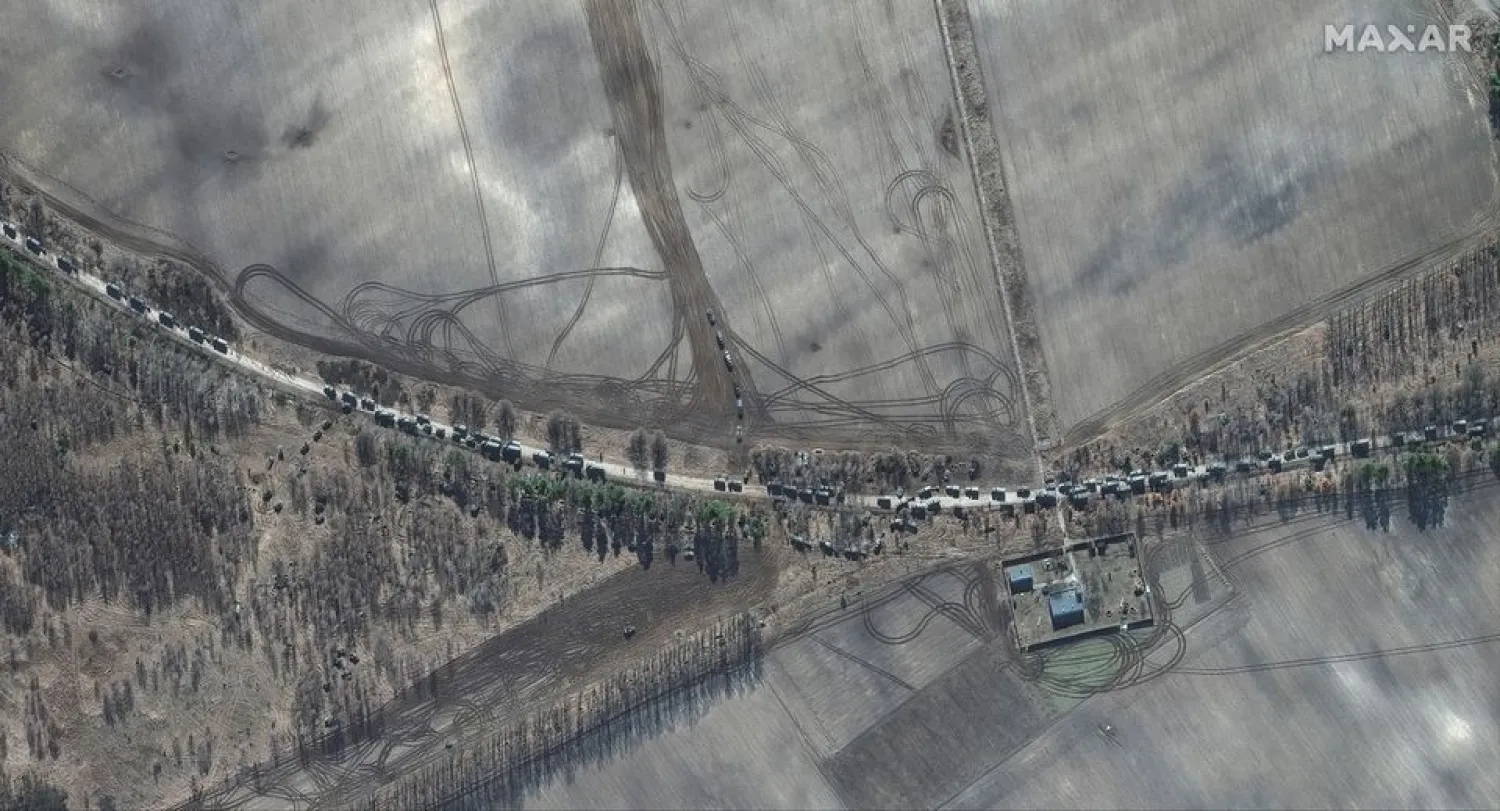
A satellite image shows southern end of convoy armor towed artillery trucks, east of Antonov airport, Ukraine, February 28, 2022. Satellite image ©2022 Maxar Technologies/Handout via REUTERS
TT

Russian Forces Step up Attacks on Ukraine’s Civilian Areas

A satellite image shows southern end of convoy armor towed artillery trucks, east of Antonov airport, Ukraine, February 28, 2022. Satellite image ©2022 Maxar Technologies/Handout via REUTERS

Russian forces stepped up their attacks on crowded urban areas Tuesday, bombarding the central square in Ukraine’s second-biggest city and Kyiv's main TV tower in what the country's president called a blatant campaign of terror.

“Nobody will forgive. Nobody will forget,” President Volodymyr Zelenskyy vowed after the bloodshed on the square in Kharkiv.

Ukrainian authorities said five people were killed in the attack on the TV tower, which is a couple of miles from central Kyiv and a short walk from numerous apartment buildings. A TV control room and power substation were hit, and at least some Ukrainian channels briefly stopped broadcasting, officials said.

Zelenskyy’s office also reported a powerful missile attack on the site of the Babyn Yar Holocaust memorial, near the tower.

At the same time, a 40-mile (64-kilometer) convoy of hundreds of Russian tanks and other vehicles advanced slowly on Kyiv in what the West feared was a bid by Russian President Vladimir Putin to topple Ukraine's government and install a Kremlin-friendly regime.

Russian forces pressed their assault on other towns and cities across the country, including the strategic ports of Odesa and Mariupol in the south.

Day 6 of the biggest ground war in Europe since World War II found Russia increasingly isolated, beset by tough sanctions that have thrown its economy into turmoil and left the country practically friendless, apart from a few countries like China, Belarus and North Korea.

Many military experts worry that Russia may be shifting tactics. Moscow’s strategy in Chechnya and Syria was to use artillery and air bombardments to pulverize cities and crush fighters’ resolve.

The bombing on the TV tower came after Russia’s Defense Ministry announced it would target transmission facilities in the capital used by Ukraine’s intelligence agency. It urged people living near such places to leave their homes.

Overall death tolls from the fighting remained unclear, but a senior Western intelligence official estimated Tuesday that more than 5,000 Russian soldiers had been captured or killed.

Britain’s Defense Ministry said it had seen an increase in Russian air and artillery strikes on populated urban areas over the past two days. The ministry also said three cities — Kharkiv, Kherson and Mariupol —were encircled by Russian forces.

In Kharkiv, with a population of about 1.5 million, at least six people were killed when the region's Soviet-era administrative building on Freedom Square was hit with what was believed to be a missile.

The attack on Freedom Square — Ukraine’s largest plaza, and the nucleus of public life in the city — was seen by many Ukrainians as brazen evidence that the Russian invasion wasn’t just about hitting military targets but also about breaking their spirits.

The bombardment blew out windows and walls of buildings that ring the massive square, which was piled high with debris and dust. Inside one building, chunks of plaster were scattered, and doors, ripped from their hinges, lay across hallways.

“People are under the ruins. We have pulled out bodies,” said Yevhen Vasylenko, an emergency official.

Zelenskyy pronounced the attack on the square “frank, undisguised terror” and a war crime. “This is state terrorism of the Russian Federation,” he said.

In an emotional appeal to the European Parliament later, Zelenskyy said: “We are fighting also to be equal members of Europe. I believe that today we are showing everybody that is what we are.”

He said 16 children had been killed around Ukraine on Monday, and he mocked Russia's claim that it is going after only military targets.

“Where are the children? What kind of military factories do they work at? What tanks are they going at?” Zelenskyy said.

Human Rights Watch said it documented a cluster bomb attack outside a hospital in Ukraine’s east in recent days. Local residents also reported the use of the weapons in Kharkiv and the village of Kiyanka, The Kremlin denied using cluster bombs.

If the allegations are confirmed, that would represent a new level of brutality in the war and could lead to even further isolation of Russia.

Unbowed by Western condemnation, Russian officials upped their threats of escalation, days after raising the specter of nuclear war. A top Kremlin official warned that the West's “economic war” against Russia could turn into a “real one.”

More than a half-million people have fled the country, and countless others have taken shelter underground. Bomb damage to water pipes and other basic services have left hundreds of thousands of families without drinking water, UN humanitarian coordinator Martin Griffiths said.

“It is a nightmare, and it seizes you from the inside very strongly. This cannot be explained with words,” said Kharkiv resident Ekaterina Babenko, taking shelter in a basement with neighbors for a fifth straight day. “We have small children, elderly people, and frankly speaking it is very frightening.”

The UN human rights office said it has recorded 136 civilian deaths. The real toll is believed to be far higher.

A Ukrainian military official said Belarusian troops joined the war Tuesday in the Chernihiv region in the north, without providing details. But just before that, Belarusian President Alexander Lukashenko said his country had no plans to join the fight.

In Kharkiv, explosions burst one after another through a residential area in a video verified by The Associated Press. In the background, a man pleaded with a woman to leave, and a woman cried.

Hospital workers moved a Kharkiv maternity ward to a bomb shelter. Amid mattresses piled up against the walls, pregnant women paced the crowded space, accompanied by the cries of dozens of newborns.

Russia’s goals in hitting central Kharkiv were not immediately clear. Western officials speculated that it is trying to pull in Ukrainian forces to defend the city while a larger Russian force encircles Kyiv.

Russian troops continued to press toward the capital, a city of nearly 3 million. The leading edge of the convoy was 17 miles (25 kilometers) from the center of the city, according to satellite imagery from Maxar Technologies.

A senior US defense official described the long convoy as “bogged down,” saying Russia appeared to be pausing and regrouping to re-evaluate how to retake the momentum in the fighting.

Overall, the Russian military has been been stalled by fierce resistance on the ground and a surprising inability to completely dominate Ukraine’s airspace.

The immense convoy, packed together along narrow roads, would seemingly be “a big fat target” for Ukrainian forces, the senior Western intelligence official said on condition of anonymity.

“But it also shows you that the Russians feel pretty comfortable being out in the open in these concentrations because they feel that they’re not going to come under air attack or rocket or missile attack,” the official said.

Ukrainians used whatever they had to try to stop the Russian advance. On a highway between Odesa and Mykolaiv in southern Ukraine, residents piled tractor tires filled with sand and topped with sandbags to block convoys.



Israel Army Says on ‘Defensive Alert’ Regarding Iran but No Change to Public Guidelines

Israeli air defense system fires to intercept missiles during an Iranian attack over Tel Aviv, Israel, Thursday, June 19, 2025. (AP)
TT

Israel Army Says on ‘Defensive Alert’ Regarding Iran but No Change to Public Guidelines

Israeli air defense system fires to intercept missiles during an Iranian attack over Tel Aviv, Israel, Thursday, June 19, 2025. (AP)

The Israeli army said it was on "defensive alert" as the United States threatens potential military action against Iran, but insisted there were no changes in its guidelines for the public.

"We are closely monitoring regional developments and are aware of the public discourse concerning Iran. The (Israeli military) is on defensive alert," army spokesman Brigadier General Effie Defrin said in a video statement published Friday.

"Our eyes are wide open in all directions, and our finger is more than ever on the trigger in response to any change in the operational reality," he added, but emphasized "there is no change in the instructions".


Trump Says Weighing Strike on Iran as Tehran Says Draft Deal Coming Soon

US President Donald Trump speaks during a Governors Working Breakfast in the State Dining Room of the White House in Washington, DC, USA, 20 February 2026. (EPA)
TT

Trump Says Weighing Strike on Iran as Tehran Says Draft Deal Coming Soon

US President Donald Trump speaks during a Governors Working Breakfast in the State Dining Room of the White House in Washington, DC, USA, 20 February 2026. (EPA)

US President Donald Trump said he was considering a limited strike on Iran after ordering a major naval buildup in the Middle East aimed at heaping pressure on Tehran to cut a deal to curb its nuclear program.

The latest threat came after Iran's foreign minister said a draft proposal for an agreement with Washington would be ready in a matter of days following negotiations between the two sides in Geneva earlier this week.

Trump had suggesting on Thursday that "bad things" would happen if Tehran did not strike a deal within 10 days, which he subsequently extended to 15.

Asked by a reporter on Friday whether he was contemplating a limited military strike, Trump answered: "The most I can say -- I am considering it."

After the talks in Geneva, Tehran said the two sides had agreed to submit drafts of a potential agreement, which Iranian Foreign Minister Abbas Araghchi told US media would be the "next step".

"I believe that in the next two, three days, that would be ready, and after final confirmation by my superiors, that would be handed over to Steve Witkoff," he said, referring to Trump's main Middle East negotiator.

Araghchi also said US negotiators had not requested that Tehran end its nuclear enrichment program, contradicting statements from American officials.

"We have not offered any suspension, and the US side has not asked for zero enrichment," he said in an interview released Friday by US TV network MS NOW.

"What we are now talking about is how to make sure that Iran's nuclear program, including enrichment, is peaceful and would remain peaceful forever," he added.

His comments stand in contrast to information relayed by high-ranking US officials, including Trump, who has repeatedly said Iran must not be allowed to enrich uranium at any level.

Western countries accuse Tehran of seeking to acquire nuclear weapons, which it denies, though it insists on its right to enrichment for civilian purposes.

Iran, for its part, is seeking to negotiate an end to sanctions that have proven to be a massive drag on its economy.

Economic hardships sparked protests in December that evolved into a nationwide anti-government movement last month, prompting a crackdown from authorities that left thousands dead, rights groups say.

- 'No ultimatum' -

The two foes held an initial round of discussions on February 6 in Oman, the first since previous talks collapsed during the 12-day Iran-Israel war last June, which the US joined by striking Iranian nuclear facilities.

Washington has pursued a major military build-up in the region in tandem with the talks, and both sides have traded threats of military action for weeks.

On Thursday, Trump again suggested the US would attack Iran if it did not make a deal within the timeframe he laid out.

"We have to make a meaningful deal otherwise bad things happen," Trump told the inaugural meeting of the "Board of Peace", his initiative for the post-war Gaza Strip.

Iran's ambassador to the UN, Amir Saeid Iravani, warned that US bases, facilities and assets would be "legitimate targets" if the United States followed through on its threats.

Araghchi, however, insisted that "there is no ultimatum".

"We only talk with each other how we can have a fast deal. And a fast deal is something that both sides are interested about," he said.

"We are under sanctions, (so) obviously any day that sanctions are terminated sooner it would be better for us," he said, adding Iran had "no reason to delay".

Washington has repeatedly called for zero enrichment, but has also sought to address Iran's ballistic missile program and its support for militant groups in the region -- issues which Israel has pushed to include in the talks.

The Israeli army said Friday that it was on "defensive alert" regarding the situation with Iran, but that its guidelines for the public remained unchanged.

Ratcheting up the pressure, Trump has deployed a significant naval force to the region.

After sending the aircraft carrier USS Abraham Lincoln and escort battleships to the Gulf in January, he ordered a second carrier, the Gerald Ford, to depart for the Middle East.

Iranian naval forces also conducted military drills this week in the Gulf and around the strategic Strait of Hormuz in their own show of force.


UK Foreign Minister to Meet Rubio amid Tensions over Joint Air Base

British Foreign Secretary Yvette Cooper, president of the United Nations Security Council for February speaks during a press conference before the Security Council meeting, at UN headquarters in New York City, US, February 19, 2026. REUTERS/Jeenah Moon
TT

UK Foreign Minister to Meet Rubio amid Tensions over Joint Air Base

British Foreign Secretary Yvette Cooper, president of the United Nations Security Council for February speaks during a press conference before the Security Council meeting, at UN headquarters in New York City, US, February 19, 2026. REUTERS/Jeenah Moon

Britain's foreign minister Yvette Cooper ‌will meet with US Secretary of State Marco Rubio on Friday, after President Donald Trump renewed his criticism of London for ceding sovereignty of ​the Chagos Islands, which is home to a US-UK air base.
Last year, British Prime Minister Keir Starmer agreed a deal to transfer sovereignty of the Indian Ocean islands to Mauritius, while keeping control of one - Diego Garcia - through a 99-year lease that preserved US operations at the base, Reuters said.
Washington last year gave its blessing to the agreement, but Trump has since ‌changed his mind ‌several times. In January, Trump described it ​as ‌an ⁠act ​of "great stupidity", ⁠but earlier this month said he understood the deal was the best Starmer could make, before then renewing his criticism this week.
Cooper is meeting Rubio to discuss defense and security issues in Washington as Trump also toughens his rhetoric on Iran, saying Tehran must make a deal over its nuclear program in the ⁠next 10 to 15 days, or "really bad ‌things" will happen.
The Diego Garcia ‌base has recently been used for ​operations in the Middle East against ‌Yemen's Houthis and in humanitarian aid to Gaza.
Although on Tuesday ‌Rubio's State Department said it backed the Chagos accord, the next day Trump said Britain was making a big mistake.
"DO NOT GIVE AWAY DIEGO GARCIA!" Trump wrote in a post on Truth Social, saying the ‌base could be called upon in any future military operation to "eradicate a potential attack" from ⁠Iran.
Under the ⁠conditions for using the joint base, Britain would need to agree in advance to any operations out of Diego Garcia.
On Thursday, Britain's The Times newspaper reported that Trump's latest criticism of the Chagos deal came because Britain was yet to give permission to use the bases for future strikes against Iran, owing to concerns they may breach international law.
Asked about The Times report, Britain's Ministry of Defence said on Thursday it does not comment on operational matters and that Britain supported ​the ongoing political process between ​the US and Iran.