


Russian Forces Step up Attacks on Ukraine’s Civilian Areas

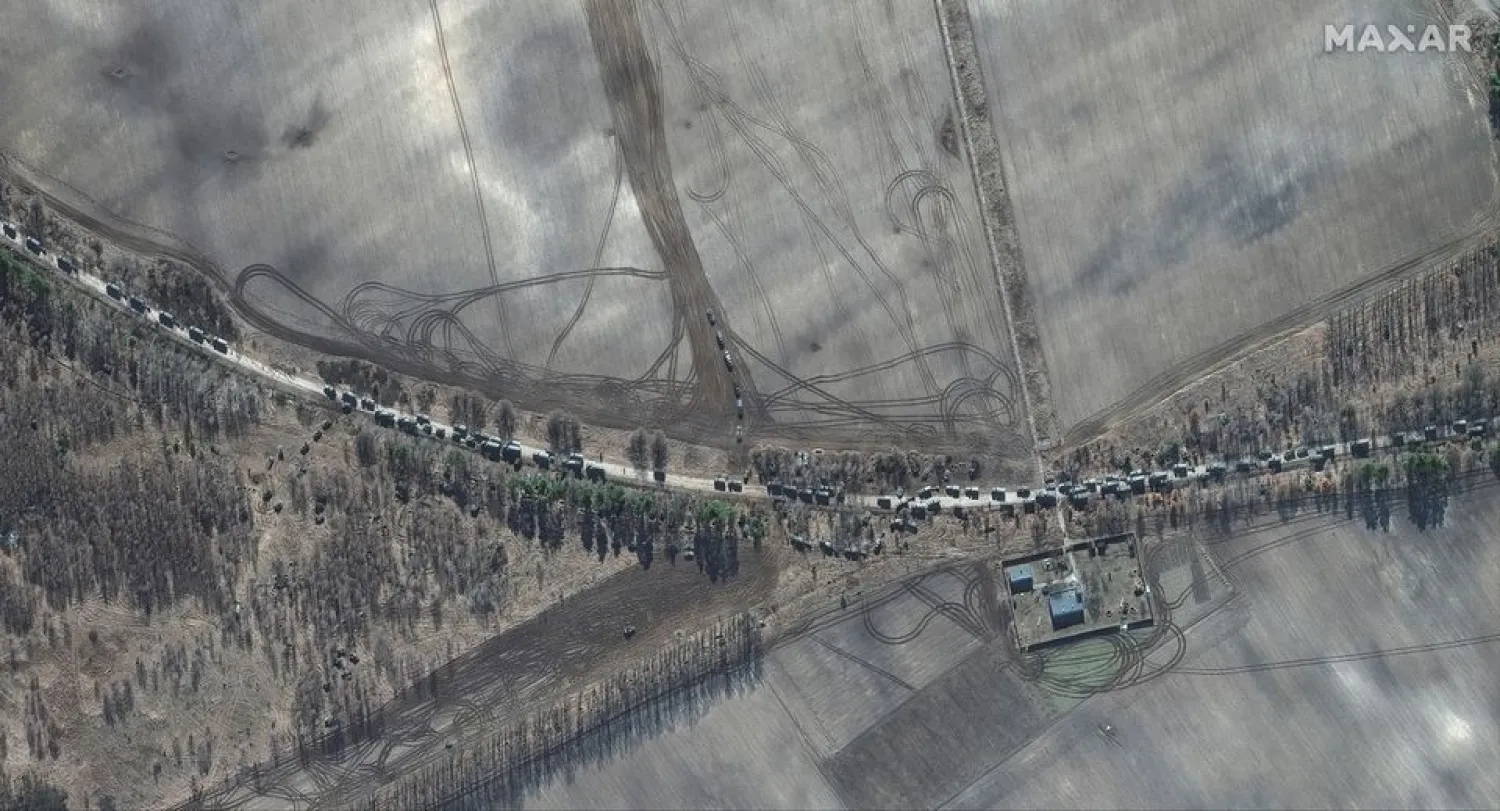
A satellite image shows southern end of convoy armor towed artillery trucks, east of Antonov airport, Ukraine, February 28, 2022. Satellite image ©2022 Maxar Technologies/Handout via REUTERS
TT

Russian Forces Step up Attacks on Ukraine’s Civilian Areas

A satellite image shows southern end of convoy armor towed artillery trucks, east of Antonov airport, Ukraine, February 28, 2022. Satellite image ©2022 Maxar Technologies/Handout via REUTERS

Russian forces stepped up their attacks on crowded urban areas Tuesday, bombarding the central square in Ukraine’s second-biggest city and Kyiv's main TV tower in what the country's president called a blatant campaign of terror.

“Nobody will forgive. Nobody will forget,” President Volodymyr Zelenskyy vowed after the bloodshed on the square in Kharkiv.

Ukrainian authorities said five people were killed in the attack on the TV tower, which is a couple of miles from central Kyiv and a short walk from numerous apartment buildings. A TV control room and power substation were hit, and at least some Ukrainian channels briefly stopped broadcasting, officials said.

Zelenskyy’s office also reported a powerful missile attack on the site of the Babyn Yar Holocaust memorial, near the tower.

At the same time, a 40-mile (64-kilometer) convoy of hundreds of Russian tanks and other vehicles advanced slowly on Kyiv in what the West feared was a bid by Russian President Vladimir Putin to topple Ukraine's government and install a Kremlin-friendly regime.

Russian forces pressed their assault on other towns and cities across the country, including the strategic ports of Odesa and Mariupol in the south.

Day 6 of the biggest ground war in Europe since World War II found Russia increasingly isolated, beset by tough sanctions that have thrown its economy into turmoil and left the country practically friendless, apart from a few countries like China, Belarus and North Korea.

Many military experts worry that Russia may be shifting tactics. Moscow’s strategy in Chechnya and Syria was to use artillery and air bombardments to pulverize cities and crush fighters’ resolve.

The bombing on the TV tower came after Russia’s Defense Ministry announced it would target transmission facilities in the capital used by Ukraine’s intelligence agency. It urged people living near such places to leave their homes.

Overall death tolls from the fighting remained unclear, but a senior Western intelligence official estimated Tuesday that more than 5,000 Russian soldiers had been captured or killed.

Britain’s Defense Ministry said it had seen an increase in Russian air and artillery strikes on populated urban areas over the past two days. The ministry also said three cities — Kharkiv, Kherson and Mariupol —were encircled by Russian forces.

In Kharkiv, with a population of about 1.5 million, at least six people were killed when the region's Soviet-era administrative building on Freedom Square was hit with what was believed to be a missile.

The attack on Freedom Square — Ukraine’s largest plaza, and the nucleus of public life in the city — was seen by many Ukrainians as brazen evidence that the Russian invasion wasn’t just about hitting military targets but also about breaking their spirits.

The bombardment blew out windows and walls of buildings that ring the massive square, which was piled high with debris and dust. Inside one building, chunks of plaster were scattered, and doors, ripped from their hinges, lay across hallways.

“People are under the ruins. We have pulled out bodies,” said Yevhen Vasylenko, an emergency official.

Zelenskyy pronounced the attack on the square “frank, undisguised terror” and a war crime. “This is state terrorism of the Russian Federation,” he said.

In an emotional appeal to the European Parliament later, Zelenskyy said: “We are fighting also to be equal members of Europe. I believe that today we are showing everybody that is what we are.”

He said 16 children had been killed around Ukraine on Monday, and he mocked Russia's claim that it is going after only military targets.

“Where are the children? What kind of military factories do they work at? What tanks are they going at?” Zelenskyy said.

Human Rights Watch said it documented a cluster bomb attack outside a hospital in Ukraine’s east in recent days. Local residents also reported the use of the weapons in Kharkiv and the village of Kiyanka, The Kremlin denied using cluster bombs.

If the allegations are confirmed, that would represent a new level of brutality in the war and could lead to even further isolation of Russia.

Unbowed by Western condemnation, Russian officials upped their threats of escalation, days after raising the specter of nuclear war. A top Kremlin official warned that the West's “economic war” against Russia could turn into a “real one.”

More than a half-million people have fled the country, and countless others have taken shelter underground. Bomb damage to water pipes and other basic services have left hundreds of thousands of families without drinking water, UN humanitarian coordinator Martin Griffiths said.

“It is a nightmare, and it seizes you from the inside very strongly. This cannot be explained with words,” said Kharkiv resident Ekaterina Babenko, taking shelter in a basement with neighbors for a fifth straight day. “We have small children, elderly people, and frankly speaking it is very frightening.”

The UN human rights office said it has recorded 136 civilian deaths. The real toll is believed to be far higher.

A Ukrainian military official said Belarusian troops joined the war Tuesday in the Chernihiv region in the north, without providing details. But just before that, Belarusian President Alexander Lukashenko said his country had no plans to join the fight.

In Kharkiv, explosions burst one after another through a residential area in a video verified by The Associated Press. In the background, a man pleaded with a woman to leave, and a woman cried.

Hospital workers moved a Kharkiv maternity ward to a bomb shelter. Amid mattresses piled up against the walls, pregnant women paced the crowded space, accompanied by the cries of dozens of newborns.

Russia’s goals in hitting central Kharkiv were not immediately clear. Western officials speculated that it is trying to pull in Ukrainian forces to defend the city while a larger Russian force encircles Kyiv.

Russian troops continued to press toward the capital, a city of nearly 3 million. The leading edge of the convoy was 17 miles (25 kilometers) from the center of the city, according to satellite imagery from Maxar Technologies.

A senior US defense official described the long convoy as “bogged down,” saying Russia appeared to be pausing and regrouping to re-evaluate how to retake the momentum in the fighting.

Overall, the Russian military has been been stalled by fierce resistance on the ground and a surprising inability to completely dominate Ukraine’s airspace.

The immense convoy, packed together along narrow roads, would seemingly be “a big fat target” for Ukrainian forces, the senior Western intelligence official said on condition of anonymity.

“But it also shows you that the Russians feel pretty comfortable being out in the open in these concentrations because they feel that they’re not going to come under air attack or rocket or missile attack,” the official said.

Ukrainians used whatever they had to try to stop the Russian advance. On a highway between Odesa and Mykolaiv in southern Ukraine, residents piled tractor tires filled with sand and topped with sandbags to block convoys.



Rival Sahel Extremists Clash in Intensifying Turf war

A recent report revealed a surge in violent attacks linked to extremist groups in West Africa’s Sahel region. (AFP)
TT

Rival Sahel Extremists Clash in Intensifying Turf war

A recent report revealed a surge in violent attacks linked to extremist groups in West Africa’s Sahel region. (AFP)

Extremists from rival Al-Qaeda and ISIS factions in the Sahel have clashed recently on an unprecedented scale in the borderlands spanning Burkina Faso, Mali and Niger, with claims of hundreds of fighters killed.

The two extremist coalitions, which covet influence over the same areas and control of the same routes and local populations, have repeatedly clashed since 2019.

The rivalry also drives their constant expansion in the Sahel, which the ruling juntas in Ouagadougou, Bamako and Niamey have found difficult to contain, said AFP.

The clashes are "the most intense direct confrontation globally" between an Al-Qaeda branch and an ISIS-linked group, a report by UN experts submitted to the Security Council in early August said.

A semi-arid belt of land that stretches from the Atlantic Ocean along the southern rim of the Sahara desert to the Red Sea, Africa's Sahel has become the ground zero of global extremism.

Extremists have steadily expanded beyond the rural areas where they first took root, killing thousands, roiling governments and sowing terror.

Since September, fighting between ISIS - Sahel Province (ISSP) and the Al-Qaeda-linked group (JNIM) has escalated to unprecedented levels.

On Monday, the ISSP said it had killed more than 400 al-Qaeda fighters, including "several leaders", in clashes four days earlier in the Burkinabe province of Oudalan on the Mali and Niger borders.

"If the claimed death toll is confirmed, then it will be the deadliest single battle recorded between the two groups," Heni Nsaibia, an analyst at conflict monitor ACLED, said.

The toll has yet to be independently confirmed.

But if so, it would surpass the more than 200 deaths claimed by the ISSP in the same area in early September.

- 2,200 deaths since 2019 -

Between 2019 and last month, the two extremist groups fought more than 320 battles, resulting in about 2,200 deaths, Nsaibia said.

The latest clashes between fighters from JNIM and ISIS erupted on October 9 in the tri-border area, according to Wamaps, a collective of west African journalists.

The rivals are fighting over "the same potential living space and the same recruitment pools" in a "race for control of the borders between the three countries", Wassim Nasr, an expert on extremist groups and an associate researcher at The Soufan Center, said in a recent study.

Long confined to Mali and Burkina Faso, the fighting has in recent months spread to western Niger and even northwestern Nigeria, Nsaibia said.

From its Malian stronghold in Menaka, the ISSP has extended its influence into the Nigerien regions of Tahoua, Dosso and Maradi, up to the Nigerian border, Nasr said in the study.

This facilitates the transfer of fighters, equipment and expertise with ISWAP, the ISIS branch active in the Lake Chad basin, he added.

- Competing visions -

Behind the violence lies competing visions of extremism.

While JNIM carries out abuses against civilians, it focuses on developing local roots, building alliances with communities and concentrating attacks on state forces and foreign troops.

The ISIS group adopts a more hardline, transnational approach and does not shy away from targeting civilians who refuse to kowtow to its authority, Sahel specialist Hasret Kargin said.

Such "enduring ideological and strategic tensions" between the two groups are seen in reported defections -- albeit limited in number -- from JNIM to ISSP, the UN experts said in their report.

In July, JNIM claimed it had killed one of its commanders, who had defected to join ISIS.

However, despite the heavy losses the ISIS claims to have inflicted, JNIM remains the leading terror threat in the Sahel, the UN expert report said.

It estimated that its forces number between 7,000 and 8,000 fighters, compared with 2,000 members of ISIS.

"There is significant information indicating that JNIM has shifted substantial reinforcements to the area from other regions," Kargin said.

Given its numbers across the Sahel and its strength compared to the ISIS's Sahel branch, Kargin said he predicted that JNIM would launch "fierce counterattacks in the coming days".


Order to Limit Starshield for Ukraine Came from Inside White House, Sources Say

FILE PHOTO: Servicemen of the 68th Oleksa Dovbush Separate Jaeger Brigade of the Armed Forces of Ukraine set up Starlink satellite internet system, amid Russia's attack on Ukraine, near the frontline town of Pokrovsk in Donetsk region, Ukraine April 10, 2025. REUTERS/Inna Varenytsia/File Photo
TT

Order to Limit Starshield for Ukraine Came from Inside White House, Sources Say

FILE PHOTO: Servicemen of the 68th Oleksa Dovbush Separate Jaeger Brigade of the Armed Forces of Ukraine set up Starlink satellite internet system, amid Russia's attack on Ukraine, near the frontline town of Pokrovsk in Donetsk region, Ukraine April 10, 2025. REUTERS/Inna Varenytsia/File Photo

The order to limit a satellite system used by Ukraine for battlefield communications and drone operations came from inside the White House, according to two US officials and a Western official briefed on the matter.

The officials said leaders at the Defense Department received a message that the SpaceX Starshield service for the Ukrainian military needed to be slowed, reported Reuters.

The officials, who spoke on the condition of anonymity, did not specify who in the White House made the decision or who was responsible for implementing the order. The Pentagon is the biggest customer of Starshield, which is the military-grade version of the Starlink service.

Ukrainian officials said this week that military-grade Starlink receptors stopped working in Ukraine when mounted on fast-moving objects, interfering with the performance of Ukrainian drones that rely on them for onboard guidance systems over Ukrainian territory.

A person in Ukraine's Defense Ministry said on Thursday that the receptors were now working when ‌in motion, but ‌only at speeds of up to 100 miles per hour (160 kph).

US PRESSURES UKRAINE OVER REFINERY ‌ATTACKS

The move ⁠to temporarily restrict ⁠the vital communications system came as President Donald Trump has pressured Kyiv to stop its attacks on Russian refineries, which he has blamed for the soaring energy prices that are denting his Republican Party's prospects in the November midterm elections.

But experts say that surge in energy costs is mainly the result of the US-Israeli war with Iran, which brought Iranian attacks on energy facilities and has largely shut the vital Strait of Hormuz.

In response to a request for comment about the order to limit Starshield, a senior US official said: "No such request was ever made by the president."

The White House did not respond to questions about whether other administration officials might have made the request.

Starshield was developed by SpaceX specifically for government ⁠and national-security customers, particularly the US Department of Defense. Starshield uses the Starlink constellation as its backbone.

Ukrainian ‌officials said the restrictions complicated strike missions against Russian forces and logistics in occupied territory ‌and slowed interceptor drones used to shoot down incoming Russian Shahed drones.

Elon Musk, the CEO of SpaceX, said on X on Wednesday that because Starshield ‌systems are owned and controlled by the US government, any limits on speed or usage are decided by the US military or ‌the president.

SpaceX did not respond to a request for comment.

The Department of Defense and the Ukrainian embassy in Washington also did not respond to requests for comment.

DECLINE IN RELATIONS

Relations between Kyiv and Washington have deteriorated in recent days following a meeting in Miami on October 9 that convened representatives from both countries as well as Europe and the World Bank.

Trump's son-in-law Jared Kushner and Steve Witkoff, the Trump administration’s Middle East envoy, struck a tough ‌tone with Ukraine in the meeting, according to a separate person familiar with the matter. They told Ukrainian officials that the US was frustrated with Kyiv's continued strikes on Russian refineries despite repeated ⁠requests from Washington to stop.

The US ⁠delegation also explained Washington's decision to strike a diesel deal with Russia, saying the White House hoped it would soften Moscow's stance on peace talks.

That deal, under which Russia will supply more than 2.25 million barrels of diesel to US and global markets, has triggered a backlash from some US lawmakers, who say it will give Moscow cash to pursue its war without forcing Russian President Vladimir Putin to make concessions to end the conflict.

In the days that followed, Ukrainian President Volodymyr Zelenskiy and Trump criticized each other, with Zelenskiy calling the US decision on the Russian diesel deal "weak." Trump called for elections in Ukraine and Zelenskiy's ouster.

Behind the scenes, American officials threatened to stop providing intelligence to Kyiv about Russian missile launches that Ukraine uses to thwart attacks, as Reuters previously reported. Trump said on Tuesday Washington was still sharing intelligence with Ukraine.

Following the move to restrict Ukraine's access to Starshield, the Ukrainians made calls on Tuesday and Wednesday to find answers from senior officials at the White House, State Department and Pentagon, a senior Ukrainian official said, adding that Kyiv was told it was a White House decision.

The Pentagon has spent billions of dollars on the Starlink and Starshield services. It has also bought dedicated Starshield satellites, including communications spacecraft for missile-warning missions and a spy constellation for the National Reconnaissance Office, Reuters reported in 2024.


Trump: Ukraine's Resumption of Strikes on Russian Refineries is 'Disgrace'

This handout photograph taken and released by the Ukrainian Presidential Press Service on October 15, 2026, shows destroyed supermarket following a Russian drone in Odesa region, amid the Russian invasion of Ukraine. (Photo by Handout / UKRAINIAN PRESIDENTIAL PRESS SERVICE / AFP)
TT

Trump: Ukraine's Resumption of Strikes on Russian Refineries is 'Disgrace'

This handout photograph taken and released by the Ukrainian Presidential Press Service on October 15, 2026, shows destroyed supermarket following a Russian drone in Odesa region, amid the Russian invasion of Ukraine. (Photo by Handout / UKRAINIAN PRESIDENTIAL PRESS SERVICE / AFP)

Ukraine's resumption of ‌strikes on Russian refineries is a 'disgrace' that keeps global energy prices elevated, US President Donald Trump told the Newsmax news outlet in an interview aired on Thursday.

Ukraine struck a Russian oil refinery after President Volodymyr Zelenskiy declared that Kyiv was abandoning a ceasefire covering energy sites that Trump had announced, and criticized his willingness to strike deals with Moscow.

"All he's doing is making the world oil price higher. Well, I think that's a disgrace," Trump said ‌in the ‌interview, after Ukraine hit a Rosneft refinery ‌southeast ⁠of Moscow which helps ⁠to supply the Russian capital, said Reuters.

"There are a lot of targets you can hit, but when you shoot at diesel refineries where you make, you know, diesel oil, and we need that, and the world needs that, then he's not doing a good service for the world."

Russia rained ⁠down missile and drone strikes, targeting energy ‌facilities such as power stations, ‌knocking out supply to hundreds of thousands, and Zelenskiy told ‌the Financial Times that Ukraine's patience had run out.

Trump's administration ‌has been trying to mediate a ceasefire deal to end the war that started with Russia's full-scale invasion of Ukraine in 2022.

He repeated to Newsmax his belief that Zelenskiy and ‌Russian President Vladimir Putin hate each other, which makes it hard to end the conflict.

"I'm not ⁠a ⁠big fan of Zelenskiy," Trump said. "I think they actually both would like to see it end, but I think I find Zelenskiy to be more difficult to deal with than Putin."

As Trump pressured Kyiv to halt strikes on Russian oil refineries, Ukraine faced reduced usage of a satellite system on which it relies for battlefield communications and drone operations.

The order came from inside the White House, said two US officials and a Western official briefed on the matter, without specifying who there made the decision or was responsible for implementing the order.