


Most of the World Lines up against Moscow, Attacks Intensify

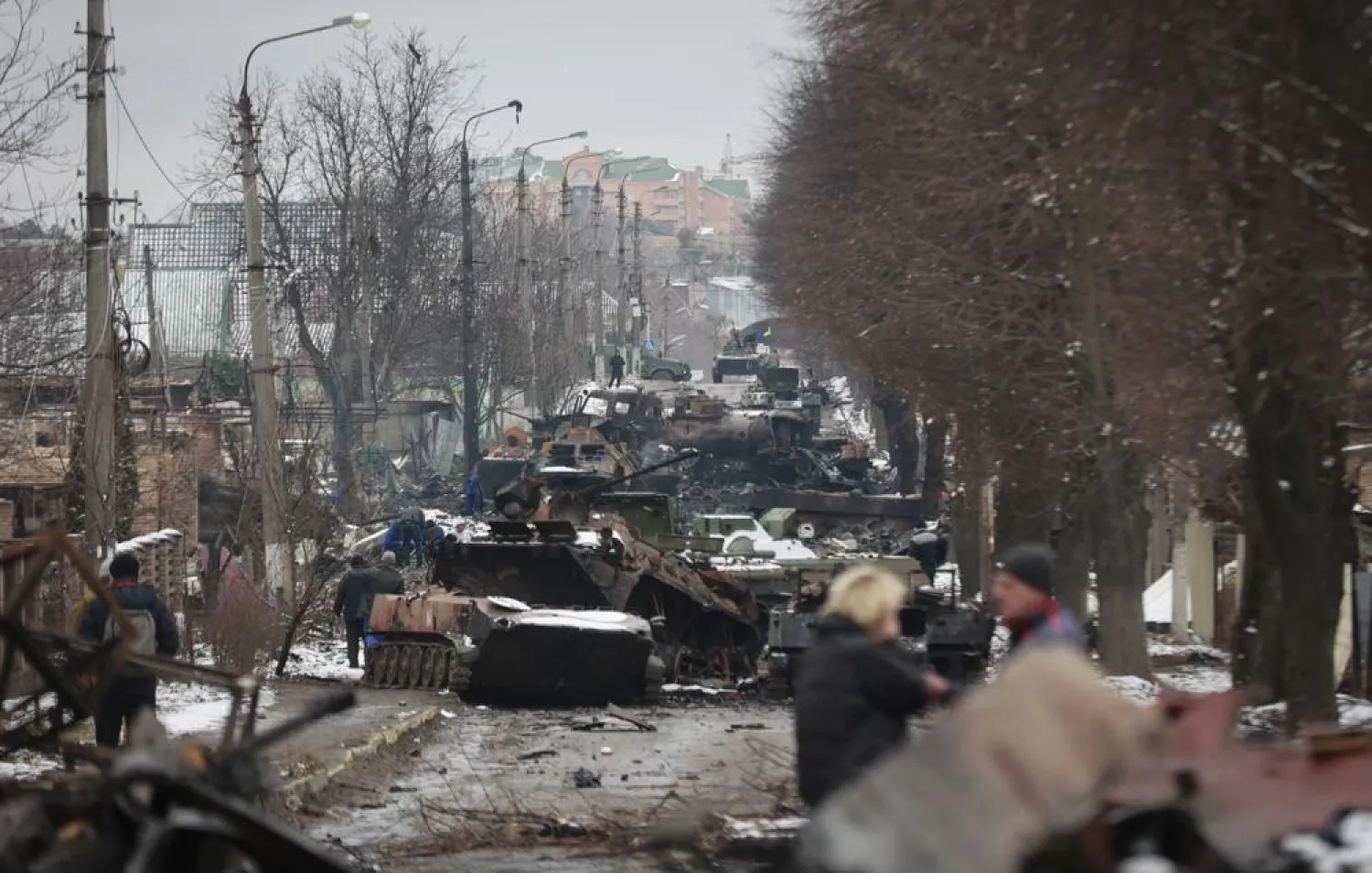
People look at the gutted remains of Russian military vehicles on a road in the town of Bucha, close to the capital Kyiv, Ukraine, Tuesday, March 1, 2022. (AP)
TT

Most of the World Lines up against Moscow, Attacks Intensify

People look at the gutted remains of Russian military vehicles on a road in the town of Bucha, close to the capital Kyiv, Ukraine, Tuesday, March 1, 2022. (AP)

Most of the world lined up against Moscow in the United Nations on Wednesday to demand it withdraw from Ukraine, as invading Russian forces renewed their bombardment of the country's second-biggest city, menaced its capital and besieged its strategic ports.

Russia reported its military casualties for the first time since the invasion began last week, saying nearly 500 of its troops had been killed and almost 1,600 wounded. Ukraine insisted Russia's losses were far higher but did not immediately disclose its own.

Envoys from Ukraine and Russia are expected to meet Thursday in Belarus for a second round of talks aimed at ending the fighting. But there appeared to be little common ground between the two sides.

The UN General Assembly voted to demand that Russia stop its offensive and immediately withdraw all troops, with world powers and tiny island states alike condemning Moscow. The vote was 141 to 5, with 35 abstentions.

Assembly resolutions aren’t legally binding but can have influence as a reflection of international opinion.

The vote came after the 193-member assembly convened its first emergency session since 1997. Countries that spoke up for Russia included Belarus, Cuba, North Korea and Syria.

Meanwhile, Russia pounded Kharkiv, Ukraine's second-largest city with about 1.5 million people, with another round of aerial attacks that shattered buildings and lit up the skyline with balls of fire. At least 21 people were killed and 112 injured over the past day, said Oleg Sinehubov, head of the Kharkiv regional administration.

Several Russian planes were shot down over Kharkiv, according to Oleksiy Arestovich, a top adviser to Ukrainian President Volodymyr Zelenskyy.

“Kharkiv today is the Stalingrad of the 21st century,” Arestovich said, invoking what is considered one of the most heroic moments in Russian history, the five-month defense of the city from the Nazis during World War II.

From his basement bunker, Kharkiv Mayor Igor Terekhov told the BBC: "The city is united and we shall stand fast."

Russian attacks, many with missiles, blew the roof off Kharkiv's five-story regional police building and set the top floor on fire, and also hit the intelligence headquarters and a university building, according to officials and videos and photos released by Ukraine’s State Emergency Service. Officials said residential buildings were also hit, but gave no details.

Ukraine found itself under threat on other fronts as well: A huge, 40-mile-long column of Russian tanks and other military vehicles stood outside Kyiv, the capital, and Russian invaders pressed their assault on the strategic port cities of Kherson and Mariupol.

Seven days into Russia's invasion, a refugee crisis unfolded on the European continent, with the UN saying that more than 870,000 people have fled Ukraine and that the number could soon hit 1 million.

The State Emergency Service reported that more than 2,000 civilians have been killed, but that could not be independently verified.

A spokesman for the Russian Defense Ministry, Maj. Gen. Igor Konashenkov, gave his side's military casualty figures, disputing as “disinformation” reports of much higher losses. Ukraine's leader claimed almost 6,000 Russian soldiers have been killed.

Konashenkov also said more than 2,870 Ukrainian troops have been killed and about 3,700 wounded, while over 570 others have been captured.

Russia ramped up its rhetoric, with Foreign Minister Sergei Lavrov reminding the world about the country's vast nuclear arsenal. In an interview with Al-Jazeera, he said: “A third world war will be nuclear, and devastating," according to Russian news sites.

In the northern city of Chernihiv, two cruise missiles hit a hospital, according to the Ukrainian UNIAN news agency, which quoted the health administration chief, Serhiy Pivovar, as saying authorities were working to determine the casualty toll.

In besieged Mariupol, at least one teenager died and two more were wounded by apparent Russian shelling. The boys' families told The Associated Press the attack came while they were playing soccer near a school.

Britain’s Defense Ministry said Kharkiv and Mariupol were encircled. Kherson was also under pressure, but there were conflicting reports as to who was in control.

Mariupol Mayor Vadym Boychenko said the attacks there had been relentless.

“We cannot even take the wounded from the streets, from houses and apartments today, since the shelling does not stop,” he was quoted by the Interfax news agency as saying.

On the far edges of Kyiv, volunteer fighters well into their 60s manned a checkpoint to block the Russian advance.

“In my old age I had to take up arms,” said Andrey Goncharuk, 68. He said the fighters needed more weapons, but “we’ll kill the enemy and take their weapons.”

On Tuesday, Russia, intensifying its attacks on cities, bombed Kharkiv's central square — where at least six people were reported killed — and struck Kyiv's main TV tower, where authorities said five died. Kyiv's nearby Babi Yar Holocaust memorial also came under fire, but the main monument was not damaged.

The announced talks inspired hope, though it remained unclear what they could yield. Ukrainian Foreign Minister Dmytro Kuleba said that Russia’s demands have not changed and that he wouldn’t accept any ultimatums.

Meanwhile, the price of oil continued to soar, reaching $112 per barrel, the highest since 2014.

Russia found itself even more isolated economically as Airbus and Boeing said they would cut off spare parts and technical support to the country's airlines, a major blow. Airbus and Boeing jets account for the vast majority or Russia’s passenger fleet.

Dmitry Peskov, the Kremlin spokesman, acknowledged the global economic punishment hitting Russia is unprecedented but said that Moscow had been prepared for all manner of sanctions and that the potential damage had been taken into account before launching the invasion.

“We have experience with this. We have been through several crises,” he said.

The International Atomic Energy Agency, the United Nations’ nuclear watchdog, warned that the fighting poses a danger to Ukraine's 15 nuclear reactors.

“When there is a conflict ongoing, there is of course a risk of attack or the possibility of an accidental hit,” Rafael Mariano Grossi, director-general of the International Atomic Energy Agency, said in Vienna.

Russia already seized control of the decommissioned Chernobyl power plant, the scene in 1986 of the world’s worst nuclear disaster.



Australia Rejects Report it is Repatriating Families of ISIS Militants from Syrian Camp

FILE PHOTO: Members of Australian families believed to be linked to ISIS militants leave Roj camp near Derik, Syria February 16, 2026. REUTERS/Orhan Qereman/File Photo
TT

Australia Rejects Report it is Repatriating Families of ISIS Militants from Syrian Camp

FILE PHOTO: Members of Australian families believed to be linked to ISIS militants leave Roj camp near Derik, Syria February 16, 2026. REUTERS/Orhan Qereman/File Photo

Australia's center-left government ‌on Sunday rejected a local media report that said it was working to repatriate Australians in a Syrian camp holding families of suspected ISIS militants.

The 34 women and children were released on Monday from the camp in northern Syria, but returned to the detention center due to technical reasons. The group is expected to travel to ‌Damascus before eventually returning ‌to Australia, despite objections from ‌ruling ⁠and opposition lawmakers.

On ⁠Sunday, Home Affairs Minister Tony Burke rejected claims made in a report in the Sunday Telegraph, asserting that official preparations were under way for the cohort’s return.

"In that report, it makes a claim that ⁠we are conducting a repatriation. We are ‌not," Burke told ‌Australian Broadcasting Corp television.

"It claims we have been ‌meeting with the states for the purposes of ‌a repatriation. We have not," Burke added.

Prime Minister Anthony Albanese, who leads Australia's Labor Party, said this week his government would not help ‌the group return to Australia.

The return of relatives of suspected ISIS ⁠militants ⁠is a political issue in Australia, which has seen a surge in popularity of the right-wing, anti-immigration One Nation party led by Pauline Hanson.


US, Iran to Meet in Geneva Thursday for Crucial Talks

US fighter jets prepare to take off from the aircraft carrier "USS Abraham Lincoln" in the Arabian Sea last week (US Navy)
TT

US, Iran to Meet in Geneva Thursday for Crucial Talks

US fighter jets prepare to take off from the aircraft carrier "USS Abraham Lincoln" in the Arabian Sea last week (US Navy)

Oman’s Foreign Minister Badr Albusaidi said talks between the United States and Iran would resume on Thursday in Geneva "with a positive push to go the extra mile towards finalizing” a deal on Tehran's nuclear program.

Speaking to CBS News on Sunday, Iran's Foreign Minister Abbas Araghchi said details of a possible deal were being drawn up ahead of the renewed talks, after Washington's envoy Steve Witkoff had publicly wondered why Tehran had not yet "capitulated.”

Witkoff said in a Fox News interview broadcast Saturday that US President Donald Trump was questioning why Iran had not yet given in to the pressure.

"He's curious as to why they haven't... I don't want to use the word 'capitulated', but why they haven't capitulated," he said.

"Why haven't they come to us and said, 'We profess we don't want a weapon, so here's what we're prepared to do'?"

Meanwhile, US threats of military action have multiplied.

"If the US attacks us, then we have every right to defend ourselves," Araghchi said, alluding to American interests in the region as potential targets.

Still, he said, "there is a good chance to have a diplomatic solution.”

Their comments came after a senior US official told Axios that the Trump administration is prepared to consider a proposal that allows Iran “token” nuclear enrichment if it leaves no possible path to a bomb.

This suggests there could be an opening, if only a small one, between the red lines set by the US and Iran for a deal to constrain Iran's nuclear capabilities and prevent war, according to Axios.

A senior Iranian official also told Reuters that Tehran could seriously ⁠consider a combination of ⁠exporting part of its highly enriched uranium (HEU) stockpile, diluting the purity of its HEU and a regional consortium for enriching uranium, but in return Iran's ⁠right to "peaceful nuclear enrichment" must be recognized.

"The negotiations continue and the possibility of reaching an interim agreement exists," the official said.

The senior official said Tehran will not hand over control of its oil and mineral resources but US companies can always participate as contractors in Iran’s oil and gas fields.


Mexican Army Kills Leader of Jalisco New Generation Cartel

A vehicle sits charred after being set on fire, on a road in Guadalajara, Jalisco state, Mexico, Sunday, Feb. 22, 2026, after the death of the leader of the Jalisco New Generation Cartel, "El Mencho." (AP Photo/Alejandra Leyva)
TT

Mexican Army Kills Leader of Jalisco New Generation Cartel

A vehicle sits charred after being set on fire, on a road in Guadalajara, Jalisco state, Mexico, Sunday, Feb. 22, 2026, after the death of the leader of the Jalisco New Generation Cartel, "El Mencho." (AP Photo/Alejandra Leyva)

The Mexican army killed the leader of the Jalisco New Generation Cartel, Nemesio Rubén Oseguera Cervantes, “El Mencho,” in an operation Sunday, a federal official said.

The official, who requested anonymity because they were not authorized to speak publicly, said it happened during a military operation in the western state of Jalisco.

It followed several hours of roadblocks with burning vehicles in Jalisco and other states, The Associated Press reported. Such tactics are commonly used by the cartels to block military operations.

Videos circulating social media showed plumes of smoke billowing over the city of Puerto Vallarta, a major city in Jalisco, and sprinting through the airport of the state's capital in panic.

The US State Department had offered a reward of up to $15 million for information leading to the arrest of El Mencho. The Jalisco New Generation Cartel is one of the most powerful and fasted growing criminal organizations in Mexico.

In February, the Trump administration designated the cartel as a foreign terrorist organization.

It has been one of the most aggressive cartels in its attacks on the military—including helicopters—and a pioneer in launching explosives from drones and installing mines. In 2020, it carried out a spectacular assassination attempt with grenades and high-powered rifles in the heart of Mexico City against the then head of the capital’s police force and now head of federal security.

The DEA considers this cartel to be as powerful as the Sinaloa cartel, one of Mexico's most infamous criminal groups, with a presence in all 50 US states where it distributes tons of drugs. It is one of the main suppliers of cocaine to the US market and, like the Sinaloa cartel, earns billions from the production of fentanyl and methamphetamines.