Lebanon’s President Tells US his Country is Fighting Money Laundering, Terrorist Financing

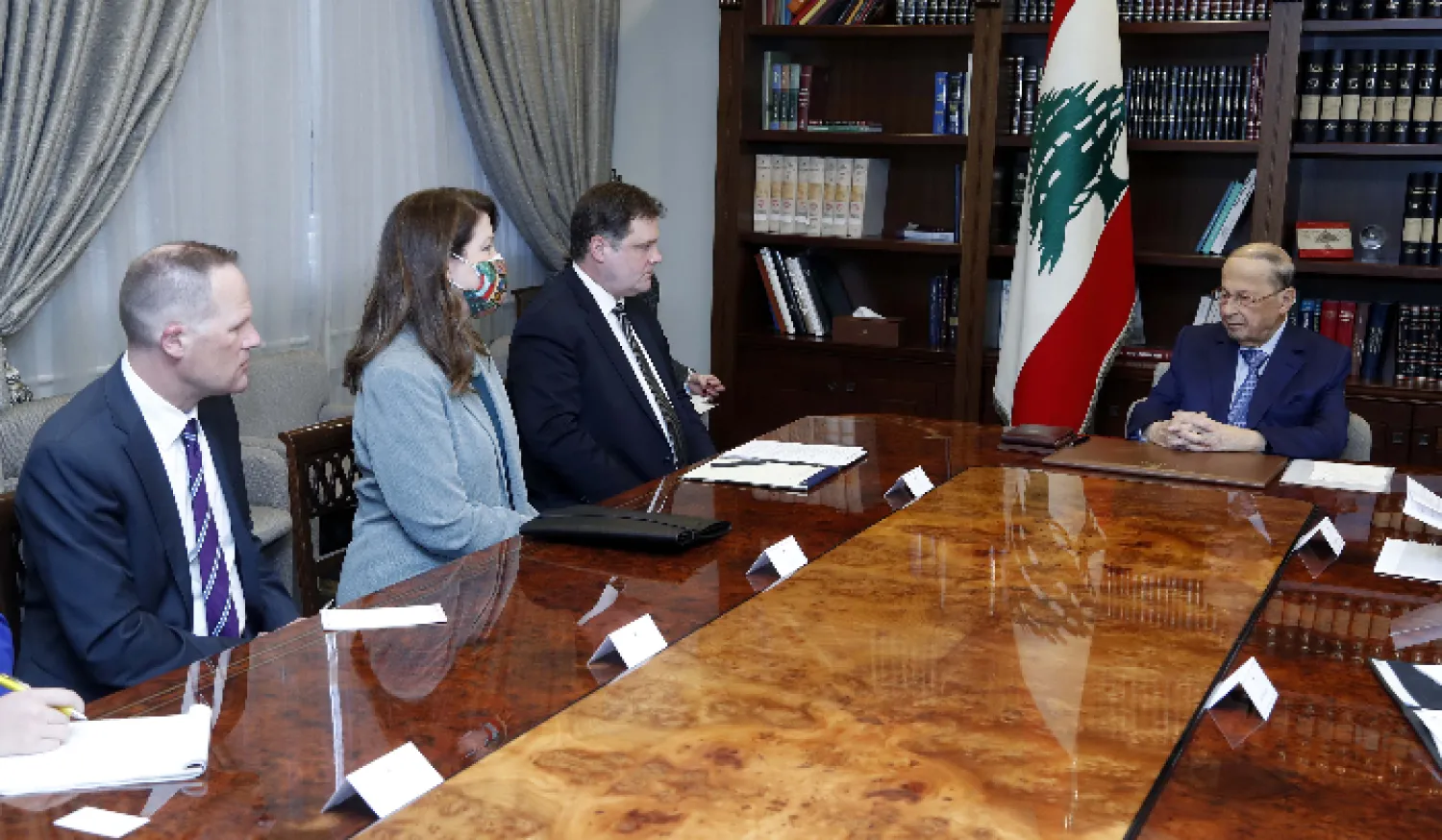
President Michel Aoun met on Tuesday with a US delegation from the Treasury (NNA)
TT

Lebanon’s President Tells US his Country is Fighting Money Laundering, Terrorist Financing

President Michel Aoun met on Tuesday with a US delegation from the Treasury (NNA)

Lebanese President Michel Aoun informed Tuesday a visiting US Treasury delegation that Lebanon continues to combat corruption, money laundering and terrorist financing operations.

“Lebanese laws are applied firmly and accurately in this field,” Aoun told the delegation during a meeting at the Presidential Palace in Baabda.

He indicated that Lebanon actively participates in international efforts to combat money laundering, and plays its role in the Financial Action Group in the Middle East region.

“Accordingly, Lebanon established the National Coordination Committee for Combating the Financing of Terrorism and the National Anti-Corruption Commission,” the President said.

The US delegation visiting the Lebanese capital includes First Deputy Assistant Secretary of the US Treasury responsible for combating the financing of terrorism and financial crimes, Paul Ahren, and Deputy Assistant Secretary of the US Treasury Eric Meyer.

US Ambassador to Lebanon Dorothy Shea also attended the Baabda meeting.

The Lebanese presidency in a statement said Aoun informed members of the US delegation that the fight against corruption will continue unabated in the remainder of this term.

Later on Tuesday, the US delegation visited Speaker Nabih Berri in Ain al-Tineh but did not make any statement.

Lebanon is struggling to take its steps out of a deep financial crisis that triggered a collapse in the currency and soaring poverty.


Report Says US Blocked $500M Cash Shipment to Iraq Over Pro-Iran Attacks

An Iraqi man walks past shops in the Jamila food market in Sadr City, east Baghdad on April 13, 2026. (AFP)
TT

Report Says US Blocked $500M Cash Shipment to Iraq Over Pro-Iran Attacks

An Iraqi man walks past shops in the Jamila food market in Sadr City, east Baghdad on April 13, 2026. (AFP)

The United States blocked a plane carrying nearly $500 million in banknotes from delivering the cash to Iraq, US media reported on Tuesday, piling pressure on Baghdad to fight Iran-backed armed factions. 

The Wall Street Journal reported that Washington has suspended cash shipments to Iraq and frozen funding for security programs following attacks on US interests in the country by groups showing solidarity with Iran. 

Iraq has long walked a tightrope between the competing influences of its allies, neighboring Iran and the United States. 

However, Iraqi leaders have struggled to maintain that delicate balance as war engulfs the Middle East. 

The US State Department said this month it had summoned Iraq's ambassador to Washington to express "strong condemnation" of attacks by pro-Iran groups on US interests, "including the April 8 ambush of US diplomats in Baghdad". 

The Wall Street Journal reported that the US Treasury Department blocked a shipment of nearly $500 million in cash from Iraqi oil sales, quoting US and Iraqi officials. 

AFP has contacted the Treasury Department for comment. 

The United States has leverage over Iraq because the country's oil export revenue is largely held at the Federal Reserve Bank in New York, under an arrangement reached after the 2003 US invasion that toppled Saddam Hussein. 

The Wall Street Journal quoted unidentified US officials as saying that the suspension on cash shipments was temporary. 

The Central Bank of Iraq has not commented specifically about the reports. 

However, it said on Tuesday it was not lacking US dollars and that it had "fulfilled all requests from banks and exchange companies for US dollars, which are intended for pilgrims, travelers and foreign transfers." 

The funding freeze to security programs includes training for Iraq's army and counterterror efforts against the ISIS group, The New York Times reported. 


Israeli Strike on Lebanon's Bekaa Kills One Despite Truce

A young boy walks amid the rubble of a building destroyed in an Israeli strike in the southern Lebanese village of Kfar Sir on April 21, 2026. (Photo by Anwar AMRO / AFP)
TT

Israeli Strike on Lebanon's Bekaa Kills One Despite Truce

A young boy walks amid the rubble of a building destroyed in an Israeli strike in the southern Lebanese village of Kfar Sir on April 21, 2026. (Photo by Anwar AMRO / AFP)

An Israeli drone strike on Lebanon's Bekaa region killed one person and injured two others on Wednesday, Lebanese state media reported, despite an ongoing truce between Israel Hezbollah.

"One person was killed and two others were wounded as a result of an attack carried out by an enemy drone at dawn on the outskirts of Al-Jabur in West Bekaa," the National News Agency (NNA) reported.

However, the Israeli military said it was unaware of the ‌strike.

Hezbollah on Tuesday said it had launched rockets and attack drones at a site in northern Israel in response to "blatant" Israeli ceasefire violations, which it said included "attacks on civilians and the destruction of their homes and villages.”

The Israeli military said that day that Hezbollah "launched several rockets" towards soldiers stationed in south Lebanon and that the military struck the launcher in response.

NNA on Wednesday reported Israeli artillery shelling and demolitions in southern towns Israel continues to occupy.

Israel conducted huge strikes across Lebanon and invaded the south after Hezbollah entered the Middle East war in support of its backer Iran on March 2.

Despite the truce which began on Friday, Israeli soldiers are still active in south Lebanon, with Defense Minister Israel Katz saying on Sunday that they would use "full force" if threatened.

Under the truce terms, Israel says it reserves the right to act against "planned, imminent or ongoing attacks.”

Israeli attacks on Lebanon have killed at least 2,454 people since the start of the war, a Lebanese government body said in its latest toll.


Israel Destroys Infrastructure in Southern Lebanon to Prevent Residents’ Return

A nun inspects a Christian religious site hit by an Israeli strike in the southern Lebanese city of Nabatieh. (AFP)
TT

Israel Destroys Infrastructure in Southern Lebanon to Prevent Residents’ Return

A nun inspects a Christian religious site hit by an Israeli strike in the southern Lebanese city of Nabatieh. (AFP)

Israel is escalating its campaign in southern Lebanon beyond direct military operations, pursuing what Lebanese officials describe as a systematic destruction of infrastructure, particularly in villages along the so-called “Yellow Line.”

Hospitals, schools, and water, electricity and telecommunications networks have been repeatedly targeted, alongside the destruction of bridges and roads, severing links between towns and isolating communities.

Lebanese ministerial sources noted that the approach is part of a policy of displacement. Residents have been repeatedly warned not to return to more than 80 villages, in what appears to be an effort to create an uninhabited buffer zone lacking basic services.

Air strikes have also hit areas outside occupied zones, including Wadi al-Hujeir, which was struck on Tuesday.

Israeli demolitions using explosives and bulldozers have not been limited to homes, but health and education facilities, seen by Lebanese officials as part of pressure on Hezbollah’s support base.

Israel considers civilian infrastructure in these areas a form of indirect support for the group and a potential platform where it can renew its activity.

Hospitals hit

From the first hours after hostilities erupted on March 2, triggering large-scale displacement, the Israeli army targeted hospitals and health centers in the south.

MP Bilal Abdullah, head of the parliamentary health committee, said Isarel had “intensified the destruction of health institutions and the medical system in southern villages.”

He told Asharq Al-Awsat that available data indicate “partial destruction of eight southern hospitals, all of which are now completely out of service,” listing them as the Tebnin Governmental Hospital, Sheikh Ragheb Harb Hospital, Salah Ghandour Hospital, Hiram Hospital, Jabal Amel Hospital, Hasbaya Governmental Hospital and Bint Jbeil Governmental Hospital.

He added that “the greatest damage has affected primary health centers,” noting that more than 100 ambulances had been destroyed and 121 doctors and paramedics killed in the hospitals and medical centers he listed.

Education sector targeted

The destruction of infrastructure is also aimed at deterring civilians from returning to the area for years to come, Lebanese officials say.

The education sector has been among the hardest hit. A source at the education ministry told Asharq Al-Awsat that targeting schools and institutes aims “to undermine the population’s ability to remain in their towns.”

Israel sees strikes on education as an effective way to empty villages of residents, forcing families to relocate in search of schooling alternatives for their children, the source stated.

The war has resulted in the total destruction of public schools in Dhayra, Bustan, Yarin and Tayr Harfa, as well as partial damage to Naqoura Intermediate School. In vocational and technical education, the Khiam and Qantara institutes have been completely destroyed, while institutes in Bint Jbeil, Aita al-Shaab, Tebnin, Toul, Nabatiyeh, Zrariyeh, Jbaa, Maarakeh, Abbasiyeh, Jouaiyya, Qana and Ansar have sustained partial damage.

The extent of structural damage means some of these institutions may be beyond repair, the source added.

According to education ministry statistics, schools in Nabatiyeh and its district have suffered the most damage: one school has been completely destroyed, 18 heavily damaged and seven left unharmed, while no information is currently available on 61 others.

Electricity and water

Damage to electricity and water infrastructure has also been severe. A source at the energy and water ministry told Asharq Al-Awsat it is not yet possible to compile a precise assessment of losses, but it confirmed damage to a number of power transformers and water facilities.

“The biggest problem lies in water networks,” the source remarked, noting that losses in the sector during the 2024 war exceeded $100 million. “The damage in this war surpasses that figure,” due to the destruction or disruption of pumping stations, treatment plants, reservoirs and supply networks.

Israel is pressing ahead with turning dozens of southern villages into a scorched zone, in what observers see as an attempt to extract political or security concessions from Lebanon. The higher the cost of destruction, the greater the pressure on the Lebanese state to seek arrangements to halt the war and limit its losses.