Russia's War Spurs Corporate Exodus, Exposes Business Risks

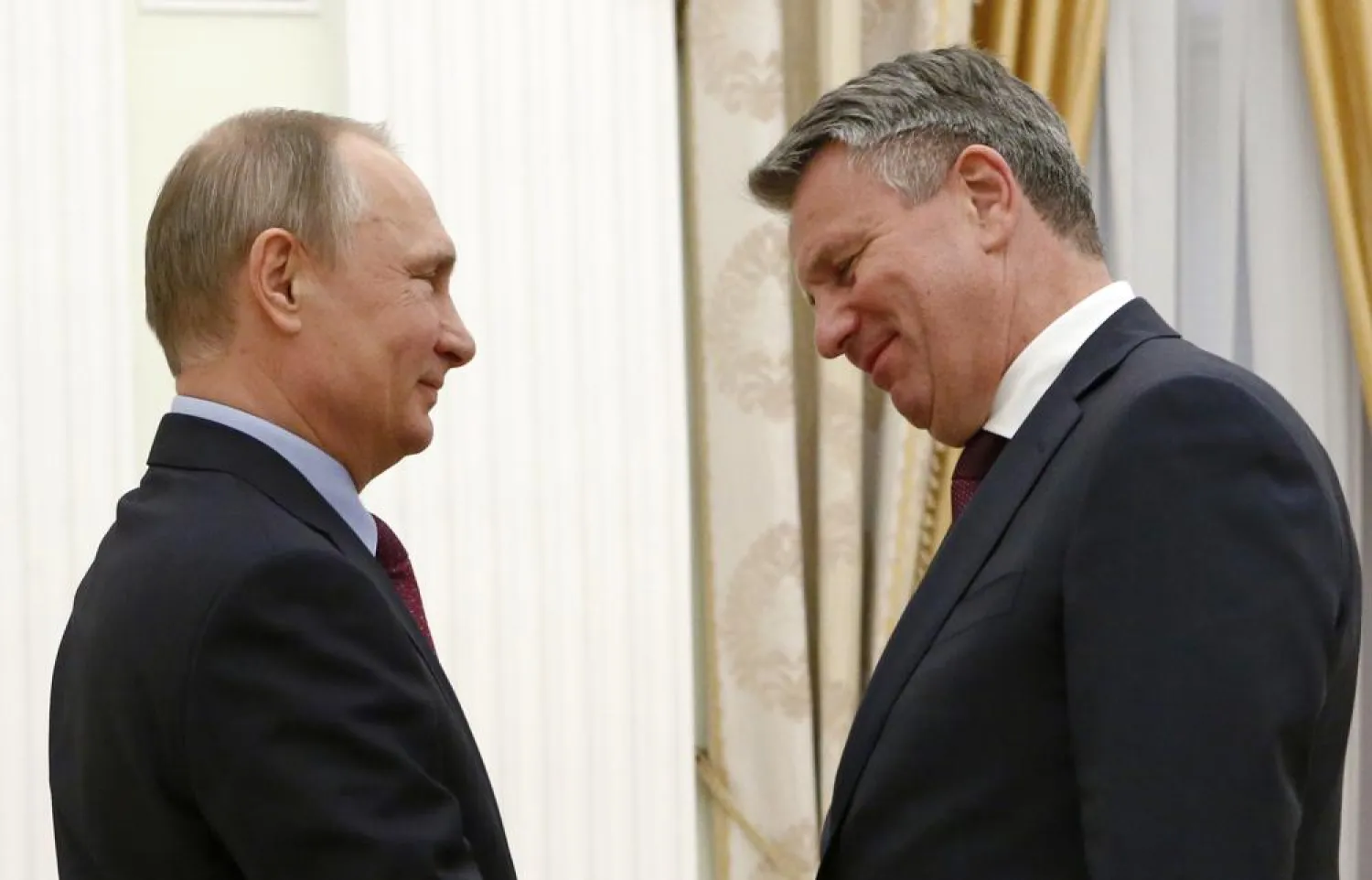
FILE - Russian President Vladimir Putin, left, meets with CEO of Royal Dutch Shell Ben van Beurden in Moscow, Russia, June 21, 2017. (Sergei Karpukhin/Pool Photo via AP, File)
TT

Russia's War Spurs Corporate Exodus, Exposes Business Risks

FILE - Russian President Vladimir Putin, left, meets with CEO of Royal Dutch Shell Ben van Beurden in Moscow, Russia, June 21, 2017. (Sergei Karpukhin/Pool Photo via AP, File)

Auto shipments stopped, beer stopped flowing, cargo ships dropped port calls and oil companies cut their pipelines.

Russia’s invasion of Ukraine has thrown business plans into disarray and forced a growing number of the world’s best known brands — from Apple to Ford and BP — to pull out of a country that's become a global outcast as companies seek to maintain their reputations and live up to corporate responsibility standards.

Investors were drawn to Russia in search of lucrative profits they thought were worth the geopolitical risks. That calculation has changed after Russian President Vladimir Putin launched war in Europe, triggering a wave of global sanctions and export restrictions that have thrown its economy into turmoil and disrupted the operations of multinational corporations there, The Associated Press said.

“You basically have Russia becoming a commercial pariah,” said economist Mary Lovely, a senior fellow at the Peterson Institute for International Economics in Washington. “Pretty much no company, no multinational, wants to be caught on the wrong side of US and Western sanctions.”

They're also expressing concern about the plight of Ukrainians, showing how they want to be seen coming out on the right side of history.

Complicating the push to flee is an order from Moscow temporarily restricting foreign investors from selling Russian assets. Prime Minister Mikhail Mishustin said Tuesday that it would help investors make “a considered decision” rather than succumb to the political pressure of sanctions. It's not clear how that may affect corporate efforts to exit Russia.

Oil and gas companies, already feeling the heat from climate activists to invest in renewable energy, were among companies to announce the most rapid and dramatic exits.

Energy firm BP said Sunday that it would abandon its $14 billion stake in state-owned oil and gas company Rosneft. Shell said the next day it was leaving its joint venture with state-owned Gazprom and its involvement in the now-suspended Nord Stream 2 pipeline built to carry natural gas to Western Europe.

ExxonMobil said it will pull out of a key oil and gas project and halt any new investment in Russia. All their chief executives said they were shocked and saddened by the increasingly bloody conflict. Smaller energy firms have followed suit.

Companies in other industries signaled they're staying out of the Russian market either out of concern for Ukraine or to comply with Western sanctions.

Swedish auto brand Volvo Cars said it's not delivering cars to Russia for the time being in light of “potential risks associated with trading material with Russia, including the sanctions imposed by the EU and US."

US automaker Ford, which has been winding down its Russian operations and only has a minority stake in a commercial van joint venture, told its partners it was suspending operations.

Similarly, Harley-Davidson halted motorcycle shipments to Russia and said its thoughts “continue for the safety of the people of Ukraine.” Putin famously rode a three-wheeled Harley on a visit to Ukraine in 2010.

Others with more entrenched Russian operations might find it harder to navigate the crisis.

Renault, one of the biggest players in Russia’s auto market, said only that it’s temporarily suspending production at its Moscow plant through Saturday “due to some logistics issues,” without being more specific.

Czech brewer Budvar, which counts Russia as one of its five major markets, halted beer production for and stopped deliveries to the country, saying business is not the top priority and that it’s looking for ways to help, including finding accommodations for Ukrainian refugees.

Copenhagen-based Danish brewery group Carlsberg suspended production at two breweries in Ukraine, saying it’s “following the situation with great concern” but didn’t comment on its extensive Russian operations, including St. Petersburg-based Baltika Breweries, which exports beer worldwide.

The world’s biggest shipping company, A.P. Moller-Maersk, said it will stop making Russian port calls, saying it was “deeply concerned” by the escalating crisis.
Airplane makers Boeing and Airbus stopped supplying parts and service support for Russian carriers. Boeing said it suspended major operations in Moscow and temporarily closed its Kyiv office.

Hollywood studios are delaying the release of new films in Russia, which isn't a leading movie market but typically ranks in the top dozen countries for box office revenue. Warner Bros., the Walt Disney Co., Sony Pictures cited the “humanitarian crisis.”

Tech companies also headed for the door.

Apple said Tuesday that it would stop selling its iPhone and other popular devices inside Russia.

Computer maker Dell Technologies said it has “suspended” sales in both Ukraine and Russia but a spokesperson didn't say why.

Google and TikTok blocked Russian state media channels from their platforms after a plea from the European Union. Apple also blocked downloads of the RT News and Sputnik News apps from its mobile App Store outside Russia.

Executives are realizing it makes more sense to pull out of Russia, business experts said.

“It’s really tough to do business in Russia under the best of conditions. Now it’s become just crazy. So getting out is a smart business proposal,” said James O'Rourke, professor of management at the University of Notre Dame’s Mendoza College of Business, who specializes in reputation management and business communications.
Companies will have to chalk up any losses as the cost of doing business.

“This is like going into business with the Manson family," O’Rourke said, referring to the followers of cult leader Charles Manson. “You honestly do not want your name associated with those people, and it’s probably not going to cost you that much to disinvest.”

It’s not just sanctions but public sentiment that companies have to respond to as the human costs of the war grow.

Company commitments to environmental, social and corporate governance, known as ESG, are being put to the test. ESG has become a buzzy acronym that's increasingly seen as an important way for corporations to tout responsible business credentials.

“But there can also be an element of greenwashing," where companies say things that make it seem like they hold certain values or are on the right side of ESG issues while their practices and behavior suggest otherwise, Columbia Business School associate professor Vanessa Burbano said.

“Stakeholders like employees and consumers will want to see if companies’ actions and behaviors are consistent with the communicated support that companies are expressing for Ukrainians,” she said.

Some companies were going beyond just making statements about halting deliveries or operations.

Lego, Ford, Volkswagen Group and its Czech-based Skoda brand said they would make millions of dollars in charitable donations to support Ukrainian refugees.
___


Iraq Oil Output Exceeds 5 million bpd

Majnoon oil field near the Iraqi city of Basra (Reuters)
TT

Iraq Oil Output Exceeds 5 million bpd

Majnoon oil field near the Iraqi city of Basra (Reuters)

Iraq produces more than 5 million barrels of oil per day (bpd), Oil Minister Basim Mohammed told state news agency INA on Saturday.

According to Reuters, Iraq is pushing for a higher OPEC production quota as the economic fallout from the Iran war and new investment by oil majors increase pressure on Baghdad to boost output, potentially putting it at odds with the producer group.

The conflict has hit Iraq particularly hard, forcing major export cuts and depriving the state of oil revenue, which accounted for 88% of government income last year.


IMF: Any Slowdown in AI-driven Growth Would be Factor for Central Banks

IMF Managing Director Kristalina Georgieva speaks during the Annual Meetings Plenary at the Annual Meetings of the International Monetary Fund (IMF) and the World Bank Group (WBG) at the Queen Sirikit National Convention Center (QSNCC) in Bangkok on October 16, 2026. (Photo by Lillian SUWANRUMPHA / AFP)
TT

IMF: Any Slowdown in AI-driven Growth Would be Factor for Central Banks

IMF Managing Director Kristalina Georgieva speaks during the Annual Meetings Plenary at the Annual Meetings of the International Monetary Fund (IMF) and the World Bank Group (WBG) at the Queen Sirikit National Convention Center (QSNCC) in Bangkok on October 16, 2026. (Photo by Lillian SUWANRUMPHA / AFP)

Central bankers around the world would need to consider any slowdown in AI-driven growth as they assess steps in their fight against inflation, International Monetary Fund Managing Director Kristalina Georgieva said on Friday.

Georgieva said concerns about dependence on the AI investment boom and high valuations were impacting markets around the world.

"Things are going up and down, and this is likely to continue," she told an audience at IMF headquarters in Washington, adding that the volatility would complicate the job of central banks at a time when risks to price stability had been growing.

A steep rout in technology stocks on Thursday rippled through markets on fears that ⁠the Democrats' victory ⁠in the US midterm elections would increase regulatory scrutiny of AI and slow the data center build-out, sending investors to the safety of bonds.

The political jitters are hitting an AI trade already on shaky footing due to worry about return on massive spending on AI-related infrastructure, with the meltdown spurring margin calls and spooking retail investors and hedge ⁠funds alike.

Georgieva said the AI investment boom was lifting growth in some countries, helping to offset a negative oil-supply shock triggered by the war in the Middle East, but it was also adding to inflationary pressures and financial stability concerns.

The IMF last month flagged significant growth and financial stability risks from a potential ending of the AI investment boom, among other factors, including a prolonged Middle East war. At the time, it warned that a steep drop in AI investment could lead to a sharp fall in asset prices, ultimately cutting global GDP ⁠by 1.1% ⁠by 2028, including a 1.8% drop in US output.

Georgieva did not repeat the downside forecast on Friday, but acknowledged the recent market volatility.

"Should there be a slowdown in the AI-driven growth impulse, it would need to be factored in as central banks assess the necessary steps in the fight against stubborn inflation," she said.

Democrats are planning to unleash a flood of new legislation targeting artificial intelligence systems and data-center development when they take control of the US Congress in January, Reuters reported on Friday, citing congressional aides and advocates.

That would mark a sharp shift from the Republican-led Congress, where lawmakers largely focused on promoting AI development and declined to pass legislation restricting the technology.


World Food Prices Dip in October, but Remain Higher Than a Year Ago

A worker carries loaves of bread for sale at a bakery in the capital city of Cairo, Egypt November 4, 2026. (Reuters)
TT

World Food Prices Dip in October, but Remain Higher Than a Year Ago

A worker carries loaves of bread for sale at a bakery in the capital city of Cairo, Egypt November 4, 2026. (Reuters)

World food prices edged lower in October as weaker import demand contributed to monthly declines in cereal, dairy and meat prices, but were still nearly 6% higher than a year earlier, the United Nations' Food and Agriculture Organization said on Friday.

The FAO Food Price Index, which tracks monthly changes in international prices for a basket of food commodities, ‌averaged 133.9 points ‌in October, down from a revised ‌135.6 ⁠in September.

The index ⁠was 5.9% higher than a year earlier, but remained 16.4% below its March 2022 peak.

FAO's cereal price index fell 4.5% from September and was 12.6% lower than a year ago, as wheat and maize quotations declined. Wheat prices eased on weak import demand ⁠and improved production prospects, especially in Argentina.

"Expectations of ‌easing constraints on Black ‌Sea export flows added to the downward pressure on prices, ‌although continued disruptions to Black Sea logistics limited the decline," ‌FAO said in a statement.

Maize prices also eased after reaching a three-year high in September, pressured by the US harvest, expectations of ample supplies in South America and renewed ‌prospects of easing tensions in the Black Sea region.

Vegetable oil prices edged up 0.3%, ⁠as ⁠higher soybean and sunflower oil prices more than offset a fall in rapeseed oil prices.

Sugar prices rose 6.6%, their fourth straight monthly increase, to the highest level since December 2024, after rainfall disrupted harvesting in Brazil. They were now 28.8% above a year ago.

The dairy index fell 1.1%, as lower butter and cheese prices linked to ample supplies and subdued demand outweighed gains in milk powder.

The meat index declined 1.2%, while still slightly above its year-earlier level, as ovine and bovine meat prices fell.