


Long Road ahead for Iraq Pledge to Phase Out Gas Flares

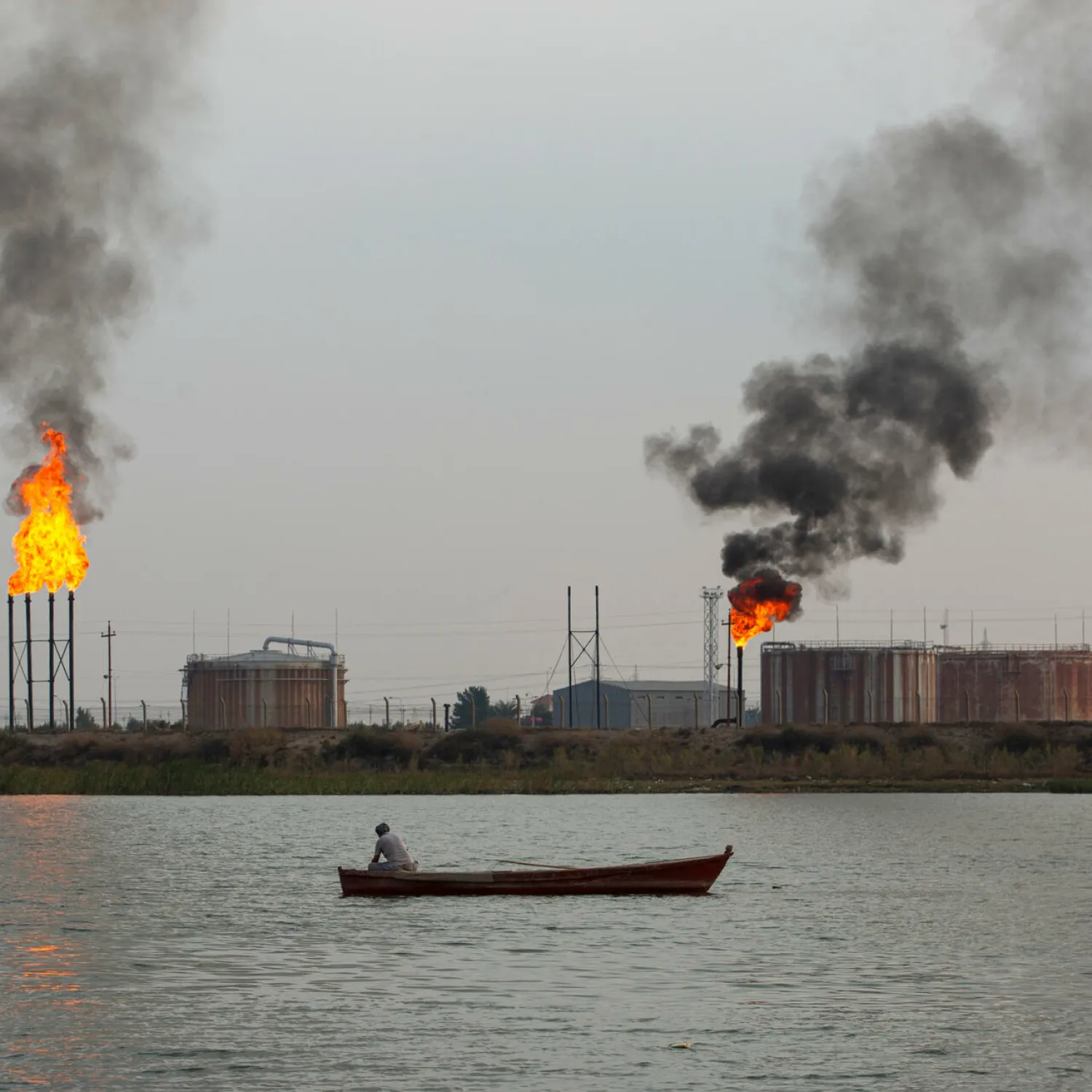
A boat passes polluting gas flares at the Umm Qasr port near Iraq's southern city of Basra. Hussein FALEH AFP
TT

Long Road ahead for Iraq Pledge to Phase Out Gas Flares

A boat passes polluting gas flares at the Umm Qasr port near Iraq's southern city of Basra. Hussein FALEH AFP

In the oilfields of southern Iraq, billions of cubic feet of gas literally go up in smoke, burnt off on flare stacks for want of the infrastructure to capture and process it.

The flares produce vast amounts of carbon dioxide and other greenhouse gases, contributing to global warming without any economic or social benefit, AFP reported.

Analysts say the waste is particularly egregious, as Iraq is a significant importer of natural gas, meeting a third of its needs through expensive and not always reliable supplies from neighboring Iran.

The government has pledged to phase out the practice by 2030 but the road to a greener, less wasteful energy sector is proving a long one.

For the oil companies exploiting the mega fields around Basra, it is actually cheaper to flare off the associated gas than to capture, process and market it, despite the obvious environmental costs.

Currently, only half of the three million cubic feet of gas that comes out of Iraqi oil wells each day is captured and processed.

The rest is burnt off in flares creating the plumes of acrid black smoke that blight the skies.

"Flared gas, if captured and processed, could provide electricity to three million homes," said Yesar al-Maleki, Gulf analyst at Middle East Economic Survey.

"This could definitely help the country end its acute power shortages that go up all the way to a supply and demand gap of nine gigawatts in summer."

- 'Up in smoke' -
In December, Iraq's oil minister Ihsan Ismail pledged to cut flare gas by 90 percent by 2024.

But despite contracts with foreign oil majors, including France's TotalEnergies, the target is likely to face bureaucratic obstacles in a sector which provides 90 percent of government revenues.

Over the past two years, the government has cut flare gas by just five percent.

The captured gas is fuel that Iraq desperately needs for its power stations.

Under an exemption from US sanctions on Iran, Iraq imports 750 million cubic feet per day from its eastern neighbour.

Any disruption to that supply can lead to widespread power cuts, particularly in summer when the demand for air conditioning and refrigeration peaks.

Maleki said the failure to address the issue bore multiple costs for Iraq.

"It loses financially by burning money in the air; it loses more money by importing gas from neighboring countries at a premium; it loses more money resolving resultant issues in its power sector when it switches its gas turbines to costly and pollutive liquid fuels; and it definitely loses environmentally."

Basra province is home to Iraq's five largest oilfields and accounts for 65 percent of its flared gas, according to World Bank figures.

The Basrah Gas Company, a consortium of Iraq's state-owned South Gas Company, Shell and Mitsubishi, captures one billion cubic feet of gas from the three fields in which it operates.

It plans to raise that figure to 1.4 billion cubic feet by the end of 2023 but doing so requires heavy investment, in processing as well as capture.

Managing director Malcolm Mayes said the consortium was investing around $1.5 billion in a giant new processing facility in Artawi, outside Basra.

"In Artawi, we are building two processing trains," Mayes said.

"The first will be on stream in May 2023 and the second will come on stream in November 2023, and at that point we will have the capacity to process 1.4 billion cubic feet -- approaching 90 percent from our lease area."

- 'Cleaner electricity' -
Iraq has also signed a mega-contract with TotalEnergies that includes building a processing facility for the associated gas from three southern oilfields.

"The plant's launch is scheduled for 2026," the French firm said.

Iraq says the plant will process 300 million cubic feet a day of gas that is currently flared off, rising to 600 million in a second phase.

Teams from TotalEnergies are already on the ground carrying out preliminary studies, but the process is dragging on.

Last month, Baghdad said some clauses of the contract "require time and cannot be implemented or solved in a short period".

A similar project awarded to Chinese firms in neighboring Maysan province is only half finished.

In the meantime, Basra's residents continue to live with the environmental consequences.

"Everything is polluted by these flares -- the water, the animals, they're all dead," said Salem, an 18-year-old shepherd in the village of Nahr Bin Omar, site of a major oilfield just north of Basra.



UN: At Least 15 Children Killed in Sudan Drone Strike

The war in Sudan, ongoing since mid-April 2023, has caused extensive destruction across the country (AFP)
TT

UN: At Least 15 Children Killed in Sudan Drone Strike

The war in Sudan, ongoing since mid-April 2023, has caused extensive destruction across the country (AFP)

A drone strike on a displacement camp in Sudan killed at least 15 children earlier this week, the United Nations reported late on Wednesday.

"On Monday 16 February, at least 15 children were reportedly killed and 10 wounded after a drone strike on a displacement camp in Al Sunut, West Kordofan," the UN children's agency said in a statement.

Across the Kordofan region, currently the Sudan war's fiercest battlefield, "we are seeing the same disturbing patterns from Darfur -- children killed, injured, displaced and cut off from the services they need to survive," UNICEF's Executive Director Catherine Russell said.


MSF Will Keep Operating in Gaza 'as Long as We Can'

(FILES) A Palestinian man walks on his crutches to the Doctors Without Borders or Medecins Sans Frontieres (MSF) clinic, in the al-Rimal neighborhood of Gaza City on new year's Eve, December 31, 2025. (Photo by Omar AL-QATTAA / AFP)
TT

MSF Will Keep Operating in Gaza 'as Long as We Can'

(FILES) A Palestinian man walks on his crutches to the Doctors Without Borders or Medecins Sans Frontieres (MSF) clinic, in the al-Rimal neighborhood of Gaza City on new year's Eve, December 31, 2025. (Photo by Omar AL-QATTAA / AFP)

The head of Doctors Without Borders in the Palestinian territories told AFP the charity would continue working in Gaza for as long as possible, following an Israeli decision to end its activities there.

In early February, Israel announced it was terminating all the activities in Gaza by the medical charity, known by its French acronym MSF, after it failed to provide a list of its Palestinian staff.

MSF has slammed the move, which takes effect on March 1, as a "pretext" to obstruct aid.

"For the time being, we are still working in Gaza, and we plan to keep running our operations as long as we can," Filipe Ribeiro told AFP in Amman, but said operations were already facing challenges.

"Since the beginning of January, we are not anymore in the capacity to get international staff inside Gaza. The Israeli authorities actually denied any entry to Gaza, but also to the West Bank," he said.

Ribeiro added that MSF's ability to bring medical supplies into Gaza had also been impacted.

"They're not allowed for now, but we have some stocks in our pharmacies that will allow us to keep running operations for the time being," he said.

"We do have teams in Gaza that are still working, both national and international, and we have stocks."

In December, Israel announced it would prevent 37 aid organizations, including MSF, from working in Gaza from March 1 for failing to submit detailed information about their Palestinian employees, drawing widespread condemnation from NGOs and the United Nations.

It had alleged that two MSF employees had links with Palestinian militant groups Hamas and Islamic Jihad, which the medical charity has repeatedly and vehemently denied.

MSF says it did not provide the names of its Palestinian staff because Israeli authorities offered no assurances regarding their safety.

Ribeiro warned of the massive impact the termination of MSF's operations would have for healthcare in war-shattered Gaza.

"MSF is one of the biggest actors when it comes to the health provision in Gaza and the West Bank, and if we are obliged to leave, then we will create a huge void in Gaza," he said.

The charity says it currently provides at least 20 percent of hospital beds in the territory and operates around 20 health centers.

In 2025 alone, it carried out more than 800,000 medical consultations, treated more than 100,000 trauma cases and assisted more than 10,000 infant deliveries.


Egyptian-Turkish Military Talks Focus on Strengthening Partnership

The Commander of the Egyptian Air Force during his meeting with the Turkish Air Force chief in Cairo on Wednesday (Egyptian military spokesperson)
TT

Egyptian-Turkish Military Talks Focus on Strengthening Partnership

The Commander of the Egyptian Air Force during his meeting with the Turkish Air Force chief in Cairo on Wednesday (Egyptian military spokesperson)

Senior Egyptian and Turkish air force commanders met in Cairo on Wednesday for talks focused on strengthening military partnership and expanding bilateral cooperation, in the latest sign of warming defense ties between the two countries.

The meeting brought together the Commander of the Egyptian Air Force, Lt. Gen. Amr Saqr, and his Turkish counterpart, Gen. Ziya Cemal Kadioglu, to review a range of issues of mutual interest amid growing cooperation between the two air forces.

Egypt’s military spokesperson said the talks reflect the Armed Forces’ commitment to deepening military collaboration with friendly and partner nations.

Earlier this month, Egypt and Türkiye signed a military cooperation agreement during talks in Cairo between Egyptian President Abdel Fattah el-Sisi and his Turkish counterpart, President Recep Tayyip Erdogan.

Sisi highlighted similar viewpoints on regional and international issues, while Erdogan noted that enhanced cooperation and forthcoming joint steps would help support regional peace.

Cairo and Ankara also signed an agreement last August on the joint production of vertical take-off and landing (VTOL) drones. Production of unmanned ground vehicles has also begun under a partnership between the Turkish firm HAVELSAN and Egypt’s Kader Factory.

During the talks, Saqr underscored the importance of coordinating efforts to advance shared interests and expressed hope for closer ties that would benefit both air forces.

Kadioglu, for his part, stressed the depth of bilateral partnership and the strong foundations of cooperation between the two countries’ air forces.

According to the military spokesperson, Kadioglu also toured several Egyptian Air Force units to review the latest training and armament systems introduced in recent years.

Military cooperation between Egypt and Türkiye has gained momentum since 2023, following the restoration of full diplomatic relations and reciprocal presidential visits that reflected positively on the defense sector.

In September last year, the joint naval exercise “Sea of Friendship 2025” was held in Turkish territorial waters, aimed at enhancing joint capabilities and exchanging expertise against a range of threats.