Iran’s Revolutionary Guards Unveil Two Missile, Drone Bases

Drones at the new base. (Tasnim)
TT

Iran’s Revolutionary Guards Unveil Two Missile, Drone Bases

Drones at the new base. (Tasnim)

Iran's Revolution Guards Corps (IRGC) unveiled two new missile and drone tunnel bases, Iranian media reported on Saturday.

“The two underground missile bases house ground-to-ground missile systems with advanced equipment, as well as attack drones penetrating the enemy's radar and defense networks,” said state media.

The Tasnim news agency reported that IRGC Commander Major General Hossein Salami and IRGC commander of Aerospace Force, Brigadier General Amir-Ali Hajizadeh attended the inauguration ceremony of the two underground bases

The IRGC names underground missile bases as Missile Cities.

Tasnim’s report said the new base boasts homegrown drones with a range of 2,000 kilometers, twin missile launch platforms, and platforms for the launch of multiple drones.

It added that a combination of accuracy and quality in the employment of the new military systems was put on display in a massive exercise held in December 2021.

The IRGC had declared its ability to launch 60 drones simultaneously, according to Reuters.

Saturday’s unveiling comes days after Iran suffered another failed launch of a satellite-carrying rocket.

Satellite images from Maxar Technologies seen by The Associated Press showed scorch marks at a launchpad at the Imam Khomeini Spaceport in Iran's rural Semnan province.


Netanyahu Again Seeks Unity Government Despite Mandate Denial

 Supporters of Prime Minister Benjamin Netanyahu protest against left-wing activists calling for the formation of a government that includes Arab parties, following Israel's general election, in Tel Aviv, Israel, Saturday, Oct. 31, 2026. (AP)
Supporters of Prime Minister Benjamin Netanyahu protest against left-wing activists calling for the formation of a government that includes Arab parties, following Israel's general election, in Tel Aviv, Israel, Saturday, Oct. 31, 2026. (AP)
TT

Netanyahu Again Seeks Unity Government Despite Mandate Denial

 Supporters of Prime Minister Benjamin Netanyahu protest against left-wing activists calling for the formation of a government that includes Arab parties, following Israel's general election, in Tel Aviv, Israel, Saturday, Oct. 31, 2026. (AP)
Supporters of Prime Minister Benjamin Netanyahu protest against left-wing activists calling for the formation of a government that includes Arab parties, following Israel's general election, in Tel Aviv, Israel, Saturday, Oct. 31, 2026. (AP)

Israeli Prime Minister Benjamin Netanyahu called again Monday for a unity government that would keep him in power, a day after opposition rival Gadi Eisenkot was given a mandate to form a coalition.

"A unity government is, simply, a necessity," Netanyahu said in a video posted on social media that ignored President Isaac Herzog on Sunday formally giving Eisenkot the first chance at a government.

Eisenkot's opposition bloc received 48 out of 61 seats needed for a majority in Israel's parliament in October 27 elections. Netanyahu's bloc won 53 seats.

But Eisenkot received a majority of recommendations in parties' talks with Herzog. He could rely on Arab-majority parties, which won a record 19 seats after unprecedented voter turnout on anger over racism and marginalization by Netanyahu's far-right government.

In his video, Netanyahu warned Israelis against what he described as the threat of including Arab-Israelis in a future government.

"You cannot form a government with Hamas supporters, a government that depends on Hamas supporters," Netanyahu said Monday, repeating an often-used scare tactic against Arab-Israeli parties, which he has also accused of election fraud despite a lack of evidence.

The parties deny the charges. Eisenkot faces resistance within the opposition to including Arab-Israeli parties, which could also vote to put him in power without joining the government, leaving it fragile.

Netanyahu said that a unity government around his Likud party should instead include all Zionist parties, as well as ultra-Orthodox Jewish parties.

Avigdor Liberman, a right-wing critic of Netanyahu and leader of the smallest of the core opposition parties, has made clear he opposes any partnership with Israeli-Arabs, questioning their ideology and warning of the political cost.

Liberman has instead courted the ultra-Orthodox, despite his years of criticism of the community over its key demand that its young people remain exempt from mandatory military service.

Liberman met Monday with Eisenkot in a public show of unity.

"Both expressed full confidence in their ability to form a stable government for a full four-year term," Liberman's Yashar party said in a statement.

Eisenkot and Netanyahu have both offered a national-unity government with the rival party -- but with each one insisting he would be in charge.

Eisenkot has publicly said that Netanyahu is dangerous and unfit to lead Israel, pointing to his failure to prevent the October 7, 2023 Hamas attack, his deep divisiveness and corruption charges that could land Netanyahu in prison if he were to lose power.


Europe Top Diplomats Press Rubio on Ukraine at G7

 From left, Germany's Foreign Minister Johann Wadephul, US Secretary of State Marco Rubio and EU High Representative and Vice-President for Foreign Affairs and Security Policy Kaja Kallas attend a working lunch at the G7 foreign ministers summit in Paris, Monday, Nov. 9, 2026. (AP)
From left, Germany's Foreign Minister Johann Wadephul, US Secretary of State Marco Rubio and EU High Representative and Vice-President for Foreign Affairs and Security Policy Kaja Kallas attend a working lunch at the G7 foreign ministers summit in Paris, Monday, Nov. 9, 2026. (AP)
TT

Europe Top Diplomats Press Rubio on Ukraine at G7

 From left, Germany's Foreign Minister Johann Wadephul, US Secretary of State Marco Rubio and EU High Representative and Vice-President for Foreign Affairs and Security Policy Kaja Kallas attend a working lunch at the G7 foreign ministers summit in Paris, Monday, Nov. 9, 2026. (AP)
From left, Germany's Foreign Minister Johann Wadephul, US Secretary of State Marco Rubio and EU High Representative and Vice-President for Foreign Affairs and Security Policy Kaja Kallas attend a working lunch at the G7 foreign ministers summit in Paris, Monday, Nov. 9, 2026. (AP)

European foreign ministers on Monday pressed US Secretary of State Marco Rubio at a G7 meeting in Paris to ensure any settlement in the war with Russia is fair to Ukraine, ahead of US-mediated talks on ending the conflict.

European capitals have insisted that they must be represented at the table in the negotiations in Abu Dhabi and some have also expressed wariness about intensifying American talk of a new security architecture for Europe.

The meeting of ministers from the leading industrialized nations of Britain, Canada, France, Germany, Italy, Japan and the United States provides Europe and its allies with a chance to air concerns with their US counterpart.

Russia's war against Ukraine following the February 2022 full-scale invasion of its neighbor is grinding towards its fifth anniversary. And Washington is still not ruling out new attacks against Iran even after the defeat of President Donald Trump's Republicans in last week's midterm elections.

The meeting coincides with US-mediated talks with Moscow and Kyiv in Abu Dhabi, scheduled for Tuesday and Wednesday, on ending the Ukraine war.

"It is certainly neither necessary, nor right, nor appropriate to make a fundamental change" to Europe's existing security architecture, said German Foreign Minister Johann Wadephul after talks with Rubio.

"Europe belongs at this table. There can be no solution without Europe -- only with Europe," he added.

French Foreign Minister Jean-Noel Barrot said on Sunday that Europeans would be represented at the Abu Dhabi talks, with France also participating.

Trump stoked fears of a US pivot toward the Kremlin by predicting a "very big" deal with Russia involving not only Ukraine but "all of Europe".

But before leaving for Paris, Rubio said the post-war security infrastructure of Europe is "one of the key topics that's been raised repeatedly in every conversation any time negotiations have been discussed".

"We obviously have to get past the conflict to get to that point," he noted.

- Europe security concerns -

President Trump's son-in-law and envoy Jared Kushner meanwhile said Russia and Europe must hold direct talks on "broader security arrangements" as part of any Ukraine peace deal.

"We recognize the difficult decisions ahead," he said.

Speaking in Bucharest, EU commission chief Ursula von der Leyen said Russia must halt fighting in Ukraine before "meaningful" talks can be held on broader security arrangements in Europe.

Ukraine's Foreign Minister Andriy Sybiga will be joining the talks in Paris for a session on Ukraine on Tuesday.

Before leaving for Paris, he said: "No one has the right to decide our fate behind our backs."

Wadephul said the Abu Dhabi talks must show whether Russia is "genuinely prepared to negotiate", urging Moscow to "give up maximalist demands" and warning against any "negotiation show" in the UAE capital.

He warned that against a background of continued Russian attacks on Ukrainian civilian infrastructure "we see no substantial contribution whatsoever toward negotiations gaining any serious momentum" on Moscow's part.

But in an interview with AFP, Canada's Foreign Minister Anita Anand hailed the "importance" of US-mediated talks, saying it was "positive" that both sides were willing to discuss a settlement to end the war.

- Iran conflict -

On Iran, Trump has not ruled out new strikes, including at so-called Pickaxe Mountain, a suspected nuclear site which Tehran denies is such a facility.

Europeans, however, are eager to see a resolution and shipping traffic return to normal in the Strait of Hormuz energy transit hub.

Trump allayed some fears by telling CNN it was "highly unlikely" that fighting would resume.

"We certainly cannot afford any military escalation at this point," said Wadephul, adding the G7 talks would "focus on identifying ways to ensure it is indeed avoided".

Rubio warned however there had been "no progress" in talks with Iran, whose demands he said were "simply not just unacceptable but, in some cases, outrageous and ridiculous and really not realistic".


France Says Iran’s Guards Behind Cyberattacks on Fridges, Vows Sanctions

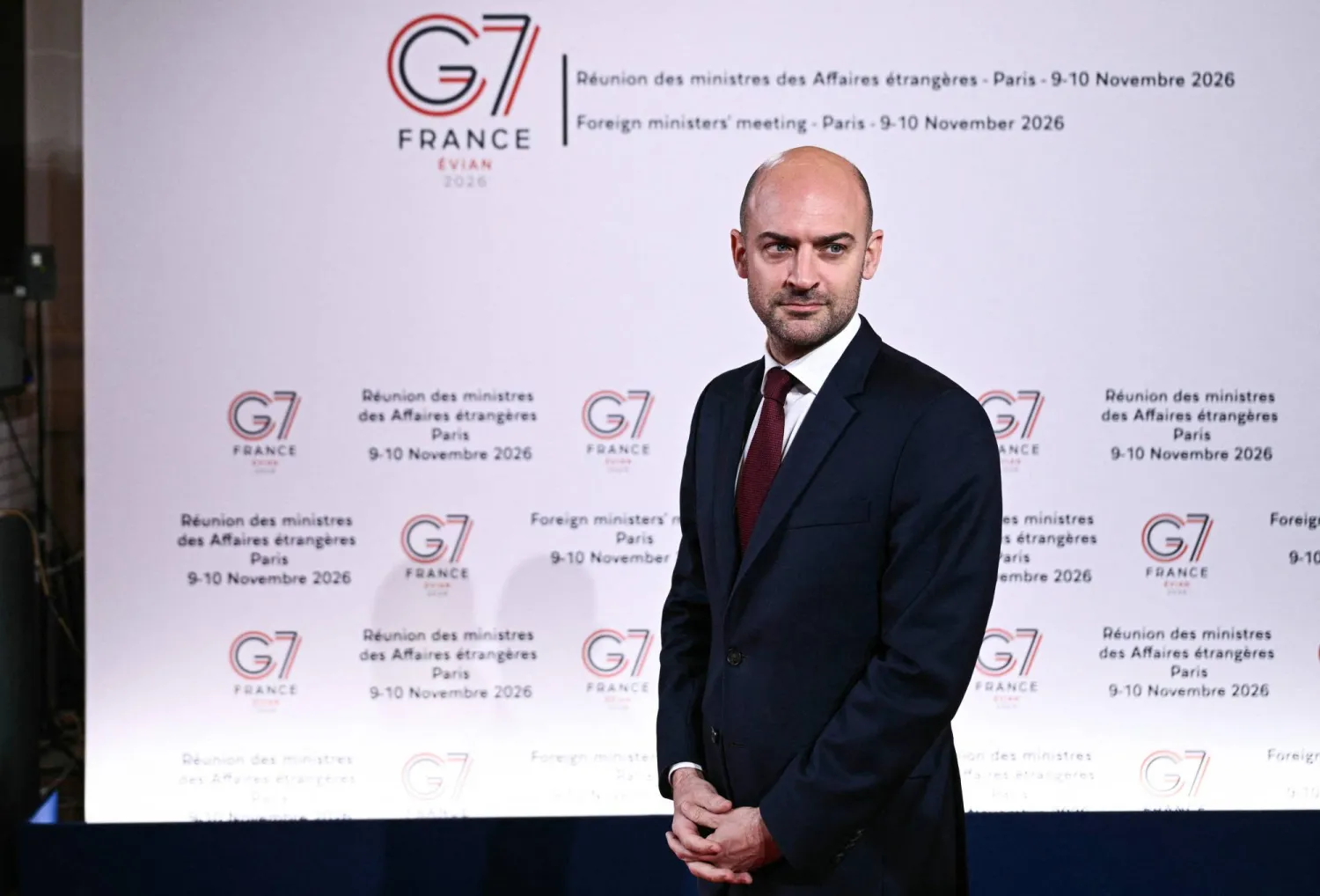
France's Minister for Europe and Foreign Affairs Jean-Noel Barrot looks on during the G7 foreign ministers summit at the Quai d'Orsay in Paris on November 9, 2026. (AFP)
TT

France Says Iran’s Guards Behind Cyberattacks on Fridges, Vows Sanctions

France's Minister for Europe and Foreign Affairs Jean-Noel Barrot looks on during the G7 foreign ministers summit at the Quai d'Orsay in Paris on November 9, 2026. (AFP)

French officials on Monday accused Iran's Revolutionary Guards of responsibility for the cyberattacks that knocked out commercial refrigerators and freezers across France last month, saying there would be consequences for Iran. 

The hacks that struck hundreds of French supermarkets in early October were among the most disruptive cyberattacks of the Iran war that began in February, a conflict that has been marked by scattered incidents of alleged digital disruption. These have included hacks against the Los Angeles transit system in March, against US water treatment plants in July and against ships bound for the United States in August. 

Iran's mission to the United Nations did not return messages seeking comment. Iran routinely denies carrying out malicious cyber operations. 

The French announcement was made only ‌minutes after Reuters revealed ‌that investigators privately suspected Iran of being behind the attacks. French Foreign ‌Minister ⁠Jean-Noel Barrot said the ⁠Iranian ambassador had been summoned to France's foreign ministry. Barrot also threatened further EU sanctions against Iran. 

"This attack is unprecedented in both its scale and its level of aggression," he said, adding "we will implement sanctions at the European level against all those responsible for this attack." 

The October 11 cyberattack, which overrode the temperature controls on commercial fridges in hundreds of establishments, appeared to have been easy to pull off, cybersecurity experts previously told Reuters. The firm behind many of the stricken units said that several were obsolete or were running outdated firmware, which could have made it easy for hackers to break in. 

The effects were still dramatic. Some refrigerators had the temperature turned up so high they caught fire. In the hours following the hack, ⁠supermarket employees carted boxes full of perished meat and melted ice cream into ‌giant trash containers. The attack's total costs could add up ‌to tens of millions of euros nationwide, one French supermarket owner estimated. 

Reuters could not establish exactly how the French ‌made their determination. 

The October hacks were followed this month by a second wave of hacking that hit more ‌than 100 establishments across Europe and even affected refrigerators used by French blood banks, prompting employees there to have to move some of the blood to different cold storage units. 

The seemingly straightforward nature of the refrigerator hacks — and their repetition across multiple countries — prompted speculation about who might be responsible amid ongoing concerns over Russia's suspected sabotage campaign in Europe, the war ‌between the US and Iran and the global rise of AI-powered cyberattacks. 

US REFRIGERATOR HACKS 

The sabotage of European supermarket fridges was preceded by at least one ⁠similar incident in the ⁠United States. 

In August, refrigerators in at least half a dozen military commissaries went out of commission. Pentagon investigators are treating the malfunctions as a suspected cyberattack and are working with French officials to get to the bottom of what happened, Reuters reported last month. 

Reuters could not independently establish whether there was any link between the refrigeration incidents at US military bases in August, the hacking campaign in France and the more recent wave of refrigeration hacks that struck Europe. 

A person familiar with the matter said that the Pentagon considers Iran a suspect in the August commissary hacks but that the investigation is still in progress. 

Reuters could not establish how the military made its determination or whether it was also looking into other suspects. That the US military considers Iran a suspect in the commissary sabotage campaign was first reported last month by news website Nextgov. 

The Pentagon said on Monday that it is "aware of speculation regarding a potential cyber incident" but that military investigators were on the case and it could not offer further comment for security reasons.