Death Toll Nears 6 Million as Pandemic Enters its 3rd Year

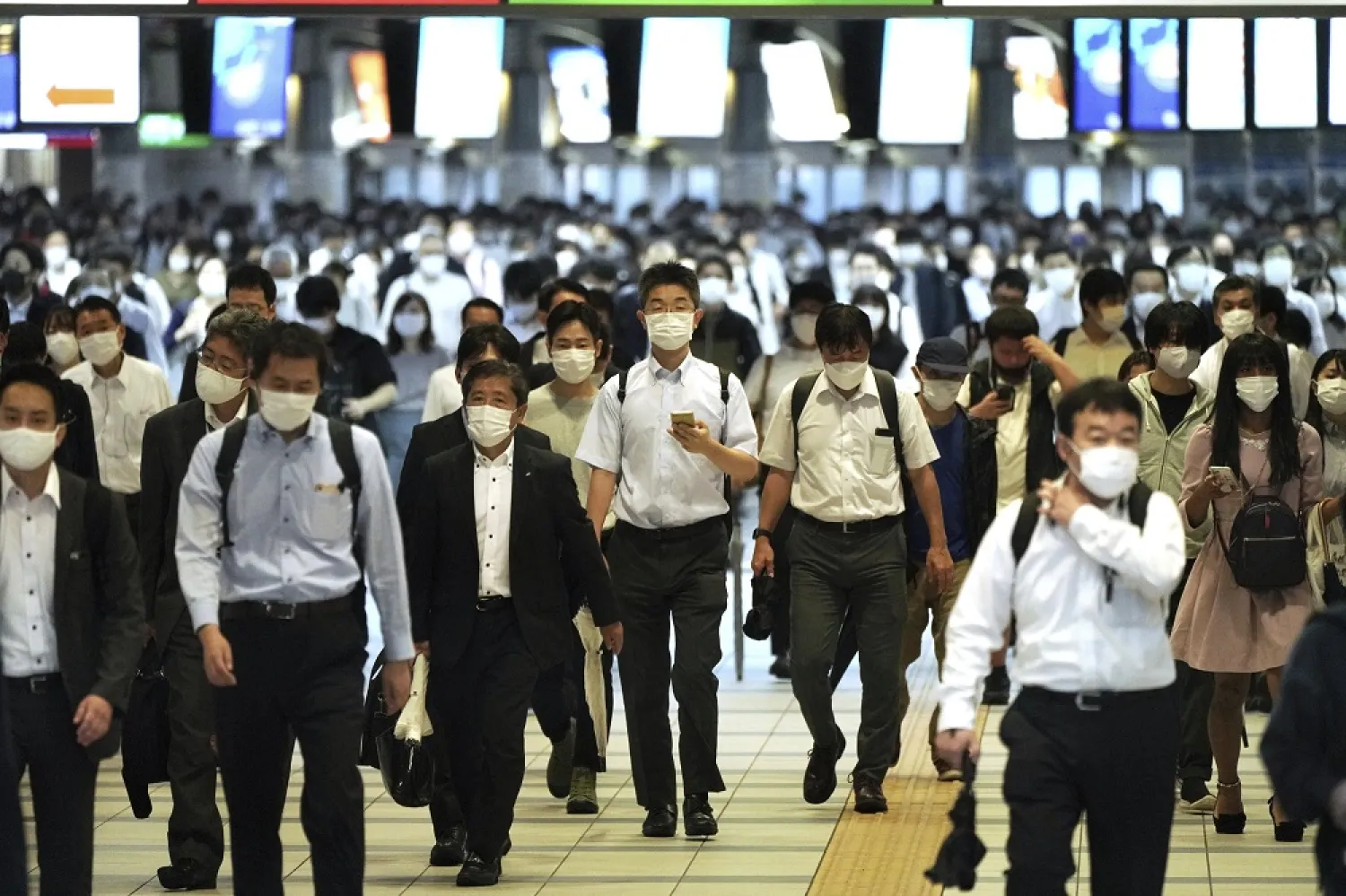
Commuters wearing face masks to help curb the spread of the coronavirus walk in a passageway during a rush hour at Shinagawa Station, in Tokyo, Japan, Oct. 1, 2021. (AP)
TT

Death Toll Nears 6 Million as Pandemic Enters its 3rd Year

Commuters wearing face masks to help curb the spread of the coronavirus walk in a passageway during a rush hour at Shinagawa Station, in Tokyo, Japan, Oct. 1, 2021. (AP)

The official global death toll from COVID-19 is on the verge of eclipsing 6 million — underscoring that the pandemic, now in its third year, is far from over.

The milestone is the latest tragic reminder of the unrelenting nature of the pandemic even as people are shedding masks, travel is resuming and businesses are reopening around the globe. The death toll, compiled by Johns Hopkins University, stood at 5,996,882 as of Sunday morning and was expected to pass the 6 million mark later in the day.

Remote Pacific islands, whose isolation had protected them for more than two years, are just now grappling with their first outbreaks and deaths, fueled by the highly contagious omicron variant.

Hong Kong, which is seeing deaths soar, is testing its entire population of 7.5 million three times this month as it clings to mainland China’s “zero-COVID” strategy.

As death rates remain high in Poland, Hungary, Romania and other Eastern European countries, the region has seen more than 1 million refugees arrive from war-torn Ukraine, a country with poor vaccination coverage and high rates of cases and deaths.

And despite its wealth and vaccine availability, the United States is nearing 1 million reported deaths on its own.

Death rates worldwide are still highest among people unvaccinated against the virus, said Tikki Pang, a visiting professor at the National University of Singapore’s medical school and co-Chair of the Asia Pacific Immunization Coalition.

“This is a disease of the unvaccinated — look what is happening in Hong Kong right now, the health system is being overwhelmed,” said Pang, the former director of research policy and cooperation with the World Health Organization. “The large majority of the deaths and the severe cases are in the unvaccinated, vulnerable segment of the population.”

It took the world seven months to record its first million deaths from the virus after the pandemic began in early 2020. Four months later another million people had died, and 1 million have died every three months since, until the death toll hit 5 million at the end of October. Now it has reached 6 million — more than the populations of Berlin and Brussels combined, or the entire state of Maryland.

But despite the enormity of the figure, the world undoubtedly hit its 6 millionth death some time ago. Poor record-keeping and testing in many parts of the world has led to an under-count in coronavirus deaths, in addition to excess deaths related to the pandemic but not from actual COVID-19 infections, like people who died from preventable causes but could not receive treatment because hospitals were full.

Edouard Mathieu, head of data for the Our World in Data portal, said that — when countries’ excess mortality figures are studied — as many as nearly four times the reported death toll have likely died because of the pandemic.

An analysis of excess deaths by a team at The Economist estimates that the number of COVID-19 deaths is between 14 million and 23.5 million.

“Confirmed deaths represent a fraction of the true number of deaths due to COVID, mostly because of limited testing, and challenges in the attribution of the cause of death,” Mathieu told The Associated Press. “In some, mostly rich, countries that fraction is high and the official tally can be considered to be fairly accurate, but in others it is highly underestimated.”

The United States has the biggest official death toll in the world, but the numbers have been trending downward over the last month.

Lonnie Bailey lost his 17-year-old nephew, Carlos Nunez Jr., who contracted COVID-19 last April — the same month Kentucky opened his age group to vaccinations. The Louisville resident said the family is still suffering, including Carlos' younger sibling, who had to be hospitalized himself and still has lingering symptoms. The aggressive reopening of the country has been jarring for them to witness.

“For us it is hard to let our guard down; it’s going to take a while for us to adjust," Bailey said.

The world has seen more than 445 million confirmed COVID-19 cases, and new weekly cases have been declining recently in all regions except for the Western Pacific, which includes China, Japan and South Korea, among others, the World Health Organization reported this week.

Although the overall figures in the Pacific islands seeing their first outbreaks are small compared to larger countries, they are significant among their tiny populations and threaten to overwhelm fragile health care systems.

“Given what we know about COVID ... it’s likely to hit them for the next year or so at least," said Katie Greenwood, head of the Red Cross Pacific delegation.

Tonga reported its first outbreak after the virus arrived with international aid vessels following the Jan. 15 eruption of a massive volcano, followed by a tsunami. It now has several hundred cases, but — with 66% of its population fully vaccinated — it has so far reported people suffering mostly mild symptoms and no deaths.

The Solomon Islands saw the first outbreak in January and now has thousands of cases and more than 100 deaths. The actual death toll is likely much higher, with the capital’s hospital overwhelmed and many dying at home, Greenwood said.

Only 12% of Solomon Islanders are fully vaccinated, though the outbreak has provided new impetus to the country’s vaccination campaign and 29% now have at least one shot.

Global vaccine disparity continues, with only 6.95% of people in low-income countries fully vaccinated, compared to more than 73% in high-income nations, according to Our World in Data.

In a good sign, at the end of last month Africa surpassed Europe in the number of doses administered daily, but only about 12.5% of its population has received two shots.

The Africa Centers for Disease Control and Prevention is still pressing for more vaccines, though it has been a challenge. Some shipments arrive with little warning for countries’ health systems and others near the expiration date — forcing doses to be destroyed.

Eastern Europe has been particularly hard hit by the omicron variant, and with the Russian invasion of Ukraine, a new risk has emerged as hundreds of thousands of people flee to places like Poland on crowded trains. Health officials there have been offering free vaccinations to all refugees, but have not been making them test upon arrival or quarantine.

“This is really tragic because great stress has a very negative effect on natural immunity and increases the risk of infections,” said Anna Boron-Kaczmarska, a Polish infectious disease specialist. “They are in very high stress, being afraid for their lives, the lives of their children, they family members.”

Mexico has reported 300,000 deaths, but with little testing, a government analysis of death certificates puts the real number closer to 500,000. Still, four weeks of falling infection rates have left health officials optimistic.

In India, where the world was shocked by images of open-air pyres of bodies burned as crematoria were overwhelmed, the scars are fading as the number of new cases and deaths has slowed.

India has recorded more than 500,000 deaths, but experts believe its true toll is in the millions, primarily from the delta variant. Migrants from India’s vast hinterland are now returning to its megacities in search of jobs, and the streets are packed with traffic. Shopping malls have customers, albeit still masked, while schools and universities are welcoming students after a months-long gap.

In Britain, infections have fallen since an omicron-driven surge in December, but remain high. England has now lifted all restrictions, including mask mandates and the requirement that all who test positive isolate at home.

With about 250,000 reported deaths, the African continent's smaller death toll is thought to stem from under-reporting, as well as a generally younger and less mobile population.

“Africa is a big question mark for me, because it has been relatively spared from the worst so far, but it could just be a time bomb,” Pang said, noting its low vaccination rates.

In South Africa, Soweto resident Thoko Dube said she received news of the deaths of two family members on the same day in January 2021 — a month before the country received its first vaccines.

It has been difficult, but “the family is coping,” she said. “We have accepted it because it has been happening to other families.”


Le Pen Says France Will No Longer Aid Ukraine ‘Financially’ if Elected

Marine Le Pen (C), the far-right National Rally (RN) party's candidate for the 2027 French presidential election, visits the "Made in France" fair at the Porte de Versailles exhibition center in Paris, France, 13 November 2026. (EPA)
TT

Le Pen Says France Will No Longer Aid Ukraine ‘Financially’ if Elected

Marine Le Pen (C), the far-right National Rally (RN) party's candidate for the 2027 French presidential election, visits the "Made in France" fair at the Porte de Versailles exhibition center in Paris, France, 13 November 2026. (EPA)

Marine Le Pen on Monday said that France would provide no further financial aid to Ukraine if she is elected president next year, after a meeting with Kyiv's ambassador in Paris.

"The state of France's public finances would no longer allow the country to provide financial assistance to Ukraine in the coming months," Le Pen said in a statement, while insisting France would honor existing commitments, including toward a 90-billion-euro ($100-billion) European Union loan.

Le Pen is currently ahead in polls in the race to succeed President Emmanuel Macron next year, as the war sparked by Russia's 2022 full-scale invasion of Ukraine grinds towards its fifth anniversary.

She has faced criticism over past links to Russia, which included a 2017 meeting in the Kremlin with President Vladimir Putin and her party taking a loan from a Russian bank that it paid off in full in 2023.

But she has opposed the invasion and, at her talks in Paris with Ukrainian ambassador Vadym Omelchenko, Le Pen made clear her "unwavering support for Ukraine since the beginning of the conflict".

The statement said the talks -- the first such between Le Pen and the Ukrainian ambassador -- were "cordial".

While financial aid would be cut, Le Pen told the ambassador that "France would continue to support Ukraine through donations of equipment, humanitarian aid and much more active diplomacy".

The statement said there was a "frank discussion" on the future of the conflict, with Le Pen stressing that "the pursuit of peace -- though a difficult goal to achieve -- must remain a priority for all".

She also asked the ambassador to tell President Volodymyr Zelensky she is ready to meet in "either Paris or Brussels". However, there was no mention of the candidate making the journey to Kyiv after Zelensky invited her to visit the Ukrainian capital.

Le Pen's opponents have expressed alarm that by emphasizing the importance of ending the war swiftly, she could force Ukraine to capitulate on unfavorable terms.

"If Russia imposes its will on a European nation through brutality, all of Europe is weakened," Macron wrote on Facebook at the weekend.

Taking aim at Le Pen, he said: "Let us be clear: those who seek to limit the resources available to Ukraine are, in effect, pushing for an unjust peace -- one that would leave Ukraine permanently vulnerable, and, by extension, leave Europe vulnerable as well."


Trump Says He Might Meet with North Korea’s Kim Jong Un in China

US President Donald Trump and North Korean leader Kim Jong Un shake hands before their one-on-one chat during the second US-North Korea summit at the Metropole Hotel in Hanoi, Vietnam February 27, 2019. (Reuters)
TT

Trump Says He Might Meet with North Korea’s Kim Jong Un in China

US President Donald Trump and North Korean leader Kim Jong Un shake hands before their one-on-one chat during the second US-North Korea summit at the Metropole Hotel in Hanoi, Vietnam February 27, 2019. (Reuters)

US President Donald Trump said on Monday he might meet with North Korean leader Kim Jong Un in China this week, an announcement that could dramatically reshape his upcoming trip through East Asia if it occurs.

The president, who met the North Korean leader several times during his 2017-2021 term, including once in the Korean Demilitarized Zone, has previously expressed ‌interest in ‌another meeting during his current term. Senior ‌US ⁠officials, however, have previously ⁠said he has no immediate plans to do so.

Moreover, Trump has repeatedly previewed meetings with Kim that never took place, including during a trip to Asia last year. North Korea, whose mission to the United Nations did not immediately respond to a ⁠request for comment, has publicly indicated it ‌has no intention of ‌meeting with the US president at this time.

Trump told reporters ‌while departing the White House en route to ‌the Philippines and China that any meeting would occur in China, and that the North Korean leader's presence was ultimately up to Chinese President Xi Jinping.

"(Xi) was here a ‌month ago, and we're also going to meet with (Russian) President Putin, and we ⁠may ⁠meet with Kim Jong Un also," Trump said.

"So that'll be good. We have a chance to accomplish a lot."

Trump has indicated he will meet with Putin and Xi during his trip, but US officials and analysts have played down the possibility of a meaningful agreement emerging from any trilateral sit-down.

Among the possible topics of conversation, Trump and others have said, are Russia's invasion of Ukraine, counterproliferation and the war in Iran.


Third US Aircraft Carrier Arrives in Middle East

This US Navy handout photograph released by US Naval Forces Central Command on November 4, 2026, shows the Nimitz-class aircraft carrier USS Theodore Roosevelt (CVN 71) sails alongside Royal Australian Navy Supply-class replenishment oiler HMAS Stalwart (A304). (AFP / NAVCENT Public Affairs / US Navy)
TT

Third US Aircraft Carrier Arrives in Middle East

This US Navy handout photograph released by US Naval Forces Central Command on November 4, 2026, shows the Nimitz-class aircraft carrier USS Theodore Roosevelt (CVN 71) sails alongside Royal Australian Navy Supply-class replenishment oiler HMAS Stalwart (A304). (AFP / NAVCENT Public Affairs / US Navy)

The USS Theodore Roosevelt aircraft carrier arrived in the Middle East on Sunday, media reports said, bringing the number of American carrier strike groups in the region to three.

The deployment, which was reported by the National News and Axios journalist Barak Ravid, comes as fighting reignites in the region, with Iran claiming a drone attack on Bahrain on Sunday, ending a lull in strikes in the war.

Iran also fired drones at Bahrain on Friday -- the first strikes since September against countries in the energy-rich Gulf, which has been targeted several times in the conflict that erupted in February.

US President Donald Trump plans to discuss the war at a trilateral meeting with his Chinese and Russian counterparts Xi Jinping and Vladimir Putin this week, an official said Friday.

Months of diplomacy have failed to resolve the war, which began with US-Israeli strikes that killed Iran's supreme leader Ali Khamenei.