Biden Seeks New Sanctions, Help for Ukrainians in Europe

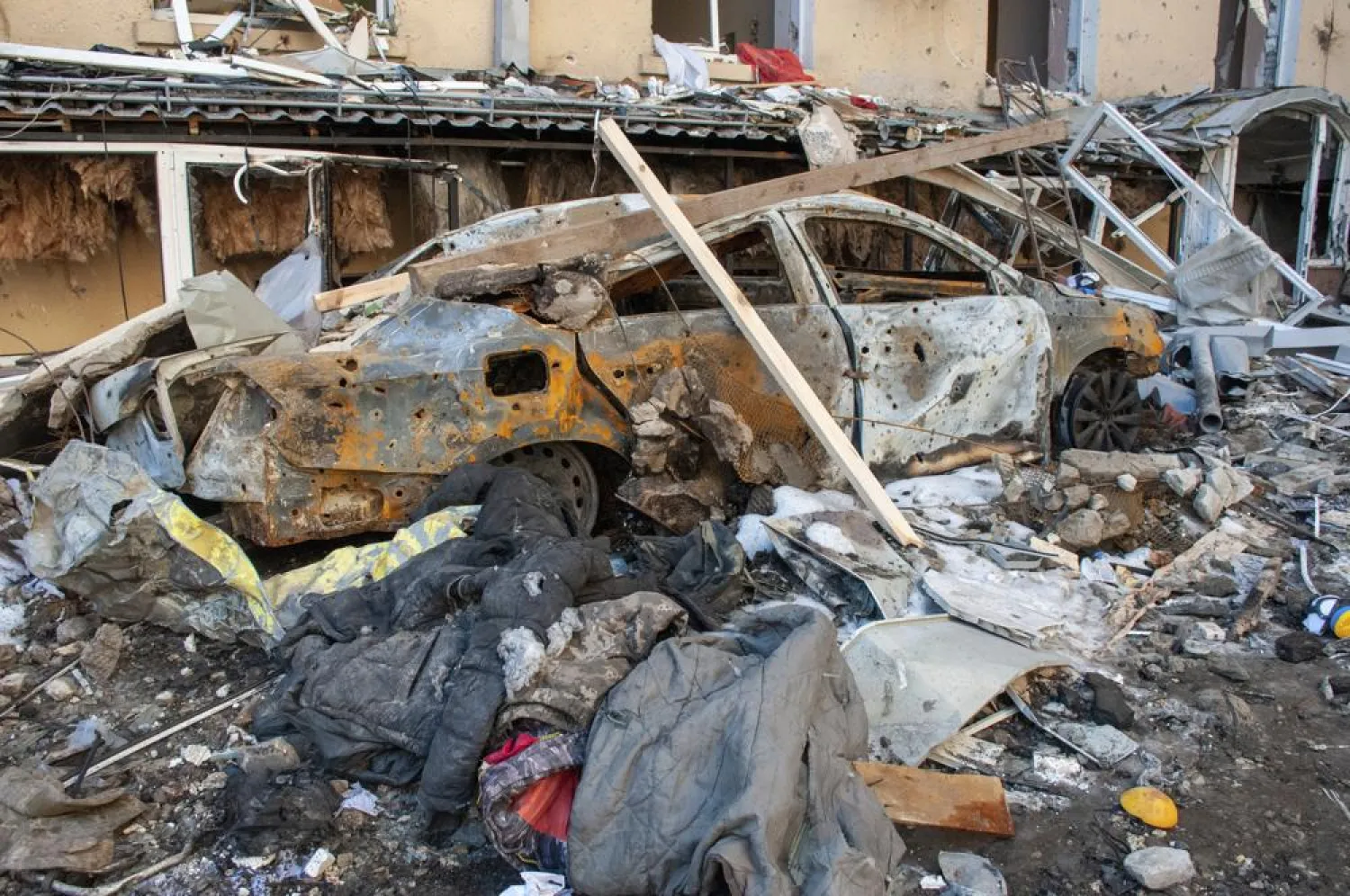
A car destroyed by shelling is seen in a street in Kharkiv, Ukraine, Tuesday, March 22, 2022. (AP)
TT

Biden Seeks New Sanctions, Help for Ukrainians in Europe

A car destroyed by shelling is seen in a street in Kharkiv, Ukraine, Tuesday, March 22, 2022. (AP)

With Europe facing its most precarious future since World War II, President Joe Biden will huddle with key allies in Brussels and Warsaw this week as the leaders try to prevent Russia’s war on Ukraine from spiraling into an even greater catastrophe.

Biden embarks Wednesday on a four-day trip that will test his ability to navigate the continent’s worst crisis since WWII ended in 1945. There are fears that Russia could use chemical or nuclear weapons as its invasion becomes bogged down in the face of logistical problems and fierce Ukrainian resistance.

Humanitarian challenges are growing as well. Millions of refugees have fled the fighting, mostly by crossing the border into Poland, and the war has jeopardized Ukraine's wheat and barley harvests, raising the possibility of rising hunger in impoverished areas around the globe.

Jake Sullivan, Biden’s national security adviser, said the president would coordinate with allies on military assistance for Ukraine and new sanctions on Russia. He added that Biden is working on long-term efforts to boost defenses in Eastern Europe, where more countries fear Russian aggression. The president is also aiming to reduce the continent's reliance on Russian energy.

“This war will not end easily or rapidly,” Sullivan told reporters at a White House briefing on Tuesday. “For the past few months, the West has been united. The president is traveling to Europe to make sure we stay united.”

Sullivan said Vladimir Putin's references to nuclear weapons at the beginning of the conflict are “something that we do have to be concerned about,” adding that Biden would be talking with allies about “potential responses” if the Russian leader takes that step.

Sullivan's description of Biden's trip was another sign that the crisis is entering a new and uncertain phase.

After the initial invasion failed to topple Ukraine's government, the war has become a grinding endeavor for Putin, who is relying on airstrikes and artillery that are devastating civilian communities. Negotiations between Ukraine and Russia have not produced a ceasefire or a path to ending the conflict, and the US continues to rush weapons like anti-tank missiles to Ukrainian forces.

The war's ripple effects are also spreading. Biden warned that Russia could be planning cyberattacks that would affect US companies, and he spoke to Chinese President Xi Jinping on Friday to warn him against backing Russia with military or financial assistance. Meanwhile, a top State Department official visited India this week shortly after that country decided to purchase more Russian oil.

“This is one of those decisive moments for an American leader that defines their legacy internationally,” said Timothy Naftali, a presidential historian at New York University.

Biden’s first stop is Brussels, where he’ll attend back-to-back-to-back meetings.

NATO is holding a hastily arranged emergency summit, where Biden is expected to reiterate his support for Article 5 of the alliance's charter, which commits all members to collective defense if any are attacked.

“I think the meeting of all heads of state and government in NATO will provide us with yet another platform to demonstrate our unity, our support to Ukraine, but also our readiness to protect and defend all NATO allies,” NATO Secretary-General Jens Stoltenberg told NBC’s “Meet the Press” on Sunday. “And by sending that message, we are preventing an escalation of the conflict to a full-fledged war between NATO and Russia.”

Biden will also participate in meetings of the European Union and the Group of Seven, which includes the world’s richest democracies.

He’ll then travel to Warsaw on Friday to meet Polish officials to discuss the enormous humanitarian strain caused by the Ukrainian refugee crisis. Biden is scheduled to meet with Polish President Andrzej Duda on Saturday.

Duda, whose country suffered a brutal Nazi occupation during World War II, compared Russian actions in Ukraine to Adolf Hitler's infamous SS forces. Visiting Bulgaria on Tuesday, Duda said Putin's army “is behaving in exactly the same way." He said he hoped that those responsible for attacks on civilians would be brought before international courts.

Polish leaders have pressed for a Western peacekeeping mission to intervene in Ukraine, a step that the US and other Western allies worry could lead to a broadening of the war. The Polish leadership also wants an increased military presence along NATO's eastern flank.

Sullivan said Biden's trip to Poland is an important opportunity to “meet with a frontline and very vulnerable ally.” Poland is also host to a growing number of US troops, and Sullivan suggested Biden may visit them as well.

Last week, at NATO’s Brussels headquarters, US Defense Secretary Lloyd Austin and his counterparts weighed what defenses to set up on the organization’s eastern flank, from Estonia in the north through Latvia, Lithuania and Poland down to Bulgaria and Romania on the Black Sea.

The aim is to deter Putin from ordering an invasion of any of the 30 allies, not just for the duration of the war in Ukraine but into the future.

Putin has demanded that NATO withdraw its forces on its eastern flank and stop expanding.

Sullivan said that Biden, during his talks in Europe, “will work with allies on longer-term adjustments to NATO force posture.”

Biden's visit to Poland follows on Vice President Kamala Harris' visit to Warsaw and Bucharest earlier this month. While Harris was in Poland, Duda called on the Biden administration to expedite visa procedures for Ukrainians who have family living in the United States so that they could resettle in the US at least temporarily.


Le Pen Says France Will No Longer Aid Ukraine ‘Financially’ if Elected

Marine Le Pen (C), the far-right National Rally (RN) party's candidate for the 2027 French presidential election, visits the "Made in France" fair at the Porte de Versailles exhibition center in Paris, France, 13 November 2026. (EPA)
TT

Le Pen Says France Will No Longer Aid Ukraine ‘Financially’ if Elected

Marine Le Pen (C), the far-right National Rally (RN) party's candidate for the 2027 French presidential election, visits the "Made in France" fair at the Porte de Versailles exhibition center in Paris, France, 13 November 2026. (EPA)

Marine Le Pen on Monday said that France would provide no further financial aid to Ukraine if she is elected president next year, after a meeting with Kyiv's ambassador in Paris.

"The state of France's public finances would no longer allow the country to provide financial assistance to Ukraine in the coming months," Le Pen said in a statement, while insisting France would honor existing commitments, including toward a 90-billion-euro ($100-billion) European Union loan.

Le Pen is currently ahead in polls in the race to succeed President Emmanuel Macron next year, as the war sparked by Russia's 2022 full-scale invasion of Ukraine grinds towards its fifth anniversary.

She has faced criticism over past links to Russia, which included a 2017 meeting in the Kremlin with President Vladimir Putin and her party taking a loan from a Russian bank that it paid off in full in 2023.

But she has opposed the invasion and, at her talks in Paris with Ukrainian ambassador Vadym Omelchenko, Le Pen made clear her "unwavering support for Ukraine since the beginning of the conflict".

The statement said the talks -- the first such between Le Pen and the Ukrainian ambassador -- were "cordial".

While financial aid would be cut, Le Pen told the ambassador that "France would continue to support Ukraine through donations of equipment, humanitarian aid and much more active diplomacy".

The statement said there was a "frank discussion" on the future of the conflict, with Le Pen stressing that "the pursuit of peace -- though a difficult goal to achieve -- must remain a priority for all".

She also asked the ambassador to tell President Volodymyr Zelensky she is ready to meet in "either Paris or Brussels". However, there was no mention of the candidate making the journey to Kyiv after Zelensky invited her to visit the Ukrainian capital.

Le Pen's opponents have expressed alarm that by emphasizing the importance of ending the war swiftly, she could force Ukraine to capitulate on unfavorable terms.

"If Russia imposes its will on a European nation through brutality, all of Europe is weakened," Macron wrote on Facebook at the weekend.

Taking aim at Le Pen, he said: "Let us be clear: those who seek to limit the resources available to Ukraine are, in effect, pushing for an unjust peace -- one that would leave Ukraine permanently vulnerable, and, by extension, leave Europe vulnerable as well."


Trump Says He Might Meet with North Korea’s Kim Jong Un in China

US President Donald Trump and North Korean leader Kim Jong Un shake hands before their one-on-one chat during the second US-North Korea summit at the Metropole Hotel in Hanoi, Vietnam February 27, 2019. (Reuters)
TT

Trump Says He Might Meet with North Korea’s Kim Jong Un in China

US President Donald Trump and North Korean leader Kim Jong Un shake hands before their one-on-one chat during the second US-North Korea summit at the Metropole Hotel in Hanoi, Vietnam February 27, 2019. (Reuters)

US President Donald Trump said on Monday he might meet with North Korean leader Kim Jong Un in China this week, an announcement that could dramatically reshape his upcoming trip through East Asia if it occurs.

The president, who met the North Korean leader several times during his 2017-2021 term, including once in the Korean Demilitarized Zone, has previously expressed ‌interest in ‌another meeting during his current term. Senior ‌US ⁠officials, however, have previously ⁠said he has no immediate plans to do so.

Moreover, Trump has repeatedly previewed meetings with Kim that never took place, including during a trip to Asia last year. North Korea, whose mission to the United Nations did not immediately respond to a ⁠request for comment, has publicly indicated it ‌has no intention of ‌meeting with the US president at this time.

Trump told reporters ‌while departing the White House en route to ‌the Philippines and China that any meeting would occur in China, and that the North Korean leader's presence was ultimately up to Chinese President Xi Jinping.

"(Xi) was here a ‌month ago, and we're also going to meet with (Russian) President Putin, and we ⁠may ⁠meet with Kim Jong Un also," Trump said.

"So that'll be good. We have a chance to accomplish a lot."

Trump has indicated he will meet with Putin and Xi during his trip, but US officials and analysts have played down the possibility of a meaningful agreement emerging from any trilateral sit-down.

Among the possible topics of conversation, Trump and others have said, are Russia's invasion of Ukraine, counterproliferation and the war in Iran.


Third US Aircraft Carrier Arrives in Middle East

This US Navy handout photograph released by US Naval Forces Central Command on November 4, 2026, shows the Nimitz-class aircraft carrier USS Theodore Roosevelt (CVN 71) sails alongside Royal Australian Navy Supply-class replenishment oiler HMAS Stalwart (A304). (AFP / NAVCENT Public Affairs / US Navy)
TT

Third US Aircraft Carrier Arrives in Middle East

This US Navy handout photograph released by US Naval Forces Central Command on November 4, 2026, shows the Nimitz-class aircraft carrier USS Theodore Roosevelt (CVN 71) sails alongside Royal Australian Navy Supply-class replenishment oiler HMAS Stalwart (A304). (AFP / NAVCENT Public Affairs / US Navy)

The USS Theodore Roosevelt aircraft carrier arrived in the Middle East on Sunday, media reports said, bringing the number of American carrier strike groups in the region to three.

The deployment, which was reported by the National News and Axios journalist Barak Ravid, comes as fighting reignites in the region, with Iran claiming a drone attack on Bahrain on Sunday, ending a lull in strikes in the war.

Iran also fired drones at Bahrain on Friday -- the first strikes since September against countries in the energy-rich Gulf, which has been targeted several times in the conflict that erupted in February.

US President Donald Trump plans to discuss the war at a trilateral meeting with his Chinese and Russian counterparts Xi Jinping and Vladimir Putin this week, an official said Friday.

Months of diplomacy have failed to resolve the war, which began with US-Israeli strikes that killed Iran's supreme leader Ali Khamenei.