




UN Secretary-General Antonio Guterres has called for even stronger cooperation between the United Nations and Arab States to "face the challenges" in Yemen, Sudan, Libya, and Lebanon.
Guterres warned that the efforts have an added urgency against the backdrop of the profound global ramifications of the war in Ukraine.
Speaking at the open meeting of the Security Council on Cooperation with the Arab League, the Sec-Gen described the Arab League as "vital" in all areas of the UN's work, adding that the two organizations "need to come together and stand together in support of peaceful multilateral solutions."
"We remain united in our pursuit of multilateral answers to the cascading challenges facing the Arab world and beyond. These efforts have an added urgency as we face the profound global ramifications of the war in Ukraine. Numerous countries, for example, import at least half of their wheat from Ukraine or Russia — including Egypt, Lebanon, Libya, Somalia, Sudan, and Yemen."
He expressed "disappointment" that the appeal he launched last week for Yemen received "less than a third of the funds so urgently needed," noting that "20 million Yemenis need life-saving humanitarian assistance and protection."
He declared that he is counting on the Arab League to support UN-led efforts to reach a lasting ceasefire, defuse tensions, advance an inclusive political process, and provide humanitarian and economic assistance to the Yemeni people.
Guterres welcomed the "constructive engagement" of the League in maintaining the hard-won stability achieved in Libya since the signing of the ceasefire agreement in October 2020.
"I count on the League and its membership to continue prioritizing agreement on a comprehensive political process and advance the full implementation of Security Council resolution 2570 (2021)."
In Sudan, the Sec-Gen said the Arab League and the UN have been working closely together "both bilaterally and in the context of the Friends of Sudan Group — to encourage meaningful dialogue towards an inclusive and peaceful transition."
He recalled that the two organizations are also working in Syria, considering that "the only way to break the deadlock and alleviate the suffering of the Syrian people is through a credible political process that sees the full implementation of Security Council resolution 2254."
"We are grateful to the Arab League and its members for urging the [Lebanese] Government to address the country's crisis through meaningful reforms, timely elections, constructive engagement with the IMF (International Monetary Fund), and the full implementation of Security Council resolutions 1559 (2004) and 1701 (2006)."
The Sec-Gen also welcomed the enhanced strategic cooperation between the Iraqi government and members of the League, which included an observation mission to monitor Iraq's parliamentary elections last October.
He believed that the League and the UN remained committed to finding a path for the peace process to advance in Palestine and the occupation to end.
"Our shared goal remains two States, Israel and an independent, democratic, contiguous, viable and sovereign Palestinian State, living side by side in peace within secure and recognized borders, based on the pre-1967 lines, with Jerusalem as the shared capital of both States."
He expressed his aspiration to "build stronger partnerships" with the League in women, peace and security, disarmament, mediation, and peacebuilding.
"We are expanding our cooperation on youth, peace, and security issues, in which capacity-building and soma on a regional strategy in the Arab region are increasing."
Iran source of "Legitimate Concern"
For his part, the Secretary-General of the Arab League, Ahmed Aboul Gheit, briefed the attendees on the recent developments in the Arab region.
He also drew attention to Iran's ongoing interference in the affairs of states across the region, stressing the "centrality of the Palestinian issue" in light of the ongoing regional developments and the importance of mobilizing political action to reach a just and comprehensive solution that guarantees the achievement of the aspirations of the Palestinian people.
The Sec-Gen discussed Iran's policy in the region, stressing that the League seeks a good relationship with Iran based on sovereignty and non interference. He cautioned that "unfortunately, this goal is still not within reach."
He stressed the need to reach a new agreement on that country's nuclear program, as well as on a zone free of nuclear weapons in the Middle East, asserting that Tehran's missile program remains a source of a legitimate concern for members of the Arab League.
Razan al-Aqil: Our mission is to preserve peace towards building the future
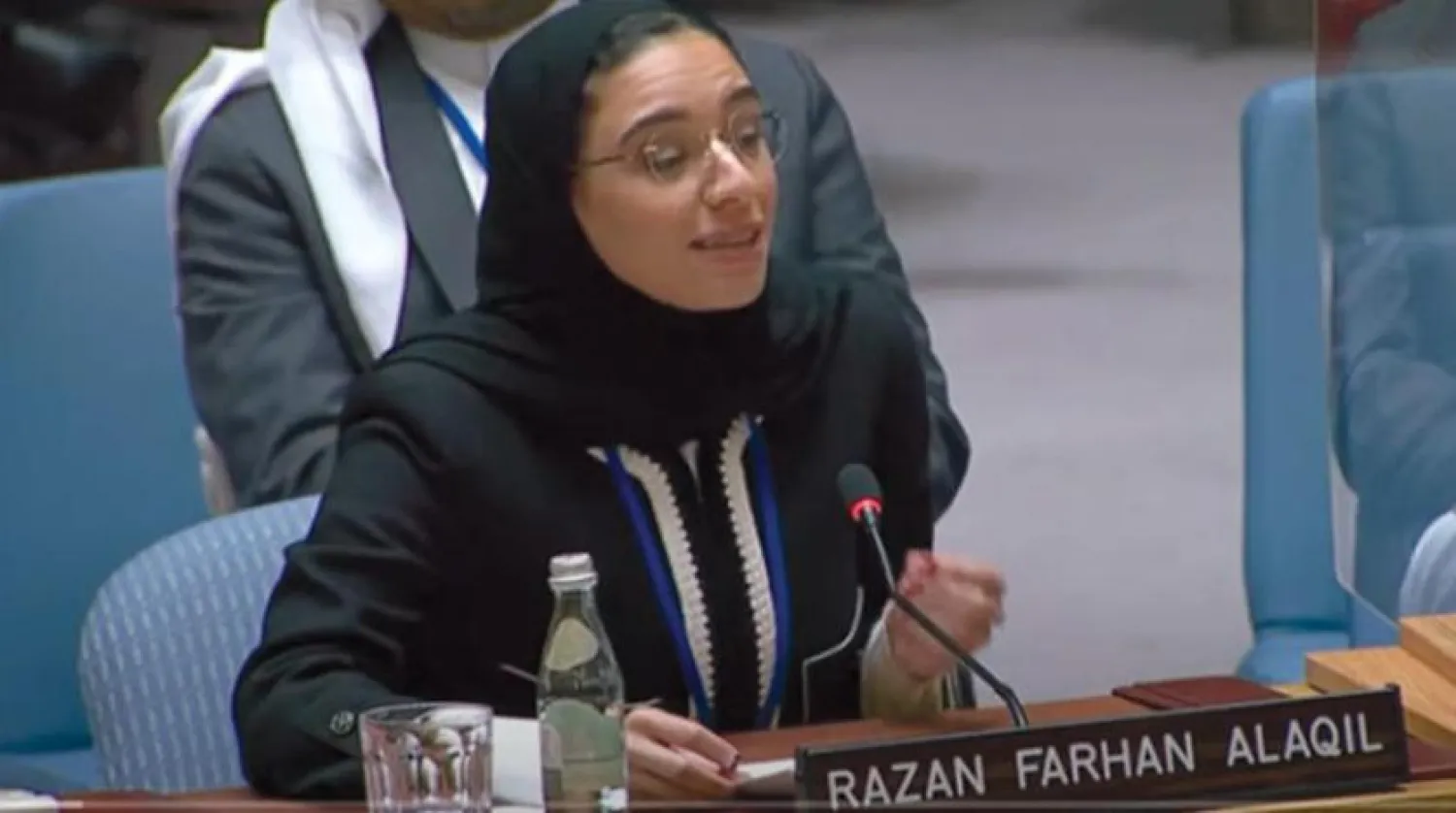
In a first-of-its-kind appearance by a Saudi girl speaking about civil society organizations at an international platform, Razan bint Farhan al-Aqil said she brings a message of peace and hope on behalf of the 100 million young people across the Middle East and North Africa, where they represent 60 percent of the population.
"The inclusion of youth means giving us a just chance based on our knowledge and our rights," she said, underscoring that youth are active members in development.
Aqil addressed major UN and global resolutions that impact the youth, the role of youth towards peace and security, and sustainable development in the region.
Speaking at the same meeting, the UAE Minister of State Khalifa Shaheen al-Marar, chairing the session, said that it was necessary to increase coordination and consultation between the Council and the League.
Marar stressed that any approach taken by the Security Council to resolve issues in the region should reflect the concerns of Arab countries and consider their views on addressing them.
Demanding an end to foreign interference in Arab affairs, he called for more efforts to strengthen the role of Arab women in peace and security issues and for the further empowerment of youth.
The minister asserted that more work is needed to combat terrorism and violent extremism and encourage peaceful coexistence among religions and cultures in the region, calling for more collaboration between the League and the UN in such crucial areas as artificial intelligence, outer space, and renewable energy.
