


Sign of Things to Come? Royals' Caribbean Tour Hit by Protests

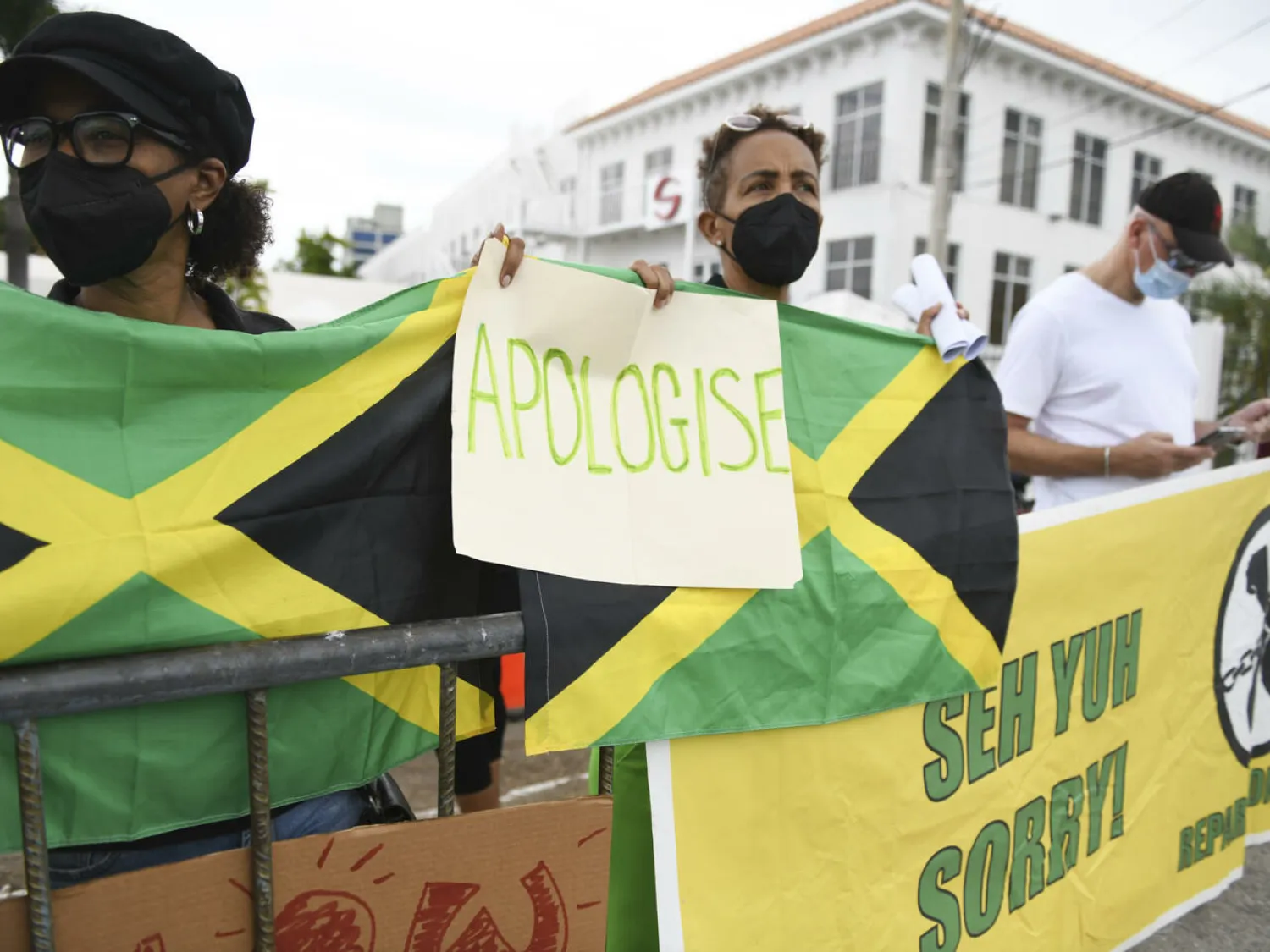
In Jamaica, Prince William and his wife Catherine faced protests for the royal family to apologize for slavery and pay reparations. Ricardo Makyn AFP
TT

Sign of Things to Come? Royals' Caribbean Tour Hit by Protests

In Jamaica, Prince William and his wife Catherine faced protests for the royal family to apologize for slavery and pay reparations. Ricardo Makyn AFP

Prince William's trip to the Caribbean was meant to help Commonwealth countries where his 95-year-old grandmother is also head of state celebrate her record-breaking 70 years on the throne.

But what were designed to be carefully choreographed photocalls and public appearances for Queen Elizabeth II's Platinum Jubilee did not go entirely to plan.

Instead, William, 39, and his wife Catherine, 40, faced calls to apologize for the slave trade that help make his ancestors' fortunes and to atone for the sins of the past.

The Bahamas National Reparations Committee said Britain's royals had benefited from the "blood, sweat and tears" of slaves and called for reparations.

Colonized lands and people had been "looted and pillaged" by the UK monarchy over centuries, leaving them under-developed in the modern age, it added.

In Jamaica, meanwhile, Prime Minister Andrew Holness pointedly told the Duke of Cambridge -- as he is formally known -- in front of television cameras that the nation was "moving on" as an independent country.

By doing so, he gave William's father Prince Charles another indication of what he could face when he is king, after Barbados became a republic last year.

On the streets of Jamaica's capital, Kingston, the Rastafarian dub poet Mutabaruka said ditching the queen would make little difference to ordinary people.

"Making Jamaica a republic will not change the price of food but it has a psychological implication on the mind and the consciousness of the people," he told the Jamaica Observer newspaper.

"It has an internal significance to how we view ourselves."

Shop owner Tameka Thomas put it more bluntly. "It's time to change now. Queen Elizabeth is queen in England, not Jamaica. She should stay in England," she told AFP.

- No apology -
British royals' pivotal role in the slave trade goes back to the 16th century, when the first queen Elizabeth sponsored one of its first major proponents, John Hawkins.

King Charles II in the 1600s encouraged the expansion of the trade and with his brother, the future king James II, invested private funds in the Royal African Company.

The company transported hundreds of thousands of men, women and children from the continent across the Atlantic. Many were branded with the company's initials.

King George III's son, who became king William IV, opposed slavery abolitionists but was unsuccessful. Britain banned the transatlantic slave trade in 1807 and in all its territories in 1833.

Modern royals have addressed slavery in the past, most recently in Barbados, when Charles called it an "appalling atrocity... which forever stains our history".

In Jamaica, William echoed his father's words, expressing his "profound sorrow" and calling the practice "abhorrent". "It should never have happened," he said.

But so far, no formal apology has been made.

The visit came as Britain increasingly confronts its colonial past, in particular its memorials to historical figures.

Last December, four people were cleared of criminal damage after a statue of a 17th century slave trader was toppled during a Black Lives Matter anti-racism protest in Bristol.

Just this week, a Cambridge University college was told its bid to remove a memorial to a donor who had links to the Royal African Company was unsuccessful.

- 'Read the room' -
For Olivette Otele, professor of the history of slavery and memory of enslavement at the University of Bristol, the protests were "not unexpected".

She noted various contentions foreshadowed the visit, including the global Black Lives Matter movement, the debate back home, and anger at treatment of Caribbean migrants who moved to Britain after World War II.

Thousands of the so-called "Windrush generation" were later wrongfully detained or deported, despite having arrived legally.

"Apologies have never been enough. They are an important step," said Otele.

"Nowadays people want to see more. They want to see change. They know there's a relationship between past and present."

But the royal family and the British government had not made that link and were not part of any meaningful conversation about how to make amends, she added.

One of numerous critics writing in the Washington Post called the visit a "colonial tour" and outdated charm offensive that was "more offensive than charming".

Otele, a vice-president of the Royal Historical Society, said the royals "need to read the room".

"Things are changing. If it (the visit) is about keeping these countries and the queen as head of state, they might not have understood there is a broader debate there," she noted.

"It's about inequalities, about poverty and the legacies of the past.

"As wonderful as the jubilee might be here, it seems awkward to expect people to celebrate without looking at what's happening there."



Iran Seizes Ships in Strait of Hormuz after Trump Halts Attacks

FILE PHOTO: A cargo ship in the Gulf, near the Strait of Hormuz, as seen from northern Ras al-Khaimah, near the border with Oman’s Musandam governance, amid the US-Israeli conflict with Iran, in United Arab Emirates, March 11, 2026. REUTERS
TT

Iran Seizes Ships in Strait of Hormuz after Trump Halts Attacks

FILE PHOTO: A cargo ship in the Gulf, near the Strait of Hormuz, as seen from northern Ras al-Khaimah, near the border with Oman’s Musandam governance, amid the US-Israeli conflict with Iran, in United Arab Emirates, March 11, 2026. REUTERS

Iran seized two ships in the Strait of Hormuz on Wednesday, tightening its grip on the strategic waterway, after US President Donald Trump called off attacks indefinitely with no sign of peace talks restarting.

Iran's semi-official Tasnim news agency said the Revolutionary Guards had seized two vessels for maritime violations and escorted them to Iranian shores. It was the first time Iran has seized ships since the war began at the end of February.

The Revolutionary Guard Corps Navy also warned that any disruption to order and safety in the strait would be considered a "red line", Tasnim said.

Earlier, a British maritime security agency reported that three ships had come under fire.

Trump said in a statement on social media late on Tuesday that the US had agreed to a request by Pakistani mediators "to hold our Attack on the Country of Iran until such time as their leaders and representatives can come up with a unified proposal ... and discussions are concluded, one way or the other."

But even as he announced what appeared to be a unilateral ceasefire extension, Trump also said he would continue the US Navy's blockade of Iran's trade by sea. The US fired on and seized an Iranian cargo vessel on Saturday and boarded a huge Iranian oil tanker on Tuesday in the Indian Ocean.

Iran considers the US blockade an act of war and has said that as long as it continues it will not lift its closure of the strait, which has caused a global energy crisis.

In a show of defiance, Iran showcased some of its ballistic weapons at a parade in Tehran on Tuesday evening, with images showing a large banner in the background with a fist choking off the strait, the WANA news agency reported.

Captions read: "Indefinitely under Iran's Control" and "Trump could not do a damn thing", referring to the waterway.

PAKISTAN STILL WORKING TO FOSTER TALKS DESPITE 'SETBACK'

Pakistan, which has acted as a mediator, was still trying to bring the sides together for negotiations after both failed to show up for last-ditch talks on Tuesday before the two-week-old ceasefire had been due to expire.

A luxury hotel in Islamabad had been cleared out for the talks, but Iran never publicly accepted the invitation and the US delegation led by Vice President JD Vance never left Washington. The hotel was still shut on Wednesday but a wider security perimeter had been loosened.

"We were all prepared for the talks, the stage was set," a Pakistani official briefed on the preparations told Reuters. "If you ask me honestly, it was a setback we were not expecting, because the Iranians never refused, they were up to come and join, and they still are."

Another Pakistani source who was involved in the talks said Pakistan was still "working very hard to bridge that conflict, talk to each side with their sensitivities in mind".

"We will know later on when they can come. Things change so often it's hard to speak on what's to come," the source said.

There was no response early on Wednesday to Trump's ceasefire announcement from senior Iranian officials, although some initial reactions from Tehran suggested Trump's comments were being treated skeptically.

Tasnim said Iran had not asked for a ceasefire extension and repeated Tehran's threats to break the US blockade by force.

An adviser to Iran's lead negotiator, the speaker of parliament Mohammad Baqer Qalibaf, said Trump's announcement might be a ploy.

Just hours before Trump called off attacks, he had repeated threats to resume them, saying his military was "raring to go".


Chief of Staff: Israel Ready ‘to Return Immediately and Forcefully’ to Fighting on All Fronts

Israel's military chief Lieutenant General Eyal Zamir speaks during the funeral of Lieutenant Hadar Goldin who was killed during the six-week 2014 war in Gaza, in a military cemetery in Kfar Saba on November 11, 2025. (Photo by Abir SULTAN / POOL / AFP)
TT

Chief of Staff: Israel Ready ‘to Return Immediately and Forcefully’ to Fighting on All Fronts

Israel's military chief Lieutenant General Eyal Zamir speaks during the funeral of Lieutenant Hadar Goldin who was killed during the six-week 2014 war in Gaza, in a military cemetery in Kfar Saba on November 11, 2025. (Photo by Abir SULTAN / POOL / AFP)

Israeli Chief of Staff Lt. Gen. Eyal Zamir said Wednesday that the military remained on high alert and was ready to return to fighting on all fronts, amid the fragile truces in Iran and Lebanon.

“Since the inferno of October 7, we have been working to reestablish our military strength through continuous fighting,” Zamir said while addressing soldiers honored at an Independence Day ceremony at the President’s Residence.

The Times of Israel quoted Zamir as saying that in Gaza, the Israeli military “prevailed in the fight against Hamas.”

“At this very moment, we are conducting intense fighting in Lebanon to strengthen the defense of the northern communities,” he stated.

“So too in the fighting against Iran in Rising Lion and Roaring Lion,” he said, referring to the June 2025 war with Iran and the latest 40-day conflict with Iran.

The Israeli military is on high alert and “prepared to return immediately and forcefully to combat in all sectors,” Zamir added.

Israeli Foreign Minister Gideon Saar called on Lebanon to work with Israel to disarm the Iranian-backed militant group Hezbollah ahead of negotiations in Washington on Thursday.

The meeting follows a similar gathering last week in Washington, and is the first time in decades the two countries are speaking directly.


NATO ‘Will Always Defend’ Türkiye, Says Rutte

A handout photo made available by the Turkish Defense Ministry Press Office shows Turkish Defense Minister Yasar Guler (R) and North Atlantic Treaty Organization (NATO) Secretary General Mark Rutte (L) shaking hands during a meeting in Ankara, Türkiye, 21 April 2026. (EPA/Turkish Defense Ministry/Handout)
TT

NATO ‘Will Always Defend’ Türkiye, Says Rutte

A handout photo made available by the Turkish Defense Ministry Press Office shows Turkish Defense Minister Yasar Guler (R) and North Atlantic Treaty Organization (NATO) Secretary General Mark Rutte (L) shaking hands during a meeting in Ankara, Türkiye, 21 April 2026. (EPA/Turkish Defense Ministry/Handout)

NATO chief Mark Rutte said on Wednesday the alliance would do "what's necessary to defend" its members including Türkiye after intercepting four missiles fired from Iran and head into Turkish air space over the past weeks.

A member of the US-led defense alliance, Türkiye, which borders Iran, has been largely spared the sort of retaliation from Tehran suffered by countries in the Middle East before the ceasefire.

NATO forces had shot down ballistic missiles fired from Iran for four times, prompting the alliance to deploy a new Patriot missile battery at Incirlik air base in southern Türkiye.

"Iran is spreading terror and chaos, and you feel this prominently here in Türkiye," Rutte told journalists on a visit to Türkiye’s largest defense electronics company Aselsan.

"In recent weeks, NATO has successfully intercepted ballistic missiles heading to Türkiye from Iran on four separate occasions," he said.

"NATO is prepared for such threats and will always do what is necessary to defend Türkiye and all others. And we cannot do it alone," he added.

Rutte's visit comes ahead of a July summit by NATO leaders to be held in Ankara.

Praising the progress made by Türkiye in the defense field, Rutte said: "We can learn a lot from what Türkiye is doing here".

"This is needed because we live in a more dangerous world... and that means we need strong defenses to protect our security".

Rutte said: "Türkiye has gone through a defense industrial revolution. I could really say it's a revolution in recent years."

The NATO chief is due to meet with President Recep Tayyip Erdogan.