


Shelled City in North Ukraine Fears Becoming 'Next Mariupol'

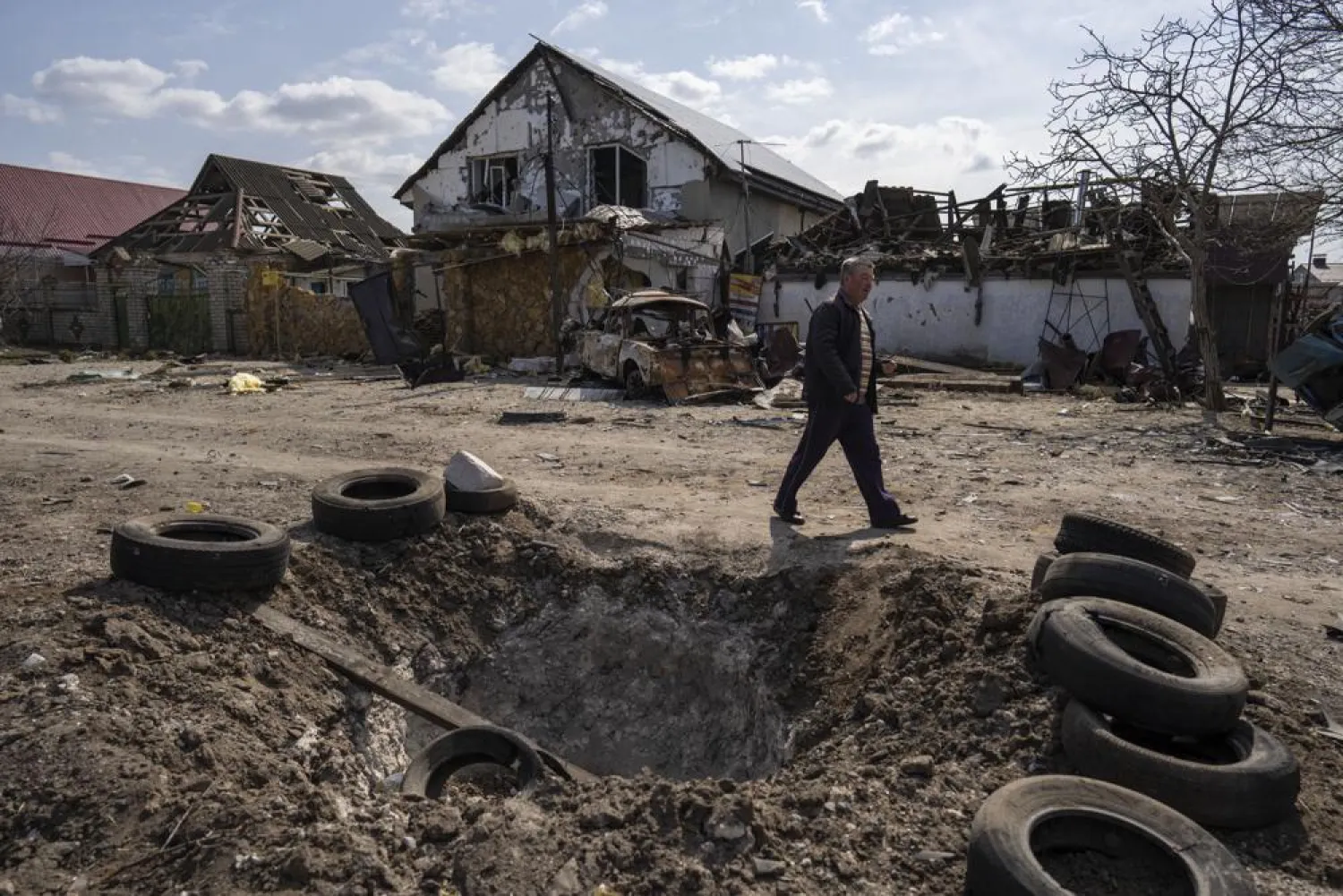
A man walks behind a crater created by a bomb and in front of damaged houses following a Russian bombing earlier this week, outskirts Mykolaiv, Ukraine, Friday, 25, 2022.(AP)
TT

Shelled City in North Ukraine Fears Becoming 'Next Mariupol'

A man walks behind a crater created by a bomb and in front of damaged houses following a Russian bombing earlier this week, outskirts Mykolaiv, Ukraine, Friday, 25, 2022.(AP)

Like many residents of Ukraine's besieged city of Chernihiv, linguistics scholar Ihar Kazmerchak spends his nights in a bomb shelter and starts his day lining up for the little potable water authorities have left to hand out.

Surrounded by Russian forces and under constant bombardment, the northern city known for its eclectic monasteries has no electricity, heating or running water. The lists at pharmacies of the medicines no longer available grow longer by the day.

“In basements at night, everyone is talking about one thing: Chernihiv becoming next Mariupol,” Kazmerchak, 38, said, referring to the southern port city 845 kilometers (525 miles) away that has suffered some of the worst horrors since Russia invaded Ukraine.

The fear is not misplaced. Russian bombs destroyed Chernihiv's main bridge over the Desna River on the road leading to Kyiv on Wednesday; on Friday, artillery shells rendered the remaining pedestrian bridge impassable, cutting off the last possible route for people to get out or for food and medical supplies to get in.

Just over a month into the invasion, Russia's attack has slowed into a grinding war of attrition as its military tries to pound cities like Chernihiv into submission. Bombings of hospitals and other non-military sites, such as the Mariupol theater where Ukrainian officials said a Russian airstrike is believed to have killed some 300 people last week, have given rise to war crime allegations.

Questions about the direction of Russia's offensive surfaced Friday when a high-ranking military official said the main objective of the first stage of the operation — reducing Ukraine’s fighting capacity — had “generally been accomplished.” Col.-Gen Sergei Rudskoi, deputy chief of the Russian general staff, said Russian forces could now focus on “the main goal, the liberation of Donbas.”

Donbas is the largely Russian-speaking eastern region where Russian-backed separatists have been fighting Ukrainian forces since 2014 and where many residents desire close ties to Moscow. Mariupol is located there, although outside of the two territories controlled by the separatists.

US officials said Russian troops appeared to have halted for now their ground offensive aimed at capturing the capital, Kyiv, and were concentrating more on gaining control of the Donbas region in the country’s southeast.

However, British defense officials reported Saturday that the Russian military continues to besiege a number of other major Ukrainian cities, including Chernihiv, which is located 146 kilometers (91 miles) from Kyiv.

“It is likely Russia will continue to use its heavy firepower on urban areas as it looks to limit its own already considerable losses, at the cost of further civilian casualties,” the UK Ministry of Defense said in its latest intelligence briefing on the war.

Ukrainian President Volodymyr Zelenskyy, appearing by video-link at Qatar's Doha Forum, on Saturday compared the destruction of Mariupol to the Syrian and Russian destruction wrought on the city of Aleppo.

“They are destroying our ports,” Zelenskyy said. “The absence of exports from Ukraine will deal a blow to countries worldwide.”

He called on countries to increase their exports of energy to give European nations an alternative to Russian oil and gas.

“The future of Europe rests with your efforts,” he said.

In Kyiv, ashes of the dead are piling up at the main crematorium because so many relatives have left, leaving urns unclaimed. For civilians who decided to stay or have been unable to leave under constant shelling, the misery is growing more severe.

In Yasnohorodka, a village some 50 kilometers (30 miles) west of Kyiv that Russian troops who occupied earlier in the week, appeared to have been pushed out as part of a counteroffensive by Ukrainian forces. Houses on the main crossroads lay in ruins. The tower of the village church was damaged.

“You can see for yourself what happened here. People were killed here. Our soldiers were killed here,” Yasnohorodka resident Valeriy Puzakov said.

In Chernihiv, hospitals are no longer operating, and residents cook over open fires in the street because the power is out.

Chernihiv Mayor Vladyslav Atroshenko has said that more than half of the city’s 280,000 residents fled amid the unrelenting attack.

Russian forces, he told Ukrainian television, “are deliberately destroying civilian infrastructure – schools, kindergartens, churches, residential buildings and even the local football stadium.”

It has been impossible to count the dead, but Atroshenko estimated the figure was “in the hundreds.”

Located only about 70 kilometers (45 miles) from the border with Belarus on the road to Kyiv, Chernihiv was attacked in the early days of the war and encircled by Russian troops this month, but its defenders so far have prevented a takeover.

“Chernihiv has become a symbol of the Russian army’s failed blitzkrieg, in which the plan was to take the city over in one day and advance towards Kyiv,” Mykola Sunhurovskyi, a military analyst at the Kyiv-based Razumkov Center think tank, said.

Kazmerchak started spending his night in a bomb shelter after a Russian bomb hit the Stalin-era movie theater next to the 12-story residential building where he lived. A Russian missile also destroyed the hotel not far from his house.

“The walls were shaking so much that I thought my house would collapse any minute and I would be left under the rubble,” Kazmerchak said.

Dwindling supplies led to long lines out of the few grocery stores that still had food. Shelling killed 10 civilians on March 16 as they waited outside to buy bread. Residents hunkered down and stayed home, but as the siege endures, some have given up on trying to stay safe, Kazmerchak said.

“Ravaged houses, fires, corpses in the street, huge aircraft bombs that didn’t explode in courtyards are not surprising anyone anymore,” he said. “People are simply tired of being scared and don’t even always go down to the basements.”




UK Foreign Minister to Meet Rubio amid Tensions over Joint Air Base

British Foreign Secretary Yvette Cooper, president of the United Nations Security Council for February speaks during a press conference before the Security Council meeting, at UN headquarters in New York City, US, February 19, 2026. REUTERS/Jeenah Moon
TT

UK Foreign Minister to Meet Rubio amid Tensions over Joint Air Base

British Foreign Secretary Yvette Cooper, president of the United Nations Security Council for February speaks during a press conference before the Security Council meeting, at UN headquarters in New York City, US, February 19, 2026. REUTERS/Jeenah Moon

Britain's foreign minister Yvette Cooper ‌will meet with US Secretary of State Marco Rubio on Friday, after President Donald Trump renewed his criticism of London for ceding sovereignty of ​the Chagos Islands, which is home to a US-UK air base.
Last year, British Prime Minister Keir Starmer agreed a deal to transfer sovereignty of the Indian Ocean islands to Mauritius, while keeping control of one - Diego Garcia - through a 99-year lease that preserved US operations at the base, Reuters said.
Washington last year gave its blessing to the agreement, but Trump has since ‌changed his mind ‌several times. In January, Trump described it ​as ‌an ⁠act ​of "great stupidity", ⁠but earlier this month said he understood the deal was the best Starmer could make, before then renewing his criticism this week.
Cooper is meeting Rubio to discuss defense and security issues in Washington as Trump also toughens his rhetoric on Iran, saying Tehran must make a deal over its nuclear program in the ⁠next 10 to 15 days, or "really bad ‌things" will happen.
The Diego Garcia ‌base has recently been used for ​operations in the Middle East against ‌Yemen's Houthis and in humanitarian aid to Gaza.
Although on Tuesday ‌Rubio's State Department said it backed the Chagos accord, the next day Trump said Britain was making a big mistake.
"DO NOT GIVE AWAY DIEGO GARCIA!" Trump wrote in a post on Truth Social, saying the ‌base could be called upon in any future military operation to "eradicate a potential attack" from ⁠Iran.
Under the ⁠conditions for using the joint base, Britain would need to agree in advance to any operations out of Diego Garcia.
On Thursday, Britain's The Times newspaper reported that Trump's latest criticism of the Chagos deal came because Britain was yet to give permission to use the bases for future strikes against Iran, owing to concerns they may breach international law.
Asked about The Times report, Britain's Ministry of Defence said on Thursday it does not comment on operational matters and that Britain supported ​the ongoing political process between ​the US and Iran.


Turkish Police Detain Deutsche Welle Journalist over Social Media Posts

19 February 2026, Canada: Deutsche Welle (DW) logo is seen displayed on a smartphone screen. Photo: Thomas Fuller/SOPA Images via ZUMA Press Wire/dpa
TT

Turkish Police Detain Deutsche Welle Journalist over Social Media Posts

19 February 2026, Canada: Deutsche Welle (DW) logo is seen displayed on a smartphone screen. Photo: Thomas Fuller/SOPA Images via ZUMA Press Wire/dpa

Turkish police have detained investigative journalist Alican Uludag on suspicion of insulting President Recep Tayyip Erdogan and spreading misinformation, sparking outrage among journalism groups.
Uludag, who works for German broadcaster Deutsche Welle’s Turkish service, was taken from his home in Ankara late Thursday as part of an investigation into social media posts. The Istanbul Chief Prosecutor’s Office said he is suspected of “insulting the president” and “disseminating misleading information.”
The journalist, whose reporting focuses mainly on the judiciary and on corruption cases, was later transferred to Istanbul for questioning.
His detention drew sharp condemnation from press freedom advocates, who described it as an attack on media independence and democratic norms, The Associated Press said.
Deutsche Welle’s director‑general, Barbara Massing, demanded his release, calling the arrest “a deliberate act of intimidation.”
On Friday, journalists gathered outside Istanbul’s Çaglayan Courthouse to protest Uludag’s detention and to call for his immediate release.
The advocacy group, Reporters Without Borders considers Türkiye to be one of the most repressive countries for journalists, nothing that most media organizations are under government control and journalists face frequent legal pressure or intimidation.
At least 14 journalists or media sector workers are currently in prison, according to the Turkish Journalists Syndicate.


South Korea’s Ex-President Yoon Apologizes After Life Sentence Over Martial Law 

South Korean President Yoon Suk Yeol  delivers a speech to declare martial law in Seoul, South Korea, December 3, 2024. (The Presidential Office/Handout via Reuters/File Photo)
South Korean President Yoon Suk Yeol delivers a speech to declare martial law in Seoul, South Korea, December 3, 2024. (The Presidential Office/Handout via Reuters/File Photo)
TT

South Korea’s Ex-President Yoon Apologizes After Life Sentence Over Martial Law 

South Korean President Yoon Suk Yeol  delivers a speech to declare martial law in Seoul, South Korea, December 3, 2024. (The Presidential Office/Handout via Reuters/File Photo)
South Korean President Yoon Suk Yeol delivers a speech to declare martial law in Seoul, South Korea, December 3, 2024. (The Presidential Office/Handout via Reuters/File Photo)

Former ‌South Korean President Yoon Suk Yeol apologized on Friday for his short-lived declaration of martial law in December 2024, a day after a Seoul court sentenced him to life in prison for masterminding an insurrection.

In a statement released by his lawyers, Yoon said that while he was sorry for the "frustration and hardship" brought upon the people by his martial law decree, he stood behind the "sincerity and purpose" behind his actions.

The Seoul Central District Court's decision ‌to hand him ‌a life sentence on Thursday was "predetermined," he ‌said, ⁠adding that the verdict ⁠against him was political retaliation.

"Forces that seek to smear a decision made to save the nation as an 'insurrection' and to use it beyond political attacks as an opportunity to purge and eliminate their opponents will only grow more rampant going forward," he said.

Yoon also questioned ⁠whether an appeal would have meaning ‌in what he described as an ‌environment where judicial independence could not be guaranteed, while telling ‌supporters to "unite and rise."

His lawyers separately said the statement ‌did not amount to an intention to forgo an appeal.

Yoon's martial law declaration lasted around six hours before being voted down by parliament, but it sent shockwaves through the country and ‌sparked street protests.

The court found Yoon guilty of subverting constitutional order by deploying troops ⁠to storm ⁠parliament and move to detain opponents, capping a dramatic fall that saw him stripped of office and end up behind bars.

Yoon, a former career prosecutor, denied the charges, arguing he had presidential authority to declare martial law and his action was aimed at sounding the alarm over opposition parties' obstruction of government.

A special prosecutor had sought the death penalty for Yoon, though South Korea has not carried out an execution since 1997.

A prosecutor said on Thursday the team had some "regret" over the sentencing, but declined to say whether they planned to appeal.