


Developing Human Capital in the Saudi Industrial Field

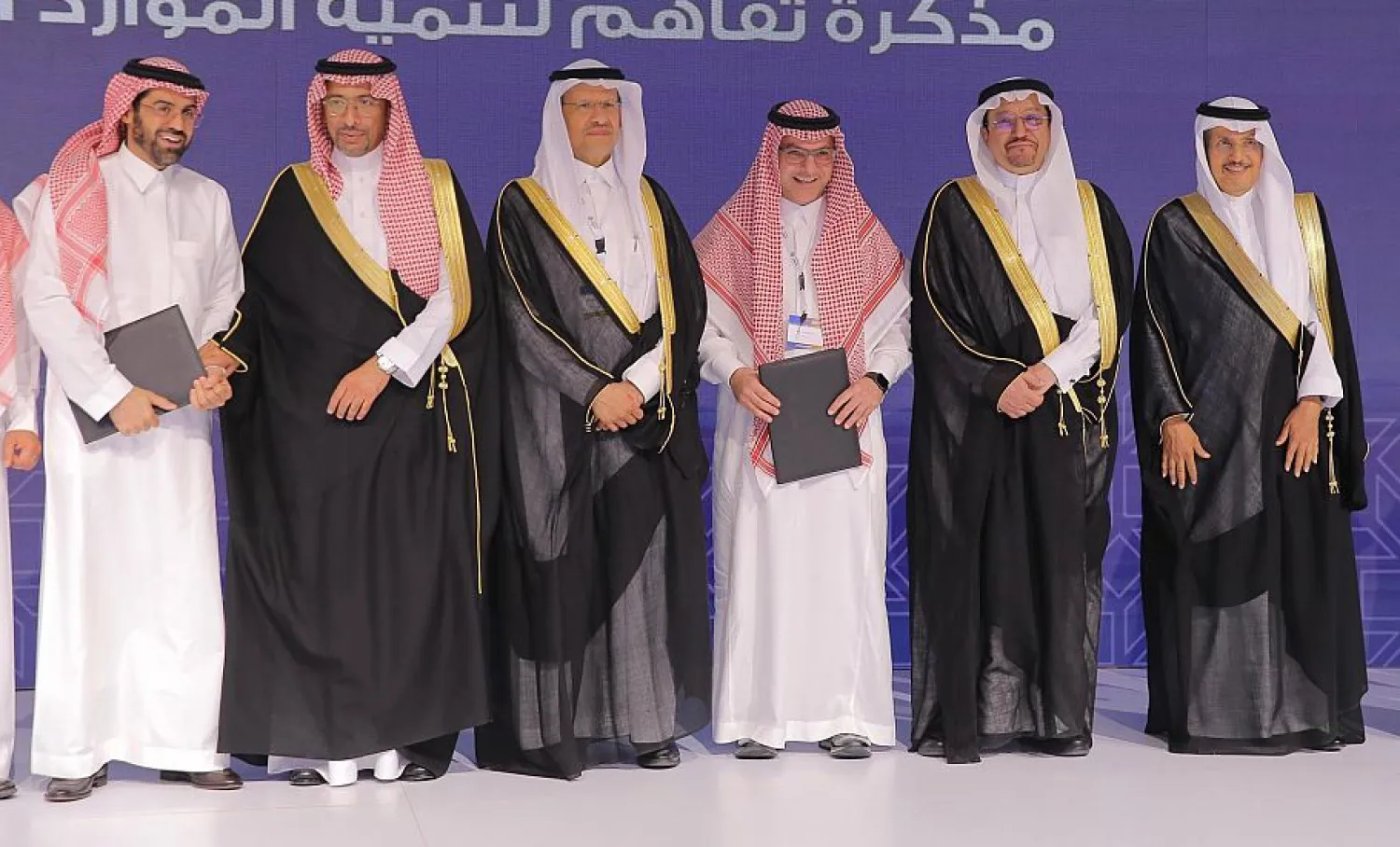
Saudi officials after signing a memorandum of cooperation to develop human capital in the industrial field (Asharq Al-Awsat)
TT

Developing Human Capital in the Saudi Industrial Field

Saudi officials after signing a memorandum of cooperation to develop human capital in the industrial field (Asharq Al-Awsat)

The Saudi Industrial Investments Company (Dussur), in cooperation with the Human Resources Development Fund (Hadaf), seeks to develop human capital in the industrial field, unify efforts, enhance collaboration in finding solutions, and address the challenges facing national cadres in the sector.

Dussur signed a memorandum of cooperation with Hadaf in the presence of Minister of Energy Prince Abdulaziz bin Salman bin Abdulaziz, Minister of Industry and Mineral Resources Bandar al-Khorayef, Minister of Education Hamad al-Sheikh, and several officials.

The memorandum of cooperation stipulated the development of human capital to serve the industrial field, identify training needs, and provide support programs in line with them.

It also launched initiatives to qualify job seekers with skills, most notably the basics of employment, technical, engineering, and professional skills, designing and implementing activities related to employment in the sector.

Crown Prince Mohammad bin Salman launched the Human Capacity Development Program to develop human capabilities and achieve the objectives of Vision 2030.

The Program aims to ensure that citizens have the required capabilities to compete globally by instilling values, developing primary and future skills, and enhancing knowledge.

It seeks to develop a solid educational base for all citizens and instill values early on while preparing the youth for the future local and global labor market.

It also focuses on upskilling citizens by providing lifelong learning opportunities, supporting innovation and entrepreneurship culture, and developing and activating policies to ensure Saudi competitiveness.

The Crown Prince stressed that the Human Capability Development Program represents a national strategy to enhance the competitiveness of national human capabilities locally and globally to be ready for the current and future labor market with abilities and ambitions.

The Program aims to ensure that citizens have the required capabilities to compete globally by instilling values, developing primary and future skills, and enhancing knowledge.

It includes 89 initiatives aimed at achieving 16 strategic objectives of Vision 2030.

The strategy includes three main pillars: develop a resilient and robust educational base, prepare for the future labor market locally and globally, and provide lifelong learning opportunities.

The Program's initiatives will include promoting the expansion of kindergartens, which will help to develop a resilient and robust educational base for all children. It entails career guidance and counseling initiative as well to provide citizens with the capabilities and skills necessary to plan their career objectives.

Human capacity development focuses on preparing and rehabilitating human capabilities in Saudi Arabia, developing the human capacity development system from early childhood to lifelong learning, developing education outputs to align them with the needs of the current and future labor market, and localizing high-skilled jobs through the rehabilitation and training of citizens, in addition to activating.

The Program will aim to achieve several goals, including increasing kindergarten enrollment from 23 percent to 90 percent and placing two Saudi universities among the top 100 universities in the world by 2030.



Saudi Arabia Achieves 2nd Position Globally in ITU’s Digital Regulatory Maturity Index 2025

Saudi Arabia Achieves 2nd Position Globally in ITU’s Digital Regulatory Maturity Index 2025
TT

Saudi Arabia Achieves 2nd Position Globally in ITU’s Digital Regulatory Maturity Index 2025

Saudi Arabia Achieves 2nd Position Globally in ITU’s Digital Regulatory Maturity Index 2025

The International Telecommunication Union (ITU) announced that the Kingdom of Saudi Arabia has ranked second globally in the Digital Regulatory Maturity Index 2025, placing just behind Germany among 193 countries, and maintaining its position in the highest “Leading” category of the global classification, according to a press release issued by the Communications, Space and Technology Commission (CST).

CST Acting Governor Eng. Haitham bin Abdulrahman Alohali stated that this achievement is the result of the support and enablement of the wise leadership, alignment of national digital economy directions with international multi-stakeholder initiatives, and strong collaboration between public and private sector entities through cooperative and participatory regulation, SPA reported.

He added that the Kingdom’s progress was further driven by adopting regulatory policies based on measuring social and economic impact, launching digital inclusion programs to empower all segments of society, implementing policies that promote development and innovation across sectors such as science, agriculture, and finance, and joining the Tampere Convention to facilitate the provision of telecommunications resources for disaster mitigation.

Alohali highlighted that attaining the highest “Leading” maturity level has contributed to accelerating the growth of Saudi Arabia’s digital economy, expanding the telecom and technology market, stimulating competition, attracting investment, and strengthening the Kingdom’s leading and active role within the ITU.

The release added that this achievement reflects the efforts led by CST in collaboration with the National Regulatory Committee, Ministry of Communications and Information Technology, Ministry of Health, Ministry of Education, Ministry of Economy and Planning, Ministry of Environment, Water and Agriculture, Digital Government Authority, Saudi Central Bank, Saudi Data and Artificial Intelligence Authority, Transport General Authority, General Authority of Media Regulation, National Cybersecurity Authority, Saudi Water Authority, Saudi Electricity Regulatory Authority, General Authority for Competition, and Consumer Protection Association.


Saudi Arabia's STC in Joint Venture with Humain to Advance Data Center Buildout

A man passes the Saudi Telecom STC office in Riyadh, Saudi Arabia, February 6, 2018. (Reuters)
TT

Saudi Arabia's STC in Joint Venture with Humain to Advance Data Center Buildout

A man passes the Saudi Telecom STC office in Riyadh, Saudi Arabia, February 6, 2018. (Reuters)

Saudi Arabia's largest telecoms operator STC on Thursday announced a joint venture with the kingdom's artificial intelligence company Humain to develop and operate data centers.

The companies signed a memorandum of understanding to establish the venture, in which Humain will hold a 51% stake, while STC will own 49%, Reuters reported.

Humain, an AI company backed by Saudi Arabia's sovereign wealth fund PIF, has secured several agreements including deals with Elon Musk's xAI and Blackstone-backed AirTrunk for data center projects in the country, and is targeting a capacity of about 6 gigawatts by 2034.
The joint venture will aim to develop infrastructure capable of supporting operations with a required load of up to 1 gigawatt, beginning with an initial deployment of up to 250 megawatts.


Oil Prices Edge Up After Reports of Possible US Sanctions on Russia, Venezuela Blockade

FILE - Pump jacks extract oil from beneath the ground in North Dakota, May 19, 2021. (AP Photo/Matthew Brown, File)
TT

Oil Prices Edge Up After Reports of Possible US Sanctions on Russia, Venezuela Blockade

FILE - Pump jacks extract oil from beneath the ground in North Dakota, May 19, 2021. (AP Photo/Matthew Brown, File)

Oil prices rose slightly on Thursday as investors assessed the likelihood of further US sanctions against Russia and the supply risks posed by a blockade of Venezuelan oil tankers.

Brent crude rose 32 cents or 0.54% to $60 per barrel at 0910 GMT. US West Texas Intermediate crude was up 38 cents, or 0.68%, at $56.32 per barrel.

US intentions to impose more sanctions against Russia and its threatened blockade of tankers under sanctions and carrying Venezuelan oil pushed prices higher, PVM analyst John Evans said.

On Wednesday, Bloomberg reported that the US is preparing another round of sanctions on Russia's energy sector in the event Moscow does not agree to a peace deal with Ukraine, citing people familiar with the matter. A White House official told Reuters President Donald Trump had not made any decisions on Russian sanctions. Further measures targeting Russian oil could pose an even bigger supply risk to the market than Trump's announcement on Tuesday that the US would blockade tankers under sanctions entering and leaving Venezuela, ING analysts said in a note.

The Venezuela blockade could affect 600,000 barrels per day of Venezuelan oil exports, mostly to China, but 160,000 bpd of exports to the US would likely continue, ING said. Chevron vessels were continuing to depart for the US under a previous authorisation from the US government.

Most other Venezuelan exports remained on hold on Wednesday, although state oil company PDVSA restarted loading crude and fuel cargoes after suspending operations because of a cyberattack, sources and customs data indicated.

It was not clear how a US blockade would be enforced. The US Coast Guard last week took the unprecedented step of seizing a Venezuelan oil tanker and sources said the US was preparing for more such interdictions.

Venezuelan crude makes up around 1% of global supplies.