

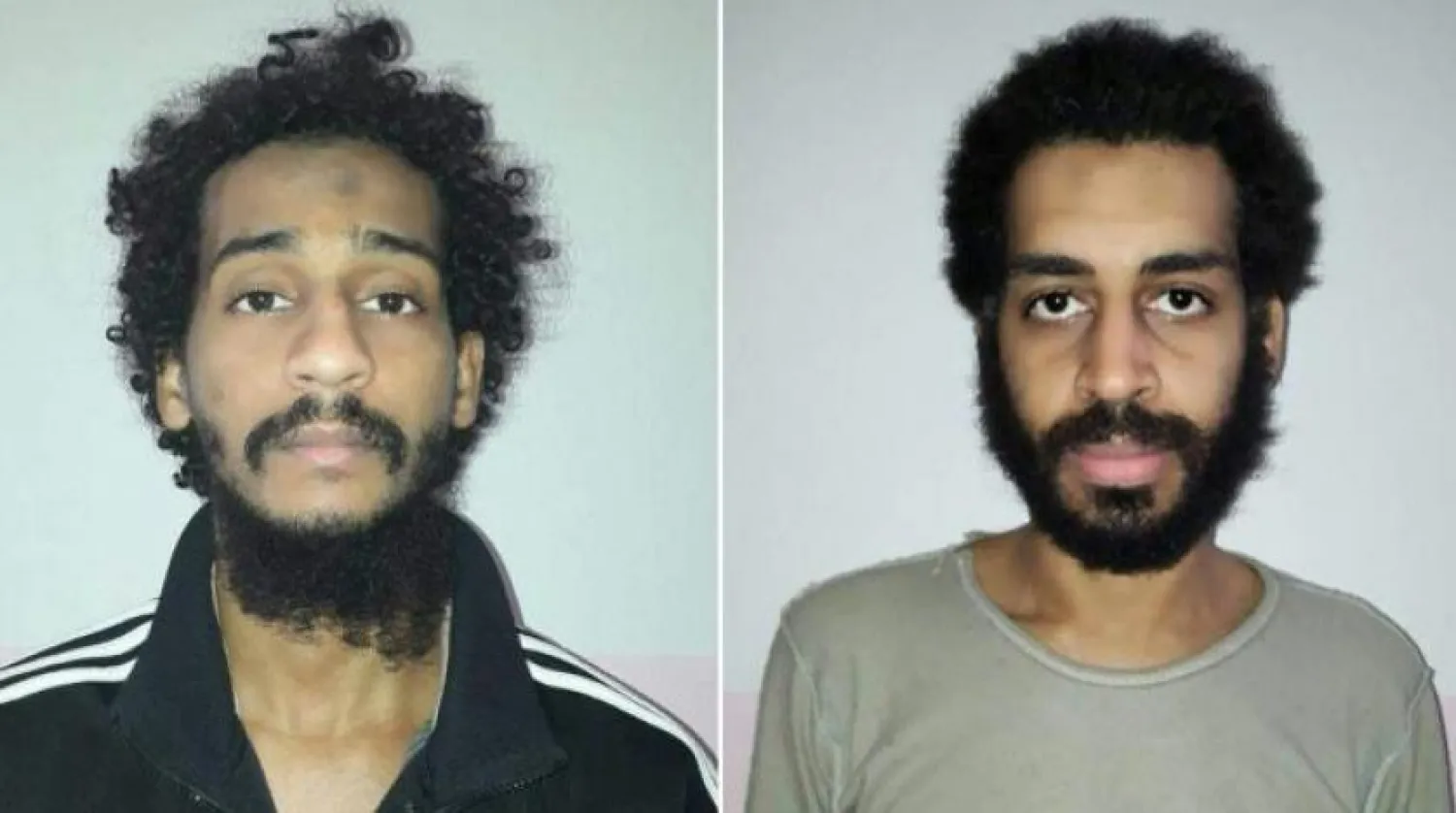

US Prosecutors Rest Case Against ISIS ‘Beatle’

Londoners Alexanda Kotey and El Shafee Elsheikh, who are suspected of being members of the ISIS group nicknamed 'The Beatles' and were captured last month, were believed to be among those stripped of their UK citizenship. PHOTO: GettyImages
TT

US Prosecutors Rest Case Against ISIS ‘Beatle’

Londoners Alexanda Kotey and El Shafee Elsheikh, who are suspected of being members of the ISIS group nicknamed 'The Beatles' and were captured last month, were believed to be among those stripped of their UK citizenship. PHOTO: GettyImages

Prosecutors rested their case Tuesday against an alleged member of the notorious ISIS kidnap-and-murder cell known as the "Beatles."

El Shafee Elsheikh, 33, declined the opportunity to testify in his own defense at his trial in a federal court in Alexandria, Virginia.

Asked by Judge T.S. Ellis if he wanted to take the stand, Elsheikh said "No," the first time his voice had been heard during the two-week trial.

Elsheikh is charged with the murders of American freelance journalists James Foley and Steven Sotloff and aid workers Kayla Mueller and Peter Kassig, and suspected of the kidnapping of nearly 20 other Westerners in Syria.

Ten European journalists, relief workers and Syrians held hostage by the "Beatles" have testified over the past few days of their brutal treatment at their captors' hands.

Elsheikh's lawyers declined to cross-examine any of the witnesses and presented only 20 minutes of excerpts from interviews he gave to media outlets as his defense.

The interviews were conducted after Elsheikh and another alleged "Beatle," Alexanda Amon Kotey, were captured in January 2018 by a Kurdish militia in Syria, according to AFP.

Unlike now, Elsheikh acknowledged in the interviews that he had interactions with the Western hostages, who dubbed the hostage-takers the "Beatles" because of their British accents.

Elsheikh's lawyers contend that he lied about being a "Beatle" in the interviews so he would be transferred to the United States instead of being put on trial in Iraq, where he would have faced a certain death sentence.

The final former hostage to testify was Danish photographer Daniel Rye Ottosen, who recounted how he was given 25 blows for his 25th anniversary.

He also recalled having a knife placed against his throat and a gun thrust into his mouth.

The prosecution and defense are to deliver their closing arguments on Wednesday, and the case will go to the jury.

Foley, Sotloff and Kassig were killed by their ISIS jailers and videos of their murders released for propaganda purposes.

According to witnesses and her family, Mueller -- the other American -- was turned over to ISIS leader Abu Bakr al-Baghdadi, who raped her repeatedly.

ISIS announced her death in February 2015 and said she was killed in a Jordanian airstrike, a claim that was disputed by US authorities.

Elsheikh and Kotey were turned over to US forces in Iraq following their capture.

They were flown to Virginia in 2020 to face charges of hostage-taking, conspiracy to murder US citizens and supporting a terrorist organization.

Kotey pleaded guilty in September 2021 and is facing life in prison.

The other "Beatle," Mohamed Emwazi, the notorious executioner known as "Jihadi John," was killed by a US drone strike in Syria in 2015.



Detained Russia-Linked Tanker Arrives in France

The Russian oil tanker "Tagor", suspected of flying a false Cameroonian flag and boarded by the French Navy on May 31, 2026, arrives in Douarnenez Bay, western France on June 2, 2026. (AFP)
TT

Detained Russia-Linked Tanker Arrives in France

The Russian oil tanker "Tagor", suspected of flying a false Cameroonian flag and boarded by the French Navy on May 31, 2026, arrives in Douarnenez Bay, western France on June 2, 2026. (AFP)

An oil tanker believed to be part of Russia's "shadow fleet" sailed into a French harbor Tuesday, an AFP reporter said, after the French navy detained it on suspicion of flying a false flag.

It is the fourth such ship that France has seized since September last year on suspicions of belonging to the "shadow fleet," which Russia is believed to use to circumvent Western sanctions.

The French navy boarded the Tagor on Sunday morning in international waters with the help of Britain, after its Russian captain refused to comply with orders, French authorities said.

The Kremlin likened the seizure to "international piracy".

The Tagor sailed into the Bay of Douarnenez in western France's region of Brittany on Tuesday morning, the AFP reporter said.

Suspected of carrying Russian or Iranian oil despite international sanctions, the Tagor is linked to petroleum shipping magnate Mohammad Hossein Shamkhani, according to open-source database Opensanctions.org.

Shamkhani is the son of security official Ali Shamkhani, who was an adviser to the former Iranian supreme leader Ali Khamenei, both of whom were killed on February 28, the first day of the US-Israeli attacks that started the Middle East war.

According to French authorities, the Tagor was on its way from Murmansk in northwestern Russia when it was boarded.

It was falsely flying a Cameroonian flag and was heading toward Limbe, a seaside city in the west of the African country, they added.

- Flag-hopping -

"Shadow fleet" vessels frequently change the flags they fly, a practice known as flag-hopping, or use invalid registrations in an attempt to escape tracking.

France previously detained two tankers in the Mediterranean, the Deyna in March and the Grinch in January, but they were allowed to set sail after paying fines.

In another case, a French court in March issued a one-year jail sentence in absentia and a 150,000-euro ($177,000) fine against the Chinese captain of another tanker, the Boracay, for failing to comply with orders to stop his ship in September last year off the coast of Brittany.

In April, France announced a plan to double penalties for ships that fail to fly a flag or refuse to comply.

Several Western countries have imposed sanctions on hundreds of vessels believed to be part of Russia's "shadow fleet" over its 2022 invasion of Ukraine.

Nearly 600 ships suspected of belonging to the fleet are subject to European Union sanctions.


EU Strikes Migration Deal for More Deportations and Detention Centers Abroad

Migrants walk away from the beach after a failed attempt to cross the English Channel to reach Britain, from Petit-Fort-Philippe beach in Gravelines, near Calais, France, September 27, 2025. Abdul Saboor, Reuters
TT

EU Strikes Migration Deal for More Deportations and Detention Centers Abroad

Migrants walk away from the beach after a failed attempt to cross the English Channel to reach Britain, from Petit-Fort-Philippe beach in Gravelines, near Calais, France, September 27, 2025. Abdul Saboor, Reuters

The European Union has moved forward with a vast overhaul of its migration policy, aiming to ramp up deportations and ink controversial deals to build detention centers abroad, in what rights groups compare to the Trump administration's aggressive immigration policies.

“The new regulation will speed up the return process and increase returns of persons who have no legal right to stay in the EU,” said Nicholas Ioannides, deputy migration minister for Cyprus, which holds the rotating presidency of the 27-nation bloc, The Associated Press said.

The deal was struck between the EU's three main institutions — the European Commission, the European Council and European Parliament — during a so-called “trilogue” Monday evening.

Critics compared the regulation to the immigration strategy of the Trump administration, which has struck a series of secretive agreements with nations around the world to deport thousands of people to other countries. The United Kingdom also planned to deport migrants to Rwanda, but the plan was bogged down in legal red tape and the new government dropped the plan as soon as it came into power.

"The Regulation is going to create a draconian detention and deportation machine,” said Silvia Carter, spokesperson for the Brussels-based Platform for International Cooperation on Undocumented Migrants.

“Across the Atlantic, we see the violence and fear created by ICE’s brutal immigration enforcement. Europe should be learning from the harms of that model, not building its own version of it.”

The provisional agreement will now head to the EU lawmakers and heads of state, where approval will likely be swift.

EU member nations will soon be able to set up bilateral deals with countries outside the bloc to build deportation centers. At least five EU nations — Germany, Austria, the Netherlands, Denmark and Greece — are already in talks with third countries, mostly in Africa, to host “return hubs” on the model of Italy's detention deal with Albania.

The EU has continually tightened migration policies after right-wing parties took power in some countries in 2024. European Commission President Ursula von der Leyen, from the center-right European People’s Party coalition, has said that the new measures will prevent a repeat of the 2015 crisis caused by Syria’s civil war, when about 1 million people arrived to seek asylum.

Fueled by people fleeing conflict and poverty across Africa and the Middle East, the 2015 refugee crisis and successive years of irregular migration to Europe have driven a rightward shift in the bloc's politics not unlike the anti-immigrant sentiment that buoyed a “ red wave ” in the 2024 election in the United States.

Center-right political groups allied with the far-right to overcome opposition from centrist and left-wing parties, said Mélissa Camara, a French lawmaker and member of the Greens who called the deal “a historic setback” for human rights in the bloc.

“The legalization of return hubs outside the European Union, the green light for the detention of minors, home visits inspired by ICE practices: the legal arsenal serving a xenophobic ideology is now complete,” she said.

Activist groups warned the legislation would cut deep into the protections granted by the EU fundamental charter on human rights and expose people to risks outside the bloc.

“This deal will give governments much broader powers to detain and deport people," said Marta Welander, a spokesperson for the International Rescue Committee. "It looks set to normalize immigration raids, expand the use of detention in prison-like facilities outside EU territory that are essentially legal black holes, and increase the risk of people being deported to countries where they could face persecution, torture or worse.”


Congo Re-Opens Airport at Center of Ebola Outbreak

A staff member wears personal protective equipment at a building designed for the treatment of Ebola virus patients in Bunia, Ituri, Democratic Republic of Congo, 31 May 2026. (EPA)
TT

Congo Re-Opens Airport at Center of Ebola Outbreak

A staff member wears personal protective equipment at a building designed for the treatment of Ebola virus patients in Bunia, Ituri, Democratic Republic of Congo, 31 May 2026. (EPA)

Democratic Republic of Congo has re-opened the airport in the capital city of the province hit hardest by the ongoing Ebola outbreak, a government statement said, reversing a move that some residents said had cut them off from critical supplies.

The government in Kinshasa announced last month that it was suspending passenger flights to Bunia, the main airport in Ituri, where the first Ebola cases ‌were confirmed. Humanitarian and ‌medical flights continued subject to approvals.

In a ‌statement ⁠published late on Monday, ⁠Congo's transport ministry said conditions were now in place "to allow a gradual and safe resumption of air transport activities" and that the airport would re-open immediately.

The ministry said all passengers would have their body temperatures screened before boarding and on arrival, that passengers were required to wash their hands before boarding and that any passenger with a fever would not ⁠be allowed to board.

The Africa Centres for Disease ‌Control and Prevention announced the outbreak of ‌the Bundibugyo strain of Ebola, Congo's 17th Ebola outbreak, on May 15, ‌and the World Health Organization swiftly declared it a public health emergency ‌of international concern.

The outbreak, already the third-largest on record, persisted for weeks undetected, say health officials, who are now behind the curve and struggling to bring it under control.

CONFIRMED CASES RISE TO 321

The decision to re-open the airport ‌in Bunia followed a visit from WHO Director-General Tedros Adhanom Ghebreyesus, who told reporters on Monday he saw ⁠some encouraging ⁠signs in the response, including five certified recoveries.

But he also noted the need to ramp up testing and treatment capacity and promote trust in health workers.

There have been 321 confirmed Ebola cases including 48 confirmed deaths, according to the latest government figures on Monday.

Ebola has reached 15 of 36 health zones in Ituri, and cases have also been reported in North and South Kivu provinces and in neighboring Uganda.

The International Rescue Committee warned on Monday that the outbreak was probably significantly larger and more advanced than official figures suggested.

The aid agency said the virus might have been spreading for up to three months before the first official cases were detected in mid-May.