


Water Crisis Hits Sanaa amid Cooking Gas, Fuel Crunch

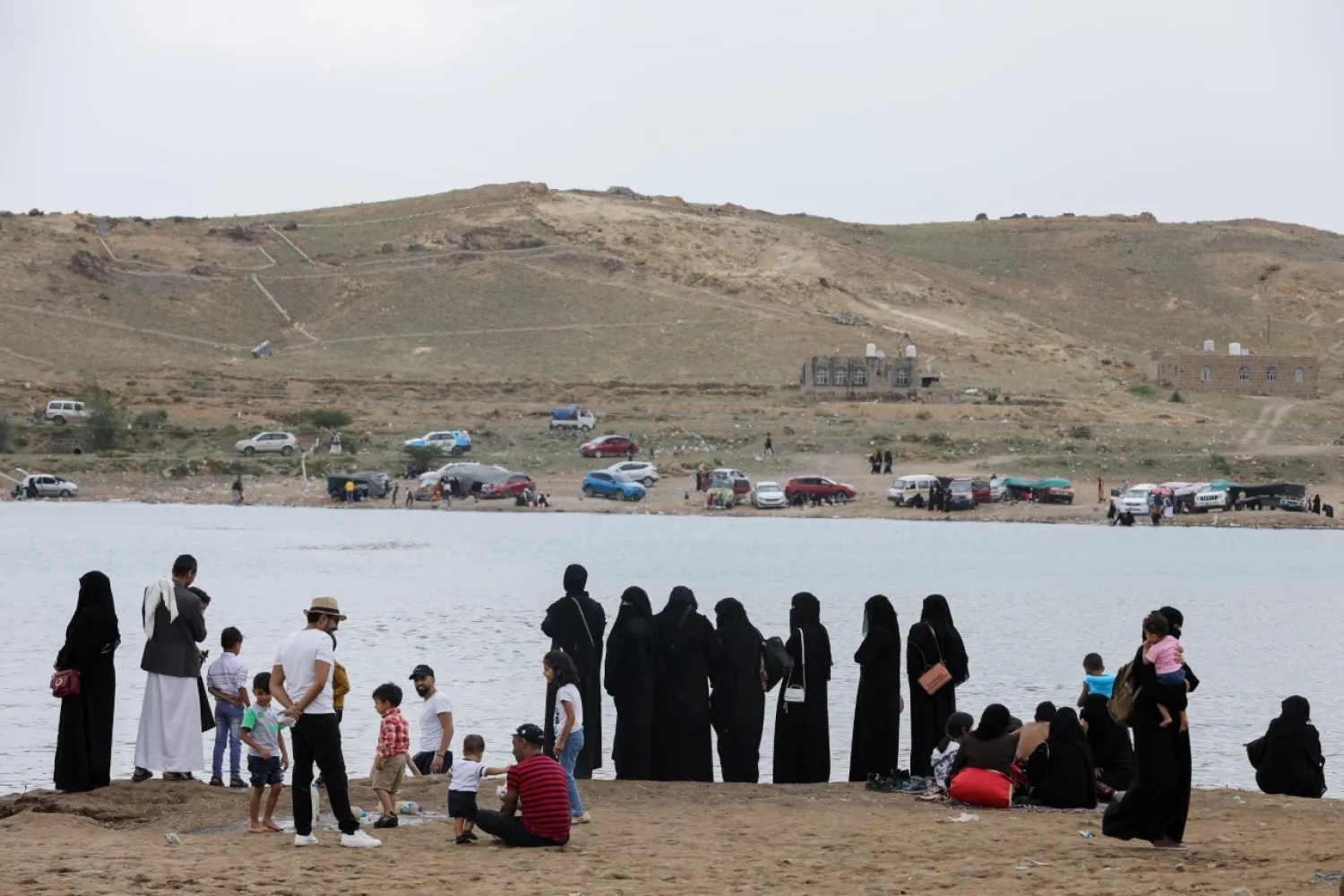
People gather during an excursion at a dam in Sayyan near Sanaa, Yemen May 16, 2021. REUTERS/Khaled Abdullah
TT

Water Crisis Hits Sanaa amid Cooking Gas, Fuel Crunch

People gather during an excursion at a dam in Sayyan near Sanaa, Yemen May 16, 2021. REUTERS/Khaled Abdullah

It was midnight when Ali al-Yirimi, a Yemeni private sector breadwinner living under Houthi rule, received a phone call from the neighborhood supervisor urging him to rush to save his spot in a long queue of residents waiting for their monthly share of cooking gas.

Yirimi had to wait for four long hours at the queue and was forced to ignore another call from his wife informing him that the water had run out at their home. Their family couldn’t prepare Ramadan’s Suhur meal because there wasn’t any water, but the compromise was a must because Yemenis living under Houthi militia rule can’t obtain cooking gas frequently.

If Yirimi had left his spot in the queue, his family would be left without any cooking gas.

“The issue is no longer limited to waiting in line for four hours, but extends to the inability to pay the costs of buying a gas canister and a water tank because the prices have doubled,” Yirimi told Asharq Al-Awsat.

“Nowadays, I pay double the amount of rent that I paid last year, and all the prices of goods have doubled, and my income from working in the private sector is still the same,” he complained while expressing his fears of being unable to provide for his family.

According to Yirimi, the price of a gas canister was hiked by Houthi supervisors to the equivalent of more than $12 instead of $6, and the price of a water tank increased from 6,000 Yemeni rials to 12,000 Yemeni rials.

“The water that is pumped through the Water Corporation project only comes twice a week, and as a result of the great need, you need a pump to be able to fill the tank on the roof of the house, and because there is no electricity, you have no choice but to buy water,” explained Yirimi.

Living the same struggles, Amal Abdullah, a Yemeni housewife whose husband makes a humble pay day, tells the story of how her family is forced to live in the city’s outskirts because rent is cheaper.

Abdullah tells the story of how she is forced to wake up early in the morning every day to save her spot at a location where water reserves are being donated.

Despite waking up early, Abdullah is also faced with a long queue of struggling Yemenis looking for water. She ends up waiting for hours on end.

Abdullah asserts that due to the doubled fuel rates, the price of everything has gone up, and buying a water tanker for the house has become impossible.

The crisis worsened with the advent of Islam’s holy month of Ramadan and many families were forced to resort to firewood for cooking, because they were unable to buy gas on the black market.

According to Abdullah, Houthi supervisors in Yemeni neighborhoods have a monopoly on cooking gas.

Najat, another Yemeni housewife suffering under Houthi rule, complains about how she is forced to set up fire pits for cooking her family’s Iftar fast-breaking meals. She is forced to inhale fumes despite her respiratory illness because her family can’t afford buying cooking gas after the Houthi price increase.

Najat’s husband earns a daily wage that goes into buying basic commodities, instead of buying water and cooking gas.

While Houthis continue to appropriate the salaries of thousands of public sector workers, they are pumping up living expenses for Yemenis living under their control. Before the Houthi-led insurgency, a kilowatt of electricity cost around 12 Yemeni rials, but today it costs over 500 Yemeni rials.

The 100% and over hikes have affected cooking gas, fuel, water supplies and property rent rates.



Syria to Start Currency Swap on January 1st, Central Bank Governor Says

Syrian pounds are pictured inside an exchange currency shop in Azaz, Syria February 3, 2020. Picture taken February 3, 2020. REUTERS/Khalil Ashawi/File Photo
TT

Syria to Start Currency Swap on January 1st, Central Bank Governor Says

Syrian pounds are pictured inside an exchange currency shop in Azaz, Syria February 3, 2020. Picture taken February 3, 2020. REUTERS/Khalil Ashawi/File Photo

Syria will start swapping old banknotes for new ones under a ​plan to replace Assad-era notes starting from January 1, 2026, Central Bank Governor Abdelkader Husrieh said on Thursday.

Husrieh announced the introduction of the new Syrian currency, saying the decree "sets January ‌1, 2026, ‌as the start date ‌for ⁠the ​exchange ‌process". Sources familiar with the matter told Reuters in August that the country will issue new banknotes, removing two zeros from its currency in an attempt to restore ⁠public confidence in the severely devalued pound.

The ‌step is intended ‍to strengthen ‍the Syrian pound after its purchasing ‍power collapsed to record lows following a 14-year conflict that ended with President Bashar al-Assad's ouster in December.

Husrieh ​said the operation will take place through a smooth and orderly ⁠swap - a move bankers hope will ease fears that the new currency could fuel inflation and further erode the purchasing power of Syrians already reeling from high prices.

He added that a press conference will soon outline the exact regulations and mechanisms.


Türkiye Begins Black Box Analysis of Jet Crash That Killed Libyan Military Chief and 7 Others

Libyan national flags fly at half-mast in Tripoli on December 24, 2025, after the head of Libya's armed forces and his four aides died in a plane crash in Türkiye. (AFP)
TT

Türkiye Begins Black Box Analysis of Jet Crash That Killed Libyan Military Chief and 7 Others

Libyan national flags fly at half-mast in Tripoli on December 24, 2025, after the head of Libya's armed forces and his four aides died in a plane crash in Türkiye. (AFP)

The technical analysis of the recovered black boxes from a jet crash that killed eight people, including western Libya’s military chief, began as the investigation proceeded in cooperation with Libyan authorities, the Turkish Ministry of Defense said Thursday.

The private jet with Gen. Muhammad Ali Ahmad al-Haddad, four other military officials and three crew members crashed on Tuesday after taking off from Türkiye’s capital, Ankara, killing everyone on board. Libyan officials said the cause of the crash was a technical malfunction on the plane.

The high-level Libyan delegation was on its way back to Tripoli after holding defense talks in Ankara aimed at boosting military cooperation between the two countries.

The wreckage was scattered across an area covering 3 square kilometers (more than a square mile), complicating recovery efforts, according to the Turkish Interior Minister Ali Yerlikaya.

A 22-person delegation, including five family members, arrived from Libya early on Wednesday to assist in the investigation.


Lebanese President: We are Determined to Hold Parliamentary Elections on Time

President Joseph Aoun between Prime Minister Nawaf Salam and Speaker Nabih Berri (Lebanese Presidency file photo)
TT

Lebanese President: We are Determined to Hold Parliamentary Elections on Time

President Joseph Aoun between Prime Minister Nawaf Salam and Speaker Nabih Berri (Lebanese Presidency file photo)

Lebanese President Joseph Aoun reiterated on Thursday that the country’s parliamentary elections are a constitutional obligation that must be carried out on time.

Lebanon’s state-run National News Agency quoted Aoun as saying that he, alongside Prime Minister Nawaf Salam and Parliament Speaker Nabih Berri, is determined to hold the elections on schedule.

Aoun also emphasized that diplomatic efforts have continued unabated to keep the specter of war at bay, noting that "things are heading in a positive direction".

The agency also cited Berri reaffirming that the elections will take place as planned, with "no delays, no extensions".

The Lebanese parliamentary elections are scheduled for May next year.