


Israel Coalition Faces New Split over Jerusalem Violence

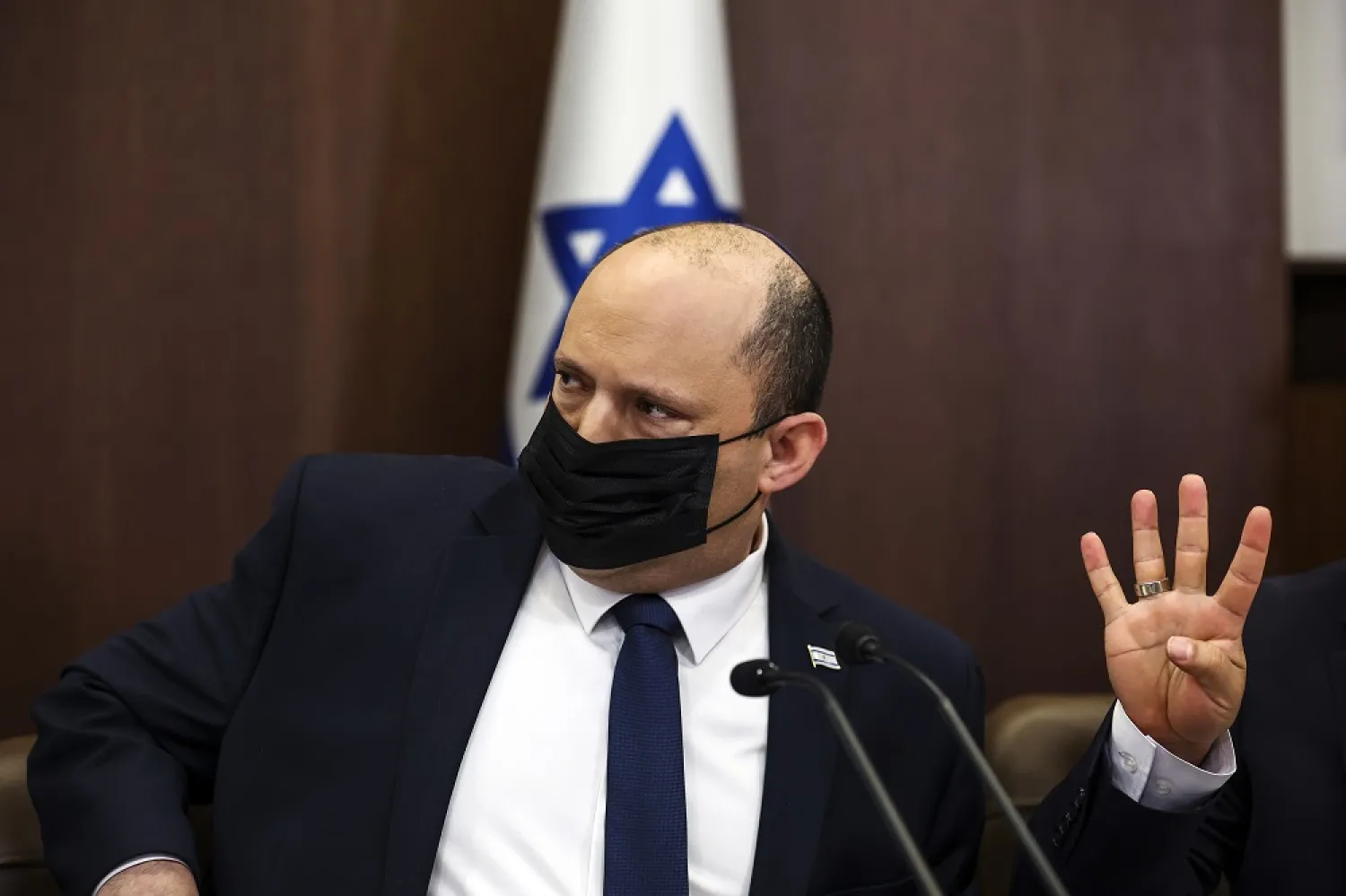
Israeli Prime Minister Naftali Bennett gestures as he attends a cabinet meeting at the Prime Minister's office in Jerusalem Sunday, April 10, 2022. (AP)
TT

Israel Coalition Faces New Split over Jerusalem Violence

Israeli Prime Minister Naftali Bennett gestures as he attends a cabinet meeting at the Prime Minister's office in Jerusalem Sunday, April 10, 2022. (AP)

Israeli Prime Minister Naftali Bennett is working to hold his fractious coalition together after a split on the right and an Arab-Israeli party's threat to quit over violence in Jerusalem.

Right-winger Bennett, a key figure in Israel's settlement movement, last year ended 12 continuous years of rule by Benjamin Netanyahu, Israel's longest-serving premier.

To do so, the former tech tycoon brought together an unlikely grouping united by little other than their opposition to Netanyahu.

They included leftists and centrists, religious and hard-line Jewish nationalist parties -- and, for the first time in Israel's history, a party drawn from the country's Arab-Israeli minority.

But after more than 150 Palestinians were wounded in clashes with police over a flashpoint holy site in Jerusalem, the Raam party -- largely backed by Muslim Arab-Israelis -- said on Sunday evening that it was suspending its membership.

"If the government continues its steps against the people of Jerusalem... we will resign as a bloc," Raam said in a statement.

That would be a serious blow to a coalition that already, two weeks earlier, lost its one-seat majority of 61 in the 120-seat Knesset, Israel's parliament.

The departure of Member of the Knesset (MK) Idit Silman, in a dispute over the use of leavened bread products in hospitals during Passover, left the coalition with 60 seats -- the same as the opposition.

Raam's threat to withdraw its four MKs poses the most serious threat yet to the coalition.

'Testing the limits'

Emmanuel Navon, a political science professor at Tel Aviv University, said the question of the Al-Aqsa compound, a flashpoint religious site known to Jews as the Temple Mount, "is testing the limits" of the coalition.

On the one hand, the coalition's right-wing members are demanding a heavy-handed "law-and-order" approach to dealing with Palestinian demonstrators, especially after a series of deadly attacks inside Israel.

But on the other, the sight of Israeli police officers deploying and firing stun grenades in one of Islam's holiest sites during the holy month of Ramadan has sparked outrage among Raam MKs and across the Muslim world.

"This will be a huge headache (for Bennett) to manage," said Navon.

Despite the crisis however, Navon said the coalition was likely to survive.

"Mansour Abbas (Raam's leader) has no interest in leaving the coalition. He took a huge political risk in joining, and he needs time to show his voters that it was worth it," Navon said.

"He wants to prove to his constituency that by being pragmatic, he managed to improve their daily lives, unlike the other Arab-Israeli parties."

Navon added that neither Abbas, nor anyone else in the government, had anything to gain from early elections.

"Everyone in the coalition has an interest in not rocking the boat," he said.

If Raam were to leave, the coalition would find itself in a minority government, with just 56 seats.

That would force it to strike deals with opposition parties every time it wanted to pass legislation.

Yet to topple the government, the opposition would have to cobble together an even less likely administration, bringing Arab parties into a coalition with Netanyahu's 53-seat bloc of right-wing, orthodox and far-right Jewish parties.

Moreover, in 2014, Israel passed a law that means the opposition must be able to present a majority government of 61 seats in order to replace the incumbent.

"Even if Netanyahu manages to gather a majority to topple the government, that wouldn't mean that he could reach a majority to propose a new one," said political science professor Shmuel Sandler from Bar-Ilan University.

"Nor could he add Raam, because the religious nationalists would oppose it," he added.

Another election?

However, Sandler said the latest developments could raise the prospect of the opposition gathering enough votes to dissolve the Knesset and trigger new elections -- the fifth in three years.

The political challenge comes at a tense time, when the Jewish Passover festival coincides with the Muslim fasting month of Ramadan. The Knesset is in recess until May 5.

But one other move could flip Israeli politics on its head: Netanyahu retiring from politics.

Some coalition members have refused to join a Netanyahu-led administration because the veteran premier is on trial for corruption.

Were he to quit politics, it could open the way for a new alliance to be formed.

"That would make it possible to form a government tomorrow, without going to new elections," Sandler said.

Navon agreed. "The government would fall in five minutes," he said.

But analyst Dahlia Scheindlin warned there was little chance of such a scenario.

"Bibi (Benjamin Netanyahu) isn't known for being someone who rolls over," she said.


Türkiye Holds Military Funeral for Libyan Officers Killed in Plane Crash

The Libyan national flag flies at half-mast in Tripoli on December 24, 2025, after the head of Libya's armed forces and his four aides died in a plane crash in Türkiye. (AFP)
TT

Türkiye Holds Military Funeral for Libyan Officers Killed in Plane Crash

The Libyan national flag flies at half-mast in Tripoli on December 24, 2025, after the head of Libya's armed forces and his four aides died in a plane crash in Türkiye. (AFP)

Türkiye held a military funeral ceremony Saturday morning for five Libyan officers, including western Libya’s military chief, who died in a plane crash earlier this week.

The private jet with Gen. Muhammad Ali Ahmad al-Haddad, four other military officers and three crew members crashed on Tuesday after taking off from Ankara, Türkiye’s capital, killing everyone on board. Libyan officials said the cause of the crash was a technical malfunction on the plane.

Al-Hadad was the top military commander in western Libya and played a crucial role in the ongoing, UN-brokered efforts to unify Libya’s military.

The high-level Libyan delegation was on its way back to Tripoli, Libya’s capital, after holding defense talks in Ankara aimed at boosting military cooperation between the two countries.

Saturday's ceremony was held at 8:00 a.m. local time at the Murted Airfield base, near Ankara, and attended by the Turkish military chief and the defense minister. The five caskets, each wrapped in a Libyan national flag, were then loaded onto a plane to be returned to their home country.

Türkiye’s military chief, Selcuk Bayraktaroglu, was also on the plane headed to Libya, state-run news agency TRT reported.

The bodies recovered from the crash site were kept at the Ankara Forensic Medicine Institute for identification. Justice Minister Yilmaz Tunc told reporters their DNA was compared to family members who joined a 22-person delegation that arrived from Libya after the crash.

Tunc also said Germany was asked to help examine the jet's black boxes as an impartial third party.


Syrian Foreign Ministry: Talks with SDF Have Not Yielded Tangible Results

SDF fighters are seen at a military parade in Qamishli. (Reuters file)
TT

Syrian Foreign Ministry: Talks with SDF Have Not Yielded Tangible Results

SDF fighters are seen at a military parade in Qamishli. (Reuters file)

A source from the Syrian Foreign Ministry said on Friday that the talks with the Kurdish Syrian Democratic Forces (SDF) over their integration into state institutions “have not yielded tangible results.”

Discussions about merging the northeastern institutions into the state remain “hypothetical statements without execution,” it told Syria’s state news agency SANA.

Repeated assertions over Syria’s unity are being contradicted by the reality on the ground in the northeast, where the Kurds hold sway and where administrative, security and military institutions continue to be run separately from the state, it added.

The situation “consolidates the division” instead of addressing it, it warned.

It noted that despite the SDF’s continued highlighting of its dialogue with the Syrian state, these discussions have not led to tangible results.

It seems that the SDF is using this approach to absorb the political pressure on it, said the source. The truth is that there is little actual will to move from discussion to application of the March 10 agreement.

This raises doubts over the SDF’s commitment to the deal, it stressed.

Talk about rapprochement between the state and SDF remains meaningless if the agreement is not implemented on the ground within a specific timeframe, the source remarked.

Furthermore, the continued deployment of armed formations on the ground that are not affiliated with the Syrian army are evidence that progress is not being made.

The persistence of the situation undermines Syria’s sovereignty and hampers efforts to restore stability, it warned.


Terrorist Attack on Mosque in Syria’s Homs Draws Wide Condemnation

 A view shows an interior of a damaged mosque after several people were killed in an explosion in Homs, Syria December 26, 2025. (Reuters)
A view shows an interior of a damaged mosque after several people were killed in an explosion in Homs, Syria December 26, 2025. (Reuters)
TT

Terrorist Attack on Mosque in Syria’s Homs Draws Wide Condemnation

 A view shows an interior of a damaged mosque after several people were killed in an explosion in Homs, Syria December 26, 2025. (Reuters)
A view shows an interior of a damaged mosque after several people were killed in an explosion in Homs, Syria December 26, 2025. (Reuters)

Condemnations poured in across the Arab world and international community of the terrorist attack that targeted a mosque in Syria’s Homs city on Friday.

An explosion killed at least eight worshippers with the extremist group Saraya Ansar al-Sunna claiming responsibility.

In a statement on Telegram, the group said its fighters “detonated a number of explosive devices” in the Imam Ali Bin Abi Talib Mosque in the central Syrian city.

Syria's interior ministry said in a statement that “a terrorist explosion” targeted the mosque and that authorities had “begun investigating and collecting evidence to pursue the perpetrators of this criminal act.”

The Saudi Ministry of Foreign Affairs condemned the attack, stressing the Kingdom’s “categorical rejection of terrorism and extremism in all their forms, including attacks on mosques and places of worship and the targeting of innocent civilians.”

It expressed the Kingdom’s “solidarity with Syria in this tragic incident and its support for the Syrian government’s efforts to uphold security and stability.”

Türkiye slammed the attack, saying it stands by Syria and its efforts to support stability, security and unity “despite all the provocations.”

The Iraqi Foreign Ministry strongly condemned the “heinous terrorist attack,” saying Baghdad rejects all forms of terrorism, violence and extremism regardless of their motives.

It slammed the attack against civilians and places of worship, saying they aim to create instability and sow strife in society.

The ministry underlined Iraq’s support for regional and international efforts aimed at eliminating terrorism and drying up its sources of funding.

The United Arab Emirates condemned the attack, saying it rejects all forms of violence and terrorism that aim to undermine security and stability.

Jordan’s Foreign Ministry slammed the attack, voicing its full support to Syria in its reconstruction process “based on principles that ensure its territorial unity, sovereignty, security and stability.”

In Beirut, President Joseph Aoun slammed the Homs attack, saying Lebanon stands by Syria in its war on terrorism. He offered his condolences to the Syrian people.

Qatar slammed the attack, saying it fully stands by the Syrian government and all the measures it takes to preserve security.

France said the blast was an “act of terrorism” designed to destabilize the country, while United Nations Secretary General Antonio Guterres condemned the “unacceptable” attack and said the perpetrators should be brought to justice.
