

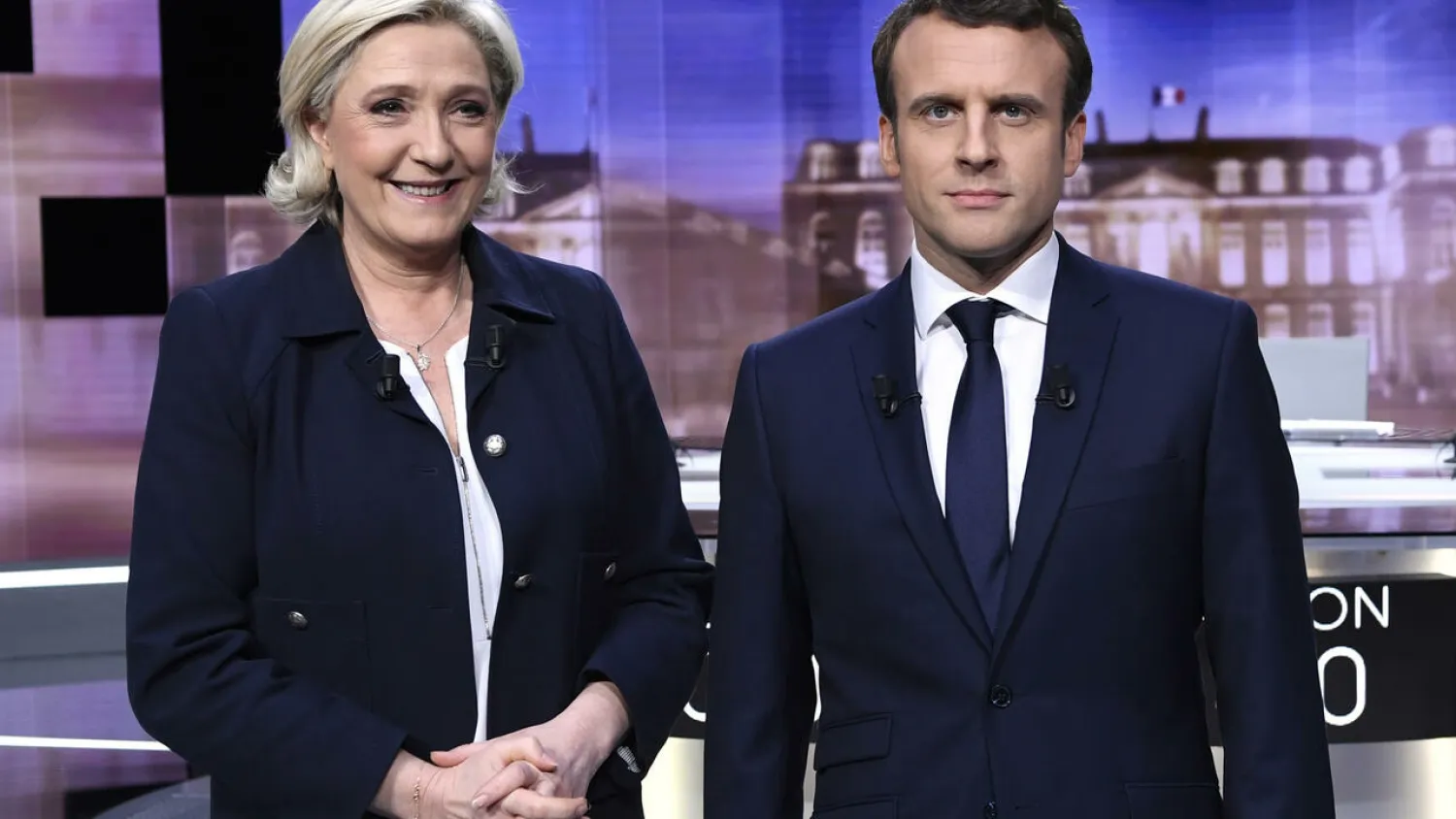

Le Pen, Macron to Face off in Crunch TV Election Duel

The run-off debate is traditionally a pivotal moment in French presidential elections. Eric Feferberg POOL/AFP/File
TT

Le Pen, Macron to Face off in Crunch TV Election Duel

The run-off debate is traditionally a pivotal moment in French presidential elections. Eric Feferberg POOL/AFP/File

French leader Emmanuel Macron and the far-right's Marine Le Pen go head-to-head in a crunch TV debate on Wednesday, seeking to sway undecided voters with four days left until the presidential election's decisive second round.

Macron holds a solid poll lead, but his political allies have warned against any complacency in the prime-time duel -- their only direct clash -- which will be watched by millions, AFP said.

Some polls are predicting a lead of around 10 points for Macron over Le Pen in the run-off, a repeat of the 2017 election. But undecided voters and abstentions could yet swing the figures.

Le Pen has cleared her diary to concentrate on preparing for the debate, hoping to avoid any repeat of the fiasco five years ago, when her ill-prepared performance contributed to her defeat at the hands of the centrist Macron.

This year's vote will mark the closest the far right has come to taking the Elysee presidential palace. Marine Le Pen's father Jean-Marie was crushed by Jacques Chirac in the 2002 run-off election, and she was easily defeated by Macron in 2017.

The live televised debate -- scheduled from 1900 GMT -- has been a political tradition in France since 1974, when Socialist Francois Mitterrand took on centrist Valery Giscard d'Estaing.

But it did not take place in 2002, when Chirac said debate was impossible with "intolerance and hatred" after Jean-Marie Le Pen stunned France by making the run-off.

- 'Kick in the backside' -
The stakes are high in this election, and Europe is watching.

Macron is expected to continue to champion the EU if he wins another five years in office. Le Pen has vowed to reform it under a far-right presidency.

Opinion polls currently put Macron at 53 to 56 percent in the run-off against 44 to 47 percent for Le Pen -- a much tighter finish than five years ago, when Macron carried the vote with 66 percent.

For Le Pen, the debate represents a final chance to win back ground in the polls and convince France she has moderated her anti-immigration party into a mainstream force.

Macron will likely seek to portray her as a dangerous extremist who cannot be trusted on foreign policy -- especially after Russia's invasion of Ukraine, given her past comments in support of President Vladimir Putin.

Both candidates are particularly keen to woo the electorate of hard-left candidate Jean-Luc Melenchon, who finished a strong third in the first round.

Le Pen was reportedly spending Tuesday with her closest aides to rehearse the debate, having admitted previously that her performance against Macron in 2017 was not up to scratch.

"For me, failure is sometimes a kick in the backside," she told TF1 television.

Le Monde newspaper said Le Pen would seek to present herself as a credible French leader and portray the election as an anti-Macron "referendum".

She has "spent five years trying to bury that disastrous (2017) televised duel, by sprucing up her image, party and ideological tenets," the paper said.

- 'Either could win' -
Macron has insisted the election is not yet in the bag, reminding voters of the political upsets of 2016 when Britons voted to leave the EU and Americans put Donald Trump in the White House.

Key allies have made clear nothing should be taken for granted, telling voters tempted to stay at home that they must cast their ballots.

"The game isn't over yet and we certainly can't draw conclusions... that this election, this match, is already decided," Prime Minister Jean Castex told France Inter radio.

"We have to convince the French that Emmanuel Macron's programs are the best for France and for them," he said. He added that if Macron won, his government would resign to give the ruling party new impetus ahead of legislative elections in June.

Castex's predecessor as prime minister, Edouard Philippe, mayor of the northern city of Le Havre and a heavyweight center-right backer of Macron, said nothing could be taken for granted due to the numerous "unknowns" hanging over the election -- abstentions above all.

He told Le Figaro newspaper on Monday that the so-called Republican front -- which in past elections had seen French voters of all political stripes line up against the far right -- "was no longer a natural reflex".

"Right now, either candidate could win," added another ally, Francois Bayrou, the leader of the pro-Macron Modem party.



Australia PM to Invite Israeli President to Visit

 15 August 2025, Australia, Sydney: Australian Prime Minister Anthony Albanese speaks at the Martin Place cenotaph during a ceremony marking the 80th anniversary of Victory in the Pacific, which commemorates Japan's acceptance of the Allied demand for unconditional surrender and the end of World War II for Australia. (dpa)
15 August 2025, Australia, Sydney: Australian Prime Minister Anthony Albanese speaks at the Martin Place cenotaph during a ceremony marking the 80th anniversary of Victory in the Pacific, which commemorates Japan's acceptance of the Allied demand for unconditional surrender and the end of World War II for Australia. (dpa)
TT

Australia PM to Invite Israeli President to Visit

 15 August 2025, Australia, Sydney: Australian Prime Minister Anthony Albanese speaks at the Martin Place cenotaph during a ceremony marking the 80th anniversary of Victory in the Pacific, which commemorates Japan's acceptance of the Allied demand for unconditional surrender and the end of World War II for Australia. (dpa)
15 August 2025, Australia, Sydney: Australian Prime Minister Anthony Albanese speaks at the Martin Place cenotaph during a ceremony marking the 80th anniversary of Victory in the Pacific, which commemorates Japan's acceptance of the Allied demand for unconditional surrender and the end of World War II for Australia. (dpa)

Australian Prime Minister Anthony Albanese on Tuesday said his government would invite Israel's president to visit, after a mass shooting in Sydney targeting the Jewish community.

"Prime Minister Albanese advised President (Isaac) Herzog that, upon the recommendation of the Australian government, the Governor-General of Australia will issue an invitation in accordance with protocol to President Herzog to visit Australia as soon as possible," said a post on the leader's X account.

Fifteen people were killed and dozens injured in a mass shooting at a Jewish Hanukkah celebration at Bondi on December 14.


Trump Says It Would Be 'Smart' for Venezuela's Maduro to Leave Power

US President Donald Trump attends a press conference, as he makes an announcement about the Navy's "Golden Fleet" at Mar-a-lago in Palm Beach, Florida, US, December 22, 2025. REUTERS/Jessica Koscielniak
TT

Trump Says It Would Be 'Smart' for Venezuela's Maduro to Leave Power

US President Donald Trump attends a press conference, as he makes an announcement about the Navy's "Golden Fleet" at Mar-a-lago in Palm Beach, Florida, US, December 22, 2025. REUTERS/Jessica Koscielniak

US President Donald Trump said on Monday it would be smart for Venezuelan President Nicolas Maduro to leave power, and the United States could keep or sell the oil it had seized off the coast of Venezuela in recent weeks.

Trump's pressure campaign on Maduro has included a ramped-up military presence in the region and more than two dozen military strikes on vessels allegedly trafficking drugs in the Pacific Ocean and Caribbean Sea near the South American nation. At least 100 people have been killed in ‌the attacks, reported Reuters.

Asked ‌if the goal was to force ‌Maduro ⁠from power, Trump ‌told reporters: "Well, I think it probably would... That's up to him what he wants to do. I think it'd be smart for him to do that. But again, we're gonna find out."

"If he wants to do something, if he plays tough, it'll be the last time he's ever able to play tough," he said.

During the press conference, Trump ⁠also took aim at Colombian President Gustavo Petro, who he has also feuded with throughout ‌the year.

"He's no friend to the ‍United States. He's very bad. ‍Very bad guy. He's gotta watch his ass because he makes ‍cocaine and they send it into the US," Trump said when asked about Petro's criticisms towards the Trump administration's handling of the tensions with Venezuela.

In addition to the strikes, Trump has previously announced a "blockade" of all oil tankers under sanctions entering and leaving Venezuela. The US Coast Guard started pursuing an oil tanker in international waters near Venezuela ⁠on Sunday, in what would be the second such operation this weekend and the third in less than two weeks if successful.

"Maybe we will sell it, maybe we will keep it," Trump said when asked what would happen with the seized oil, adding it might also be used to replenish the United States' strategic reserves. Without directly referring to Trump's statements, Maduro said every leader should attend to the internal affairs of their own country.

"If I speak to him again, I will tell him: each country should mind its own internal affairs," Maduro ‌said, referring to an initial phone call between the two leaders last month.


Suspected Militants Ambush Police Vehicle in Northwest Pakistan, Killing 5 Officers

File photo: Police officers stand guard to secure a procession during the mourning month of Muharram in Karachi, Pakistan, 03 July 2025. EPA/SHAHZAIB AKBER
TT

Suspected Militants Ambush Police Vehicle in Northwest Pakistan, Killing 5 Officers

File photo: Police officers stand guard to secure a procession during the mourning month of Muharram in Karachi, Pakistan, 03 July 2025. EPA/SHAHZAIB AKBER

Suspected militants opened fire on a police vehicle in northwest Pakistan on Tuesday, killing five officers before fleeing, officials said, part of a surge in violence in the region bordering Afghanistan.

The attack took place in the Karak district of Khyber Pakhtunkhwa province while police were on routine patrol near an oil and gas field, said local police chief Noor Wali told The Associated Press. He said the assailants, after killing the officers, poured gasoline on the vehicle and torched it.

A large police contingent cordoned off the area and launched a search operation to track the attackers, according to The Associated Press.

Pakistan's Interior Minister Mohsin Naqvi and Khyber Pakhtunkhwa Chief Minister Suhail Afridi condemned the attack. In separate statements, they said the assailants would be brought to justice and expressed condolences to the families of the killed police officers.

No group immediately claimed responsibility, but suspicion is likely to fall on the Pakistani Taliban, or TTP, which is separate from but aligned with Afghanistan’s Taliban government and has been blamed by authorities for previous attacks.

Pakistan has seen a steady rise in militant violence, which has strained relations with Afghanistan. Islamabad accuses the TTP of operating freely inside Afghanistan since the Taliban takeover in 2021, a charge Kabul denies.

Tensions escalated in October after Afghanistan accused Pakistan of an Oct. 9 drone strike in Kabul, followed by cross-border clashes that killed dozens, before a Qatar-brokered cease-fire on Oct. 19. Talks in Istanbul last week ended without agreement.