

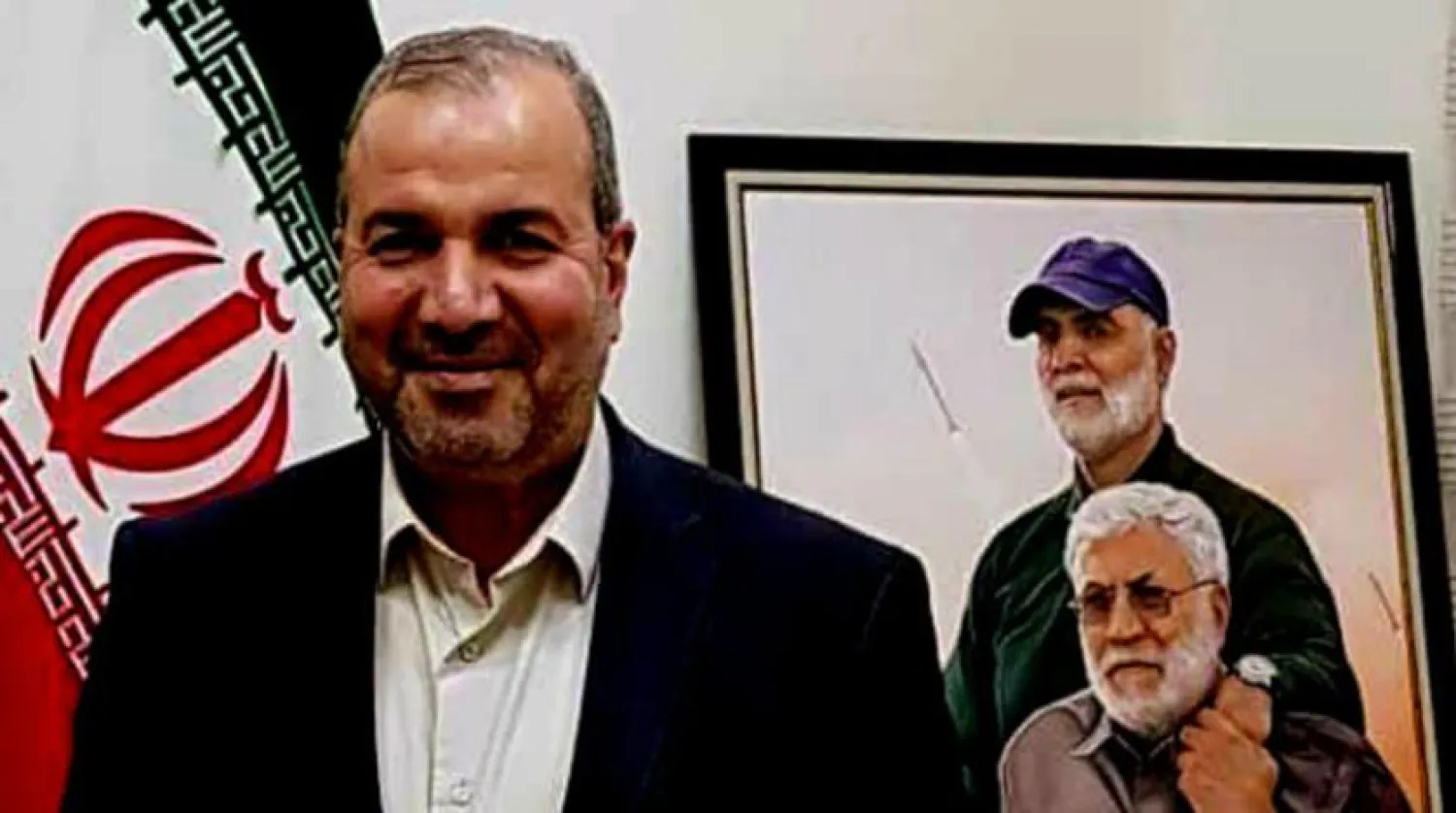

Iran Hands over ‘Iraq’ to Soleimani Successor

Iran’s new ambassador to Iraq Mohammad Kazem Al-Sadeq (Asharq Al-Awsat)
TT

Iran Hands over ‘Iraq’ to Soleimani Successor

Iran’s new ambassador to Iraq Mohammad Kazem Al-Sadeq (Asharq Al-Awsat)

The US and Iran have appointed new ambassadors to Iraq. The diplomats come from an intelligence and military background and were involved in the region's crises at different levels.

What does this mean for a politically dysfunctional country that has been unable to form a new government since the October elections?

Iran has named Mohammad Kazem Al-Sadeq as its new ambassador to Baghdad. As is often the case with Iranian ambassadors to Iraq, Sadeq is reportedly a member of the Iranian Revolutionary Guards’ elite Quds Force.

Al-Sadeq would replace Iraj Masjedi, who has held the post since April 2017.

Even though Iraqi diplomats deny the change “having anything to do with the crisis of forming the Iraqi government,” many behind-the-scenes Shiite actors suggest otherwise.

In Washington, the Senate Committee on Foreign Relations, earlier this month, heard the testimony of the new ambassador, Alina Romanowski.

Romanowski described Iraq as a “cornerstone” and warned against the influence of armed factions there.

After finishing her mission as ambassador in Kuwait, Romanowski is on her way to Baghdad with a strong resume packed with experience in the US Department of Defense and the CIA.

Romanowski is motivated to redraw the rules of engagement with the Iranians, who sent Al-Sadeq to wait for her in Baghdad.

The story of how Al-Sadeq ended up as an Iranian ambassador to Iraq is more remarkable than Romanowski’s.

It exposes the dynamics of the Iranian Revolutionary Guards in Iraq, and the desire of Iranian Supreme Leader Ali Khamenei to address the confusion in which Esmail Qaani, the commander of the Quds Force (the foreign arm of the Revolutionary Guards), and Masjedi did not succeed in resolving.

Al-Sadeq born in Najaf, hails from an Iranian-Iraqi family known for its commitment to “religious studies.”

His family enjoys connections dating back to the 70s to prominent religious families in Iraq and Iran.

Al-Sadeq was one of the most prominent figures to accompany Qassem Soleimani, the late commander of the Quds Force.

In Iraq, Al-Sadeq has deeply rooted connections with the leaders of Shiite parties. This has allowed him to understand and get involved in doctrinal issues in the Iraqi crisis and created the needed atmosphere for him to be Soleimani’s possible successor in the region.

It seems that Al-Sadeq’s main task will be focused on keeping the Iranian influence strong and growing in the central government in Baghdad.

His appointment could provide a different administrative model for the implementation of Iranian policy, and this may greatly affect the negotiations to form the new Iraqi government.



‘Not Right’ for Iran to Attend Davos Summit After Deadly Protests, Say Organizers

Iranian Foreign Minister Abbas Araghchi speaks in a joint press briefing with his Iraqi counterpart Fuad Hussein in Tehran, Iran, Sunday, Jan. 18, 2026. (AP)
TT

‘Not Right’ for Iran to Attend Davos Summit After Deadly Protests, Say Organizers

Iranian Foreign Minister Abbas Araghchi speaks in a joint press briefing with his Iraqi counterpart Fuad Hussein in Tehran, Iran, Sunday, Jan. 18, 2026. (AP)

Iran's foreign minister will not be attending the Davos summit in Switzerland this week, the organizers said Monday, stressing it would not be "right" after the recent deadly crackdown on protesters in Iran.

Abbas Araghchi had been scheduled to speak on Tuesday during the annual gathering of the global elite at the upscale Swiss ski resort town.

But activists have been calling on the World Economic Forum organizers to disinvite him amid what rights groups have called a "massacre" in his country.

"The Iranian Foreign Minister will not be attending Davos," the World Economic Forum said on X.

"Although he was invited last fall, the tragic loss of lives of civilians in Iran over the past few weeks means that it is not right for the Iranian government to be represented at Davos this year," it added.

Demonstrations sparked by anger over economic hardship exploded into protests late December in what has been widely seen as the biggest challenge to the Iranian leadership in recent years.

The rallies subsided after a government crackdown under the cover of a communications blackout that started on January 8.

Norway-based Iran Human Rights says it has verified the deaths of 3,428 protesters killed by security forces, confirming cases through sources within the country's health and medical system, witnesses and independent sources.

The NGO warned that the true toll is likely to be far higher. Media cannot independently confirm the figure and Iranian officials have not given an exact death toll.


Iran to Consider Lifting Internet Ban; State TV Hacked

People walk past a burnt-out building destroyed during public protests in the Iranian capital Tehran on January 19, 26. (AFP)
TT

Iran to Consider Lifting Internet Ban; State TV Hacked

People walk past a burnt-out building destroyed during public protests in the Iranian capital Tehran on January 19, 26. (AFP)

Iran may lift its internet blackout in a few days, a senior parliament member said on Monday, after authorities shut communications while they used massive force to crush protests in the worst domestic unrest since ​the 1979 revolution.

In the latest sign of weakness in the authorities' control, state television appeared to be hacked late on Sunday, briefly showing speeches by US President Donald Trump and the exiled son of Iran's last shah calling on the public to revolt.

Iran's streets have largely been quiet for a week since anti-government protests that began in late December were put down in three days of mass violence.

An ‌Iranian official ‌told Reuters on condition of anonymity that the ‌confirmed ⁠death ​toll ‌was more than 5,000, including 500 members of the security forces, with some of the worst unrest taking place in ethnic Kurdish areas in the northwest. Western-based Iranian rights groups also say thousands were killed.

Opponents accuse the authorities of opening fire on peaceful demonstrators to crush dissent. Iran's clerical rulers say armed crowds egged on by foreign enemies attacked hospitals and mosques.

The death tolls dwarf ⁠those of previous bouts of anti-government unrest put down by the authorities in 2022 and 2009. ‌The violence drew repeated threats from Trump ‍to intervene militarily, although he has backed ‍off since the large-scale killing stopped.

INTERNET TO RETURN WHEN 'CONDITIONS ARE APPROPRIATE'

Ebrahim ‍Azizi, the head of parliament's National Security and Foreign Policy Committee, said top security bodies would decide on restoring internet in the coming days, with service resuming "as soon as security conditions are appropriate".

Another parliament member, hardliner Hamid Rasaei, said authorities should ​have listened to earlier complaints by Supreme Leader Ali Khamenei about "lax cyberspace".

Iranian communications including internet and international phone lines were ⁠largely stopped in the days leading up to the worst unrest. The blackout has since partially eased, allowing accounts of widespread attacks on protesters to emerge.

During Sunday's apparent hack into state television, screens broadcast a segment lasting several minutes with the on-screen headline "the real news of the Iranian national revolution".

It included messages from Reza Pahlavi, the US-based son of Iran's last shah, calling for a revolt to overthrow rule by the clerics who have run the country since the 1979 revolution that toppled his father.

Pahlavi has emerged as a prominent opposition voice and has said he plans ‌to return to Iran, although it is difficult to assess independently how strong support for him is inside Iran.


12 Schoolchildren Killed in South Africa Crash

File photo: A general view of the scene of a bus accident in Ekurhuleni on March 11, 2025. (AFP)
TT

12 Schoolchildren Killed in South Africa Crash

File photo: A general view of the scene of a bus accident in Ekurhuleni on March 11, 2025. (AFP)

A minibus carrying school students collided with a truck south of Johannesburg on Monday, killing 12 pupils, police said.

It was the latest in a string of deadly crashes in a country whose modern road network is undermined by rampant speeding, reckless driving and poorly maintained vehicles.

The crash happened near the industrial city of Vanderbijlpark, about 60 kilometers (40 miles) south of Johannesburg.

Police said the driver of the minibus appeared to have lost control while attempting to overtake other vehicles.

Eleven students died at the scene and another in hospital, provincial education minister Matome Chiloane told reporters at the scene.

He did not know the ages of the children involved but said they were from primary schools, where pupils are aged from six years, and also high schools.

Images on social media showed the crushed minibus on the roadside with distraught parents gathered behind the police tape. Some broke down in wails when they were allowed to see the bodies.

"It is a terrible scene," Gauteng premier Panyaza Lesufi said.

More than 11,400 lives were lost on South African roads in 2025, according to the latest data from the transport ministry.

Many South African parents have to rely on private minibuses to get their children to school.

In October, 18 children were badly hurt when their minibus lost control and overturned on a highway in KwaZulu-Natal.

At least five students were killed and eight others injured in September when a school minibus ploughed into a creche in a KwaZulu-Natal township.