


Democrats Warn Biden Administration Against Lifting Iran Sanctions

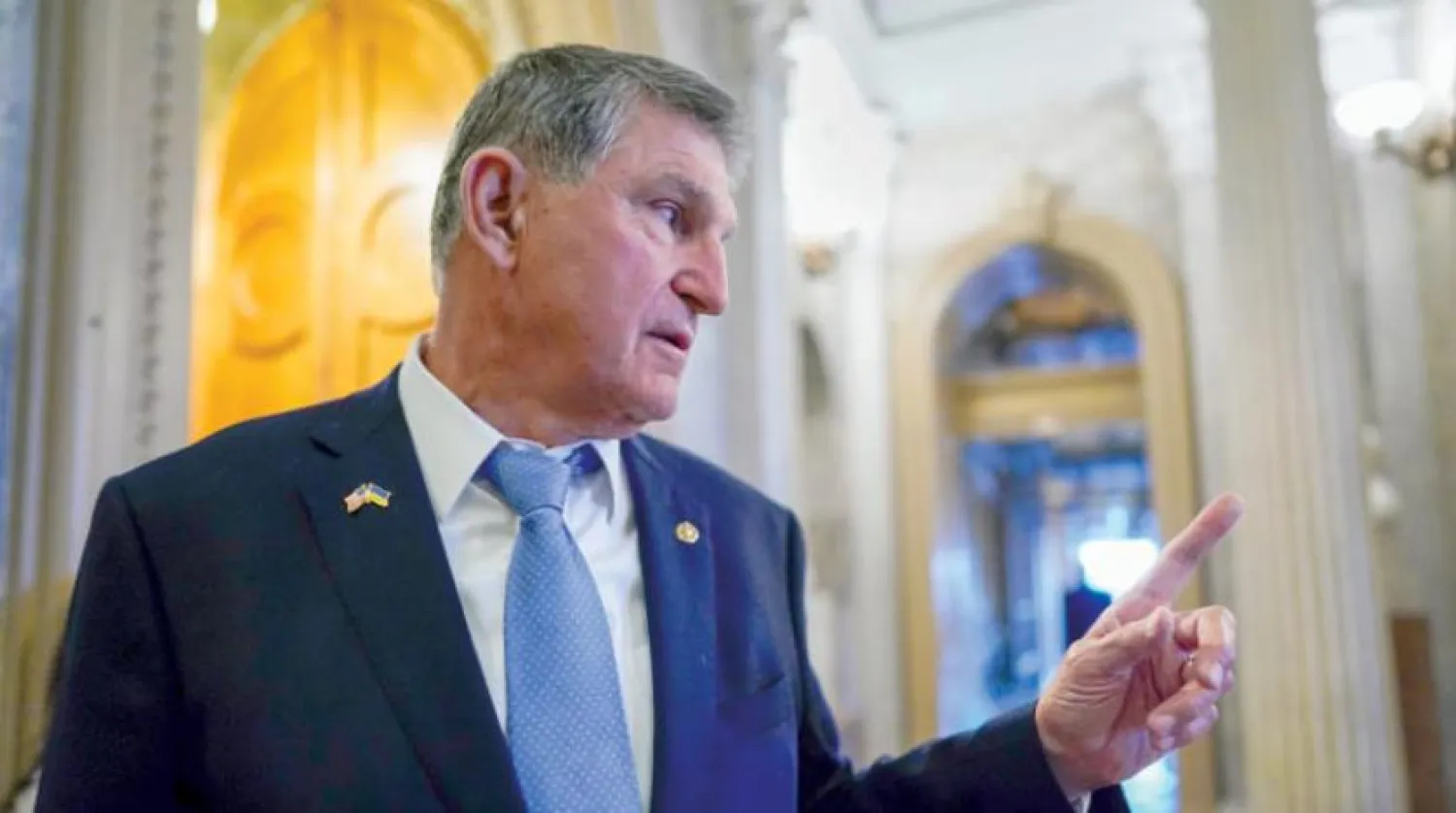
US Senator Joe Manchin speaks to the press in Washington (AP)
TT

Democrats Warn Biden Administration Against Lifting Iran Sanctions

US Senator Joe Manchin speaks to the press in Washington (AP)

Democratic lawmakers are increasingly growing their opposition to the ongoing negotiations with Iran over its nuclear program after an apparent reluctance to publicly criticize the US administration during the negotiations that began more than a year ago.

US Senator Joe Manchin detailed his concerns with the ongoing negotiations between the Biden Administration and Iran.

He urged Secretary of State Antony Blinken to maintain the current sanctions and refrain from removing the Revolutionary Guard Corps (IRGC) from the State Department's Foreign Terrorist Organization list.

Manchin wrote a letter to Blinken saying he remains "very concerned about your ongoing negotiations with Iran regarding a return to the Joint Comprehensive Plan of Action (JCPOA) and request a detailed briefing on the status of those talks."

The Senator announced his support for Biden's commitment to re-engaging Iran in diplomacy, saying: "We should not reward Iran with sanctions relief before they demonstrate verifiable efforts towards curbing their malign influence," including their "nuclear ambitions, terrorism financing, and dual-use weapons development."

Democrats, such as Manchin, are probably prompted to publicly express their opposition to the negotiations after reports about the possibility of lifting the IRGC from the Foreign Terrorist Organization list.

"Let me be clear. The IRGC is a terrorist organization," reiterated Manchin.

"We must not be shortsighted in the use of sanctions relief to mitigate our present energy challenges. Sanctions are our primary leverage to facilitate agreements on halting malign Iranian actions and should not be used to achieve non-strategic objectives. […] We cannot and should not look to Iran to solve our energy problems."

Other members of Congress agree with this position, notably the Senate Foreign Relations Committee Chairman, Bob Menendez, who previously affirmed his opposition to any efforts to remove the terrorist designation on the IRGC.

Some lawmakers reported that the administration was considering removing the IRGC from the terror list while keeping the Quds Force, which they also oppose.

The US administration sought to appease fears, and State Department spokesman Ned Price said at a press briefing that "if Iran wants sanctions-lifting that goes beyond the JCPOA, they'll need to address concerns of ours that go beyond the JCPOA."

Earlier, Blinken indicated that the administration was hardening its position against removing the designation, describing the IRGC as a "terrorist organization."

"I'm not overly optimistic at the prospects of actually getting an agreement to the conclusion," he told NBC News.

The Washington Post also quoted a US official that the President does not intend to delist the IRGC.

Lawmakers warn that strained relations with Russia will push the US administration to make more significant concessions to Tehran in negotiations, which Russia is mediating.

Bipartisan opponents of removing the designation point out that Iran will use the funds to support terrorism in the region.

Republican Senator Jim Risch has estimated the funds to be about $130 billion.

US researchers warn that the Iranian government will not allocate this money to its people but rather to arm its militias and launch attacks in the region, adding that the Kremlin will benefit financially from the agreement.



Taiwan Says China Deploys Warships in ‘Military Operations’

A Chinese PLA navy ship monitors an area during a maritime cooperative activity between the Philippines, Australia and Canadian navy near Scarborough Shoal in the disputed South China Sea on Sep 3, 2025. (AFP)
TT

Taiwan Says China Deploys Warships in ‘Military Operations’

A Chinese PLA navy ship monitors an area during a maritime cooperative activity between the Philippines, Australia and Canadian navy near Scarborough Shoal in the disputed South China Sea on Sep 3, 2025. (AFP)

Taiwan said Friday that China had deployed warships for “military operations” stretching hundreds of kilometers from the Yellow Sea to the South China Sea, posing a “threat” to the region.

Beijing, which claims self-ruled Taiwan as part of its territory, neither confirmed nor denied the maneuvers.

Taiwan’s defense ministry and other security agencies were monitoring China’s activities and had a “complete grasp of the situation,” presidential office spokeswoman Karen Kuo told reporters.

She did not say how many Chinese ships were involved in the deployment, but a security source told AFP the number was “significant.” The source spoke on condition of anonymity because they were not authorized to speak to the media.

The operations were not limited to the Taiwan Strait, but extended from the southern Yellow Sea, to the East China Sea near the disputed Diaoyu Islands and on into the South China Sea and even the Western Pacific, Kuo said.

“This indeed poses a threat and impact on the Indo-Pacific and the entire region,” she said.

Taiwan urged China to “exercise restraint,” Kuo said, adding: “We are also confident that we can handle this matter well.”

Neither China’s armed forces nor state media have announced any increased military activity in the region where Taiwan said Chinese ships had been detected.

Beijing’s defense ministry spokesman Jiang Bin said Friday that the navy’s training on the high seas complies with international law and “is not directed at any specific country or target.”

He was responding to a question about a Chinese naval flotilla that reportedly may be heading toward Australia.

A spokesman for China’s foreign ministry said Beijing “has consistently followed a defensive policy” and urged “relevant parties” not to “overreact or... engage in groundless hype.”

China has refused to rule out using force to take Taiwan, and also contentiously claims sovereignty over nearly all of the South China Sea.

Taiwan’s intelligence chief Tsai Ming-yen said Wednesday that October to December was the “peak season” for China’s “annual evaluation exercises.”

There was a possibility that China’s ruling Communist Party could turn seemingly routine military activities into drills targeting Taiwan, Tsai warned.

Last December, Taiwan said about 90 Chinese warships and coast guard vessels took part in vast exercises including simulating attacks on foreign ships and practicing blockading sea routes in Beijing’s biggest maritime drills in years.

Beijing did not confirm the drills at that time.

The United States has historically been Taiwan’s main security backer.

But President Donald Trump’s administration signaled a potential shift in that policy on Friday, saying in a strategy document that its Asian allies Japan and South Korea should take on more of the burden of defending the region.


France Investigates Reports of Drones Over Nuclear Sub Base

A picture taken on December 5, 2016 shows a nuclear submarine at the naval base in Ile Longue, western of France. (AFP)
TT

France Investigates Reports of Drones Over Nuclear Sub Base

A picture taken on December 5, 2016 shows a nuclear submarine at the naval base in Ile Longue, western of France. (AFP)

French prosecutors are investigating after drones were suspected to have flown over a nuclear submarine base on the Atlantic coast late on Thursday, a prosecutor in charge of military affairs in the city of Rennes said on Friday.

Jean-Marie Blin said overflights had been reported from around 7 p.m. (1800 GMT) on Thursday until 1 a.m. (midnight GMT) on Friday morning, with the bulk of the sightings occurring during the first couple of hours.

He denied press reports that gendarmes had fired at the suspected drones, but said they had taken "precautionary measures".

Drone flights, mostly of unknown origin, have been disrupting Europe's airspace in the past few months. European Commission President Ursula von der Leyen has called the incursions "hybrid warfare". Russia regularly denies accusations that it is responsible.

The Ile Longue base in northwest France houses nuclear-powered submarines, according to the navy's website. Each is equipped with 16 ballistic missiles carrying several nuclear warheads.

Blin said the investigation was for now focused on verifying whether there really had been drones in the sky. "Some of the reports may be completely fanciful, others are much more serious."

He said the reports had come from different people on site, including gendarmes and military officers.


Putin, Modi Agree to Expand and Widen India-Russia Trade, Strengthen Friendship

05 December 2025, India, New Delhi: Russian President Vladimir Putin is welcomed by Indian President Droupadhi Murmu, and Indian Prime Minister Narendra Modi. (Konstantin Zavrazhin/Kremlin/dpa)
TT

Putin, Modi Agree to Expand and Widen India-Russia Trade, Strengthen Friendship

05 December 2025, India, New Delhi: Russian President Vladimir Putin is welcomed by Indian President Droupadhi Murmu, and Indian Prime Minister Narendra Modi. (Konstantin Zavrazhin/Kremlin/dpa)

Russian President Vladimir Putin offered India uninterrupted fuel supplies on Friday, eliciting a cautious response even as he and Indian Prime Minister Narendra Modi agreed to expand trade and defense ties between countries with decades-old ties.

India, the world's top buyer of Russian arms and seaborne oil, has rolled out the red carpet for Putin during his two-day state visit, his first to New Delhi since Russia's invasion of Ukraine in 2022. But New Delhi is also in talks with the US on a trade deal to cut punitive tariffs imposed by President Donald Trump on its goods over India's purchases of Russian oil.

India's energy imports are expected to fall to a three-year-low this month following US tariffs and sanctions. Russia has said it wants to import more Indian goods in an effort to grow trade to $100 billion by 2030.

INDIA CAUTIOUS ON OIL IMPORTS

Putin said Moscow was ready to continue ensuring "uninterrupted fuel supplies" to India, following up on comments on Thursday questioning US pressure on India to curb oil purchases from Russia.

India appeared cautious about the offer.

Asked about the future of energy trade between the two countries, India's foreign secretary said Indian energy companies take decisions based on "evolving market dynamics" and "commercial issues that they confront while sourcing their supplies", indicating the pressures of sanctions and prices.

Energy cooperation between the two countries continues within this framework, Vikram Misri told a media briefing. Underlining this caution, Indian state refiners Indian Oil Corp and Bharat Petroleum Corp have placed January orders for the loading of Russian oil from non-sanctioned suppliers due to widening discounts, Reuters reported on Friday.

TIES HAVE 'STOOD TEST OF TIME', SAYS MODI

Describing India's enduring partnership with Russia as "a guiding star", Modi said: "Based on mutual respect and deep trust, these relations have always stood the test of time."

"We have agreed on an economic cooperation program for the period up to 2030. This will make our trade and investment more diversified, balanced, and sustainable," he told reporters, with Putin by his side.

Modi, who warmly embraced Putin on the airport tarmac when he arrived on Thursday, also reiterated India's support for a peaceful resolution to the war in Ukraine.

A joint statement issued following the summit said: "The leaders emphasized that in the current complex, tense, and uncertain geopolitical situation, Russian-Indian ties remain resilient to external pressure."

21-GUN SALUTE

Putin received a ceremonial welcome on Friday on the forecourt of Rashtrapati Bhavan, the colonial-era presidential palace, with a 21-gun salute as his convoy drove in.

A large business and government delegation has accompanied Putin.

Among the deals signed, the two countries agreed to help Indians move to Russia for work, to set up a joint venture fertilizer plant in Russia, and boost cooperation in agriculture, healthcare and shipping.

They also agreed to reshape their defense ties to take account of New Delhi's push for self-reliance through joint research and development, as well as the production of advanced defense platforms. This would include joint production in India of spare parts, components, assemblies, and other products for servicing Russian weapons and military equipment.

PUTIN QUESTIONS WASHINGTON

In an interview with broadcaster India Today aired on Thursday, Putin challenged US pressure on India not to buy Russian fuel.

"If the US has the right to buy our (nuclear) fuel, why shouldn't India have the same privilege?" he said, adding that he was ready to discuss the matter with Trump.

India has said Trump's tariffs are unjustified and unreasonable, noting continued US trade with Moscow.

The US and European Union still import billions of dollars worth of Russian energy and commodities, ranging from liquefied natural gas to enriched uranium, despite economic sanctions.