

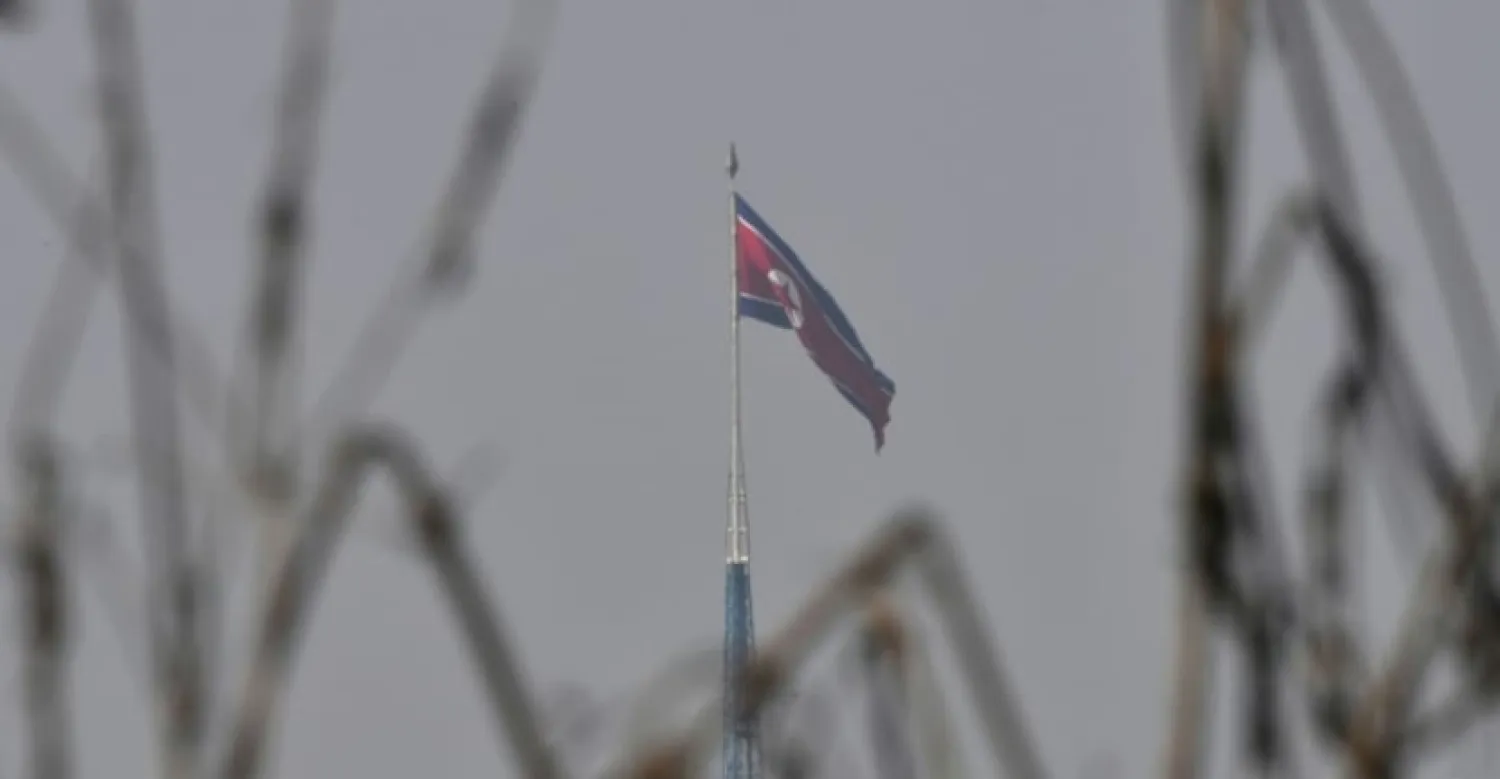

Two South Koreans, Including Army Captain, Arrested for Spying for North

North Korea is known to operate an army of thousands of well-trained hackers who have attacked firms, institutions and researchers in South Korea and elsewhere (Photo: AFP/Jung Yeon-je)
TT

Two South Koreans, Including Army Captain, Arrested for Spying for North

North Korea is known to operate an army of thousands of well-trained hackers who have attacked firms, institutions and researchers in South Korea and elsewhere (Photo: AFP/Jung Yeon-je)

Two South Koreans, including a serving army captain, have been arrested on charges of stealing military secrets for a suspected North Korean agent who paid them in cryptocurrency, Seoul police said Friday.

The nuclear-armed yet impoverished North -- which is technically at war with the South -- is known to operate an army of thousands of well-trained hackers who have attacked firms, institutions and researchers in South Korea and elsewhere, AFP said.

But this is the first case where a South Korean "civilian and an active-duty military captain were caught trying to obtain military secrets, at the behest of a North Korean agent," the police said in a statement.

One of them is a 29-year-old army captain who allegedly passed login information for South Korea's Joint Command & Control System -- a crucial military-run internal communications network -- to the suspected Pyongyang spy, Seoul authorities said.

The other, a 38-year-old businessman who runs a virtual asset management firm, is accused of giving the army captain a wristwatch with a secret camera to aid in intelligence gathering -- at the request of the spy.

The businessman is also suspected of purchasing and assembling a USB-like hacking device called "Poison Tap" to access the Joint Command & Control System, Seoul police said.

"The two men have been arrested on charges of violating the national security law," an official at the Korean National Police Agency told AFP Friday.

Seoul police said the arrested businessman first met the Pyongyang spy in an online community about cryptocurrency around six years ago, and the trio had communicated only via secure messaging service Telegram.

Both were paid in cryptocurrency, the police said. The army captain received about 48 million won ($37,789) from the North Korean agent, while the 38-year-old businessman got around $600,000.

"We will strictly respond to security criminals in accordance to laws and principles," Seoul's prosecution office said in a statement.

North and South Korea remain technically at war since the 1950-53 Korean War ended with the signing of an armistice and not a peace treaty.

Besides having deployed hackers against other countries and companies, the North has also been accused of exploiting its cyber capabilities for financial gain as it looks to shore up its sanctions-hit economy.

Earlier this month US authorities said Pyongyang-linked hackers were responsible for a $620-million cryptocurrency heist in March targeting players of the popular Axie Infinity game.

A rapid rise in house prices and lackluster gains on the local stock market have driven many young South Korean adults to look to cryptocurrencies for quick profits, local media has reported.



Trump Hails Burnham as ‘Natural Business Person’ After First Meeting

 President Donald Trump meets with Britain's Prime Minister Andy Burnham during the United Nations General Assembly, Tuesday, Sept. 22, 2026, at the UN headquarters. (AP)
President Donald Trump meets with Britain's Prime Minister Andy Burnham during the United Nations General Assembly, Tuesday, Sept. 22, 2026, at the UN headquarters. (AP)
TT

Trump Hails Burnham as ‘Natural Business Person’ After First Meeting

 President Donald Trump meets with Britain's Prime Minister Andy Burnham during the United Nations General Assembly, Tuesday, Sept. 22, 2026, at the UN headquarters. (AP)
President Donald Trump meets with Britain's Prime Minister Andy Burnham during the United Nations General Assembly, Tuesday, Sept. 22, 2026, at the UN headquarters. (AP)

US President Donald Trump hailed Andy Burnham on Tuesday as a "natural business person" at what the new British leader's team described as a smooth first face-to-face meeting.

After days of preparation for the Trump meeting, Burnham emerged relatively unscathed, with the US leader only taking issue with what he called a "terrible deal" to cede sovereignty of the Chagos Islands, home to a US-British air base.

Otherwise, Trump praised Burnham, saying Britain's seventh prime minister in a decade was someone with whom he could do business and a patriot who had put Britain on the up after replacing the former prime minister, Keir Starmer, in July.

"I think right now, based on my relationship with the prime minister, Andy, I think that ... we're doing very well," Trump said after they met on the sidelines of the United Nations General Assembly in New York for around 40 minutes.

"I think he's a natural business person. We've had a lot of discussions, even before this meeting we were talking with each other numerous times on the phone."

'ENCOURAGING MEETING'

Burnham, who travelled to New York on Monday to take part in the UN assembly, had ‌said little beforehand ‌about his expectations for the meeting with Trump, saying only that in their two phone calls he ‌had found "a ⁠connection" with the ⁠US president.

Afterwards, he repeated that earlier conversations had established that connection "and that very much came through today".

"(I) can certainly work with him. It was a very encouraging meeting," Burnham told reporters, saying the two leaders had found "common ground" on dealing with cost-of-living pressures, ending the conflict in the Middle East and reindustrializing nations to spur economic growth, among other issues.

"He was very upbeat about the country's (Britain's) prospects, which, to be honest, was great to hear."

Before arriving in New York, Burnham had sought common ground with Trump on AI, a focus of his comments to the UN on Monday in which he described the technology as having the ability to bring "huge benefits" to the British and global economy.

Trump has said he wants to cherish AI rather than stifle its growth, dismissing fears ⁠about it as a hoax and "sick conspiracy". The US leader has said concerns can be addressed through the ‌existing justice system without extra regulation — an issue that might cause some friction with Britain.

Yet, ‌while the two leaders seemed to find common ground on a number of issues, there were some pitfalls.

Trump again criticized Britain's move, under Starmer, to cede ‌sovereignty of the Chagos Islands while retaining control of Diego Garcia air base on a 99-year lease.

Trump called the agreement with Mauritius, ‌now on hold, a "terrible" deal. "It's amazing how strategic it is, and I think the prime minister is going to be looking at it," he said.

Burnham later told reporters he had inherited the problem and would work to find a resolution between the different sides. "It was clear that we need to come to that agreement, but I'm confident we can find it working with our US partners," he said.

Burnham also showed a willingness to disagree with Trump if it is ‌in his nation's interest, saying he would "stand firm in the face of any threats" to the right of Falkland Islanders to self-determination and to remain British.

In August, Trump said he was reviewing the ⁠United States' neutral position on the ⁠remote archipelago in the South Atlantic. Days later Argentine President Javier Milei — who will address the UN on Wednesday — said he would impose sanctions on oil companies drilling in the islands.

And the British leader navigated some other bilateral sticking points. Trump appeared unmoved over Britain's decision to block imports from Israeli settlements in the occupied West Bank, while its decision not to back the US over the Iran war was also skated over.

OPENS WAY FOR BURNHAM TO FOCUS ON AI

With the meeting done, Burnham turns his focus for UNGA to AI and his support for the technology, which he hopes will help Britain assume a leading role globally.

At an earlier business roundtable, Burnham said he would make the case for Britain in a speech later on Tuesday to help establish "a single set of global principles and standards" to unlock the potential of AI.

Describing Britain as being stuck in 10 years of political turbulence since voting to leave the European Union in 2016, Burnham told business leaders he wanted to usher in a period of stability and embrace AI, while being clear-eyed on the risks.

"So outside Downing Street, on my first day, I said I want to be the circuit breaker," he told the roundtable, including Tim Cook, executive chairman of Apple, and Citigroup CEO Jane Fraser.

"(To) bring forward a very clear path that everyone can understand, a 10-year plan for Britain ... so that nobody's in any doubt at all about what we're trying to do."


Trump Renames AI ‘Super Intelligence’ as Leaders Jostle Over Dangers

US President Donald Trump speaks during the 81st session of the UN General Assembly at the UN Headquarters on September 22, 2026 in New York City. (Getty Images/AFP)
TT

Trump Renames AI ‘Super Intelligence’ as Leaders Jostle Over Dangers

US President Donald Trump speaks during the 81st session of the UN General Assembly at the UN Headquarters on September 22, 2026 in New York City. (Getty Images/AFP)

President Donald Trump on Tuesday announced that the US government would rename artificial intelligence "super intelligence" in official communications, as world leaders jostled over how to address the dangers of the fast-advancing technology.

AI has become a major topic at the UN General Assembly after incidents of the technology falling out of the control of humans and warnings by company insiders drew global alarm and calls for better government supervision of the industry.

Speaking to the assembly, Trump stood by his firm opposition to regulating AI, while arguing the word "artificial" undersold the technology and voicing hope the rest of the world would adopt the new term.

Super Intelligence "sounds much better" and "it's much more accurate," he said.

The rebrand is the latest in a series of renamings pursued by the Trump administration, which changed the Gulf of Mexico to the "Gulf of America" via executive order last year and, in August, renamed Lake Ontario "Lake America" amid a trade dispute with Canada.

The US leader also compared the warnings of AI safety advocates to warnings about climate change, whose human causes are affirmed by the overwhelming consensus of the scientific community.

"The United States totally rejects any attempt to construct a globalist scheme to control... artificial intelligence," he said.

"Every major new technology brings challenges, and superintelligence is no exception," he added.

"The very same people who said we'll all be dead in 12 years because of global warming... are now saying that AI is going to kill us all, that robots are going to attack us, and that everything is going to be a total disaster."

Ahead of the UN assembly, leaders of more than 20 mostly European countries urged binding safety measures for advanced AI, warning that the technology's development could outpace the ability to control it.

AI superpowers China and the United States did not endorse the idea.

- 'Vassals' -

Speaking on the sidelines of the UN meeting, Prime Minister Andy Burnham said he planned to use Britain's role as host of the Group of 20 next year to push for a "single set of global principles and standards" around AI, according to Bloomberg.

French President Emmanuel Macron proposed building AI technology independent from the great powers.

"I don't want anyone to become the vassal of one of the great powers," Macron told the UN General Assembly, apparently in reference to China and the US.

"Our investment capabilities must be pooled to build a cutting-edge open-source AI model, which we will share. We should not depend on somebody else."

The US-based AI giants themselves are increasingly asking for global coordination on AI safety, with OpenAI's Sam Altman set to address the UN Security Council on Wednesday.

Anthropic chief Dario Amodei and Hugging Face co-founder Clement Delangue will also participate remotely, a French official said Tuesday.

France, which holds the Security Council presidency this month, initiated the meeting and believes AI's threat to international peace and security has not been sufficiently discussed at the UN.

UN chief Antonio Guterres, meanwhile, called for the US and China to start a dialogue on the technology's future akin to US-Soviet engagement at the height of the Cold War.

"Governments with the greatest AI capabilities have the greatest responsibilities to humanity, to establish channels for dialogue," Guterres said in his address to the assembly.

"At a pivotal moment during the Cold War, strategic rivals came to recognize the need to manage shared existential risks."

China and the US are currently discussing creating a communication channel for AI concerns in anticipation of a Washington summit meeting between Trump and Chinese President Xi Jinping on Thursday.


Zelenskiy Says He Discussed Energy Truce, Efforts to End Russia War with Trump

US President Donald Trump and Ukraine's President Volodymyr Zelenskiy react as they meet during the 81st United Nations General Assembly (UNGA) in New York City, US, September 22, 2026. (Reuters)
TT

Zelenskiy Says He Discussed Energy Truce, Efforts to End Russia War with Trump

US President Donald Trump and Ukraine's President Volodymyr Zelenskiy react as they meet during the 81st United Nations General Assembly (UNGA) in New York City, US, September 22, 2026. (Reuters)

Ukrainian leader Volodymyr Zelenskiy said on Tuesday he discussed with US President Donald Trump efforts to end the 4-year-old war with Russia, including a potential bilateral ceasefire on energy-related targets.

Speaking to the media after a 40-minute meeting with Trump at UN headquarters in New York, Zelenskiy said Kyiv was ready for any format of an energy ceasefire with Moscow, but there had been no discussion of Ukraine unilaterally halting its attacks on Russian oil refineries.

Trump, whose approval ratings have slumped to a record low amid high gas prices ahead of the US midterm elections in November, had expressed concern in recent days over ‌the extensive damage done ‌to Russia's fuel-processing capacity, which he said was stoking diesel prices globally.

Zelenskiy reiterated ‌that ⁠he was ready ⁠to meet Russian President Vladimir Putin at a trilateral meeting with Trump, adding that he hoped the US would find a way to bring Moscow back to the negotiating table after talks unraveled earlier this year.

Zelenskiy, however, said he had seen no indication that Putin was ready to talk.

"I'm ready for a trilateral meeting. It means that I'm agreed to end the war," Zelenskiy said.

Before their meeting, Trump told reporters that he and Zelenskiy would discuss Ukrainian attacks on oil refineries.

"It is a serious hit on the Russians. It's ⁠also a serious hit on the price of diesel," said Trump.

He said he ‌and Zelenskiy would also talk about solutions for ending the ‌war, which began with Russia's full-scale invasion of Ukraine in 2022.

"I think it's going to happen," Trump said.

The ‌US leader announced last week that Ukraine and Russia had agreed not to strike energy targets, ‌but any semblance of a truce disappeared when Russia hit petrol stations in Kyiv the following day and Ukraine bombed a Russian oil refinery.

Zelenskiy also met with UK Prime Minister Andy Burnham, who said he lobbied Trump to press for a Ukraine-Russia energy ceasefire in his meeting with his Ukrainian counterpart. Burnham also promised further financial support ‌to Kyiv for infrastructure.

AERIAL ATTACKS

Intensifying aerial attacks by both sides in the Ukraine war in recent weeks have battered ports, warehouses, ships and energy infrastructure, as ⁠well as crippling ⁠Black Sea grain exports.

Amid fears in Ukraine that Russia will once again pound its heating and power facilities as winter approaches, Zelenskiy said he had discussed preparations with Trump and asked the US for a package of Patriot air defense missiles — the only weapon in Ukraine's arsenal capable of downing Russia's ballistic missiles.

The US war in Iran and the Ukraine war have depleted global supplies of Patriots, including US inventories.

Zelenskiy said that, in return for Patriots from US stockpiles this winter, Ukraine would swap future supplies of interceptors from its deal with Germany, which has agreed to provide Ukraine with 600 Patriots in 2027 and 2028.

He told reporters it was a "good step" that the idea was not rejected but acknowledged that Trump had not yet agreed to the proposal.

Zelenskiy said that discussions for Ukraine to begin licensed production of Patriots itself were still ongoing, and a member of his team had held a positive meeting with Raytheon, a US producer of Patriots.