

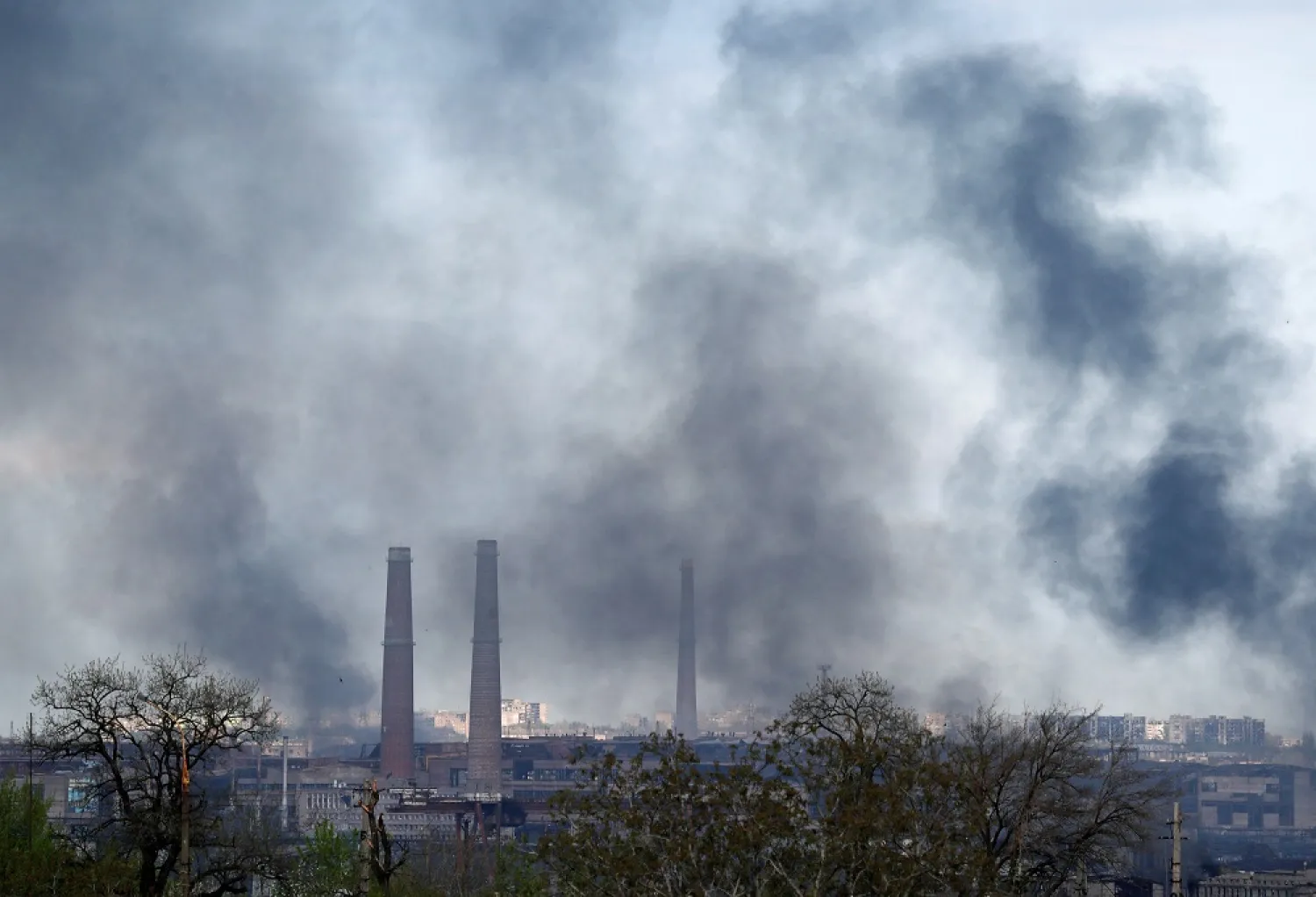

Russia Unleashes Rockets at Steel Plant, Some Evacuees Reach Safety

Smoke rises above a plant of Azovstal Iron and Steel Works during Ukraine-Russia conflict in the southern port city of Mariupol, Ukraine May 2, 2022. (Reuters)
TT

Russia Unleashes Rockets at Steel Plant, Some Evacuees Reach Safety

Smoke rises above a plant of Azovstal Iron and Steel Works during Ukraine-Russia conflict in the southern port city of Mariupol, Ukraine May 2, 2022. (Reuters)

Russia unleashed rockets on Tuesday on an encircled steel works in Mariupol, Ukraine's last redoubt in the port city, after a ceasefire broke down with some civilians still trapped beneath the sprawling site despite a UN-brokered evacuation.

However, scores of exhausted-looking evacuees who managed to leave under UN and Red Cross auspices at the weekend after cowering for weeks under the Azovstal plant finally reached the relative safety of Ukraine-controlled Zaporizhzhia.

"We would have hoped that many more people would have been able to join the convoy and get out of hell. That is why we have mixed feelings," Pascal Hundt from the International Committee of the Red Cross (ICRC) told journalists by Zoom.

Nearly 10 weeks into a war that has killed thousands, flattened cities, and driven five million Ukrainians to flee abroad, Kremlin chief Vladimir Putin raised the economic stakes for Kyiv's Western backers on Tuesday by announcing plans to block the export of vital Russian raw materials.

Russia has turned its heaviest firepower on Ukraine's east and south since failing to take Kyiv, the capital, in March.

But it has also struck targets much further west in a drive to limit Ukraine's access to the Black Sea, vital for its grain and metal exports, and also to disrupt supplies of Western military aid to President Volodymyr Zelenskiy's forces.

On Tuesday Russia's defense ministry said its forces had struck a military airfield near the port of Odesa with missiles, destroying drones, missiles and ammunition supplied to Ukraine by the United States and its European allies.

'Ukraine's finest hour'
The European Union said new sanctions on Russia would target its oil industry and banks, and that it also planned to replace two thirds of its Russian gas use by the end of 2022, part of efforts to squeeze Moscow's war-chest.

The US Congress is considering a $33 billion military aid package, and British Prime Minister Boris Johnson announced a further 300 million pounds ($375 million) in aid, including electronic warfare equipment and a counter-battery radar system.

"This is Ukraine's finest hour, (one) that will be remembered and recounted for generations to come," Johnson told Ukraine's parliament via videolink. He was channeling the words spoken by Winston Churchill in 1940 when Britain faced the threat of being invaded and defeated by Nazi Germany.

French President Emmanuel Macron urged Putin in a phone call on Tuesday to order an immediate ceasefire in Ukraine and to lift Russia's embargo on Ukrainian exports via the Black Sea. Putin said Russia remained open to dialogue, the Kremlin said.

German Chancellor Olaf Scholz said Putin's policies were "imperialistic", and that he would support Finland and Sweden if they decided to join NATO, as each is now considering.

"No one can assume that the Russian president and government will not on other occasions break international law with violence," said Scholz, who in the past has been accused of being too soft on Moscow but has now thrown Germany's support behind the EU plans for a ban on Russian oil imports.

EU countries have paid more than 47 billion euros ($47.43 billion) to Russia for gas and oil since it invaded Ukraine, according to research organization the Center for Research on Energy and Clean Air.

Under the decree signed by Putin on Tuesday, Russia's government has 10 days in which to draw up a sanctions list targeting specific people and entities in "unfriendly" states.

Hit by some of the severest sanctions in modern history over its invasion of Ukraine, Russia's own $1.8 trillion economy is heading for its biggest contraction since the years following the 1991 break-up of the Soviet Union.

'Powerful assault'
Osnat Lubrani, UN humanitarian coordinator for Ukraine, said 101 evacuees including young children and pensioners had reached Zaporizhzhia on Tuesday from Mariupol.

"I can't believe I made it, we just want rest," said Alina Kozitskaya, who spent weeks sheltering in a basement with her bags packed waiting for a chance to escape.

Mariupol, a city of 400,000 before Russia launched its invasion on Feb. 24, has seen the bloodiest fighting of the war, enduring weeks of siege and shelling. Some 100,000 civilians are still in the devastated city, now under Russian control.

"You wake up in the morning and you cry. You cry in the evening. I don't know where to go at all," said Mariupol resident Tatyana Bushlanova, sitting by a blackened apartment block and talking over the sound of shells exploding nearby.

In a Telegram video from the steel plant, Captain Sviatoslav Palamar of Ukraine's Azov Regiment said Russia had pounded Azovstal with naval and barrel artillery through the night and dropped heavy bombs from planes.

Reuters could not independently verify his account. However, Reuters images on Monday showed volleys of rockets fired from a Russian truck-mounted launcher towards Azovstal.

"As of this moment, a powerful assault on the territory of the Azovstal plant is underway with the support of armored vehicles, tanks, attempts to land on boats and a large number of infantry," Palamar said.

Russia calls its actions a "special operation" to disarm Ukraine and protect it from fascists. Ukraine and the West say the fascist allegation is baseless and that the war is an unprovoked act of aggression.

At least 10 people were killed and 15 wounded by Russian shelling of a coking plant in the city of Avdiivka in the Donetsk region of eastern Ukraine on Tuesday, the regional governor said. The Ukrainian president's office said earlier other areas of Donetsk were under constant fire.

Ukraine's prosecutor general, visiting the shattered town of Irpin near Kyiv on Tuesday, accused Russia of using rape as a tactic of war.

Iryna Venediktova also described Putin as "the main war criminal of the 21st century".

Russia denies targeting civilians and rejects charges that its forces have committed war crimes.



Iran Hangs 18-Year-Old Over Protests in Latest Wartime Execution, Say Activists

Iranians walk at a park on Nature Day, amid the US-Israeli conflict with Iran, in Tehran, Iran, April 2, 2026. Majid Asgaripour/WANA (West Asia News Agency) via Reuters
TT

Iran Hangs 18-Year-Old Over Protests in Latest Wartime Execution, Say Activists

Iranians walk at a park on Nature Day, amid the US-Israeli conflict with Iran, in Tehran, Iran, April 2, 2026. Majid Asgaripour/WANA (West Asia News Agency) via Reuters

Iranian authorities Thursday executed a teenager convicted over January protests after a fast-track trial rights groups labelled as "grossly unfair", as the country ramps up executions during the war with the US and Israel.

Amir Hossein Hatami, 18, was sentenced to death in February along with six others by a Tehran revolutionary court and was hanged at dawn in the notorious Ghezel Hesar prison outside the capital, according to Norway-based NGO Iran Human Rights.

The Iranian judiciary's Mizan Online website said he acted "against national security" on behalf of Israel and the United States by breaking into "a military center and destroying it in order to seize the weapons stored there" during the protests.

But Amnesty International said it was "outraged by the arbitrary execution of the teenage protester", adding the trial was "grossly unfair" and that he had been sentenced to death less than a month after his arrest.

Hatami is the fourth man to be executed over protests that broke out in Iran in late December against the rising cost of living before evolving into nationwide anti-government demonstrations. The protests peaked on January 8 and 9 and were met with a crackdown that activists say left thousands dead.

On March 19, authorities executed three men convicted of killing police in the protests, including 19-year-old Saleh Mohammadi, a wrestler who took part in international competitions.

This week, authorities have hanged four men convicted on charges of rebellion for membership in the banned People's Mujahedin of Iran (MEK) after their sentences were upheld by the supreme court.

Hatami "was subjected to torture and sentenced based on forced confessions in a grossly unfair trial before the revolutionary Court," said IHR director Mahmood Amiry-Moghaddam.

"In the past two weeks alone, three protesters and four political prisoners have been executed, and hundreds more remain at imminent risk," he added. IHR said that just 84 days had elapsed between his arrest and execution.

- 'Tool of repression' -

The seven were accused of setting fire to a base belonging to the Basij militia -- a volunteer force of the Revolutionary Guards -- in Tehran during the protests.

But defense lawyers accused plainclothes forces of trapping protesters inside a building, locking the doors, and themselves starting the fire.

Amnesty International said that the execution showed the judiciary is "a tool of repression sending individuals to the gallows to spread fear and exacting revenge on those demanding fundamental political change".

IHR said the seven men had been convicted in the fast track-trial -- just a month after their arrest -- by the court presided over by the notorious judge Abolqasem Salavati.

Salavati was sanctioned in 2019 by the United States, which said he is known as the "Judge of Death" for his frequent death sentences.

The executions came amid Iran's war with Israel and the United States which erupted on February 28 with strikes that killed the Islamic republic's supreme leader, Ali Khamenei.

"Hundreds more now face imminent executions in the coming days and weeks," warned Amiry-Moghaddam.


Austria Denies US Use of Airspace for Iran Military Operations

18 March 2026, ---: A US Navy F/A-18E Super Hornet with the Tomcatters of Strike Fighter Squadron 31 launches from the flight deck of the Ford-class aircraft carrier USS Gerald R. Ford in support of Operation Epic Fury. (Navy Handout/US Navy/Planet Pix via ZUMA Press Wire/dpa)
TT

Austria Denies US Use of Airspace for Iran Military Operations

18 March 2026, ---: A US Navy F/A-18E Super Hornet with the Tomcatters of Strike Fighter Squadron 31 launches from the flight deck of the Ford-class aircraft carrier USS Gerald R. Ford in support of Operation Epic Fury. (Navy Handout/US Navy/Planet Pix via ZUMA Press Wire/dpa)

Austria has denied the United States use of its airspace for military operations against Iran due to Austria's neutrality law, the country's defense ‌ministry said ‌on Thursday.

A spokesperson ‌for ⁠the ministry confirmed ⁠a report from Austrian news agency APA that the US had made "several" flyover requests to ⁠Austria, without specifying ‌how ‌many.

All US flyover requests ‌of a military ‌nature relating to the conflict in Iran had been rejected, the spokesperson ‌said.

Austria applies the same principle to ⁠other ⁠countries that are engaged in military conflict, the spokesperson added.

Individual cases were reviewed in consultation with the Austrian foreign ministry, the APA report noted.


Iran Fires on Israel as Trump Claims Threat from Tehran Nearly Eliminated

Iranian women clad in black chadors wave national flags and hold posters of Iranian Supreme Leader Mojtaba Khamenei (C) and of his late father, former Iranian Supreme Leader Ali Khamenei (R), during the annual Nature Day festival in Tehran, Iran, 02 April 2026. (EPA)
TT

Iran Fires on Israel as Trump Claims Threat from Tehran Nearly Eliminated

Iranian women clad in black chadors wave national flags and hold posters of Iranian Supreme Leader Mojtaba Khamenei (C) and of his late father, former Iranian Supreme Leader Ali Khamenei (R), during the annual Nature Day festival in Tehran, Iran, 02 April 2026. (EPA)

Iran fired more missiles at Israel and Gulf Arab states Thursday, demonstrating Tehran’s continued ability to strike its neighbors even as US President Donald Trump claimed the threat from the country was nearly eliminated.

Iran’s attacks on Gulf states along with its chokehold on the Strait of Hormuz have disrupted the world’s energy supplies with effects far beyond the Middle East. That has proved to be Iran’s greatest strategic advantage in the war. Britain held a call with nearly three dozen countries about how to reopen the strait once the fighting is over.

Trump has insisted the strait can be taken by force — but said it is not up to the US to do that. In an address to the American people Wednesday night, he encouraged countries that depend on oil from Hormuz to “build some delayed courage” and go “take it.”

Before the US and Israel started the war on Feb. 28 with strikes on Iran, the waterway was open to traffic and 20% of all traded oil passed through it.

Iran continues to strike Israel

Iran responded defiantly to Trump’s speech, in which the American president claimed US military action had been so decisive that “one of the most powerful countries” is “really no longer a threat.”

A spokesman for Iran’s military, Lt. Col. Ebrahim Zolfaghari, insisted Thursday that Tehran maintains hidden stockpiles of arms, munitions and production facilities. He said facilities targeted so far by US strikes are “insignificant.”

Just before Trump began his address — in which he said US “core strategic objectives are nearing completion” — explosions were heard in Dubai as air defenses worked to intercept an Iranian missile barrage.

Less than a half-hour after the president was done, Israel said its military was also working to intercept incoming missiles. Sirens sounded in Bahrain immediately after the speech.

Attacks continued across Iran on Thursday, with strikes reported in multiple cities.

Even amid the conflict, families went to a park in Tehran to play games and grill food to mark the last day of Iranian New Year, or Nowruz.

In Lebanon — home to Iran-backed Hezbollah who is fighting Israel, which has launched a ground invasion — an Israeli strike killed four people in the south, the Health Ministry said.

More than 1,900 people have been killed in Iran during the war, while 19 have been reported dead in Israel. More than two dozen people have died in Gulf states and the occupied West Bank, while 13 US service members have been killed.

More than 1,300 people have been killed and more than 1 million displaced in Lebanon. Ten Israeli soldiers have also died there.

Nearly three dozen nations talk about securing the Strait of Hormuz

Iranian attacks on about two dozen commercial ships, and the threat of more, have halted nearly all traffic in the waterway that connects the Gulf to the open ocean.

Since March 1, traffic through the strait has dropped 94% over the same period last year, according to the Lloyds List Intelligence shipping data firm. Two ships are confirmed to have paid a fee, the firm said, while others were allowed through based on agreements with their home governments.

Saudi Arabia piped about 1 billion barrels of oil away from the Strait of Hormuz in March, according to maritime data firm Kpler, while Iraq said Thursday that it had started to truck oil across Syria to avoid the strait.

The 35 countries that spoke Thursday, including all G7 countries except the US, as well as the United Arab Emirates and Bahrain, signed a declaration last month demanding Iran stop blocking the strait.

Thursday’s talks were focused on political and diplomatic measures, but British Foreign Secretary Yvette Cooper said military planners from an unspecified number of countries will also plot ways to ensure security once fighting ends, including potential mine-clearing work and “reassurance” for commercial shipping.

No country appears willing to try to open the strait by force while the war is raging. French President Emmanuel Macron, while on a visit to South Korea, called a military operation to secure the waterway “unrealistic.”

But there is a concern that Iran might limit traffic through the waterway even after US and Israeli attacks cease.

The idea of an international effort has echoes of the “coalition of the willing,” led by the UK and France, that was assembled to underpin Ukraine’s security in the event of a ceasefire in that war. The coalition is, in part, an attempt to demonstrate to Washington that Europe is doing more for its own security in the face of frequent criticism from Trump.

Oil prices rise again

The conflict is driving up prices for oil and natural gas, roiling stock markets, pushing up the cost of gasoline and threatening to make a range of goods, including food, more expensive.

On Thursday, Brent crude, the international standard, rose again and was around $108, up about 50% from Feb. 28.

Though the oil and gas that typically transits the strait is primarily sold to Asian nations, Japan and South Korea were the only two countries from the region joining Thursday's call about the strait. The supply of jet fuel has also been interrupted, with consequences for travel worldwide.