Embattled Israeli Leader Vows to Keep Government Afloat

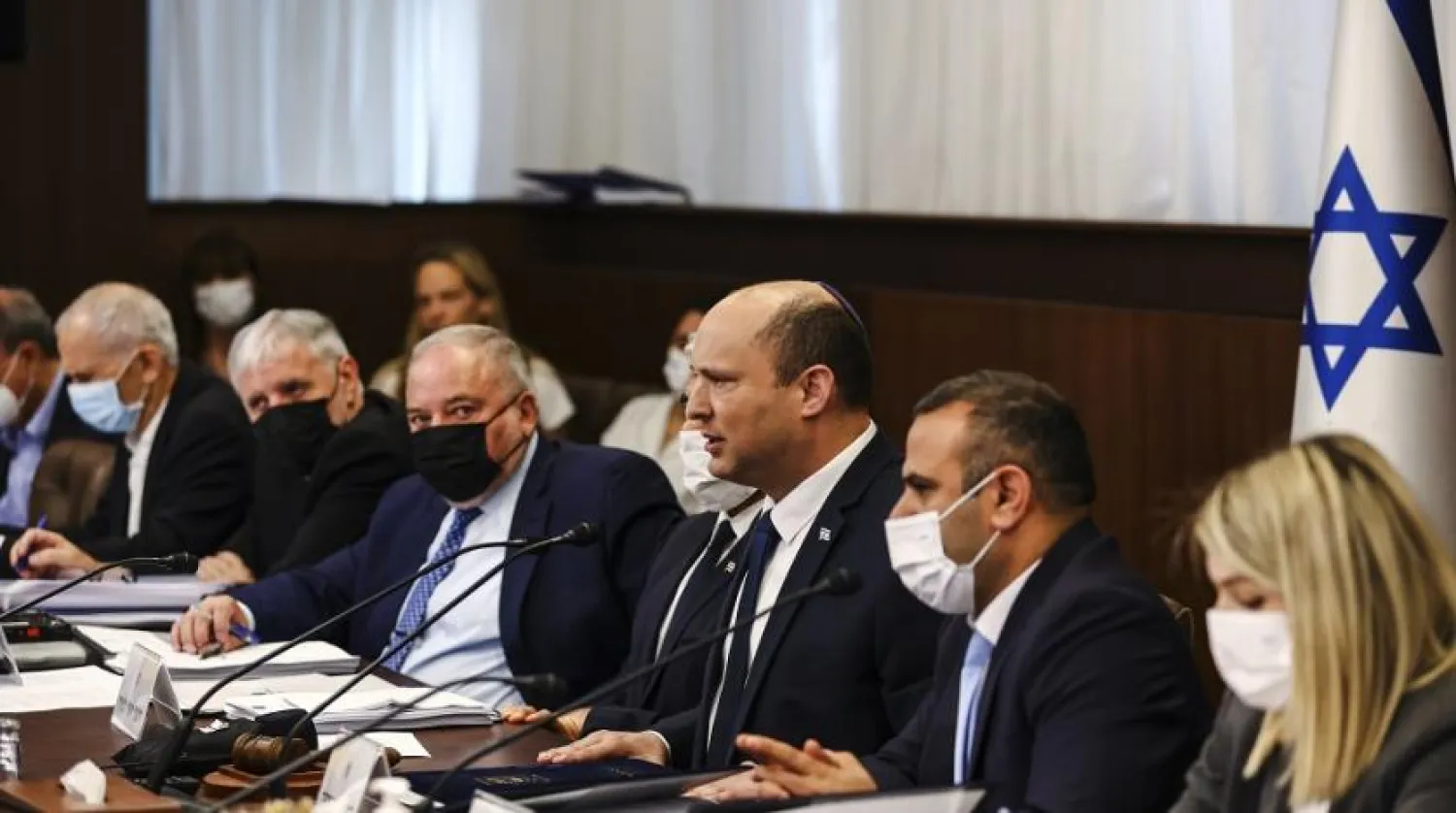
Israeli Prime Minister Naftali Bennett speaks at a cabinet meeting at the Prime Minister's office in Jerusalem Sunday, April 10, 2022. (AP)
TT

Embattled Israeli Leader Vows to Keep Government Afloat

Israeli Prime Minister Naftali Bennett speaks at a cabinet meeting at the Prime Minister's office in Jerusalem Sunday, April 10, 2022. (AP)

Israel's embattled prime minister on Monday vowed to continue to lead the country as his shaky government limped into the opening of parliament's summer session on the verge of collapse.

Less than a year after taking office, Naftali Bennett has lost his parliamentary majority, his own party is crumbling and a key governing partner has suspended cooperation with the coalition. That has set the stage for a possible attempt by the opposition, led by former Prime Minister Benjamin Netanyahu, to topple the government later this week.

While Bennett appears to be poised to fend off this immediate challenge, his longer-term prospects are uncertain at a time when the government is deeply divided over major issues, Israel is facing an ongoing wave of stabbings and shootings by lone-wolf Palestinian attackers and a confrontation with the United States over West Bank settlement construction is looming.

Boaz Toporovsky, the acting coalition chairman, acknowledged the coalition is in the midst of a "serious crisis" but said he was optimistic it would survive. "Everyone understands that we’re at a crossroads that can bring about, heaven forbid, elections in Israel," he told the Israeli public broadcaster Kan early Monday.

The new government made history when it took office last June, ending prolonged deadlock in which the country went through four rounds of inconclusive elections in just two years. Racing to head off what would have been another election, Bennett cobbled together a diverse coalition of eight parties with little in common beyond their shared animosity toward Netanyahu.

The new coalition, including hard-line religious nationalists that oppose Palestinian statehood, dovish left-wingers and for the first time in an Israeli coalition, an Islamist Arab party, agreed to sideline the country’s most divisive issues and focus on areas of broad consensus.

The government has managed to pass a budget, navigate the coronavirus pandemic and strengthen relations with both the Biden administration and Israel’s Arab countries. Bennett also has emerged as a surprising mediator in the Ukraine-Russia war, regularly speaking to the leaders of both countries.

Although Bennett, who leads a small religious-nationalist party, has ruled out peace talks with the Palestinians, he has tried to reduce tensions by taking steps to improve living conditions in the occupied West Bank and Gaza Strip.

This cautious approach has repeatedly been tested. One member of Bennett’s Yamina party defected when the government took office, accusing him of abandoning their nationalist ideology. A second member followed suit last month, leaving the coalition and opposition equally divided in the 120-seat parliament.

Weeks of Israeli-Palestinian violence, much of it fueled by tensions and fighting at Jerusalem’s most sensitive holy site, prompted Mansour Abbas, leader of the Islamist Arab Ra’am faction in the coalition, to suspend cooperation. Abbas has not said whether he will resume cooperation or join the opposition in attempts to topple the coalition this week.

"We’re in a not so simple crisis with Ra’am," Toporovsky said, adding that he understood the Islamist party's disappointment in the slow pace of effecting change for Israel's Arab citizens.

A public opinion survey in April by the Israel Democracy Institute found that only 30% of respondents believed the government was likely to survive the year, down from 49% in February. The think tank polled 751 Israeli Jews and Arabs, and reported a margin of error of 3.65 percentage points.

Netanyahu is weighing whether to introduce a motion this week to dissolve parliament and trigger new elections. Such a move is risky. It would require at least one of the remaining members of the coalition to join him, and there is no guarantee that will happen. If he fails, he would not be able to introduce a similar motion for the next six months as an ongoing corruption trial against Netanyahu moves ahead.

A pair of no-confidence motions floated by the opposition on Monday quickly failed. That prompted Bennett and his main coalition partner, Foreign Minister Yair Lapid, to release a video together on Twitter saying they had defied the skeptics.

"We are going to continue with victories, to sustain an excellent government in the state of Israel for the citizens of Israel," Bennett said.

Yohanan Plesner, a former lawmaker who is now president of the Israel Democracy Institute, said he expects the coalition to weather the storm, at least in the short term.

He said that even unhappy coalition members would have much to lose if the country were to plunge into new elections. Abbas, for instance, is just beginning to see the huge budgets he has secured to flow into the impoverished Arab communities he represents.

But any member of the coalition can now pressure the government into pushing pet projects opposed by other partners. This week, an Israeli planning committee is expected to approve plans to build some 4,000 new homes in Jewish settlements in the occupied West Bank, despite vociferous opposition from the United States and most of the international community. The construction project is being pushed by members of Bennett’s own party, which draws much of its support from the settler community.

"The next few days will allow us to know whether the coalition is in critical but stable condition or critical but unstable condition," Plesner said. "The immediate areas to look at are either the Ra'am party, as a whole or parts of it, or elements from within Yamina."


Le Pen Says France Will No Longer Aid Ukraine ‘Financially’ if Elected

Marine Le Pen (C), the far-right National Rally (RN) party's candidate for the 2027 French presidential election, visits the "Made in France" fair at the Porte de Versailles exhibition center in Paris, France, 13 November 2026. (EPA)
TT

Le Pen Says France Will No Longer Aid Ukraine ‘Financially’ if Elected

Marine Le Pen (C), the far-right National Rally (RN) party's candidate for the 2027 French presidential election, visits the "Made in France" fair at the Porte de Versailles exhibition center in Paris, France, 13 November 2026. (EPA)

Marine Le Pen on Monday said that France would provide no further financial aid to Ukraine if she is elected president next year, after a meeting with Kyiv's ambassador in Paris.

"The state of France's public finances would no longer allow the country to provide financial assistance to Ukraine in the coming months," Le Pen said in a statement, while insisting France would honor existing commitments, including toward a 90-billion-euro ($100-billion) European Union loan.

Le Pen is currently ahead in polls in the race to succeed President Emmanuel Macron next year, as the war sparked by Russia's 2022 full-scale invasion of Ukraine grinds towards its fifth anniversary.

She has faced criticism over past links to Russia, which included a 2017 meeting in the Kremlin with President Vladimir Putin and her party taking a loan from a Russian bank that it paid off in full in 2023.

But she has opposed the invasion and, at her talks in Paris with Ukrainian ambassador Vadym Omelchenko, Le Pen made clear her "unwavering support for Ukraine since the beginning of the conflict".

The statement said the talks -- the first such between Le Pen and the Ukrainian ambassador -- were "cordial".

While financial aid would be cut, Le Pen told the ambassador that "France would continue to support Ukraine through donations of equipment, humanitarian aid and much more active diplomacy".

The statement said there was a "frank discussion" on the future of the conflict, with Le Pen stressing that "the pursuit of peace -- though a difficult goal to achieve -- must remain a priority for all".

She also asked the ambassador to tell President Volodymyr Zelensky she is ready to meet in "either Paris or Brussels". However, there was no mention of the candidate making the journey to Kyiv after Zelensky invited her to visit the Ukrainian capital.

Le Pen's opponents have expressed alarm that by emphasizing the importance of ending the war swiftly, she could force Ukraine to capitulate on unfavorable terms.

"If Russia imposes its will on a European nation through brutality, all of Europe is weakened," Macron wrote on Facebook at the weekend.

Taking aim at Le Pen, he said: "Let us be clear: those who seek to limit the resources available to Ukraine are, in effect, pushing for an unjust peace -- one that would leave Ukraine permanently vulnerable, and, by extension, leave Europe vulnerable as well."


Trump Says He Might Meet with North Korea’s Kim Jong Un in China

US President Donald Trump and North Korean leader Kim Jong Un shake hands before their one-on-one chat during the second US-North Korea summit at the Metropole Hotel in Hanoi, Vietnam February 27, 2019. (Reuters)
TT

Trump Says He Might Meet with North Korea’s Kim Jong Un in China

US President Donald Trump and North Korean leader Kim Jong Un shake hands before their one-on-one chat during the second US-North Korea summit at the Metropole Hotel in Hanoi, Vietnam February 27, 2019. (Reuters)

US President Donald Trump said on Monday he might meet with North Korean leader Kim Jong Un in China this week, an announcement that could dramatically reshape his upcoming trip through East Asia if it occurs.

The president, who met the North Korean leader several times during his 2017-2021 term, including once in the Korean Demilitarized Zone, has previously expressed ‌interest in ‌another meeting during his current term. Senior ‌US ⁠officials, however, have previously ⁠said he has no immediate plans to do so.

Moreover, Trump has repeatedly previewed meetings with Kim that never took place, including during a trip to Asia last year. North Korea, whose mission to the United Nations did not immediately respond to a ⁠request for comment, has publicly indicated it ‌has no intention of ‌meeting with the US president at this time.

Trump told reporters ‌while departing the White House en route to ‌the Philippines and China that any meeting would occur in China, and that the North Korean leader's presence was ultimately up to Chinese President Xi Jinping.

"(Xi) was here a ‌month ago, and we're also going to meet with (Russian) President Putin, and we ⁠may ⁠meet with Kim Jong Un also," Trump said.

"So that'll be good. We have a chance to accomplish a lot."

Trump has indicated he will meet with Putin and Xi during his trip, but US officials and analysts have played down the possibility of a meaningful agreement emerging from any trilateral sit-down.

Among the possible topics of conversation, Trump and others have said, are Russia's invasion of Ukraine, counterproliferation and the war in Iran.


Third US Aircraft Carrier Arrives in Middle East

This US Navy handout photograph released by US Naval Forces Central Command on November 4, 2026, shows the Nimitz-class aircraft carrier USS Theodore Roosevelt (CVN 71) sails alongside Royal Australian Navy Supply-class replenishment oiler HMAS Stalwart (A304). (AFP / NAVCENT Public Affairs / US Navy)
TT

Third US Aircraft Carrier Arrives in Middle East

This US Navy handout photograph released by US Naval Forces Central Command on November 4, 2026, shows the Nimitz-class aircraft carrier USS Theodore Roosevelt (CVN 71) sails alongside Royal Australian Navy Supply-class replenishment oiler HMAS Stalwart (A304). (AFP / NAVCENT Public Affairs / US Navy)

The USS Theodore Roosevelt aircraft carrier arrived in the Middle East on Sunday, media reports said, bringing the number of American carrier strike groups in the region to three.

The deployment, which was reported by the National News and Axios journalist Barak Ravid, comes as fighting reignites in the region, with Iran claiming a drone attack on Bahrain on Sunday, ending a lull in strikes in the war.

Iran also fired drones at Bahrain on Friday -- the first strikes since September against countries in the energy-rich Gulf, which has been targeted several times in the conflict that erupted in February.

US President Donald Trump plans to discuss the war at a trilateral meeting with his Chinese and Russian counterparts Xi Jinping and Vladimir Putin this week, an official said Friday.

Months of diplomacy have failed to resolve the war, which began with US-Israeli strikes that killed Iran's supreme leader Ali Khamenei.