

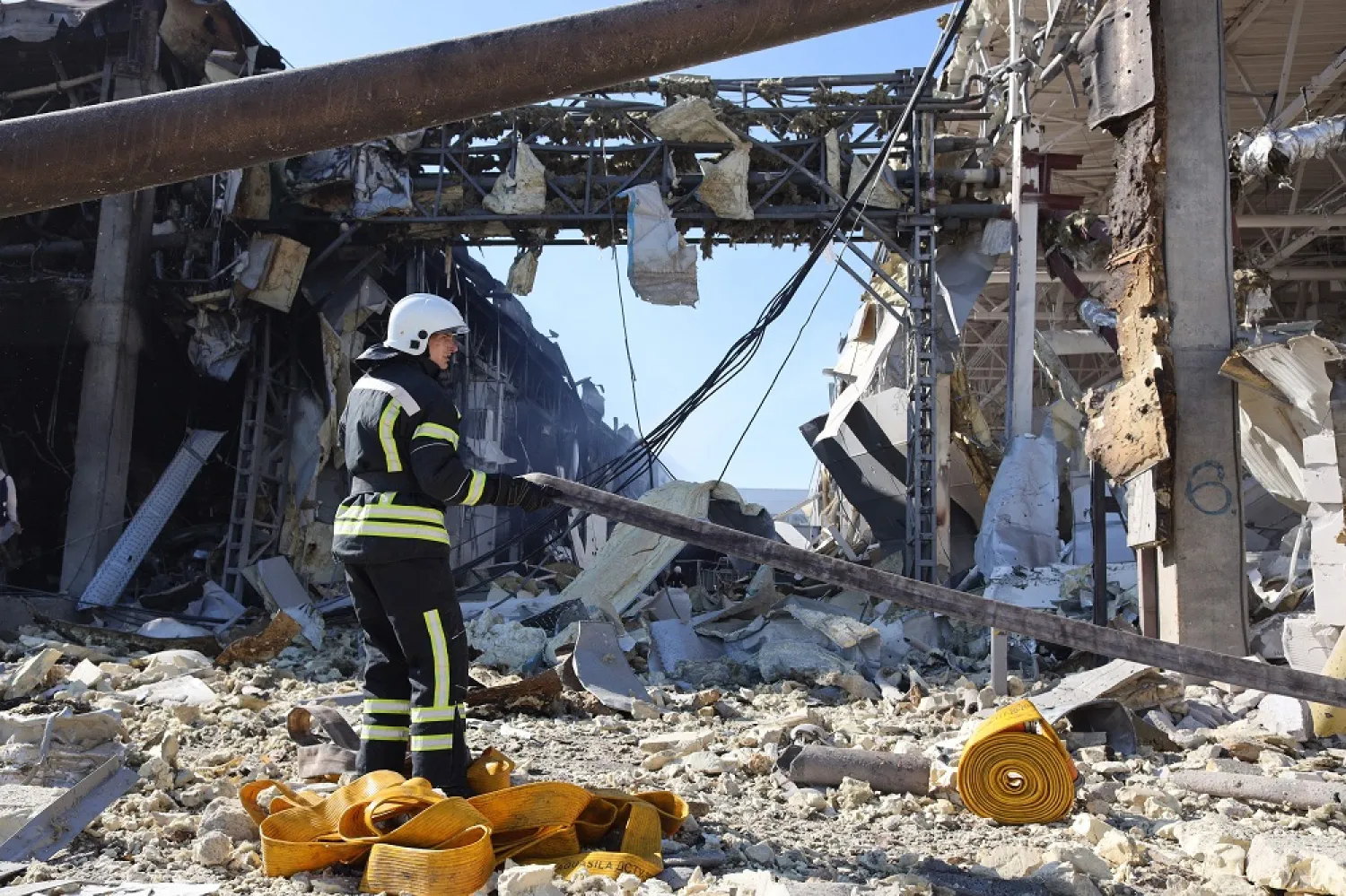

Russia Pummels Vital Port of Odesa, Targeting Supply Lines

A rescue worker gestures in front of the shopping and entertainment center in the Ukrainian Black Sea city of Odesa on May 10, 2022, destroyed after Russian missiles strike late on May 9, 2022. (AFP)
TT

Russia Pummels Vital Port of Odesa, Targeting Supply Lines

A rescue worker gestures in front of the shopping and entertainment center in the Ukrainian Black Sea city of Odesa on May 10, 2022, destroyed after Russian missiles strike late on May 9, 2022. (AFP)

Russia pummeled the vital port of Odesa, Ukrainian officials said Tuesday, an apparent effort to disrupt supply lines and Western weapons shipments critical to Kyiv's defense.

Ukraine's ability to stymie a larger, better-armed Russian military has surprised many who had anticipated a much quicker end to the conflict. With the war now in its 11th week and Kyiv bogging down Russian forces and even staging a counteroffensive, Ukraine’s foreign minister appeared to suggest the country could expand its aims beyond merely pushing Russia back to areas it or its allies held on the day of the Feb. 24 invasion.

One of the most dramatic examples of Ukraine's ability to prevent easy victories is in Mariupol, where Ukrainian fighters remained holed up at a steel plant, denying Russia's full control of the city. The regiment defending the plant said Russian warplanes continued bombarding it.

In recent days, the United Nations and Red Cross organized a rescue of what some officials said were the last civilians trapped at the plant. But two officials said Tuesday about 100 were believed to still be in the complex's underground tunnels. Others said that was impossible to confirm.

In another example of the grisly toll the war continues to take, the Ukrainians said they found the bodies of 44 civilians in the rubble of a building destroyed weeks ago in the northeastern city of Izyum.

In Washington, a top US intelligence official testified Tuesday that eight to 10 Russian generals have been killed so far in the war. Lt. Gen. Scott Berrier, who leads the Defense Intelligence Agency, told a Senate committee that because Russia lacks a non-commissioned officer corps, its generals have to go into combat zones and end up in dangerous positions.

Ukraine said Russian forces fired seven missiles Monday at Odesa, hitting a shopping center and a warehouse in the country's largest port. One person was killed and five wounded, the military said.

Images overnight showed a burning building and debris - including a tennis shoe - in a heap of destruction in the city on the Black Sea. Mayor Gennady Trukhanov later visited the warehouse and said it "had nothing in common with military infrastructure or military objects."

Ukraine alleged at least some of the munitions used dated to the Soviet era, making them unreliable in targeting. But the Center for Defense Strategies, a Ukrainian think tank, said Moscow used some precision weapons against Odesa: Kinzhal, or "Dagger," hypersonic air-to-surface missiles.

Ukrainian, British and US officials say Russia is rapidly using up its stock of precision weapons, raising the risk of more imprecise rockets being used as the conflict grinds on.

Ever since President Vladimir Putin's forces failed to take Kyiv early in the war, his focus shifted to the eastern industrial heartland of the Donbas - but one general has suggested Moscow’s aims also include cutting cutting Ukraine’s maritime access to both the Black and Azov seas.

That would also give it a swath of territory linking Russia to both the Crimean Peninsula, which it seized in 2014, and Transnistria, a pro-Moscow region of Moldova.

Even if it falls short of severing Ukraine from the coast - and it appears to lack the forces to do so - continuing missile strikes on Odesa reflect the city’s strategic importance. The Russian military has repeatedly targeted its airport and claimed it destroyed several batches of Western weapons.

Odesa is also a major gateway for grain shipments, and its blockade by Russia already threatens global food supplies. Beyond that, the city is a cultural jewel, dear to Ukrainians and Russians alike, and targeting it carries symbolic significance as well.

In Mariupol, Russians also bombarded the Azovstal steel mill, the Azov regiment said, targeting the sprawling complex 34 times in the past 24 hours. Attempts to storm the plant also continued, it said.

Meanwhile, Petro Andryushchenko, an adviser to Mariupol’s mayor, estimated on social media that at least 100 civilians are trapped in the plant. Donetsk regional Gov. Pavlo Kyrylenko said those who remain are people "that the Russians have not selected” for evacuation.

The two officials didn’t say how they knew civilians were still in the complex - a warren of tunnels and bunkers spread over 11 square kilometers (4 square miles). Sviatoslav Palamar, the deputy commander of the Azov regiment, told The Associated Press that he could not confirm any civilians remained. Mayor Vadym Boichenko also said there was no way to know.

With Russian forces struggling to gain ground in the Donbas, military analysts suggest that hitting Odesa might serve to stoke concern about southwestern Ukraine, thus forcing Kyiv to put more forces there. That would pull them away from the eastern front as Ukraine's military stages counteroffensives near the northeastern city of Kharkiv, aiming to push the Russians back across the border there.

Kharkiv and the surrounding area has been under sustained Russian attack since the early in the war. In recent weeks, grisly pictures testified to the horrors of those battles, with charred and mangled bodies strewn in one street.

Dozens of bodies were found in a five-story building that collapsed in March in Izyum, about 120 kilometers (75 miles) from Kharkiv, said Oleh Synehubov, the head of the regional administration.

Ukraine’s foreign minister, meanwhile, appeared to voice increasing confidence - and expanded goals - amid Russia's stalled offensive.

"In the first months of the war, the victory for us looked like withdrawal of Russian forces to the positions they occupied before Feb. 24 and payment for inflicted damage," Dmytro Kuleba said in an interview with the Financial Times. "Now if we are strong enough on the military front and we win the battle for Donbas, which will be crucial for the following dynamics of the war, of course the victory for us in this war will be the liberation of the rest of our territories."

That appears to indicate that Ukraine wants to try to retake Crimea as well as regions of the Donbas taken by Russia and the separatists it backs.

But the comments seemed to reflect political ambitions more than battlefield realities: Many analysts acknowledge that while Russia isn’t capable of making quick gains, the Ukrainian military isn’t strong enough to drive the Russians back.

US President Joe Biden signed a bipartisan measure Monday to reboot the World War II-era "lend-lease" program, which helped defeat Nazi Germany, to bolster Kyiv and its allies.

Western powers continued to rally around Ukraine’s embattled government. German Foreign Minister Annalena Baerbock traveled to the Kyiv suburb of Bucha, where the bodies of civilians - some bound, burned or shot at close range - were found after Russian forces withdrew.

"We owe it to the victims that we don’t just commemorate them here but that we hold the perpetrators to account," she said.



China Says Arms Trade With Cambodia, Thailand Unrelated to Border Conflict

Flags flutter at an entrance of Thai-Chinese Rayong Industrial Zone in Rayong province, east of Bangkok, Thailand, April 7, 2016. REUTERS/Chaiwat Subprasom
TT

China Says Arms Trade With Cambodia, Thailand Unrelated to Border Conflict

Flags flutter at an entrance of Thai-Chinese Rayong Industrial Zone in Rayong province, east of Bangkok, Thailand, April 7, 2016. REUTERS/Chaiwat Subprasom

China said on Thursday its arms trade with Thailand and Cambodia is unrelated to the current conflict between the Southeast Asian neighbours, with which Beijing has close ties.

"We hope relevant parties will refrain from making subjective speculation and malicious hype," the Chinese Defense Ministry said in response to reports that Thai troops seized Chinese-made weapons from Cambodian positions as border clashes between the two nations reignited, Reuters reported.

Beijing hopes the two countries can reach a ceasefire as soon as possible, the ministry said, adding that China will continue to advocate for peace and talks.

Border clashes between Thailand and Cambodia resumed this month and have killed more than 40 people and displaced over half a million in both countries.

China's Foreign Minister Wang Yi, in separate calls with his Thai and Cambodian counterparts on Thursday, also called for an immediate ceasefire and criticised "false information" that he said was aimed at smearing China's ties with the two countries.

"As a friend and close neighbour of both Cambodia and Thailand, China least wants to see the two sides engage in armed conflict, and is deeply saddened by civilian casualties caused by the clashes," the Foreign Ministry quoted Wang as saying.

China will continue to play a constructive role in facilitating peace, Wang said, urging both countries to protect the safety of Chinese projects and personnel.

Beijing last week warned Chinese citizens to leave border areas after media reports of injuries.

The Chinese Foreign Ministry said on Wednesday a special envoy for Asian affairs would be visiting Cambodia and Thailand on Thursday to conduct mediation.


UK Police Arrest Pro-Palestinian Protesters as Authorities Toughen Hate Speech Law Enforcement

Police officers carry a protester during a protest to support Palestine Action in London, Saturday, Sept. 6, 2025. (AP Photo/ Joanna Chan)
TT

UK Police Arrest Pro-Palestinian Protesters as Authorities Toughen Hate Speech Law Enforcement

Police officers carry a protester during a protest to support Palestine Action in London, Saturday, Sept. 6, 2025. (AP Photo/ Joanna Chan)

Police in London arrested two people who called for “intifada” during a pro-Palestinian protest, which followed a decision by authorities to toughen enforcement of hate speech laws after a deadly attack on a Hanukkah celebration in Australia.

The arrests Wednesday came hours after police in London and Manchester, England, announced a crackdown on protesters using slogans such as “globalize the intifada.” The Arabic word intifada is generally translated as “uprising.”

While pro-Palestinian demonstrators say the slogan describes the worldwide protests against the war in Gaza, Jewish leaders say it inflames tensions and encourages attacks on Jews, including the attack that killed 15 people on Sunday at Bondi Beach in Sydney, The Associated Press said.

London Metropolitan Police Commissioner Mark Rowley and Greater Manchester Police Chief Constable Stephen Watson said they decided to take a tougher stance after Bondi Beach and an Oct. 2 attack on a Manchester synagogue that left two people dead.

“We know communities are concerned about placards and chants such as `globalize the intifada,’ and those using it at future protest or in a targeted way should expect the Met and GMP to take action,” they said in a joint statement released Wednesday. “Violent acts have taken place, the context has changed — words have meaning and consequence.”

In the hours before Wednesday night’s demonstration in support of Palestine Action, a pro-Palestinian group that was banned as a terrorist organization earlier this year, London police warned protesters to be aware of the earlier announcement.

Two protesters were arrested for “racially aggravated public order offenses” after they shouted slogans calling for intifada during the protest outside the Ministry of Justice on Wednesday night, the Metropolitan Police Service said on social media. A third person was arrested for trying to interfere with the initial arrests.

The term “intifada” is used to describe two major Palestinian uprisings against Israeli policy in the West Bank and Gaza Strip, the first beginning in 1987 and the second beginning in 2000. During the recent conflict in Gaza, the slogan “globalize the intifada” has been widely used by pro-Palestinian protesters around the world.

The debate over such language comes after antisemitic hate crime and online abuse soared in Britain following the Hamas-led attack on Israel on Oct. 7, 2023, and the Israeli military campaign in Gaza that followed.

Around 1,200 people were killed and 251 taken hostage during the initial attack on Israel. More than 70,660 Palestinians have been killed during the ensuing Israeli campaign in Gaza, according to the territory’s health ministry.


Russia Says It Hopes Trump Does Not Make 'a Fatal Mistake' on Venezuela

Supporters of Venezuela's President Nicolas Maduro wave a Venezuelan flag during a rally demanding peace in Caracas on December 15, 2025. (Photo by Juan BARRETO / AFP)
TT

Russia Says It Hopes Trump Does Not Make 'a Fatal Mistake' on Venezuela

Supporters of Venezuela's President Nicolas Maduro wave a Venezuelan flag during a rally demanding peace in Caracas on December 15, 2025. (Photo by Juan BARRETO / AFP)

Russia's foreign ministry said on Thursday that it hoped that US President Donald Trump's administration did not make a fatal mistake over Venezuela and said that Moscow was concerned about US decisions that threatened international navigation.

Trump on Tuesday ordered a "blockade" of all sanctioned oil tankers entering and leaving Venezuela as Washington tried to increase pressure on Nicolas Maduro's government.

There has been an effective embargo in place after the US seized a sanctioned oil tanker off the coast of Venezuela last week, with loaded vessels carrying millions of barrels of oil staying in Venezuelan waters rather than risk seizure.

"We hope that the D. Trump administration, which is characterized by a rational and pragmatic approach, will not make a fatal mistake," Russia's foreign ministry said in a statement.

The ministry said that Venezuela was a friendly country to Russia, and that Moscow hoped the US would not wade into a situation that would have "unpredictable consequences for the entire Western Hemisphere".

Russia quoted Simon Bolivar, a brilliant Venezuelan military tactician who liberated much of South America from centuries of Spanish rule, as saying that every nation had the right to choose its own rulers and that other countries should respect this.

Russia, the ministry said, wanted a normalization of dialogue between Washington and Caracas, and reaffirmed Russia's "solidarity with the Venezuelan people in the face of the trials they are going through."

Russia supports "the Maduro government's course aimed at protecting the national interests and sovereignty of the Motherland."