


Pandemic Gets Tougher to Track as COVID Testing Plunges

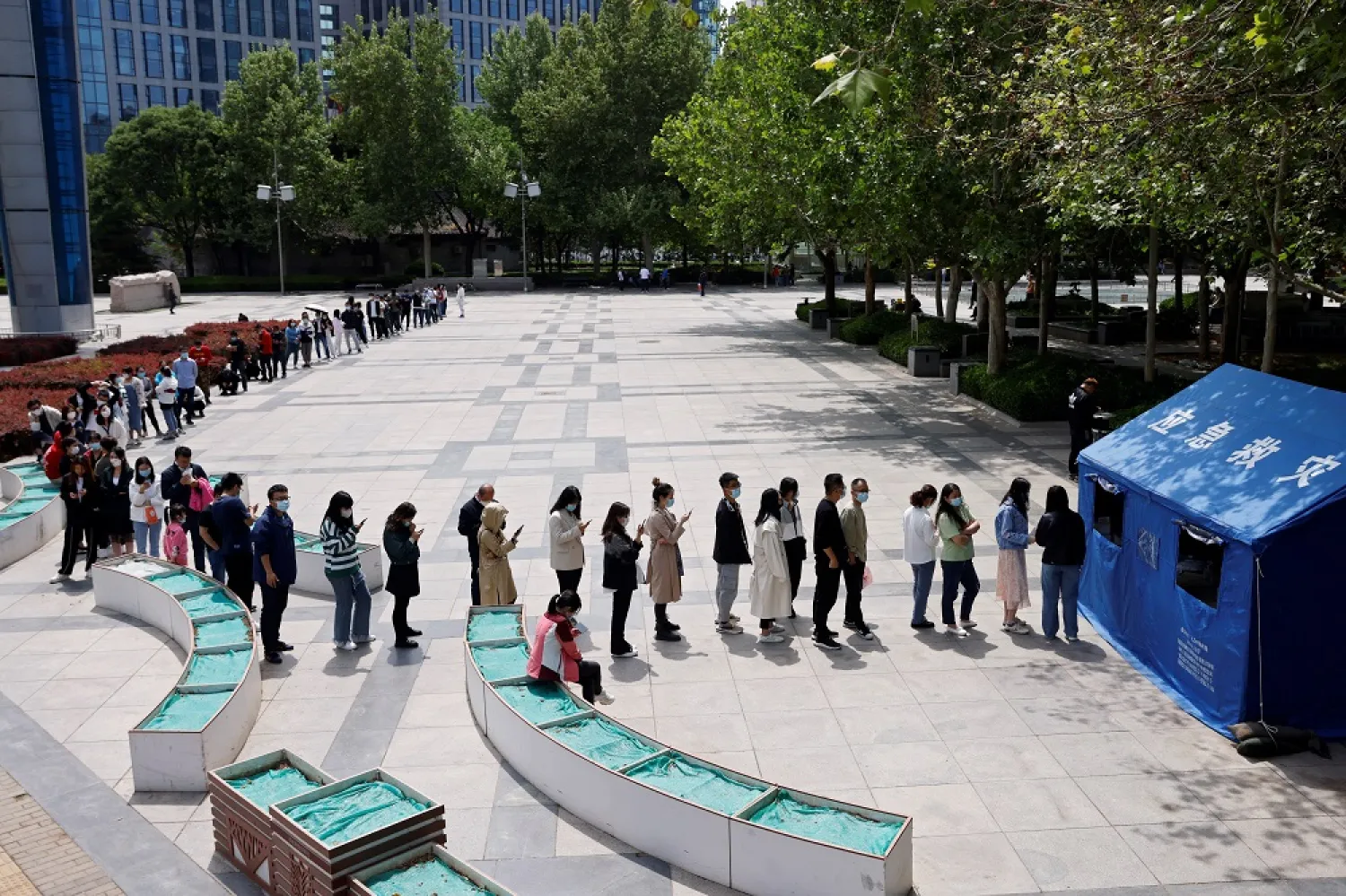
People line up at a makeshift nucleic acid testing site to get tested for the coronavirus disease (COVID-19) in Haidian district of Beijing, China May 9, 2022. (Reuters)
TT

Pandemic Gets Tougher to Track as COVID Testing Plunges

People line up at a makeshift nucleic acid testing site to get tested for the coronavirus disease (COVID-19) in Haidian district of Beijing, China May 9, 2022. (Reuters)

Testing for COVID-19 has plummeted across the globe, making it much tougher for scientists to track the course of the pandemic and spot new, worrisome viral mutants as they emerge and spread.

Experts say testing has dropped by 70 to 90% worldwide from the first to the second quarter of this year - the opposite of what they say should be happening with new omicron variants on the rise in places such as the United States and South Africa.

"We’re not testing anywhere near where we might need to," said Dr. Krishna Udayakumar, who directs the Duke Global Health Innovation Center at Duke University. "We need the ability to ramp up testing as we’re seeing the emergence of new waves or surges to track what’s happening" and respond.

Reported daily cases in the US, for example, are averaging 73,633, up more than 40% over the past two weeks, according to data compiled by Johns Hopkins University. But that is a vast undercount because of the testing downturn and the fact tests are being taken at home and not reported to health departments. An influential modeling group at the University of Washington in Seattle estimates that only 13% of cases are being reported to health authorities in the US - which would mean more than a half million new infections every day.

The drop in testing is global but the overall rates are especially inadequate in the developing world, Udayakumar said. The number of tests per 1,000 people in high income countries is around 96 times higher than it is in low income countries, according to the Geneva-based public health nonprofit FIND.

What’s driving the drop? Experts point to COVID fatigue, a lull in cases after the first omicron wave and a sense among some residents of low-income countries that there’s no reason to test because they lack access to antiviral medications.

At a recent press briefing by the World Health Organization, FIND CEO Dr. Bill Rodriguez called testing "the first casualty of a global decision to let down our guard" and said "we’re becoming blind to what is happening with the virus."

Testing, genomic sequencing and delving into case spikes can lead to the discovery of new variants. New York state health officials found the super contagious BA.2.12.1 variant after investigating higher-than-average case rates in the central part of the state.

Going forward, "we’re just not going to see the new variants emerge the way we saw previous variants emerge," Rodriquez told The Associated Press.

Testing increases as infections rise and people develop symptoms - and it falls along with lulls in new cases. Testing is rising again in the US along with the recent surge.

But experts are concerned about the size of the drop after the first omicron surge, the low overall levels of testing globally, and the inability to track cases reliably. While home tests are convenient, only tests sent to labs can be used to detect variants. If fewer tests are being done, and fewer of those tests are processed in labs, fewer positive samples are available for sequencing.

Also, home test results are largely invisible to tracking systems.

Mara Aspinall, managing director of an Arizona-based consulting company that tracks COVID-19 testing trends, said there’s at least four times more home testing than PCR testing, and "we are getting essentially zero data from the testing that’s happening at home."

That’s because there’s no uniform mechanism for people to report results to understaffed local health departments. The CDC strongly encourages people to tell their doctors, who in most places must report COVID-19 diagnoses to public health authorities.

Generally, though, results from home tests fall under the radar.

Reva Seville, a 36-year-old Los Angeles parent, tested herself at home this week after she began feeling symptoms such as a scratchy throat, coughing and congestion. After the results came back positive, she tested twice more just to be sure. But her symptoms were mild, so she didn't plan to go to the doctor or report her results to anyone.

Beth Barton of Washington, Missouri, who works in construction, said she’s taken about 10 home tests, either before visiting her parents or when she’s had symptoms she thought might be COVID-19. All came back negative. She shared the results with the people around her but didn’t know how to report them.

"There should be a whole system for that," said Barton, 42. "We as a society don’t know how to gauge where we’re at."

Aspinall said one potential solution would be to use technology like scanning a QR code to report home test results confidentiality.

Another way to keep better track of the pandemic, experts said, is to bolster other types of surveillance, such as wastewater monitoring and collecting hospitalization data. But those have their own drawbacks. Wastewater surveillance remains a patchwork that doesn’t cover all areas, and hospitalization trends lag behind cases.

Udayakumar said scientists across the world must use all the tracking methods at their disposal to keep up with the virus, and will need to do so for months or even years.

At the same time, he said, steps must be taken to boost testing in lower-income countries. Demand for tests would rise if access to antivirals were improved in these places, he said. And one of the best ways to increase testing is to integrate it into existing health services, said Wadzanayi Muchenje, who leads health and strategic partnerships in Africa for The Rockefeller Foundation.

Georges Benjamin, executive director of the American Public Health Association, said there will come a point when the world stops widespread testing for COVID-19 - but that day isn’t here yet.

With the pandemic lingering and virus still unpredictable, "it’s not acceptable for us to only be concerned about individual health,” he said. "We have to worry about the population."



Thailand and Cambodia Sign New Ceasefire Agreement to End Border Fighting

A handout photo made available by the Defense Ministry of Thailand shows Cambodian Defense Minister Tea Seiha (L) and Thai Defense Minister Natthaphon Narkphanit attending a General Border Committee Meeting in Ban Pak Kard, Chanthaburi Province, Thailand, 27 December 2025. (EPA/Defense Ministry of Thailand/Handout)
TT

Thailand and Cambodia Sign New Ceasefire Agreement to End Border Fighting

A handout photo made available by the Defense Ministry of Thailand shows Cambodian Defense Minister Tea Seiha (L) and Thai Defense Minister Natthaphon Narkphanit attending a General Border Committee Meeting in Ban Pak Kard, Chanthaburi Province, Thailand, 27 December 2025. (EPA/Defense Ministry of Thailand/Handout)

Thailand and Cambodia on Saturday signed a ceasefire agreement to end weeks of armed combat along their border over competing claims to territory. It took effect at noon local time.

In addition to ending fighting, the agreement calls for no further military movements by either side and no violations of either side’s airspace for military purposes.

Only Thailand employed airstrikes in the fighting, hitting sites in Cambodia as recently as Saturday morning, according to the Cambodian defense ministry.

The deal also calls for Thailand, after the ceasefire has held for 72 hours, to repatriate 18 Cambodian soldiers it has held as prisoners since earlier fighting in July. Their release has been a major demand of the Cambodian side.

The agreement was signed by the two countries’ defense ministers, Cambodia’s Tea Seiha and Thailand’s Nattaphon Narkphanit, at a checkpoint on their border after lower-level talks by military officials met for three days as part of the already-established General Border Committee.

The agreement declares that the two sides are committed to an earlier ceasefire that ended five days of fighting in July and follow-up agreements and includes commitments to 16 de-escalation measures.

The original July ceasefire was brokered by Malaysia and pushed through by pressure from US President Donald Trump, who threatened to withhold trade privileges unless Thailand and Cambodia agreed. It was formalized in more detail in October at a regional meeting in Malaysia that Trump attended.

Despite those deals, the two countries carried on a bitter propaganda war and minor cross-border violence continued, escalating in early December to widespread heavy fighting.

Thailand has lost 26 soldiers and one civilian as a direct result of the combat since Dec. 7, according to officials. Thailand has also reported 44 civilian deaths from collateral effects of the situation.

Cambodia hasn’t issued an official figure on military casualties, but says that 30 civilians have been killed and 90 injured. Hundreds of thousands of people have been evacuated from affected areas on both sides of the border.

Each side blamed the other for initiating the fighting and claimed to be acting in self-defense.

The agreement also calls on both sides to adhere to international agreements against deploying land mines, a major concern of Thailand. Thai soldiers along the border have been wounded in at least nine incidents this year by what they said were newly planted Cambodian mines. Cambodia says the mines were left over from decades of civil war that ended in the late 1990s.

Another clause says the two sides “agree to refrain from disseminating false information or fake news.”

The agreement also says previously established measures to demarcate the border will be resumed and the two sides also agree to cooperate on an effort to suppress transnational crimes.

That is primarily a reference to online scams perpetrated by organized crime that have bilked victims around the world of billions of dollars each year. Cambodia is a center for such criminal enterprises.


Russia Attacks Kyiv with Missiles and Drones, Wounding 11 ahead of Ukraine-US Meeting

Firefighters work at the site of a private home that went up in flames after it was hit by a Russian drone during a night of attacks on Kyiv, amid Russia's attack on Ukraine, November 29, 2025. REUTERS/Thomas Peter
TT

Russia Attacks Kyiv with Missiles and Drones, Wounding 11 ahead of Ukraine-US Meeting

Firefighters work at the site of a private home that went up in flames after it was hit by a Russian drone during a night of attacks on Kyiv, amid Russia's attack on Ukraine, November 29, 2025. REUTERS/Thomas Peter

Russia attacked Ukraine's capital with missiles and drones early Saturday morning, wounding at least 11 people a day before talks between Ukraine and the US, local authorities said.

Explosions boomed across the capital for hours as ballistic missiles and drones hit the city. The attack began in the early morning hours Saturday and was continuing as day broke.

The attack came as Ukrainian President Volodymyr Zelenskyy prepares to meet with US President Donald Trump on Sunday for further talks in an effort to end the nearly four-year-old war. Zelenskyy said they plan to discuss issues including security guarantees and territorial issues in the Donetsk and Zaporizhzhia regions.

Two children were among those injured in the attack, which affected seven locations across the city of Kyiv said the head of Kyiv's City Military Administration Tymur Tkachenko in a statement on Telegram, The Associated Press said.

A fire broke out in an 18-story residential building in the Dnipro district of the city, and emergency crews rushed to the scene to contain the flames.

A 24-story residential building in the Darnytsia district was also hit, Tkachenko said, and more fires broke out in the Obolonskyi and Holosiivsky districts.

In the wider Kyiv region, the strikes hit industrial and residential buildings, according to Ukraine's Emergency Service. In the Vyshhorod area, emergency crews rescued one person found under the rubble of a destroyed house.


Russia Lashes Out at Zelensky ahead of New Trump Talks on Ukraine Plan

Trump is trying to broker an agreement between the warring sides to end Europe's worst conflict since World War II. Jim WATSON, Tetiana DZHAFAROVA / AFP/File
TT

Russia Lashes Out at Zelensky ahead of New Trump Talks on Ukraine Plan

Trump is trying to broker an agreement between the warring sides to end Europe's worst conflict since World War II. Jim WATSON, Tetiana DZHAFAROVA / AFP/File

Volodymyr Zelensky is due to meet President Donald Trump in Florida this weekend, but Russia accused the Ukrainian president and his EU backers Friday of seeking to "torpedo" a US-brokered plan to stop the fighting.

Sunday's meeting to discuss new peace proposals comes as Trump intensifies efforts to end Europe's worst conflict since World War II, one that has killed tens of thousands since February 2022, AFP said.

The 20-point plan would freeze the war on its current front line but open the door for Ukraine to pull back troops from the east, where demilitarized buffer zones could be created, according to details revealed by Zelensky this week.

Ahead of the talks, AFP journalists reported several powerful explosions in Kyiv on Saturday, and authorities warned of a possible missile attack.

“Explosions in the capital. Air defense forces are operating. Stay in shelters!" Kyiv's mayor Vitali Klitschko said on Telegram.

Ukraine's air force announced a countrywide air alert and said drones and missiles were moving over several regions including Kyiv.

Zelensky's office said earlier that a meeting with Trump is planned for Sunday in Florida, where the US leader has a home.

Trump, speaking to news outlet Politico, said about Zelensky's plan that "he doesn't have anything until I approve it", adding: "So we'll see what he's got."

Zelensky meanwhile said he held telephone talks on Friday with NATO Secretary General Mark Rutte, Germany's Chancellor Friedrich Merz and a host of other European leaders.

A spokesperson for Britain's Prime Minister Keir Starmer said the leaders "reiterated their unshakeable commitment for a just and lasting peace for Ukraine and the importance that talks continue to progress towards this in the coming days".

Security guarantees

The new plan formulated with Ukraine's input is Kyiv's most explicit acknowledgement yet of possible territorial concessions and is very different from an initial 28-point proposal tabled by Washington last month that adhered to many of Russia's core demands.

Part of the plan includes separate US-Ukraine bilateral agreements on security guarantees, reconstruction and the economy. Zelensky said those were changing on a daily basis.

"We will discuss these documents, security guarantees," he said of Sunday's meeting.

"As for sensitive issues, we will discuss (the eastern region of) Donbas and the Zaporizhzhia nuclear power plant, and we will certainly discuss other issues," he added.

Russia signaled its opposition to the plan ahead of the Florida talks.

The Kremlin said Friday that foreign policy aide Yuri Ushakov had held telephone talks with US officials, and deputy foreign minister Sergei Ryabkov criticized Zelensky's stance.

Russia accuses EU

"Our ability to make the final push and reach an agreement will depend on our own work and the political will of the other party," Ryabkov said on Russian television.

"Especially in a context where Kyiv and its sponsors -- notably within the European Union, who are not in favor of an agreement -- have stepped up efforts to torpedo it."

He said the proposal drawn up with Zelensky input "differs radically" from points initially drawn up by US and Russian officials in contacts this month.

He said any deal had to "remain within the limits" fixed by Trump and Russia's President Vladimir Putin when they met in Alaska in August, or else "no accord can be reached".

Zelensky said this week there were still disagreements between Kyiv and Washington over the two core issues of territory and the status of the Zaporizhzhia plant.

Washington has pushed Ukraine to withdraw from the 20 percent of the eastern Donetsk region that it still controls -- Russia's main territorial demand.

It has also proposed joint US-Ukrainian-Russian control of Zaporizhzhia, Europe's largest nuclear plant, which Russia seized during the invasion.

Zelensky said he could only give up more land if the Ukrainian people agree to it in a referendum, and he does not want Russian participation in the nuclear plant.

But Moscow has shown little inclination to abandon its hardline territorial demands that Ukraine fully withdraw from Donbas and end efforts to join NATO.

Zelensky said Ukrainian negotiators were not directly in touch with Moscow, but that the United States acted as intermediary and was awaiting Russia's response to the latest proposal.

"I think we will know their official response in the coming days," Zelensky said.

"Russia is always looking for reasons not to agree," he added.