

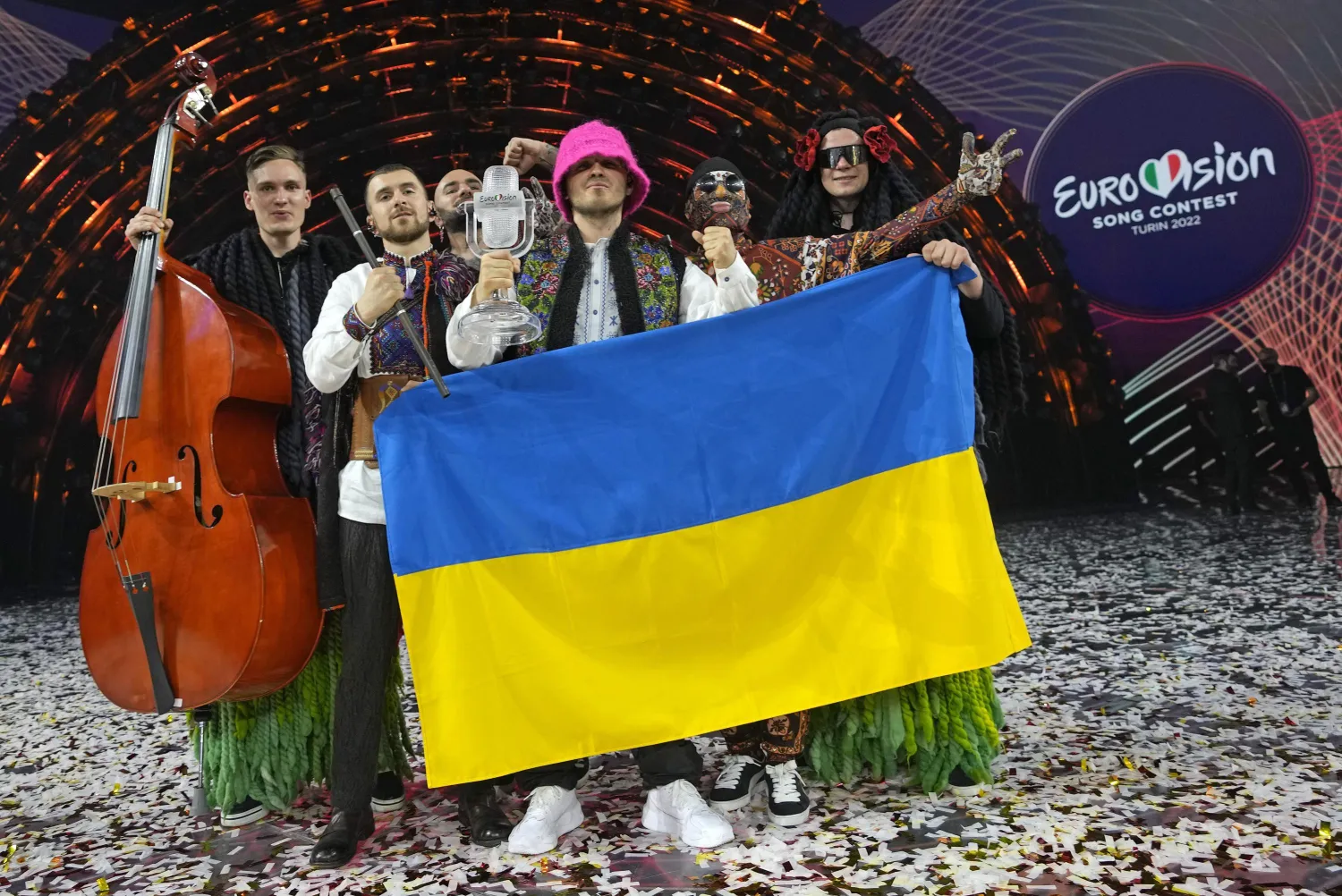

Ukrainian Band Kalush Orchestra Wins Eurovision amid War

Kalush Orchestra from Ukraine celebrate after winning the Grand Final of the Eurovision Song Contest at Palaolimpico arena, in Turin, Italy, Saturday, May 14, 2022. (AP Photo/Luca Bruno)
TT

Ukrainian Band Kalush Orchestra Wins Eurovision amid War

Kalush Orchestra from Ukraine celebrate after winning the Grand Final of the Eurovision Song Contest at Palaolimpico arena, in Turin, Italy, Saturday, May 14, 2022. (AP Photo/Luca Bruno)

Ukrainian band Kalush Orchestra won the Eurovision Song Contest, a clear show of popular support for the group's war-ravaged nation that went beyond music.

The band and its song “Stefania” beat 24 other performers early Sunday in the grand final of the competition. The public vote from home, via text message or the Eurovision app, proved decisive, lifting them above British Tik Tok star Sam Ryder, who led after the national juries in 40 countries cast their votes, The Associated Press said.

Ukrainian President Volodymyr Zelenskyy welcomed the victory, Ukraine's third since its 2003 Eurovision debut. He said “we will do our best” to host next year's contest in the devastated port city of Mariupol, which is almost completely occupied by Russian forces.

In describing the city, Zelenskyy e underlined “Ukrainian Mariupol,” adding: “free, peaceful, rebuilt!”

"I am sure our victorious chord in the battle with the enemy is not far off,'' Zelenskyy said in a post on Telegram messaging app.

Kalush Orchestra's front man, Oleh Psiuk, took advantage of the enormous global audience, last year numbering more than 180 million, to make impassioned plea to free fighters still trapped beneath a sprawling steel plant in Mariupol following their performance.

“Help Azovstal, right now,″ Psiuk implored from beneath a bright bucket hat that has become the band’s trademark among fans.

He later told a news conference that people can help by “spreading information, talking out this, reaching out to governments to help.”

The 439 fan votes is the highest number of televote points ever received in a Eurovision contest, now in its 66th year. Psiuk thanked the Ukrainian diaspora and “and everyone around the world who voted for Ukraine. ... The victory is very important to Ukraine. Especially this year.”

“Stefania” was penned by Psiuk as a tribute to his mother, but since Russia's Feb. 24 invasion it has become an anthem to the motherland, with lyrics that pledge: “I’ll always find my way home, even if all roads are destroyed."

Kalush Orchestra itself is a cultural project that includes folklore experts and mixes traditional folk melodies and contemporary hip hop in a purposeful defense of Ukrainian culture. That has become an even more salient point as Russia through its invasion has sought falsely to assert that Ukraine's culture is not unique.

“We are here to show that Ukrainian culture and Ukrainian music are alive, and they have their own and very special signature,'' Psuik told journalists.

The plea to free the remaining Ukrainian fighters trapped beneath the Azovstal plant by Russians served as a somber reminder that the hugely popular and at times flamboyant Eurovision song contest was being played out against the backdrop of a war on Europe’s eastern flank.

The Azov battalion, which is among the plant's last 1,000 defenders, sent their thanks from the warren of tunnels beneath the plant, posting on Telegram: “Thank you to Kalush Orchestra for your support! Glory to Ukraine!”

The city itself has been the site of some of the worst destruction of the 2 1/2-month war, as Russia seeks to secure a land bridge between separatist-controlled Donbas and Crimea, which it annexed in 2014.

The six-member, all-male band received special permission to leave the country to represent Ukraine and Ukrainian culture at the music contest. One of the original members stayed to fight, and the others will be back in Ukraine in two days, when their temporary exit permit expires.

Before traveling to Italy, Psiuk was running a volunteer organization he set up early in the war that uses social media to help find transportation and shelter for people in need

“It is hard to say what I am going to do, because this is the first time I win Eurovision,'' Psuik said. ”Like every Ukrainian, I am ready to fight and go until the end."

While the support for Ukraine in the song contest was ultimately overwhelming, the contest remained wide open until the final popular votes were tallied. And war or not, fans from Spain, Britain and elsewhere entering the PalaOlimpico venue from throughout Europe were rooting for their own country to win.

Still, Ukrainian music fan Iryna Lasiy said she felt global support for her country in the war and “not only for the music.”

Russia was excluded this year after its Feb. 24 invasion of Ukraine, a move organizers said was meant to keep politics out of the contest that promotes diversity and friendship among nations.

Back in Ukraine, in the battered northeastern city of Kharkiv, Kalush Orchestra’s participation in Eurovision is seen as giving the nation another platform to garner international support.

“The whole country is rising, everyone in the world supports us. This is extremely nice,″ said Julia Vashenko, a 29-year-old teacher.

“I believe that wherever there is Ukraine now and there is an opportunity to talk about the war, we need to talk,″ said Alexandra Konovalova, a 23-year-old make-up artist in Kharkiv. “Any competitions are important now, because of them more people learn about what is happening now.”

Ukrainians in Italy also were using the Eurovision event as a backdrop to a flashmob this week to appeal for help for Mariupol. About 30 Ukrainians gathered in a bar in Milan to watch the broadcast, many wearing a bright bucket hat like the one Psiuk sports, in support of the band.

“We are so happy he called on helping to save the people in Mariupol,'' said lawyer Zoia Stankovska during the show. “Oh, this victory brings so much hope."

The winner takes home a glass microphone trophy and a potential career boost — although Kalush Orchestra's first concern is peace.

The event was hosted by Italy after local rock band Maneskin won last year in Rotterdam. The victory shot the Rome-based band to international fame, opening for the Rolling Stones and appearing on Saturday Night Live and numerous magazine covers in their typically genderless costume code.

Twenty bands were chosen in two semifinals this week, and were competing along with the Big Five of Italy, Britain, France, Germany and Spain, which have permanent berths due to their financial support of the contest.

Ukrainian commentator Timur Miroshnichenko, who does the live voiceover for Ukraine’s broadcast of Eurovision, was participating from a basement in an undisclosed location, rather than from his usual TV studio.

“On the fifth or fourth day of the war, they shot our TV tower in Kyiv,” he said. To keep broadcasting, “we had to move underground somewhere in Ukraine.”

Showing Eurovision in Ukraine was important, online and on TV, he said.

“This year, I think it’s more symbolic than ever,” Miroshnichenko said.

Ukraine was able to participate in the music contest “thanks to the Armed Forces of Ukraine and the resistance of our people,” he said.



Berlin Film Festival Rejects Accusation of Censorship on Gaza

Berlinale Festival Director Tricia Tuttle speaks during the Berlinale Camera award ceremony honoring British composer Max Richter during the 76th Berlin International Film Festival, in Berlin, Germany, 18 February 2026. (EPA)
TT

Berlin Film Festival Rejects Accusation of Censorship on Gaza

Berlinale Festival Director Tricia Tuttle speaks during the Berlinale Camera award ceremony honoring British composer Max Richter during the 76th Berlin International Film Festival, in Berlin, Germany, 18 February 2026. (EPA)

The director of the Berlin Film Festival on Wednesday rejected accusations from more than 80 film industry figures that the festival had helped censor artists who oppose Israel's actions in Gaza.

In an open letter published on Tuesday, Oscar-winning actors Javier Bardem and Tilda Swinton were among dozens who criticized the Berlinale's "silence" on the issue and said they were "dismayed" at its "involvement in censoring artists who oppose Israel's ongoing genocide against Palestinians in Gaza".

In an interview with Screen Daily, the Berlinale's director, Tricia Tuttle, said the festival backs "free speech within the bounds of German law".

She said she recognized that the letter came from "the depth of anger and frustration about the suffering of people in Gaza".

However, she rejected accusations of censorship, saying that the letter contained "misinformation" and "inaccurate claims about the Berlinale" made without evidence or anonymously.

The row over Gaza has dogged this year's edition of the festival since jury president Wim Wenders answered a question on the conflict by saying: "We cannot really enter the field of politics."

The comments prompted award-winning novelist Arundhati Roy, who had been due to present a restored version of a film she wrote, to withdraw from the festival.

Tuttle said the festival represents "lots of people who have different views, including lots of people who live in Germany who want a more complex understanding of Israel's positionality than maybe the rest of the world has right now".

German politicians have been largely supportive of Israel as Germany seeks to atone for the legacy of the Holocaust.

However, German public opinion has been more critical of Israeli actions in Gaza.

Commenting on the row to the Welt TV channel, German Culture Minister Wolfram Weimer defended Wenders and Tuttle from criticism, saying they were running the festival "in a very balanced way, very sensitively".

"Artists should not be told what to do when it comes to politics. The Berlinale is not an NGO with a camera and directors," Weimer said.

Gaza has frequently been a topic of controversy at the Berlinale in recent years.

In 2024, the festival's documentary award went to "No Other Land", which follows the dispossession of Palestinian communities in the Israeli-occupied West Bank.

German government officials criticized "one-sided" remarks about Gaza by the directors of that film and others at that year's awards ceremony.


Over 80 Berlin Film Festival Alumni Sign Open Letter Urging Organizers to Take Stance on Gaza 

12 February 2026, Berlin: President of the Berlinale jury Wim Wenders waves to the audience on the opening night of the 76th Berlin International Film Festival, before the premiere of the opening film "No Good Men" at the Berlinale Palast. (dpa)
TT

Over 80 Berlin Film Festival Alumni Sign Open Letter Urging Organizers to Take Stance on Gaza 

12 February 2026, Berlin: President of the Berlinale jury Wim Wenders waves to the audience on the opening night of the 76th Berlin International Film Festival, before the premiere of the opening film "No Good Men" at the Berlinale Palast. (dpa)

More than 80 actors, directors and other ‌artists who have taken part in the Berlin Film Festival, including Tilda Swinton and Javier Bardem, signed an open letter to the organizers published on Tuesday calling for them to take a clear stance on Israel's war in Gaza.

"We call on the Berlinale to fulfil its moral duty and clearly state its opposition to Israel's genocide, crimes against humanity and war crimes against Palestinians," said the open letter, which was published in full in entertainment industry magazine Variety.

Multiple human rights experts, scholars and a UN inquiry say Israel's assault on Gaza amounts to genocide. Israel calls its actions self-defense after Hamas' October 2023 attack on Israel.

"We are appalled by Berlinale's institutional silence," ‌said the letter, which ‌was also signed by actors Adam McKay, Alia Shawkat and ‌Brian ⁠Cox, and director ⁠Mike Leigh.

It said organizers had not met demands to issue a statement affirming Palestinians' right to life and committing to uphold artists' right to speak out on the issue.

"This is the least it can - and should - do," the letter said.

The festival did not immediately respond to an emailed request for comment.

THE MOST POLITICAL FESTIVAL

The Berlin Film Festival is considered the most political of its peers, Venice and Cannes, and ⁠prides itself on showing cinema from under-represented communities and young ‌talent. However, it has been repeatedly criticized by pro-Palestinian activists ‌for not taking a stand on Gaza, in contrast to the war in Ukraine ‌and the situation in Iran.

Calls have also previously been made for the ‌entertainment industry to take a stance on Gaza.

Last year, over 5,000 actors, entertainers, and producers, including some Hollywood stars, signed a pledge to not work with Israeli film institutions that they saw as being complicit in the abuse of Palestinians by Israel.

Paramount studio later condemned that ‌pledge and said it did not agree with such efforts.

ROY PULLS OUT

Tuesday's letter also condemned statements by this year's ⁠jury president, German director ⁠Wim Wenders, that filmmakers should stay out of politics, writing: "You cannot separate one from the other."

Wenders' comments prompted Indian novelist Arundhati Roy, winner of the Booker Prize in 1997 for her novel "The God of Small Things", to pull out of the festival earlier this week.

Roy, who had been due to present "In Which Annie Gives It Those Ones", a 1989 film which she wrote, in the Berlinale's Classics section, characterized Wenders' comments as "unconscionable."

In response, festival director Tricia Tuttle issued a note on Saturday defending artists' decision not to comment on political issues.

"People have called for free speech at the Berlinale. Free speech is happening at the Berlinale," she said.

"But increasingly, filmmakers are expected to answer any question put to them," she wrote, and are criticized if they do not answer, or answer "and we do not like what they say."


‘Godfather’ and ‘Apocalypse Now’ Actor Robert Duvall Dead at 95 

Actor Robert Duvall arrives at the 72nd Golden Globe Awards in Beverly Hills, California January 11, 2015. (Reuters)
TT

‘Godfather’ and ‘Apocalypse Now’ Actor Robert Duvall Dead at 95 

Actor Robert Duvall arrives at the 72nd Golden Globe Awards in Beverly Hills, California January 11, 2015. (Reuters)

Robert Duvall, who played the smooth mafia lawyer in "The Godfather" and stole the show with his depiction of a surfing-crazed colonel in "Apocalypse Now," has died at the age of 95, his wife said Monday.

His death Sunday was confirmed by his wife Luciana Duvall.

"Yesterday we said goodbye to my beloved husband, cherished friend, and one of the greatest actors of our time. Bob passed away peacefully at home," she wrote.

Blunt-talking, prolific and glitz-averse, Duvall won an Oscar for best actor and was nominated six other times. Over his six decades-long career, he shone in both lead and supporting roles, and eventually became a director. He kept acting in his 90s.

"To the world, he was an Academy Award-winning actor, a director, a storyteller. To me, he was simply everything," Luciana Duvall said. "His passion for his craft was matched only by his deep love for characters, a great meal, and holding court."

Duvall won his Academy Award in 1983 for playing a washed-up country singer in "Tender Mercies."

But his most memorable characters also included the soft-spoken, loyal mob consigliere Tom Hagen in the first two installments of "The Godfather" and the maniacal Lieutenant Colonel William Kilgore in Francis Ford Coppola's 1979 Vietnam War epic "Apocalypse Now."

"It was an honor to have worked with Robert Duvall," Oscar winner Al Pacino, who acted alongside Duvall in "The Godfather" films, said in a statement.

"He was a born actor as they say, his connection with it, his understanding and his phenomenal gift will always be remembered. I will miss him."

As Colonel Kilgore, Duvall earned an Oscar nomination and became a bona fide star after years playing lesser roles, in a performance where he utters what is now one of cinema's most famous lines.

"I love the smell of napalm in the morning," his war-loving character -- bare chested, cocky and sporting a big black cowboy hat -- muses as low-flying US warplanes bomb a beachfront tree line where he wants to go surfing.

That character was originally created to be even more over the top -- his name was at first supposed to be Colonel Carnage -- but Duvall had it toned down, demonstrating his meticulous approach to acting.

"I did my homework," Duvall told veteran talk show host Larry King in 2015. "I did my research."

Cinema giant Francis Ford Coppola -- who directed Duvall in "Apocalypse Now" and "The Godfather" -- called his loss "a blow."

"Such a great actor and such an essential part of American Zoetrope from its beginning," Coppola said in a statement on Instagram.

- A 'vast career' -

Duvall was sort of a late bloomer in Hollywood -- he was already 31 when he delivered his breakout performance as the mysterious recluse Boo Radley in the 1962 film adaptation of Harper Lee's novel "To Kill a Mockingbird."

He would go on to play myriad roles -- a bullying corporate executive in "Network" (1976), a Marine officer who treats his family like soldiers in "The Great Santini" (1979), and then his star turn in "Tender Mercies."

Duvall often said his favorite role, however, was one he played in a 1989 TV mini-series -- the grizzled, wise-cracking Texas Ranger-turned-cowboy Augustus McCrae in "Lonesome Dove," based on the novel by Larry McMurtry.

British actress Jane Seymour, who worked with Duvall on the 1995 film "The Stars Fell on Henrietta," took to Instagram to share a heartfelt tribute to the star.

"We were able to share in his love of barbecue and even a little tango," Seymour captioned a photo of herself with Duvall. "Those moments off camera were just as memorable as the work itself."

US actor Alec Baldwin made a short video tribute to Duvall, speaking about the star's "vast career."

"When he did 'To Kill A Mockingbird' he just destroyed you with his performance of Boo Radley, he used not a single word of dialogue, not a single word, and he just shatters you," Baldwin said.

Film critic Elaine Mancini once described Duvall as "the most technically proficient, the most versatile, and the most convincing actor on the screen in the United States."