

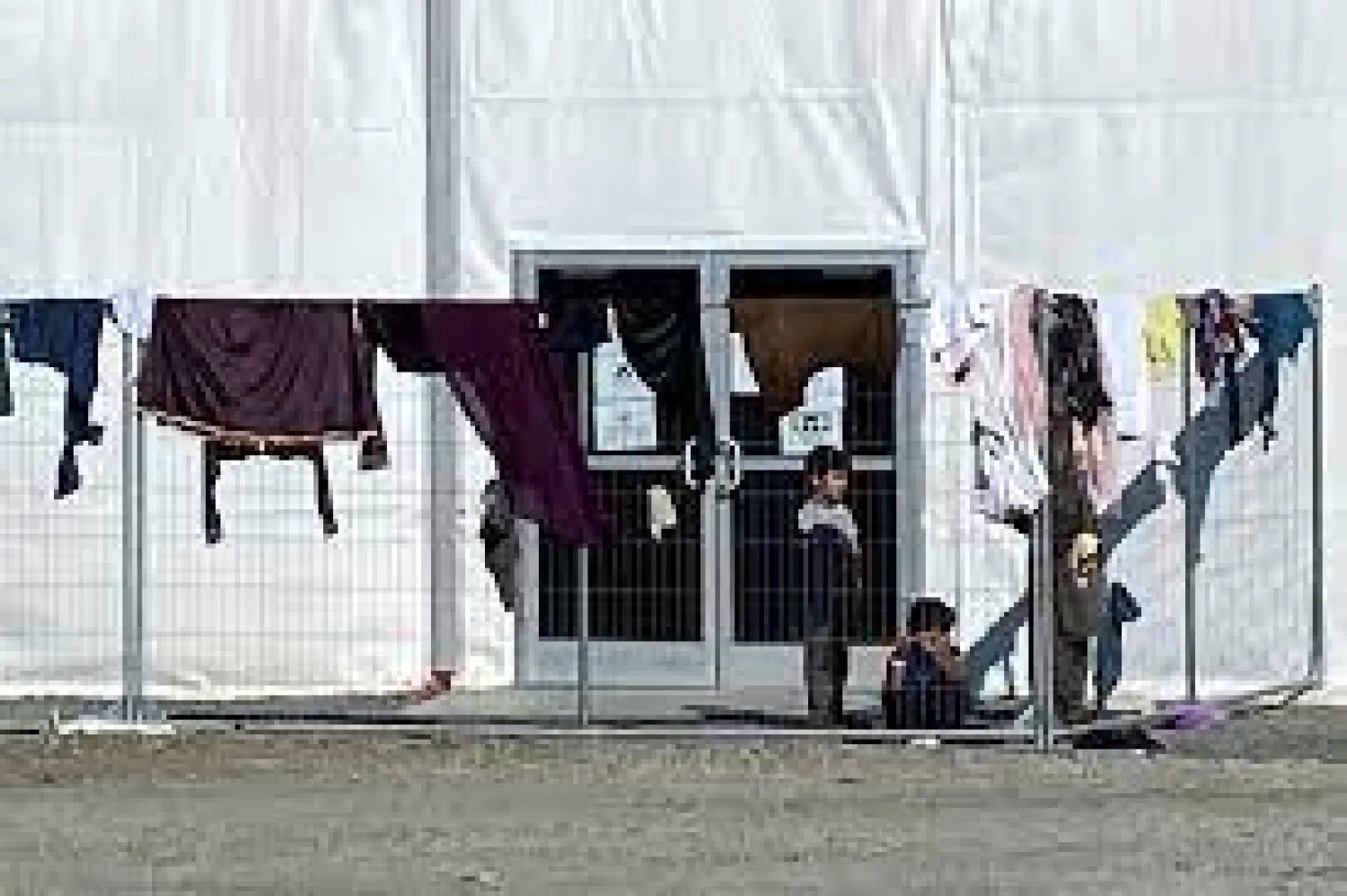

UN: More than 100 Million People Forcibly Displaced

A structure housing Afghan evacuees is seen at Joint Base McGuire-Dix-Lakehurst, New Jersey, which has surged housing and supplies to host more than 9,300 Afghans awaiting resettlement in the United States, September 27, 2021. REUTERS/Phil Stewart
TT

UN: More than 100 Million People Forcibly Displaced

A structure housing Afghan evacuees is seen at Joint Base McGuire-Dix-Lakehurst, New Jersey, which has surged housing and supplies to host more than 9,300 Afghans awaiting resettlement in the United States, September 27, 2021. REUTERS/Phil Stewart

Russia's war in Ukraine has pushed the number of forcibly displaced people around the world above 100 million for the first time ever, the United Nations said Monday.

"The number of people forced to flee conflict, violence, human rights violations and persecution has now crossed the staggering milestone of 100 million for the first time on record, propelled by the war in Ukraine and other deadly conflicts," said UNHCR, the UN Refugee Agency.

The "alarming" figure must shake the world into ending the conflicts forcing record numbers to flee their own homes, the UNHCR said in a statement.

UNHCR said the numbers of forcibly displaced people rose towards 90 million by the end of 2021, spurred by violence in Ethiopia, Burkina Faso, Myanmar, Nigeria, Afghanistan and the Democratic Republic of the Congo, AFP reported.

Russia invaded Ukraine on February 24 and since then, more than eight million people have been displaced within the country, while more than six million refugees have fled across the borders.

- 'Wake-up call' -
"One hundred million is a stark figure -- sobering and alarming in equal measure. It's a record that should never have been set," said UNHCR chief Filippo Grandi.

"This must serve as a wake-up call to resolve and prevent destructive conflicts, end persecution, and address the underlying causes that force innocent people to flee their homes."

The 100 million figure amounts to more than one percent of the global population, while only 13 countries have a bigger population than the number of forcibly displaced people in the world.

The figures combine refugees, asylum-seekers, as well as more than 50 million people displaced inside their own countries.

"The international response to people fleeing war in Ukraine has been overwhelmingly positive," said Grandi.

"Compassion is alive and we need a similar mobilization for all crises around the world. But ultimately, humanitarian aid is a palliative, not a cure.

"To reverse this trend, the only answer is peace and stability so that innocent people are not forced to gamble between acute danger at home or precarious flight and exile."

UNHCR will outline the full data on forced displacement in 2021 in its annual Global Trends Report, due for release on June 16.

- 'Never been as bad' -
More than two years on since the start of the Covid-19 pandemic, at least 20 countries still deny access to asylum for people fleeing conflict, violence, and persecution based on measures to clamp down on the virus.

Grandi called Friday for those countries to lift any remaining pandemic-related asylum restrictions, saying they contravene a fundamental human right.

"I am worried that measures enacted on the pretext of responding to Covid-19 are being used as cover to exclude and deny asylum to people fleeing violence and persecution," he said.

A joint report last week by the Internal Displacement Monitoring Centre (IDMC) and the Norwegian Refugee Council (NRC) said around 38 million new internal displacements were reported in 2021. Some of those were by people forced to flee multiple times during the year.

The figure marks the second-highest annual number of new internal displacements in a decade after 2020, which saw record-breaking movement due to a string of natural disasters.

Last year, new internal displacements specifically from conflict surged to 14.4 million -- marking a 50-percent jump from 2020, the report showed.

"It has never been as bad as this," NRC chief Jan Egeland told reporters.

"The world is falling apart."

Natural disasters continued to account for most new internal displacement, spurring 23.7 million such movements in 2021.



Le Pen Says France Will No Longer Aid Ukraine ‘Financially’ if Elected

Marine Le Pen (C), the far-right National Rally (RN) party's candidate for the 2027 French presidential election, visits the "Made in France" fair at the Porte de Versailles exhibition center in Paris, France, 13 November 2026. (EPA)
TT

Le Pen Says France Will No Longer Aid Ukraine ‘Financially’ if Elected

Marine Le Pen (C), the far-right National Rally (RN) party's candidate for the 2027 French presidential election, visits the "Made in France" fair at the Porte de Versailles exhibition center in Paris, France, 13 November 2026. (EPA)

Marine Le Pen on Monday said that France would provide no further financial aid to Ukraine if she is elected president next year, after a meeting with Kyiv's ambassador in Paris.

"The state of France's public finances would no longer allow the country to provide financial assistance to Ukraine in the coming months," Le Pen said in a statement, while insisting France would honor existing commitments, including toward a 90-billion-euro ($100-billion) European Union loan.

Le Pen is currently ahead in polls in the race to succeed President Emmanuel Macron next year, as the war sparked by Russia's 2022 full-scale invasion of Ukraine grinds towards its fifth anniversary.

She has faced criticism over past links to Russia, which included a 2017 meeting in the Kremlin with President Vladimir Putin and her party taking a loan from a Russian bank that it paid off in full in 2023.

But she has opposed the invasion and, at her talks in Paris with Ukrainian ambassador Vadym Omelchenko, Le Pen made clear her "unwavering support for Ukraine since the beginning of the conflict".

The statement said the talks -- the first such between Le Pen and the Ukrainian ambassador -- were "cordial".

While financial aid would be cut, Le Pen told the ambassador that "France would continue to support Ukraine through donations of equipment, humanitarian aid and much more active diplomacy".

The statement said there was a "frank discussion" on the future of the conflict, with Le Pen stressing that "the pursuit of peace -- though a difficult goal to achieve -- must remain a priority for all".

She also asked the ambassador to tell President Volodymyr Zelensky she is ready to meet in "either Paris or Brussels". However, there was no mention of the candidate making the journey to Kyiv after Zelensky invited her to visit the Ukrainian capital.

Le Pen's opponents have expressed alarm that by emphasizing the importance of ending the war swiftly, she could force Ukraine to capitulate on unfavorable terms.

"If Russia imposes its will on a European nation through brutality, all of Europe is weakened," Macron wrote on Facebook at the weekend.

Taking aim at Le Pen, he said: "Let us be clear: those who seek to limit the resources available to Ukraine are, in effect, pushing for an unjust peace -- one that would leave Ukraine permanently vulnerable, and, by extension, leave Europe vulnerable as well."


Trump Says He Might Meet with North Korea’s Kim Jong Un in China

US President Donald Trump and North Korean leader Kim Jong Un shake hands before their one-on-one chat during the second US-North Korea summit at the Metropole Hotel in Hanoi, Vietnam February 27, 2019. (Reuters)
TT

Trump Says He Might Meet with North Korea’s Kim Jong Un in China

US President Donald Trump and North Korean leader Kim Jong Un shake hands before their one-on-one chat during the second US-North Korea summit at the Metropole Hotel in Hanoi, Vietnam February 27, 2019. (Reuters)

US President Donald Trump said on Monday he might meet with North Korean leader Kim Jong Un in China this week, an announcement that could dramatically reshape his upcoming trip through East Asia if it occurs.

The president, who met the North Korean leader several times during his 2017-2021 term, including once in the Korean Demilitarized Zone, has previously expressed ‌interest in ‌another meeting during his current term. Senior ‌US ⁠officials, however, have previously ⁠said he has no immediate plans to do so.

Moreover, Trump has repeatedly previewed meetings with Kim that never took place, including during a trip to Asia last year. North Korea, whose mission to the United Nations did not immediately respond to a ⁠request for comment, has publicly indicated it ‌has no intention of ‌meeting with the US president at this time.

Trump told reporters ‌while departing the White House en route to ‌the Philippines and China that any meeting would occur in China, and that the North Korean leader's presence was ultimately up to Chinese President Xi Jinping.

"(Xi) was here a ‌month ago, and we're also going to meet with (Russian) President Putin, and we ⁠may ⁠meet with Kim Jong Un also," Trump said.

"So that'll be good. We have a chance to accomplish a lot."

Trump has indicated he will meet with Putin and Xi during his trip, but US officials and analysts have played down the possibility of a meaningful agreement emerging from any trilateral sit-down.

Among the possible topics of conversation, Trump and others have said, are Russia's invasion of Ukraine, counterproliferation and the war in Iran.


Third US Aircraft Carrier Arrives in Middle East

This US Navy handout photograph released by US Naval Forces Central Command on November 4, 2026, shows the Nimitz-class aircraft carrier USS Theodore Roosevelt (CVN 71) sails alongside Royal Australian Navy Supply-class replenishment oiler HMAS Stalwart (A304). (AFP / NAVCENT Public Affairs / US Navy)
TT

Third US Aircraft Carrier Arrives in Middle East

This US Navy handout photograph released by US Naval Forces Central Command on November 4, 2026, shows the Nimitz-class aircraft carrier USS Theodore Roosevelt (CVN 71) sails alongside Royal Australian Navy Supply-class replenishment oiler HMAS Stalwart (A304). (AFP / NAVCENT Public Affairs / US Navy)

The USS Theodore Roosevelt aircraft carrier arrived in the Middle East on Sunday, media reports said, bringing the number of American carrier strike groups in the region to three.

The deployment, which was reported by the National News and Axios journalist Barak Ravid, comes as fighting reignites in the region, with Iran claiming a drone attack on Bahrain on Sunday, ending a lull in strikes in the war.

Iran also fired drones at Bahrain on Friday -- the first strikes since September against countries in the energy-rich Gulf, which has been targeted several times in the conflict that erupted in February.

US President Donald Trump plans to discuss the war at a trilateral meeting with his Chinese and Russian counterparts Xi Jinping and Vladimir Putin this week, an official said Friday.

Months of diplomacy have failed to resolve the war, which began with US-Israeli strikes that killed Iran's supreme leader Ali Khamenei.