


‘National Egyptian Film Festival’ Honors Young Talents

Egyptian actor Samir Sabri in 2016 at the 9th Muscat International Film Festival in Oman. AFP
TT

‘National Egyptian Film Festival’ Honors Young Talents

Egyptian actor Samir Sabri in 2016 at the 9th Muscat International Film Festival in Oman. AFP

Young talents have bagged most of the prizes awarded during the 24th edition of the National Egyptian Film Festival in its two competitions: best feature film, and best short film, documentary, and animation.

The festival, organized by the ministry of culture to support the Egyptian cinema with money prizes worth 1.2 million Egyptian pounds, was attended by Minister Dr. Ines Abdel Dayem. At the beginning of the ceremony, the festival paid tribute to the late artist Samir Sabri, whose pictures were raised in the big theater, at the Cairo Opera House. During a keynote he addressed, Critic Kamal Ramzi said, “the late artist was indeed a man of festivals who supported all the cinema events in the country.”

The festival reflected the status of the Egyptian cinema in the past year on the level of production and quality. This edition saw the participation of 15 out of 24 feature films that were produced in 2021, while 92 movies competed in the short film, documentary, and animation contest.

The minister said the National Egyptian Film Festival is a major contributor to promoting the role of cinema in highlighting and addressing social causes and enhancing the national identity.

He said that cinema was and will always be a means to spread awareness and build a strong, coherent society.

In the beginning of the ceremony, as part of the ‘Eternals’ program dedicated to honor prominent artists, the minister paid tribute to four major figures in the Egyptian cinema: Rajaa Hussein, Abdelaziz Makhiun, and film editor Rahma Montaser, in addition to late director Abdul Qadir al-Talmasani.

The festival also released four books that highlight the journeys of the four figures.

Young talents won most of the prizes in the feature film contest overseen by a jury headed by Director Inas El Degheidy. ‘Al Aaref’ and ‘Abu Saddam’ won the biggest number of prizes; the first won five awards: best direction (Ahmed Alaa al-Deeb), best actress (Carmen Bsaibes), best montage (Ahmed Hafez), and best sound (Ahmed Abu al-Saad), in addition to the best production award.

The second won best actor (Mohammed Mamdouh), best supporting actress (Zeina Mansour), and the second-best production award. ‘Abu Saddam’ director Nadine Khan, daughter of late director Mohammed Khan, won the best direction of first work award.

Nadine expressed her gratitude for this tribute. “It’s very motivating. I dedicate this tribute to the Egyptian cinema, filmmakers, and to my father’s soul. I am so proud of his artistic journey; I learned a lot from him,” she told Asharq Al-Awsat.

The ‘For Rent’ movie won the best script award (Islam al-Sayed), and the third best production award; ‘Moses’ won the best cinematography award (Hussein Osr) and best production design (Ahmed Fayez); ‘Human and Mongoose’ movie won the best wardrobe award (Ines Abdullah), and best music award (Moudi Imam). Actor Ahmed Dash won the best supporting actor award for his role in “The Court” movie.

The jury also awarded a special prize to actresses Layla Elwi and Isaad Younis for their roles in the film ‘200 Pounds’.

Inas El Degheidy said the festival’s awards went to those who deserve them. “We didn’t give a prize to someone who doesn’t deserve it. We chose good works made by young filmmakers in their first or second experiences. They presented good movies with high artistic potential.

“But the common problem among all the participating works was the weak script. In fact, we considered suspending the best script award, but we didn’t to encourage the industry. We also noted the small number of participating movies, and the shrinking productions. We used to produce around 70 films every year in the past decades, which indicates a major problem that should be considered carefully.”

The short film awards, whose jury was headed by cinematographer Said Shimi, were also bagged by young filmmakers. Director Bassem al-Turki was loudly applauded when he took the stage to receive his best short film award for his movie ‘Illusions of the Locked Room,’ which he wrote, directed, and montaged despite his disability.

Director Nabil al-Shazly won the best long documentary award for his work ‘Crocodiles of the Nile’.

“I don’t mind screening my movie for free on cable channels to reach the widest audience. This is the true award,” Shazly told Asharq Al-Awsat.

The festival used to screen all the participating movies to the public before announcing the awards, however, this year, it only screened the winning works one day after its closing ceremony.

“We honor the winning movies by screening them to those who didn’t have the chance to watch them, and those who want to discover the reasons behind their success. We also planned seminars to discuss the winning works with their makers,” Kamal Ramzi, head of the festival, told Asharq Al-Awsat about the screening decision.

Ramzi said he ensured the competing movies get the best evaluation, noting that the awards were a happy surprise for the young filmmakers who are making their first steps in this industry. “We were also keen to honor fewer productions compared to previous editions, to add more depth and value to the tribute.”

Photos Show Filming of Ramadan TV Drama Series on the War-scarred Streets of Syria's Aleppo

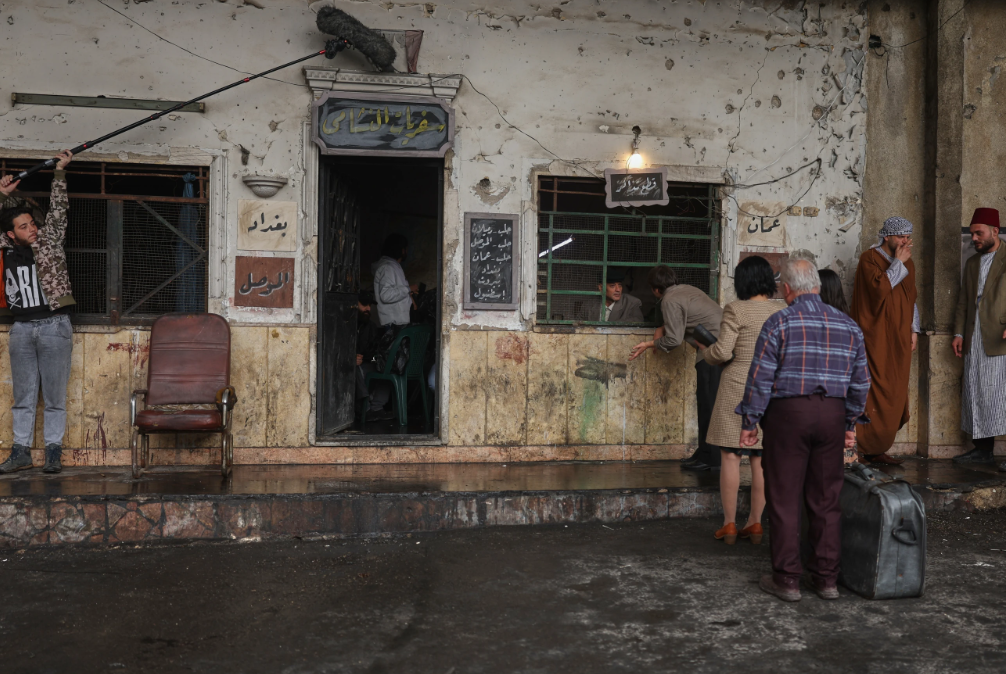
Extras stand by as a television crew films an episode of the TV series “Al-Souriyoun al-Aada” (“The Syrian Enemies”), based on a novel of the same name that was banned under Bashar Assad, along a transformed street in central Aleppo, Syria, Friday, Feb. 13, 2026. (AP Photo/Ghaith Alsayed)
TT

Photos Show Filming of Ramadan TV Drama Series on the War-scarred Streets of Syria's Aleppo

Extras stand by as a television crew films an episode of the TV series “Al-Souriyoun al-Aada” (“The Syrian Enemies”), based on a novel of the same name that was banned under Bashar Assad, along a transformed street in central Aleppo, Syria, Friday, Feb. 13, 2026. (AP Photo/Ghaith Alsayed)

Ramadan in the Arab world is a month of fasting and prayer by day — and television by night. For decades, families have gathered after the iftar, the evening meal that breaks the daytime fast, to follow the season’s highly anticipated drama series, produced specially to air during the Islamic holy month.

In the week before Ramadan, a television crew in central Aleppo was busy preparing one of those productions, with a battered street in the historic city transformed into a scene from decades past.

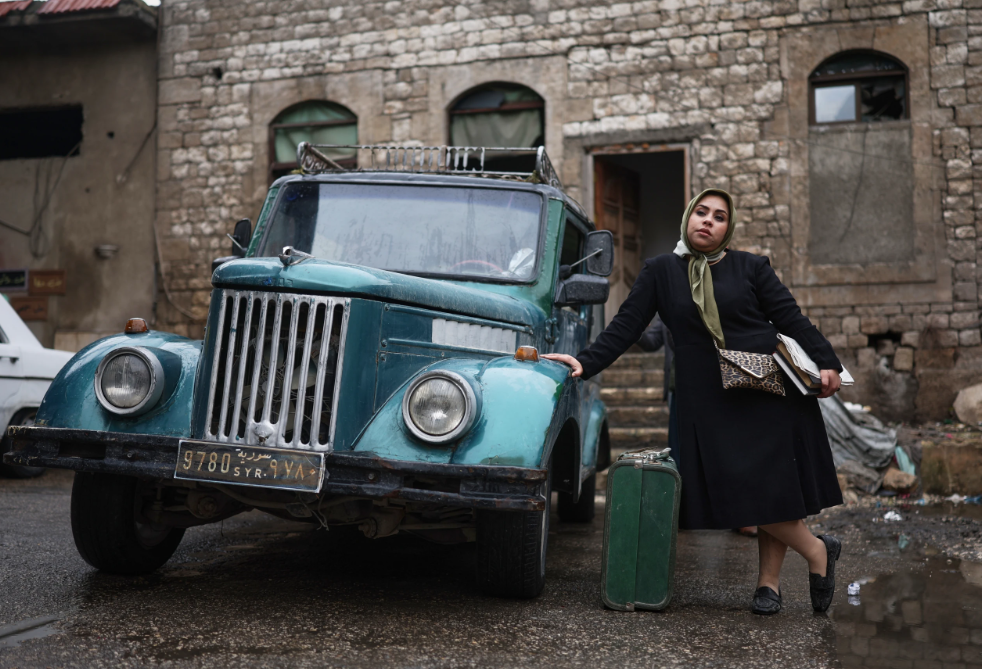
Lamees Al-Ali, an extra in the series, poses for a photograph during the filming of an episode of the TV series “Al-Souriyoun al-Aada” (“The Syrian Enemies”), based on a novel of the same name that was banned under Bashar Assad, along a transformed street in central Aleppo, Syria, Friday, Feb. 13, 2026. (AP Photo/Ghaith Alsayed)

Classic 1970s cars lined the curb. A horse-drawn cart rolled through the frame. A vendor in a red tarboush, a brimless cone-shaped hat, stood beside steaming pots of sahlep — a sweet, thickened milk drink flavored with spices and associated with winter evenings.

Just outside the camera’s view stood a stark reminder of Syria's more recent history. Collapsed buildings and damaged facades testified to Aleppo’s role as a major battleground during the country's civil war. However, with costumes, props and careful framing, the production temporarily carried the street back to what it portrays as a more innocent era, according to The AP news.

A television crew films an episode of the TV series “Al-Souriyoun al-Aada” (“The Syrian Enemies”), based on a novel of the same name that was banned under Bashar Assad, along a transformed street in central Aleppo, Syria, Friday, Feb. 13, 2026.(AP Photo/Ghaith Alsayed)

The series being filmed — “Al-Souriyoun al-Aada,” or “The Syrian Enemies” — is based on a novel that was banned during the rule of former President Bashar Assad. The story examines painful chapters of Syria’s past, including the 1982 events in Hama, when government forces crushed an uprising led by the Muslim Brotherhood, killing or disappearing an estimated 10,000 to 40,000 people and leaving the city in ruins.

As filming continues into Ramadan, the production reflects both a cherished seasonal tradition and Syria’s complex, layered history.


How Bomb Cyclones Form and Create Dangerous Conditions 

A man works in a snowstorm, Sunday, Feb. 22, 2026, in New York. (AP)
TT

How Bomb Cyclones Form and Create Dangerous Conditions 

A man works in a snowstorm, Sunday, Feb. 22, 2026, in New York. (AP)

When turbulent weather with whipping winds and heavy snow is in the forecast, meteorologists sometimes warn that a storm could “bomb out” or become a bomb cyclone. But what exactly does this mean?

According to the US National Oceanic and Atmospheric Administration, certain storms undergo bombogenesis, which happens when a storm’s central pressure drops at least 24 millibars in 24 hours. These storms are sometimes called bomb cyclones. Storm intensity is measured by central pressure, so the lower the pressure, the stronger the storm.

Such rapidly strengthening storms are capable of producing heavy rain, blizzard conditions and intense winds that can create dangerous conditions such as downed trees and power outages.

“If you’re watching TV at night and the weather report comes on and you’re hearing ‘bomb cyclone’ being used, that usually means there’s quite a bit of active weather going on,” said Andrew Orrison, a meteorologist with the National Weather Service in College Park, Maryland.

Bomb cyclones can happen in any season, but mainly occur during fall and winter when frigid air from the Arctic can creep south and clash with warmer air masses.

“It’s really the clash of those air masses that really kind of helps to generate the areas of low pressure in the first place,” said Orrison.

Regions in North America that are prone to seeing bomb cyclones include Alaska, the Pacific Northwest and the Great Lakes region.


New York Orders Citywide Travel Ban as Major Storm Hits US 

People walk along Manhattan's Times Square during a snowfall in New York City, on February 22, 2026. (AFP)
TT

New York Orders Citywide Travel Ban as Major Storm Hits US 

People walk along Manhattan's Times Square during a snowfall in New York City, on February 22, 2026. (AFP)

New York ordered drivers off the road and shut down schools on Monday, while residents braced for a massive snowstorm hitting the United States northeast.

Tens of millions of Americans from the US capital, Washington, to the northern state of Maine have prepared for up to two feet (60 centimeters) of snow forecast in some areas.

Light snow and "freezing fog" with lows of 30F (-1C) were recorded in New York in the early hours of Monday morning, the National Weather Service (NWS) said on its website.

NWS also predicted blizzard conditions would "quickly materialize" from Maryland up to southeastern New England, making travel "extremely treacherous."

Snow could fall at a rate of two to three inches per hour at the peak of the storm, with nearly 54 million people in its path, it said.

Early Monday morning, the storm had already begun to hit New York, slashing visibility to the extent that the skyscrapers of Wall Street were barely visible from the adjacent borough of Brooklyn.

Power outages are likely due to heavy snow and strong wind gusts, forecasters said. Just after 01:39 am local time (0639 GMT) on Monday, nearly 80,000 customers were without power in the state of New Jersey, according to tracking website poweroutage.us.

Meanwhile, more than 5,000 flights have been cancelled, data from the tracker FlightAware showed early Monday.

In New York, which has more than eight million residents, Mayor Zohran Mamdani said streets, highways and bridges would be shut down from 9:00 pm Sunday until noon Monday.

"New York City has not faced a storm of this scale in the last decade," he said, explaining the state of emergency. "We are asking New Yorkers to avoid all non-essential travel."

The ban will not apply to essential workers or New Yorkers needing to travel due to emergencies.

Brandon Smith, 33, who lives in Brooklyn, complained that some workplaces had remained open, even if roads were not.

"It's going to be difficult for most New Yorkers to get around because we still have to go to work. It's unfortunate (roads) are suspended as jobs are not going to stop calling us in," he said.

Tourists, on the other hand, were delighted by the spectacle of their first experiences of snowfall.

Macarena Gonzalez, who came from Chile, said that she knew it was going to snow but didn't realize to what extent.

"I'm happy, it's a great experience," she told AFP on Sunday while exploring Times Square.

- 'Worst yet to come' -

The NWS warned heavy snow, high winds and low visibility were "expected to cause dangerous to impossible travel" conditions.

Gusts of up to 60 miles (100 kilometers) per hour were expected late Sunday and into Monday, the NWS said.

New Jersey Governor Mikie Sherrill declared a state of emergency beginning midday Sunday, freeing up funds and allowing the swift deployment of resources to address the weather crisis.

In Boston, Mayor Michelle Wu closed all public schools and municipal buildings on Monday.

"We ask everyone to plan ahead, stay safe and warm, and stay off the roads to help our public works and public safety efforts," Wu said.

The NWS said "moderate to major" coastal flooding affecting waterfront roads and properties was possible from Delaware up to Cape Cod in Massachusetts.

The storm comes just weeks after the region recovered from another devastating winter weather system that was linked to more than 100 deaths.

"The worst is yet to come," New York Governor Kathy Hochul told a press briefing on Sunday.

"Whatever you need -- any groceries, any medicines you need to be refilled at the pharmacy, any pet food you need to have -- do it right now."

Then, she advised, "just settle in."

"Watch some more Olympics, read a book, catch up on the news, call your family members, call your moms -- especially your moms."
