


Iraqi State TV Station Threatened for Criticizing Iran's Khamenei, Soleimani

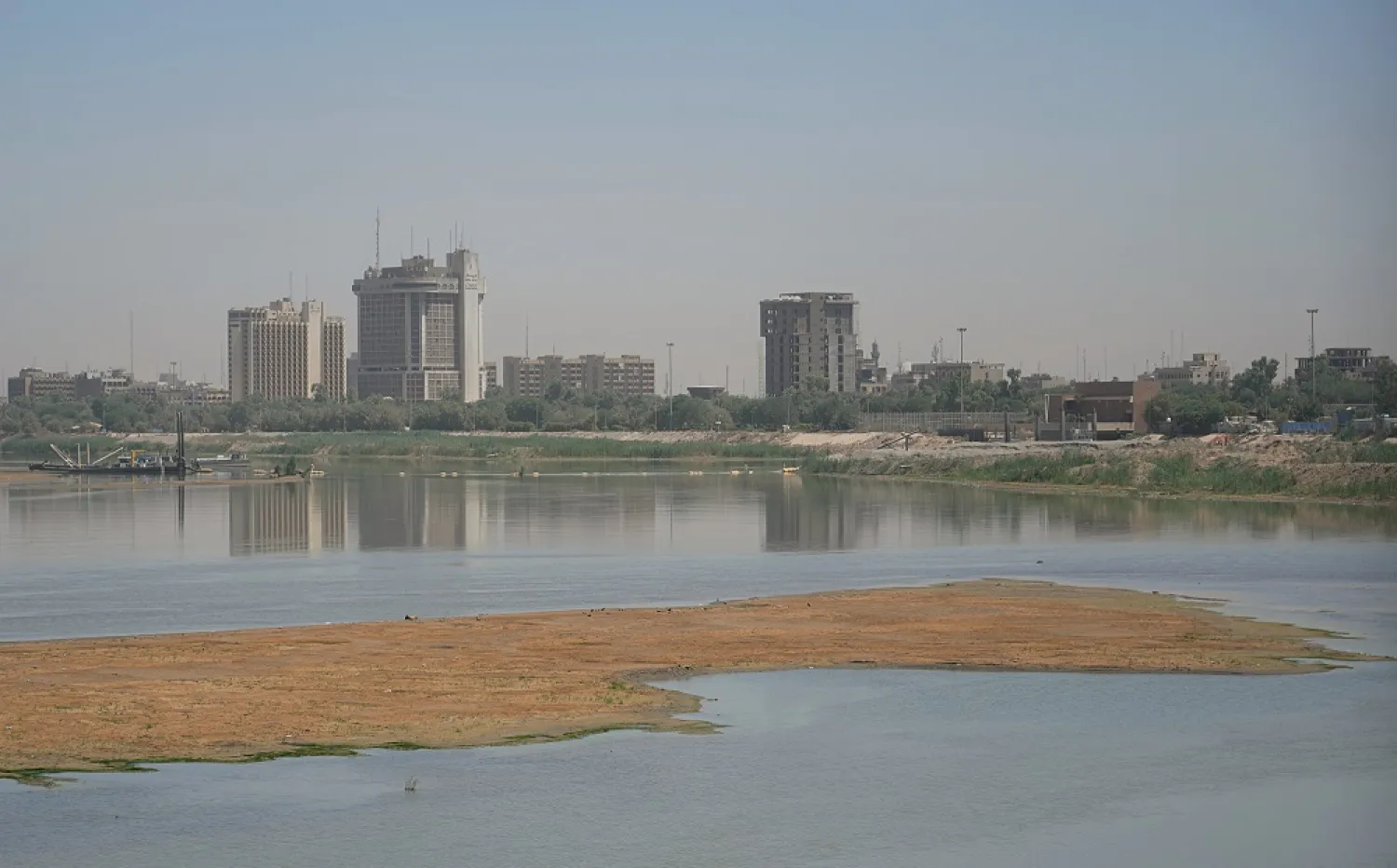
Significantly lower water levels are seen on the Tigris River, in Baghdad, Iraq, Saturday, May 28, 2022. (AP)
TT

Iraqi State TV Station Threatened for Criticizing Iran's Khamenei, Soleimani

Significantly lower water levels are seen on the Tigris River, in Baghdad, Iraq, Saturday, May 28, 2022. (AP)

The state-run Iraqiya television station found itself in hot water after political analyst Sarmad al-Tai made a scathing critique of President of the Supreme Judicial Council Faiq Zidan, Iranian Supreme Leader Ali Khamenei and slain Iran Quds Force commander Qassem Soleimani.

Journalists revealed to Asharq Al-Awsat that security forces were deployed to the station's headquarters on Thursday to protect it against threats from pro-Iran factions.

The factions had turned to social media to openly threaten the channel and the organizers of the show from where the criticism was made.

On Wednesday, Al-Tai appeared on the live show that is hosted by Saadoun Mohsen Damad.

Responding to a question about the judiciary and how to improve it, he replied: "Mr. Faiq Zidan knows that he can't play with fire forever. He is delusional in believing that the youth, who believe in change, will fear arrest warrants that he issues against them. I am one of them, and I challenge him to intimidate us."

"We have confronted Khamenei and Qassem Soleimani, who has slaughtered and killed us. The nooses are around our necks and Iraq is greater than them. Iraq is greater than Faiq Zidan, who manipulates the Supreme Court and abuses the judiciary to launch a political and security coup against the results of the parliamentary elections."

The elections were held in October and dealt a strong blow to pro-Iran factions.

Al-Tai lived for years in Iran's city of Qom where his family fled the oppression of the former regime in Iraq. He studied fiqh (Islamic jurisprudence) in Qom, but in recent years has adopted anti-Iran views. He also believes that the Iraqi judicial authorities are being pressured by the politicians and that they are abusing their position to silence rivals.

His severe criticism on live television marked a precedent in Iraq, made even more significant since it was made on a channel that usually sides with the government and is funded by the people.

The show has since been taken off the air.

Al-Tai's remarks were both applauded and slammed in Iraq.

The Iraqi Media Network regretted his comments, saying it was "not responsible for the guests' abuse of the freedom of expression accorded to them."

It added that it reserves the right to sue whoever abuses this freedom to "insult national figures and constitutional institutions, especially the judiciary," it added.

The judiciary issued an arrest warrant against Al-Tai, who resides in Erbil, the capital of the Iraqi Kurdistan Region.

He already has an outstanding warrant for his arrest issued in wake of a complaint filed by former Prime Minister Nouri al-Maliki.

For his part , Zidan issued a strongly worded statement against Iraqiya, saying he regretted that it hosted a figures who "have a negative (extremist) view of the judiciary." It also regretted that it airs a show that is hosted by a journalist who has "negative and extremist views, as well."

Some parties, lawmakers and organizations rejected the threats against Iraqiya, Al-Tai and Damad.

The Press Freedom Advocacy Association in Iraq questioned Zidan's criticism of Al-Tai and Damad, whom it said is "known for his professionalism and objective positions in a show he has hosted for over a decade."

In a statement, it said a television station that is funded by the people should include all points of view and host everyone, regardless of their convictions.

The Iraqi people share different views and convictions and the channel cannot simply host guests who express the same positions based on political demands.

It slammed authorities for halting Damad's show, urging caretaker Prime Minister Mustafa al-Kadhimi to "assume his responsibilities and fulfill the pledges he made two years ago in protecting press freedom."

Independent lawmaker Sajjad Salem tweeted his support to press freedom and freedom of expression.


Lebanon Central Bank Governor Expresses Reservations Over Draft Law on Deposit Recovery

 Lebanese Prime Minister Nawaf Salam heads a cabinet meeting in Beirut, Lebanon December 23, 2025. (Reuters)
Lebanese Prime Minister Nawaf Salam heads a cabinet meeting in Beirut, Lebanon December 23, 2025. (Reuters)
TT

Lebanon Central Bank Governor Expresses Reservations Over Draft Law on Deposit Recovery

 Lebanese Prime Minister Nawaf Salam heads a cabinet meeting in Beirut, Lebanon December 23, 2025. (Reuters)
Lebanese Prime Minister Nawaf Salam heads a cabinet meeting in Beirut, Lebanon December 23, 2025. (Reuters)

Lebanon’s Central Bank governor has expressed some reservations over a draft law allowing depositors to gradually recover funds ​frozen in the banking system since a financial collapse in 2019, a move critical to reviving the economy.

Karim Souaid described the proposed timetable for the cash component of deposit repayments as "somewhat ambitious" in a statement on Tuesday.

He suggested ‌it may ‌be adjusted without hindering ‌the depositors' ⁠rights ​guarantee "regular, ‌uninterrupted, and complete payments over time".

He also urged the cabinet to conduct a careful review of the draft law , calling for clarifications to ensure fairness and credibility before it is submitted to parliament.

The central ⁠bank governor said the draft required further refinement, ‌including clearer provisions to guarantee equitable ‍treatment of depositors ‍and to reinforce the state’s commitments ‍under the law.

The 2019 financial collapse - the result of decades of unsustainable financial policies, waste and corruption - led the state to default ​on its sovereign debt and sank the Lebanese pound.

The draft law marks ⁠the first time Beirut has put forward legislation aimed at addressing a vast funding shortfall - estimated at $70 billion in 2022 but now believed to be higher.

Prime Minister Nawaf Salam on Monday urged ministers to swiftly approve the draft legislation.

The cabinet discussed the law on Monday and Tuesday and is set to continue discussions ‌on Friday.


Libya Army Chief of Staff Killed in Jet Crash Near Ankara After Fault Reported, Turkish Official Says

Search and rescue team members and emergency services try to reach the wreckage after a plane crash as five people including Libyan Chief of General Staff Muhammad Ali Ahmad al-Haddad were killed at Haymana District in Ankara, Türkiye, early 24 December 2025. (EPA)
TT

Libya Army Chief of Staff Killed in Jet Crash Near Ankara After Fault Reported, Turkish Official Says

Search and rescue team members and emergency services try to reach the wreckage after a plane crash as five people including Libyan Chief of General Staff Muhammad Ali Ahmad al-Haddad were killed at Haymana District in Ankara, Türkiye, early 24 December 2025. (EPA)

A private jet that crashed overnight, killing Libya's army chief of staff and seven others on board, had reported an electrical fault and requested an emergency landing shortly before contact was lost, a Turkish official said on Wednesday.

The Dassault Falcon 50 jet, which took off from Ankara Esenboga Airport at 1717 GMT on Tuesday for Tripoli, informed air traffic control at 1733 GMT of an emergency caused by an electrical malfunction, ‌said communications directorate ‌head Burhanettin Duran.

Search teams found the black box ‌of ⁠the ​plane ‌early on Wednesday, Türkiye’s interior minister said.

'A GREAT LOSS FOR THE NATION'

Libya's Government of National Unity (GNU) said the dead included army chief of staff, Mohammed Ali Ahmed Al-Haddad, and four members of his entourage. Head of the GNU Abdulhamid al-Dbeibah called it a "great loss for the nation."

Three crew members were also killed, Turkish officials said.

In Libya, divided between administrations in the west and east, ⁠authorities on both sides announced a three-day period of mourning and lowered flags to half mast.

Mohammed ‌Al-Menfi, head of the Tripoli-based Presidential Council, said ‍the deputy chief of staff would assume ‍Haddad's duties until a new chief is appointed.

"We want to emphasize ‍the continuity of operations as a military institution," Menfi told Istanbul-based TV channel Libya Alahrar.

Haddad, from the coastal city of Misrata some 200 km (124 miles) east of Tripoli, was appointed chief of staff in 2020.

JET VANISHED FROM RADAR WHILE DESCENDING ​FOR LANDING

Air traffic control had redirected the aircraft back toward Esenboga Airport and emergency measures were initiated, but the jet disappeared from ⁠radar at 1736 GMT while descending for landing and contact was lost, Duran said.

"The aircraft's voice recorder was found at 0245 and the flight data recorder at 0320. Examination and analysis of these devices have begun," Interior Minister Ali Yerlikaya told reporters at the crash site near Ankara’s Haymana district.

Yerlikaya earlier said the aircraft had requested an emergency landing while flying over Haymana, adding that its wreckage was found near Kesikkavak village.

Duran said investigations into the cause of the crash were continuing by all relevant authorities.
Libyan officials have said the jet was leased and registered in Malta, and that its ownership and ‌technical history would be examined as part of the investigation.


How Israel’s Hilltop Settlers Coordinate Attacks to Expel Palestinians

An Israeli settler strikes an olive tree near the Palestinian village of Beita, following a rise in violent settler attacks in the Israeli-occupied West Bank November 12, 2025. (Reuters)
TT

How Israel’s Hilltop Settlers Coordinate Attacks to Expel Palestinians

An Israeli settler strikes an olive tree near the Palestinian village of Beita, following a rise in violent settler attacks in the Israeli-occupied West Bank November 12, 2025. (Reuters)

The Jewish settler outpost of Or Meir is small. A handful of prefabricated white shelters, it sits at the end of a short dirt track on a hill leading up from Road 60, a major route that dissects the Israeli-occupied West Bank.

Over time, similar modest dwellings have turned into sprawling Israeli housing developments, part of a plan that members of Israel's cabinet acknowledge they have implemented to prevent the birth of a Palestinian state.

The process can be violent. A Bedouin family told Reuters attackers who descended ​from Or Meir hurling Molotov cocktails drove them off Palestinian-owned land nearby last year. They fear they won't ever be able to return.

Messages posted on Or Meir's channel on the Telegram social media platform celebrate chasing out Bedouin herders and show the new settlers’ determination to secure lasting control over what they call “strategic” territory.

This year ​was one of the most violent on record for Israeli civilian attacks against Palestinians in the West Bank, according to United Nations data that shows more than 750 injuries and the rapid spread of outposts throughout land Palestinians hope will form the heart of a future state.

Israeli NGO Peace Now has recorded 80 outposts built in 2025, the most since the organization started its records in 1991. On December 21, Israel's cabinet approved 19 more settlements, including former outposts. Finance Minister Bezalel Smotrich said the goal was to block Palestinian statehood.

A new Israeli settler outpost near Deir Dibwan, in the Israeli-occupied West Bank December 13, 2025. (Reuters)

For decades, groups of settlers have built outposts on West Bank land without official authorization from the Israeli state. Israeli authorities in the West Bank sometimes demolish such camps but they often reappear, and in many cases end up being accepted by Israel as formal settlements. Smotrich has pushed efforts to formalize more outposts.

Most of the world considers all Israel's settlement activity in the West Bank illegal under international law relating to military occupations. Israel disputes this view.

"Since establishing our presence on the land, we have driven away nine illegal Bedouin outposts, and returned 6,000 dunams to Jewish hands," the account representing Or Meir's settlers said in a post in September, using the dunam measurement equal to about 1,000 square meters, ‌or a quarter of ‌an acre.

Reuters could not independently confirm all the attacks on the Bedouins or determine who posted on behalf of Or Meir, which was established about two years ‌ago. The ⁠settlers there ​declined to speak to ‌the news agency.

In response to Reuters questions about intensifying settler violence in the West Bank, an Israeli official blamed a "fringe minority" and said Palestinian attacks against Israelis were under-reported by the media. The Palestinian Authority did not respond to requests for comment.

Messages on the Or Meir Telegram channel, which is public, suggest a well-organized plan to take land, a finding supported by Reuters examination of a dozen other Telegram and WhatsApp groups representing similar groups, three interviews with settlers and pro-settler groups and on-the-ground reporting around Or Meir and a new settlement.

"The evidence shows that this is a systematic pattern of violence,” said Milena Ansari, a researcher based in Jerusalem for Human Rights Watch whose work includes research on settlements in the West Bank. The Bedouin Musabah family said they were attacked at night in June from the direction of Or Meir. Charred remains of their home and a barn were still visible to a Reuters team in December.

"We were living here, sitting in God's safety," said Bedouin shepherd Shahada Musabah, 39, now sheltering in the nearby Palestinian village of Deir Dibwan. "They started to set fire and they destroyed everything. They didn't leave us anything at all."

In response to questions about the incident, Israel's military told Reuters dozens of Israeli civilians set fire to property in Deir Dibwan on the night in question. It said all suspects had left by the time security forces arrived. An official in ⁠the Deir Dibwan council told Reuters up to 60 settlers were involved, throwing stones and burning the Musabah house and other property, along with cars. Several villagers were injured by stones.

In a telephone call, Or Meir settler Elkanah Nachmani told Reuters reporters not to advance up the track to the outpost from Road 60 and not to make contact ‌again.

Nachmani responded to a Reuters request for comment but did not address the issues raised by the questions. In the Telegram channel, Or Meir settlers accused ‍Palestinians of poisoning their sheep in November 2024, an accusation the Musabah family denies.

Israeli monitoring group Yesh Din said of the ‍hundreds of cases of settler violence it documented since October 7, 2023, only 2% resulted in indictments.

Reuters could not confirm the group's findings. Israel's police and military did not respond to requests for comment.
More than a thousand Palestinians were killed ‍in the West Bank between October 7, 2023 and October 17, 2025, mostly in operations by security forces and some by settler violence, according to the UN. In the same period, 57 Israelis were killed in Palestinian attacks.

A drone view of part of the Palestinian village of Beita in the Israeli-occupied West Bank November 12, 2025. (Reuters)

TURNING OUTPOSTS INTO SETTLEMENTS

The Or Meir group has been open about its goals.

In November 2024, the Or Meir account posted that it aimed to settle "a strategic ridge near the settlement of Ofra" seeking to create "a continuous Jewish settlement presence."

Dror Etkes, an Israeli peace activist, said other outposts served the same purpose, fracturing the West Bank and "limiting the possibility of Palestinians to be in these places."

Despite the government's actions to recognize dozens of previously irregular outposts, Israel’s military told Reuters in a statement Or Meir "is illegal and has been evacuated several times by the security forces." It did not provide specifics about why it considered the outpost illegal or ​why it was "evacuated" - the military's word to describe closure or demolition of outposts in the West Bank.

After the most recent evacuation in March, Or Meir re-emerged with the help of over 100,000 shekels ($30,000) raised by donations, according to the settlement's website. Reuters couldn't independently confirm the donations.

The former outposts Israel has formalized as settlements over the years include ones previously evacuated by the army. Ofra, also on Road 60 just ⁠north of Or Meir, started as an outpost and is now a major housing development.

"Why do we continue?" asked a post by the Or Meir Telegram account in March after the evacuation. The post then answered its own question. "All breakthroughs in settlements were accomplished this way. At first, the state refused to accommodate any activity on the ground and fought it fiercely, but due to the persistence of the citizens, it eventually had to accept it."

In December, Smotrich said 51,370 housing units had been approved for West Bank settlements since he became minister in late 2022, part of what the UN describes as the fastest expansion of settlements since its monitoring began in 2017. Smotrich's office did not respond to a request for comment.

On September 30, the Oir Meir Telegram account published a map showing the location of the outpost. The map highlighted a large area with a blue boundary stretching to the edge of Deir Dibwan. The group said the marked area was under control of their outpost.

At least four attacks on Palestinians have been reported within the blue boundary, according to the Deir Dibwan council, which said Palestinians could no longer access the area, including about 250 dunams belonging to the council itself.

The map also shows eight black markers, mostly within the blue boundary, listed as “abandoned Arab invasion outpost,” indicating places from which Bedouins had allegedly been ejected.

A drone view of the Palestinian village of Deir Dibwan, in the Israeli-occupied West Bank December 13, 2025. (Reuters)

ROAD 505 TO JORDAN VALLEY

Road 60 is flanked by settlements. It is intersected by Road 505, running west-east toward the Jordan Valley and also lined with settlements, including Evyatar near the Palestinian town of Beita.

Evyatar began as a tented outpost in 2019. It was evacuated in 2021 but secured Israeli government recognition in 2024. Malkiel Barhai, Evyatar’s mayor, credited Smotrich for the approval.

Speaking in Evyatar with a pistol tucked into his trousers that he said was for protection, Barhai said the settlement was vital to keep Road 505 open “because we have Arab villages, hostile Arab villages, around.”

A member of the Beita municipality told Reuters settlers from surrounding outposts or settlements, including Evyatar, killed 14 people in the area around Beita between 2021 and 2024. Reuters could not verify the deaths or who was responsible.

On November 8, Reuters witnessed an attack by settlers wielding sticks and ‌clubs and hurling large rocks as Palestinians harvested olives close to Beita. Two Reuters employees - a journalist and a security adviser - were among those injured.

Barhai denied settlers were behind attacks, and blamed Palestinians for violence.

Samer Younes Ali Bani Shamsah, a farmer who lives near Evyatar and whose leg was broken in a settler attack, said he would not leave the land no matter the cost.

"This is my place, my home. Where would I go?" he said. A hill over, another outpost stood, above a hill of olive trees.