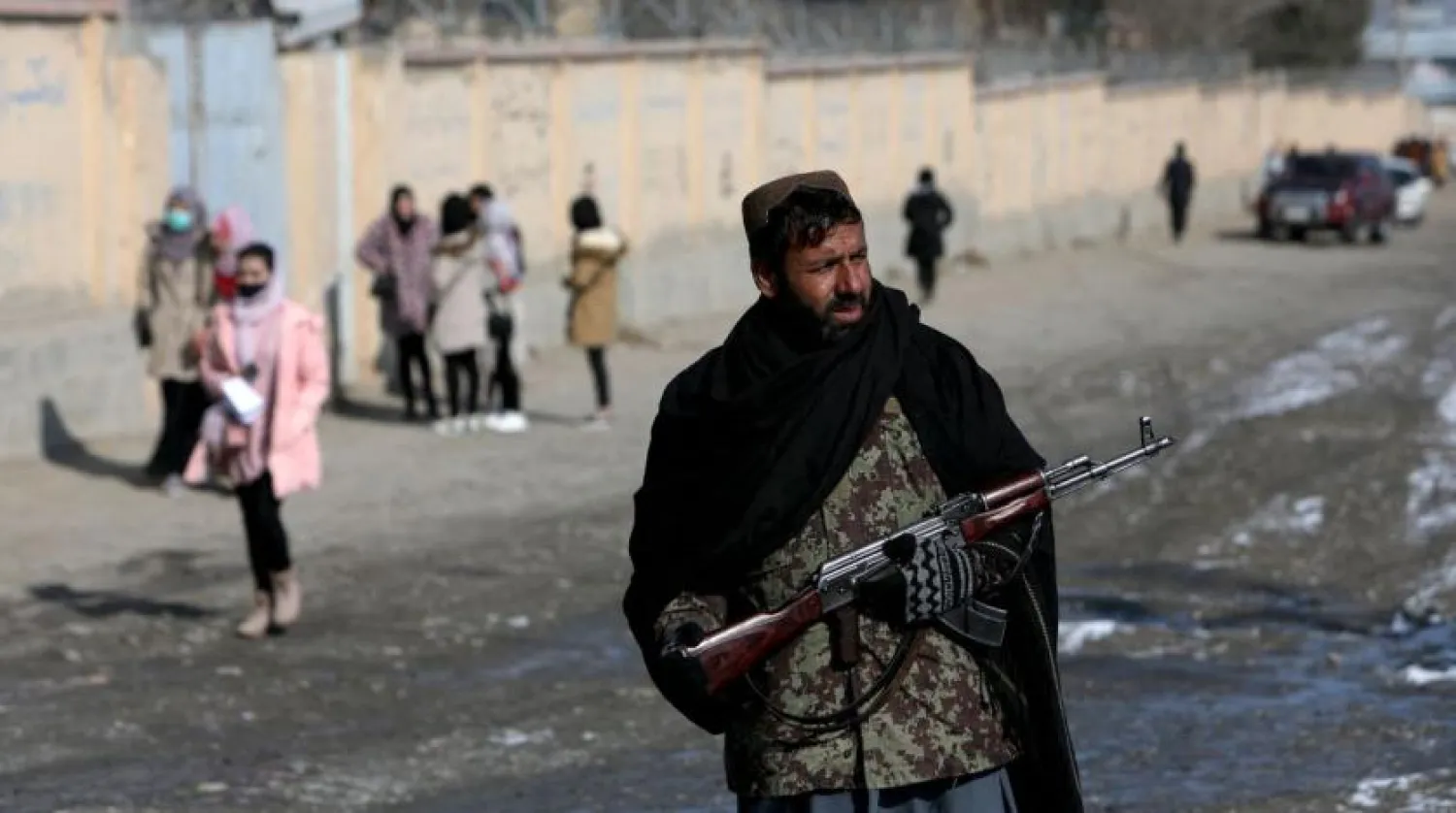
UN: Taliban Faces Threat from ISIS, New Resistance

A Taliban fighter guards a street in Kabul, Afghanistan, December 16, 2021. (Reuters)
TT

UN: Taliban Faces Threat from ISIS, New Resistance

A Taliban fighter guards a street in Kabul, Afghanistan, December 16, 2021. (Reuters)

Afghanistan’s Taliban rulers are maintaining close ties with al-Qaeda as they consolidate control over the country, and their main military threat is coming from the ISIS extremist group and guerrilla-style attacks by former Afghan government security personnel, UN experts said in a new report.

The experts said in the report to the UN Security Council that with the onset of better weather, fighting may escalate as both ISIS and resistance forces undertake operations against Taliban forces, The Associated Press said.

But neither ISIS nor al-Qaeda “is believed to be capable of mounting international attacks before 2023 at the earliest, regardless of their intent or of whether the Taliban acts to restrain them,” the panel of experts said.
Nonetheless, it said the presence of ISIS, al-Qaeda, and “many other terrorist groups and fighters on Afghan soil” is raising concerns in neighboring countries and the wider international community.

Since their takeover of Afghanistan last Aug. 15 as US and NATO forces were in the final stages of their chaotic withdrawal from the country after 20 years, the Taliban “have favored loyalty and seniority over competence, and their decision-making has been opaque and inconsistent,” the experts said.

In the report obtained Thursday, the panel monitoring sanctions against the Taliban said its leaders have appointed 41 men on the UN sanctions blacklist to the Cabinet and senior positions, and they have favored the country’s dominant Pashtun ethnic group, alienating minority communities including ethnic Tajiks and Uzbeks.

The Taliban’s primary concern has been to consolidate control “while seeking international recognition, to re-engage with the international financial system and to receive aid in order to deal with the growing economic and humanitarian crisis in Afghanistan,” the experts said.

“Since taking power, however, there have been many factors creating internal tensions within the movement, leading to perceptions that the Taliban’s governance has been chaotic, disjointed and prone to reversing policies and going back on promises.," they said.

As the Taliban struggle to transition from an insurgency to a governing body, they have been divided between pragmatists and hardliners who have gained the upper hand and want to turn the clock back to the group's harsh rule from 1996 until December 2001, when they were ousted from power by US forces following the 9/11 attacks on the United States.

To date, their efforts to win recognition and aid from Western nations have floundered, largely because they have not formed a more representative government, and have restricted the rights of girls to education beyond elementary school, and of women to work and travel without a male relative's oversight.
“The central dilemma is how a movement with an inflexible ideology can engage with a society that has evolved during the past 20 years,” the experts said. “Further stresses revolve around power, resources, and regional and ethnic divisions.”

Despite these serious issues, the panel said the Taliban “appear confident in their ability to control the country and `wait out’ the international community to obtain eventual recognition of their government.”

“They assess that, even if they make no significant concessions, the international community will ultimately recognize them as the government of Afghanistan, especially in the absence of a government in exile or significant internal resistance,” the experts said.

So far, not a single country has officially recognized the Taliban, and there is growing international anger at its treatment of girls and women and its failure to keep its promise of forming an inclusive government. There are also concerns about the Taliban’s inability to keep its promise not to allow terrorist groups to operate in Afghanistan.

The panel said the Haqqani Network, a militant extremist group with close ties to the Taliban, moved quickly after their takeover to gain control of key portfolios and ministries including interior, intelligence, passports and migration. It now “largely controls security in Afghanistan, including the security of the capital, Kabul,” the experts said.

“The Haqqani Network is still regarded as having the closest links to al-Qaeda,” the panel said, and the relationship between the Taliban and al-Qaeda also remains close. The experts pointed to the reported presence of al-Qaeda’s “core leadership” in eastern Afghanistan including its leader Ayman al-Zawahri.

To counter ISIS, the report quoted an unidentified country as saying the Taliban have created three battalions of special forces called “red units.”

The emergence of the National Resistance Front and Afghanistan Freedom Front comprising former Afghan security personnel “has led the Taliban to adopt aggressive measures against populations suspected of supporting anti-Taliban operations,” the panel said.

In April, it said National Resistance Front forces stepped up operations in Badakhshan, Baghlan, Jowzjan, Kunduz, Panjshir, Takhar and Samangan provinces.

The Afghan Freedom Front, which only emerged recently, “has also claimed several attacks on Taliban bases in Badakhshan, Kandahar, Parwan and Samangan,” the experts said.

“Taliban forces may be hard pressed to counter several insurgencies simultaneously,” they said.


Le Pen Says France Will No Longer Aid Ukraine ‘Financially’ if Elected

Marine Le Pen (C), the far-right National Rally (RN) party's candidate for the 2027 French presidential election, visits the "Made in France" fair at the Porte de Versailles exhibition center in Paris, France, 13 November 2026. (EPA)
TT

Le Pen Says France Will No Longer Aid Ukraine ‘Financially’ if Elected

Marine Le Pen (C), the far-right National Rally (RN) party's candidate for the 2027 French presidential election, visits the "Made in France" fair at the Porte de Versailles exhibition center in Paris, France, 13 November 2026. (EPA)

Marine Le Pen on Monday said that France would provide no further financial aid to Ukraine if she is elected president next year, after a meeting with Kyiv's ambassador in Paris.

"The state of France's public finances would no longer allow the country to provide financial assistance to Ukraine in the coming months," Le Pen said in a statement, while insisting France would honor existing commitments, including toward a 90-billion-euro ($100-billion) European Union loan.

Le Pen is currently ahead in polls in the race to succeed President Emmanuel Macron next year, as the war sparked by Russia's 2022 full-scale invasion of Ukraine grinds towards its fifth anniversary.

She has faced criticism over past links to Russia, which included a 2017 meeting in the Kremlin with President Vladimir Putin and her party taking a loan from a Russian bank that it paid off in full in 2023.

But she has opposed the invasion and, at her talks in Paris with Ukrainian ambassador Vadym Omelchenko, Le Pen made clear her "unwavering support for Ukraine since the beginning of the conflict".

The statement said the talks -- the first such between Le Pen and the Ukrainian ambassador -- were "cordial".

While financial aid would be cut, Le Pen told the ambassador that "France would continue to support Ukraine through donations of equipment, humanitarian aid and much more active diplomacy".

The statement said there was a "frank discussion" on the future of the conflict, with Le Pen stressing that "the pursuit of peace -- though a difficult goal to achieve -- must remain a priority for all".

She also asked the ambassador to tell President Volodymyr Zelensky she is ready to meet in "either Paris or Brussels". However, there was no mention of the candidate making the journey to Kyiv after Zelensky invited her to visit the Ukrainian capital.

Le Pen's opponents have expressed alarm that by emphasizing the importance of ending the war swiftly, she could force Ukraine to capitulate on unfavorable terms.

"If Russia imposes its will on a European nation through brutality, all of Europe is weakened," Macron wrote on Facebook at the weekend.

Taking aim at Le Pen, he said: "Let us be clear: those who seek to limit the resources available to Ukraine are, in effect, pushing for an unjust peace -- one that would leave Ukraine permanently vulnerable, and, by extension, leave Europe vulnerable as well."


Trump Says He Might Meet with North Korea’s Kim Jong Un in China

US President Donald Trump and North Korean leader Kim Jong Un shake hands before their one-on-one chat during the second US-North Korea summit at the Metropole Hotel in Hanoi, Vietnam February 27, 2019. (Reuters)
TT

Trump Says He Might Meet with North Korea’s Kim Jong Un in China

US President Donald Trump and North Korean leader Kim Jong Un shake hands before their one-on-one chat during the second US-North Korea summit at the Metropole Hotel in Hanoi, Vietnam February 27, 2019. (Reuters)

US President Donald Trump said on Monday he might meet with North Korean leader Kim Jong Un in China this week, an announcement that could dramatically reshape his upcoming trip through East Asia if it occurs.

The president, who met the North Korean leader several times during his 2017-2021 term, including once in the Korean Demilitarized Zone, has previously expressed ‌interest in ‌another meeting during his current term. Senior ‌US ⁠officials, however, have previously ⁠said he has no immediate plans to do so.

Moreover, Trump has repeatedly previewed meetings with Kim that never took place, including during a trip to Asia last year. North Korea, whose mission to the United Nations did not immediately respond to a ⁠request for comment, has publicly indicated it ‌has no intention of ‌meeting with the US president at this time.

Trump told reporters ‌while departing the White House en route to ‌the Philippines and China that any meeting would occur in China, and that the North Korean leader's presence was ultimately up to Chinese President Xi Jinping.

"(Xi) was here a ‌month ago, and we're also going to meet with (Russian) President Putin, and we ⁠may ⁠meet with Kim Jong Un also," Trump said.

"So that'll be good. We have a chance to accomplish a lot."

Trump has indicated he will meet with Putin and Xi during his trip, but US officials and analysts have played down the possibility of a meaningful agreement emerging from any trilateral sit-down.

Among the possible topics of conversation, Trump and others have said, are Russia's invasion of Ukraine, counterproliferation and the war in Iran.


Third US Aircraft Carrier Arrives in Middle East

This US Navy handout photograph released by US Naval Forces Central Command on November 4, 2026, shows the Nimitz-class aircraft carrier USS Theodore Roosevelt (CVN 71) sails alongside Royal Australian Navy Supply-class replenishment oiler HMAS Stalwart (A304). (AFP / NAVCENT Public Affairs / US Navy)
TT

Third US Aircraft Carrier Arrives in Middle East

This US Navy handout photograph released by US Naval Forces Central Command on November 4, 2026, shows the Nimitz-class aircraft carrier USS Theodore Roosevelt (CVN 71) sails alongside Royal Australian Navy Supply-class replenishment oiler HMAS Stalwart (A304). (AFP / NAVCENT Public Affairs / US Navy)

The USS Theodore Roosevelt aircraft carrier arrived in the Middle East on Sunday, media reports said, bringing the number of American carrier strike groups in the region to three.

The deployment, which was reported by the National News and Axios journalist Barak Ravid, comes as fighting reignites in the region, with Iran claiming a drone attack on Bahrain on Sunday, ending a lull in strikes in the war.

Iran also fired drones at Bahrain on Friday -- the first strikes since September against countries in the energy-rich Gulf, which has been targeted several times in the conflict that erupted in February.

US President Donald Trump plans to discuss the war at a trilateral meeting with his Chinese and Russian counterparts Xi Jinping and Vladimir Putin this week, an official said Friday.

Months of diplomacy have failed to resolve the war, which began with US-Israeli strikes that killed Iran's supreme leader Ali Khamenei.