

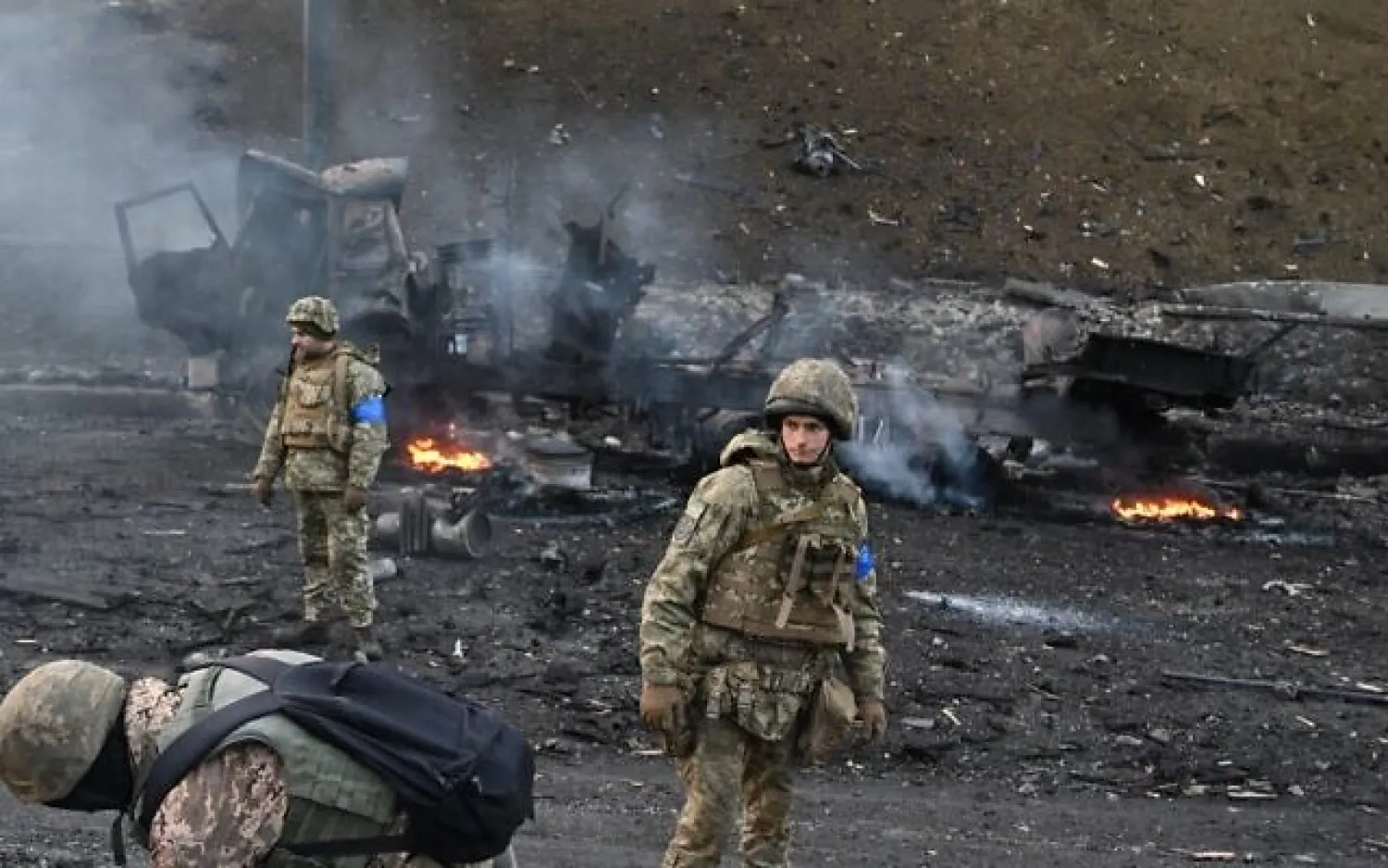

Ukraine Says It Pushes Back Russian Troops in Battlefield City

Ukrainian service members look for and collect unexploded shells after fighting with Russian troops in the Ukrainian capital of Kyiv in the morning of February 26, 2022. (Sergei Supinsky/AFP)
TT

Ukraine Says It Pushes Back Russian Troops in Battlefield City

Ukrainian service members look for and collect unexploded shells after fighting with Russian troops in the Ukrainian capital of Kyiv in the morning of February 26, 2022. (Sergei Supinsky/AFP)

Ukraine said on Saturday it had recaptured a swathe of the battlefield city of Sievierodonetsk, in a rare counter-offensive against Russia's main assault force that had been steadily advancing in the east.

The Ukrainian claim could not be independently verified and Moscow said its own forces were making gains there. But it was the first time Kyiv has claimed to have launched a big counter-attack in Sieverodonetsk after days of yielding ground there.

Russia has concentrated its forces on Sievierodonetsk in recent weeks for one of the biggest ground battles of the war, with Moscow appearing to bet its campaign on capturing one of two eastern provinces it claims on behalf of separatist proxies.
Both sides have claimed to have inflicted huge casualties in the fighting for the small industrial city, a battle that military experts say could determine which side has the momentum for a prolonged war of attrition in coming months.

In the diplomatic sphere, Kyiv rebuked French President Emmanuel Macron for saying it was important not to "humiliate" Moscow.

"We must not humiliate Russia so that the day when the fighting stops we can build an exit ramp through diplomatic means," Macron said in an interview with regional newspapers published on Saturday, adding he was "convinced that it is France's role to be a mediating power."

Ukrainian Foreign Minister Dmytro Kuleba tweeted in response: "Calls to avoid humiliation of Russia can only humiliate France and every other country that would call for it.

"Because it is Russia that humiliates itself. We all better focus on how to put Russia in its place. This will bring peace and save lives."

Ukraine now says its aim is to push Russian forces back as far as possible on the battlefield, counting on advanced missile systems pledged in recent days by the United States and Britain to swing the war in their favor.

Asked about Macron's mediation offer on national television, Ukrainian presidential adviser Mykhailo Podolyak said: "Until we receive weapons in their full amount, until we strengthen our positions, until we push them (Russia's forces) back as far as possible to the borders of Ukraine, there is no point in holding negotiations."

Moscow has said the Western weapons will pour "fuel on the fire," but will not change the course of what it calls a "special military operation" to disarm Ukraine and rid it of nationalists.

Intense fighting in Sievierodonetsk
Serhiy Gaidai, the Ukrainian governor of Luhansk province which includes Sievierodonetsk, said overnight that Ukrainian forces previously in control of just 30% of the city had mounted a counter-attack, recapturing another 20% of it.

Russia's defense ministry said its troops were forcing the Ukrainians to withdraw across the Siverskiy Donets river to Lysychansk on the opposite bank.

Gaidai said the Russians were blowing up bridges across the river to prevent Ukraine bringing in military reinforcements and delivering aid to civilians in Sievierodonetsk.

"Right now, our soldiers have pushed them back, they (the Russians) are suffering huge casualties," Gaidai said in a live TV broadcast. "The Russian army, as we understand, is throwing all its efforts, all its reserves in that direction."

Tens of thousands are believed to have died, millions have been uprooted from their homes and the global economy disrupted in a war that marked its 100th day on Friday.

The war has had a devastating impact on the global economy, especially for poor food-importing countries.

Ukraine is one of the world's leading sources of grain and cooking oil, but those supplies were largely cut off by Russia's closure of its Black Sea ports, with more than 20 million tons of grain stuck in silos.



Has Iran Built an Espionage Network in Israel?

People walk in the rain during stormy weather in the port of Tel Aviv, Israel, 27 December 2025.  EPA/ABIR SULTAN
People walk in the rain during stormy weather in the port of Tel Aviv, Israel, 27 December 2025. EPA/ABIR SULTAN
TT

Has Iran Built an Espionage Network in Israel?

People walk in the rain during stormy weather in the port of Tel Aviv, Israel, 27 December 2025.  EPA/ABIR SULTAN
People walk in the rain during stormy weather in the port of Tel Aviv, Israel, 27 December 2025. EPA/ABIR SULTAN

For the past year, Israel has arrested dozens of Israeli citizens on suspicion of spying for Iran, Yedioth Ahronoth has reported on.

The Hebrew newspaper revealed on Saturday that some of the recruits were asked to photograph sensitive facilities and to collect information including documentation of Israeli army bases, strategic sites and homes linked to senior Israeli officials.

The newspaper said that since September 2024, Israeli authorities have uncovered 35 serious Iranian espionage cases. In some, individuals acted alone; in others, they were part of organized cells, with a mission to sow chaos, burn vehicles and carry out failed assassination plots.

It said the youngest of their recruits is a 13-year-old boy from Tel Aviv. Others had served in the reserves and regular forces.

They leaked sensitive information, including documentation of sensitive military bases, strategic sites and homes linked to senior Israeli officials.

The recruits included Mordechai “Moti” Maman, 72, of Ashkelon. He entered Iran twice and discussed with the agents the possibility of carrying out terror attacks in Israel.

The Iranian handlers discussed with him the option of assassinating senior figures such as Prime Minister Benjamin Netanyahu, then-Defense Minister Yoav Gallant and then-Shin Bet chief Ronen Bar.

After Maman told them the level of security surrounding senior officials made such attacks impractical, the sides discussed alternative terror and espionage activities, including possible attacks on former Prime Minister Naftali Bennett or mayors. Maman was arrested in September 2024.

In October 2024, four cells were arrested, including a couple who had been in contact with Iranian agents since 2021 and groups of five to eight people on suspicion of conducting espionage for Iran.

One of the cases involved seven Israelis who immigrated from Azerbaijan, including a father and son, suspected of maintaining ties for two years with operatives from Iran.

As part of that relationship, the suspects photographed military bases that later became targets in Iran’s ballistic missile attack last year. Some of the group were caught surveilling a senior Israeli official and his son, allegedly as part of an assassination plan.

Authorities also uncovered another case in which seven people aged 19 to 23 from the Jerusalem neighborhood of Beit Safafa were arrested on suspicion of conducting espionage for Iran for several months. Their main assignment was to assassinate an Israeli nuclear scientist and a mayor.

In early 2025, another espionage case was uncovered, and an indictment was filed against an Israeli from Petah Tikva, on charges including contact with a foreign agent and passing information to the enemy.

According to the indictment, the recruit photographed the neighborhood of National Unity party leader Benny Gantz and a power station in Tel Aviv.

His handler contacted him via Telegram and offered payment through a digital wallet in exchange for carrying out security-related tasks. These included documenting security facilities, spraying political graffiti, arson attacks on vehicles and other acts.

During 2025, more than nine indictments have been filed against cells and individuals accused of spying for Iran, most of them Jews the newspaper said.
Investigations revealed that most of the spies had carried out various missions in exchange for payment.

The majority of the recruits had not travelled to Iran to complete their recruitment, but communicated with Iranians through social networks or during their presence in other countries.


Polls Open for Myanmar's 1st Election Since Military Seized Power

Myanmar voters line up to cast ballots during the first phase of general election at a polling station in Naypyitaw, the capital city of Myanmar, 28 December 2025. EPA/RUNGROJ YONGRIT
TT

Polls Open for Myanmar's 1st Election Since Military Seized Power

Myanmar voters line up to cast ballots during the first phase of general election at a polling station in Naypyitaw, the capital city of Myanmar, 28 December 2025. EPA/RUNGROJ YONGRIT

Voters went to the polls Sunday for the initial phase of Myanmar ’s first general election in five years, held under the supervision of its military government while a civil war rages throughout much of the country.

Final results will not be known until after two more rounds of voting are completed later in January. It is widely expected that Min Aung Hlaing, the general who has ruled the country with an iron hand since an army takeover in 2021, will then assume the presidency.

The military government has presented the vote as a return to electoral democracy, but its bid for legitimacy is marred by bans on formerly popular opposition parties and reports that soldiers have used threats to force voters to participate.

While more than 4,800 candidates from 57 parties are competing for seats in national and regional legislatures, only six are competing nationwide with the possibility to gain political clout in Parliament. The well-organized and funded Union Solidarity and Development Party, with its support from the military, is by far the strongest contender.

Voting is taking place in three phases, with Sunday’s first round being held in 102 of Myanmar’s 330 townships. The second phase will take place Jan. 11, and the third on Jan. 25. Final results are expected to be announced by February.

Critics call the election a sham to keep the army in power Critics charge that the election is designed to add a facade of legitimacy to military rule that began when the military ousted the elected government of Aung San Suu Kyi in February 2021. It blocked her National League for Democracy party from serving a second term despite winning a landslide victory in the 2020 election.

They argue that the results will lack legitimacy due to the exclusion of major parties and limits on freedom of speech and an atmosphere of repression.

The expected victory of the military-backed Union Solidarity and Development Party makes the nominal transition to civilian rule a chimera, say opponents of military rule and independent analysts.

“An election organized by a junta that continues to bomb civilians, jail political leaders, and criminalize all forms of dissent is not an election — it is a theater of the absurd performed at gunpoint,” Tom Andrews, the UN-appointed human rights expert for Myanmar, posted on X.

The United Nations also said Sunday that Myanmar needs free elections.

"It is critical that the future of Myanmar is determined through a free, fair, inclusive and credible process that reflects the will of its people," said the United Nations in Myanmar, adding the UN "stands in solidarity with the people of Myanmar and their democratic aspirations.”

Holding the election may provide an excuse for neighbors like China, India and Thailand to continue their support, claiming the election promotes stability.

Western nations have maintained sanctions against Myanmar’s ruling generals due to their anti-democratic actions and the brutal war against their opponents.

Suu Kyi, Myanmar’s 80-year-old former leader, and her party are not participating in the polls. She is serving a 27-year prison term on charges widely viewed as spurious and politically motivated. Her party, the National League for Democracy, was dissolved in 2023 after refusing to register under new military rules.

Other parties also refused to register or declined to run under conditions they deem unfair, and opposition groups have called for a voter boycott.


Report: North Korean Money Launderer Transfers Funds to IRGC

Revolutionary Guard commanders during a meeting with Iranian Supreme leader (Khamenei’s website)
TT

Report: North Korean Money Launderer Transfers Funds to IRGC

Revolutionary Guard commanders during a meeting with Iranian Supreme leader (Khamenei’s website)

A media report published in South Korea has revealed traces of financial transactions between Iran’s regime and North Korea, both US-sanctioned states, signaling the two countries’ increasing use of non-traditional financial tools to circumvent restrictions on their banking systems.

According to blockchain tracking sources, transactions between both countries were carried out through the money-laundering network of a North Korean operative using cryptocurrencies, with part of the funds transferred to entities affiliated with the Iranian Revolutionary Guard Corps (IRGC), the South Korean Chosun Ilbo newspaper said in an article published last Friday.

It said investigations by TRM Labs show that dollars were transferred this year from a cryptocurrency wallet belonging to Sim Hyon-sop, a North Korean money launderer, to a wallet linked to the Revolutionary Guard.

According to the newspaper, Iran’s regime may have exchanged cryptocurrency to evade sanctions, convert funds into US dollars, or even pay for oil.

It said Iran and North Korea, both under severe US sanctions, have increasingly turned in recent years to opaque financial tools, mainly cryptocurrencies.

Analysts told the newspaper that these transactions are a sign of overlapping financial networks between the two countries aimed at circumventing the sanctions system.

Sim Hyon-sop, who is wanted by the FBI on charges of money laundering and sanctions evasion, has played a key role in this network.

According to the newspaper, Sim saw his bounty rise from $5 million to $7 million (approximately 10 billion Korean won) in July.

Born in Pyongyang in 1983, he is affiliated with North Korea’s Foreign Trade Bank, which has been on US sanctions lists.

He used aliases such as “Sim Ali” and “Sim Hajim” and posed as a representative of Kwangson Bank.

Chosun Ilbo said Sim’s laundering process was meticulous: North Korean “IT workers” sent him cryptocurrency stolen through hacking or received as wages, routing it through multiple digital wallets to obscure traces.

Sim then transferred the funds to pre-selected brokers in an Arab country or China, who converted them into US dollars.

Also, foreign currency earned by North Korean laborers in Russia, China, and Africa flowed into Sim’s accounts via similar laundering routes.

The newspaper showed that part of the earnings were not sent directly to North Korea but were instead spent on purchasing goods, equipment, and even weapons needed by Kim Jong Un’s regime.

Among the examples cited is the use of a company in Zimbabwe to purchase a $300,000 helicopter in Russia and deliver it to North Korea.

Additionally, the newspaper said about $800,000 were spent to procure raw materials for producing counterfeit cigarettes, one of Pyongyang’s main sources of income.

The Chosun Ilbo report stated that US banks, including Citibank, JPMorgan, and Wells Fargo, failed to detect Sim’s money-laundering activities. It said at least 310 transactions totaling $74 million were processed through the US financial system.

Referring to data from the Financial Action Task Force (FATF) and Chainalysis, the report said dozens of North Korean “shadow bankers” are active outside the country. Over several years, they have laundered more than $6 billion in stolen cryptocurrency for the regime.

Chosun Ilbo said that although the US federal court had issued an arrest warrant for Sim in March 2023, his capture remains nearly impossible.