


Shoot 'em Up Video Game a Refuge for War-scarred Afghans

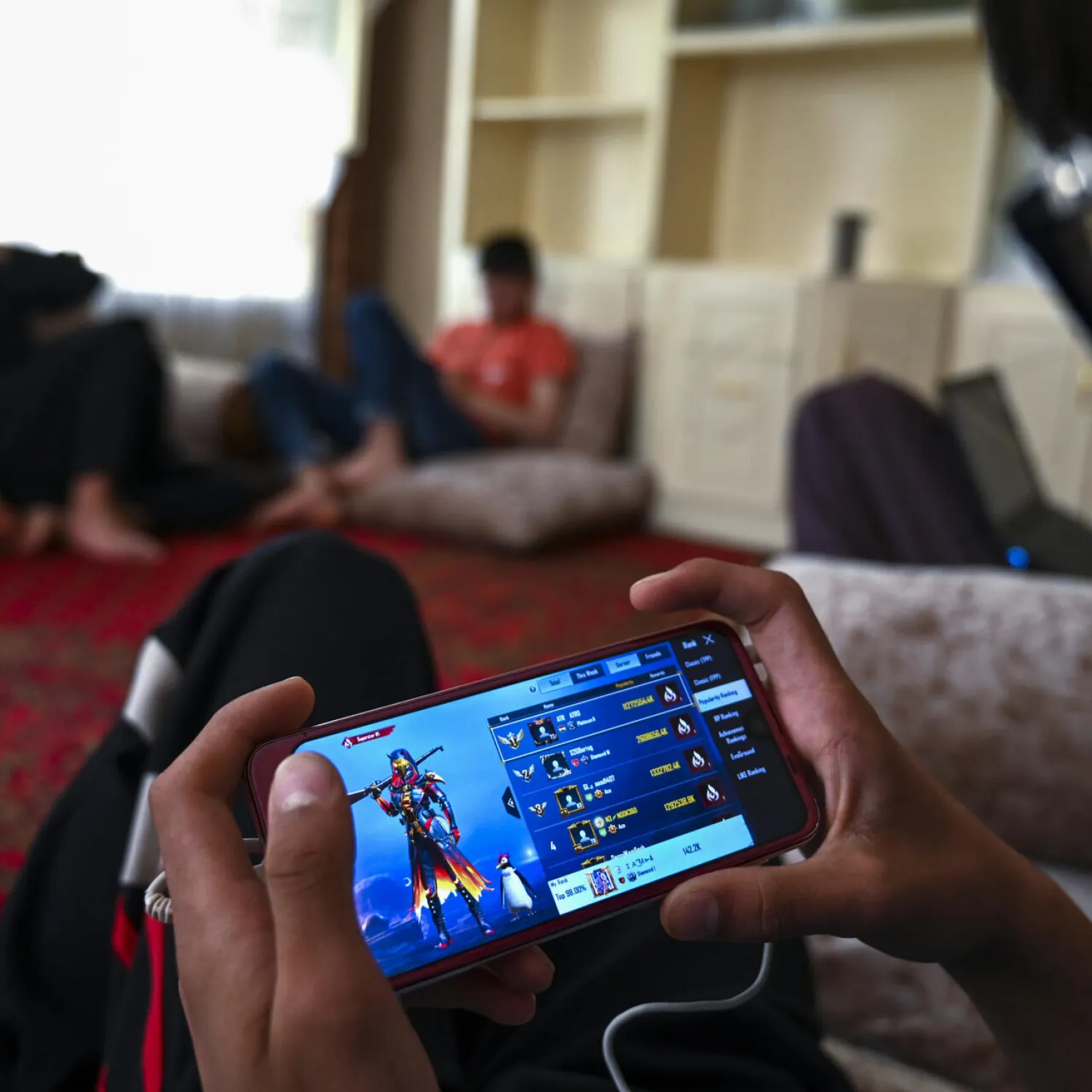
Afghan boys play PUBG on mobile phones in Kabul Wakil KOHSAR AFP
TT

Shoot 'em Up Video Game a Refuge for War-scarred Afghans

Afghan boys play PUBG on mobile phones in Kabul Wakil KOHSAR AFP

The crackle of gunfire. A gasp of a stranger. Explosions rumbling in the distance. In the Afghan capital of Kabul, such sounds would normally prompt panic.

But they are coming from the tinny speaker of a mobile phone clutched by a young man, hunched over and absorbed in the bloody shoot 'em up video game "PlayerUnknown's Battlegrounds", or PUBG.

"In this country, we are living but we are not alive," said gamer Abdul Musawir Raufi, after peeling his gaze away from the phone screen, where his avatar duels with other players in an online arena.

"We don't know what will happen from one moment to the next. It's the only way to pass the time," said the 23-year-old.

Afghanistan has been wracked by four decades of very real conflict, now largely subsided since the withdrawal of US-led troops and the return of the Taliban last year.

But in a striking irony, youngsters say the wildly popular virtual violence simulator offers respite from the turmoil of the transition and the strictures of the hardline regime, as well as a rare channel of communication with the outside world.

Meanwhile, the Taliban -- who spent the past 20 years waging their own vicious and bloody insurgency -- are currently working to cut off access to PUBG, having deemed it a corrupting influence.

- End of entertainment -

Since storming back to power in August, the Taliban have not curtailed entertainment as harshly as they did during their previous stint in power between 1996 and 2001, when TV, cinema, photography and kite flying were all banned.

In the capital, a few arcades and bowling alleys remain open and some sports are still being played. But music has been banned alongside female-fronted or foreign television series.

Many Kabul residents are wary of the Taliban fighters who patrol the streets and man checkpoints, and prefer to stay at home rather than risk an outing for entertainment.

Raufi was once a keen football player, but most of the friends he played with fled the country during the chaotic mass evacuation in the final days of the international withdrawal.

"The fun we used to have, the laughing with friends... it's all over," he said.

But PUBG, published by Chinese digital giant Tencent and downloaded on mobiles more than a billion times globally, has allowed him to stay in touch with friends and make new connections with foreign players online.

"It allows us to learn about the culture of other countries and their language. The bonds I've created are very strong," he said.

Former student Abdul Mujeeb, 20, has also found refuge in the video game from the spiraling economic crisis that accompanied the Taliban's return.

The United States has seized billions of dollars in Afghan assets, while international aid that propped up the domestic economy has dried up.

"During the previous government, we were mostly busy with our jobs and studies," said Mujeeb. "Now, we can't study and there are no jobs."

That leaves PUBG and TikTok -- the social media video app is also in the crosshairs of Taliban censors -- as "the entertainment we have at home and that keeps us busy", he said.

While mobile games offer an escape, providing a sense of community and boosting mood, the World Health Organization has warned that a small proportion of gamers can develop an addiction, characterized by the increased priority given to logging on to play.

- Taliban bans -

According to figures from specialist site DataReportal, only 9.2 million Afghans have access to the internet out of a population estimated at 40.2 million.

But Taliban authorities ordered a ban on both PUBG and TikTok in April, accusing them of leading younger generations "astray".

They nonetheless remain accessible.

The issue is currently being discussed with Afghan telecom companies and both apps "will be fully banned in our country", deputy government spokesman Inamullah Samangani told AFP.

Both Raufi and Mujeeb say they will find a way around any ban.

Student Shaheera Ghafori, 19, who plays PUBG like her brother and sister, believes the Taliban "don't have the means" to forbid the game. And she doesn't understand their reasoning.

"It's a bit of an irrational judgment," she said.

"It's better to have a place to keep young people busy rather than having them wander around the streets."

PUBG has already been banned in a number of countries, including India.

But with the Taliban increasingly confining women to the domestic sphere, Ghafori said the game is a "place to play which diverts our attention, rather than leaving us sitting at home depressed".

Ghafori hopes that contact with the modern world may cause the Taliban to change their ways. But, she admits, that may just be "wishful thinking".




Mark Zuckerberg Set to Testify in Watershed Social Media Trial 

Meta's CEO Mark Zuckerberg testifies during the Senate Judiciary Committee hearing on online child sexual exploitation at the US Capitol in Washington, US, January 31, 2024. (Reuters)
TT

Mark Zuckerberg Set to Testify in Watershed Social Media Trial 

Meta's CEO Mark Zuckerberg testifies during the Senate Judiciary Committee hearing on online child sexual exploitation at the US Capitol in Washington, US, January 31, 2024. (Reuters)

Mark Zuckerberg will testify in an unprecedented social media trial that questions whether Meta's platforms deliberately addict and harm children.

Meta's CEO is expected to answer tough questions on Wednesday from attorneys representing a now 20-year-old woman identified by the initials KGM, who claims her early use of social media addicted her to the technology and exacerbated depression and suicidal thoughts. Meta Platforms and Google’s YouTube are the two remaining defendants in the case, which TikTok and Snap have settled.

Zuckerberg has testified in other trials and answered questions from Congress about youth safety on Meta's platforms, and he apologized to families at that hearing whose lives had been upended by tragedies they believed were because of social media.

This trial, though, marks the first time Zuckerberg will answer similar questions in front of a jury. and, again, bereaved parents are expected to be in the limited courtroom seats available to the public.

The case, along with two others, has been selected as a bellwether trial, meaning its outcome could impact how thousands of similar lawsuits against social media companies would play out.

A Meta spokesperson said the company strongly disagrees with the allegations in the lawsuit and said they are “confident the evidence will show our longstanding commitment to supporting young people.”

One of Meta's attorneys, Paul Schmidt, said in his opening statement that the company is not disputing that KGM experienced mental health struggles, but rather that Instagram played a substantial factor in those struggles.

He pointed to medical records that showed a turbulent home life, and both he and an attorney representing YouTube argue she turned to their platforms as a coping mechanism or a means of escaping her mental health struggles.

Zuckerberg's testimony comes a week after that of Adam Mosseri, the head of Meta's Instagram, who said in the courtroom that he disagrees with the idea that people can be clinically addicted to social media platforms.

Mosseri maintained that Instagram works hard to protect young people using the service, and said it's “not good for the company, over the long run, to make decisions that profit for us but are poor for people’s well-being."

Much of Mosseri's questioning from the plaintiff's lawyer, Mark Lanier, centered on cosmetic filters on Instagram that changed people’s appearance — a topic that Lanier is sure to revisit with Zuckerberg.

He is also expected to face questions about Instagram’s algorithm, the infinite nature of Meta’ feeds and other features the plaintiffs argue are designed to get users hooked.


US Tech Giant Nvidia Announces India Deals at AI Summit

FILED - 04 February 2026, Bavaria, Munich: The NVIDIA logo is seen during a press conference at the opening of Telekom and NVIDIA's AI factory "Industrial AI Cloud". Photo: Sven Hoppe/dpa
TT

US Tech Giant Nvidia Announces India Deals at AI Summit

FILED - 04 February 2026, Bavaria, Munich: The NVIDIA logo is seen during a press conference at the opening of Telekom and NVIDIA's AI factory "Industrial AI Cloud". Photo: Sven Hoppe/dpa

US artificial intelligence chip titan Nvidia unveiled tie-ups with Indian computing firms on Wednesday as tech companies rushed to announce deals and investments at a global AI conference in New Delhi.

This week's AI Impact Summit is the fourth annual gathering to discuss how to govern the fast-evolving technology -- and also an opportunity to "define India's leadership in the AI decade ahead", organizers say.

Mumbai cloud and data center provider L&T said it was teaming up with Nvidia, the world's most valuable company, to build what it touted as "India's largest gigawatt-scale AI factory".

"We are laying the foundation for world-class AI infrastructure that will power India's growth," said Nvidia boss Jensen Huang in a statement that did not put a figure on the investment.

L&T said it would use Nvidia's powerful processors, which can train and run generative AI tech, to provide data center capacity of up to 30 megawatts in Chennai and 40 megawatts in Mumbai.

Nvidia said it was also working with other Indian AI infrastructure players such as Yotta, which will deploy more than 20,000 top-end Nvidia Blackwell processors as part of a $2 billion investment.

Dozens of world leaders and ministerial delegations have come to India for the summit to discuss the opportunities and threats, from job losses to misinformation, that AI poses.

Last year India leapt to third place -- overtaking South Korea and Japan -- in an annual global ranking of AI competitiveness calculated by Stanford University researchers.

But despite plans for large-scale infrastructure and grand ambitions for innovation, experts say the country has a long way to go before it can rival the United States and China.

The conference has also brought a flurry of deals, with IT minister Ashwini Vaishnaw saying Tuesday that India expects more than $200 billion in investments over the next two years, including roughly $90 billion already committed.

Separately, India's Adani Group said Tuesday it plans to invest $100 billion by 2035 to develop "hyperscale AI-ready data centers", a boost to New Delhi's push to become a global AI hub.

Microsoft said it was investing $50 billion this decade to boost AI adoption in developing countries, while US artificial intelligence startup Anthropic and Indian IT giant Infosys said they would work together to build AI agents for the telecoms industry.

Nvidia's Huang is not attending the AI summit but other top US tech figures joining include OpenAI's Sam Altman, Google DeepMind's Demis Hassabis and Microsoft founder Bill Gates.

Indian Prime Minister Narendra Modi and other world leaders including French President Emmanuel Macron and Brazil's Luiz Inacio Lula da Silva are expected to deliver a statement at the end of the week about how they plan to address concerns raised by AI technology.

But experts say that the broad focus of the event and vague promises made at previous global AI summits in France, South Korea and Britain mean that concrete commitments are unlikely.

Nick Patience, practice lead for AI at tech research group Futurum, told AFP that nonbinding declarations could still "set the tone for what acceptable AI governance looks like".

But "the largest AI companies deploy capabilities at a pace that makes 18-month legislative cycles look glacial," Patience said.

"So it's a case of whether governments can converge fast enough to create meaningful guardrails before de facto standards are set by the companies themselves."


India Eyes $200B in Data Center Investments as It Ramps Up Its AI Hub Ambitions

FILE -Google CEO Sundar Pichai, right, interacts with India's Minister for Information and Technology Ashwini Vaishnaw during Google for India 2022 event in New Delhi, Dec. 19, 2022. (AP Photo/Manish Swarup), File)
TT

India Eyes $200B in Data Center Investments as It Ramps Up Its AI Hub Ambitions

FILE -Google CEO Sundar Pichai, right, interacts with India's Minister for Information and Technology Ashwini Vaishnaw during Google for India 2022 event in New Delhi, Dec. 19, 2022. (AP Photo/Manish Swarup), File)

India is hoping to garner as much as $200 billion in investments for data centers over the next few years as it scales up its ambitions to become a hub for artificial intelligence, the country’s minister for electronics and information technology said Tuesday.

The investments underscore the reliance of tech titans on India as a key technology and talent base in the global race for AI dominance. For New Delhi, they bring in high-value infrastructure and foreign capital at a scale that can accelerate its digital transformation ambitions.

The push comes as governments worldwide race to harness AI's economic potential while grappling with job disruption, regulation and the growing concentration of computing power in a few rich countries and companies.

“Today, India is being seen as a trusted AI partner to the Global South nations seeking open, affordable and development-focused solutions,” Ashwini Vaishnaw told The Associated Press in an email interview, as New Delhi hosts a major AI Impact Summit this week drawing participation from at least 20 global leaders and a who’s who of the tech industry.

In October, Google announced a $15 billion investment plan in India over the next five years to establish its first artificial intelligence hub in the South Asian country. Microsoft followed two months later with its biggest-ever Asia investment announcement of $17.5 billion to advance India’s cloud and artificial intelligence infrastructure over the next four years.

Amazon too has committed $35 billion investment in India by 2030 to expand its business, specifically targeting AI-driven digitization. The cumulative investments are part of $200 billion in investments that are in the pipeline and New Delhi hopes would flow in.

Vaishnaw said India’s pitch is that artificial intelligence must deliver measurable impacts at scale rather than remain an elite technology.

“A trusted AI ecosystem will attract investment and accelerate adoption,” he said, adding that a central pillar of India’s strategy to capitalize on the use of AI is building infrastructure.

The government recently announced a long-term tax holiday for data centers as it hopes to provide policy certainty and attract global capital.

Vaishnaw said the government has already operationalized a shared computing facility with more than 38,000 graphics processing units, or GPUs, allowing startups, researchers and public institutions to access high-end computing without heavy upfront costs.

“AI must not become exclusive. It must remain widely accessible,” he said.

Alongside the infrastructure drive, India is backing the development of sovereign foundational AI models trained on Indian languages and local contexts. Some of these models meet global benchmarks and in certain tasks rival widely used large language models, Vaishnaw said.

India is also seeking a larger role in shaping how AI is built and deployed globally as the country doesn’t see itself strictly as a “rule maker or rule taker,” according to Vaishnaw, but an active participant in setting practical, workable norms while expanding its AI services footprint worldwide.

“India will become a major provider of AI services in the near future,” he said, describing a strategy that is “self-reliant yet globally integrated” across applications, models, chips, infrastructure and energy.

Investor confidence is another focus area for New Delhi as global tech funding becomes more cautious.

Vaishnaw said the technology’s push is backed by execution, pointing to the Indian government's AI Mission program which emphasizes sector specific solutions through public-private partnerships.

The government is also betting on reskilling its workforce as global concerns grow that AI could disrupt white collar and technology jobs. New Delhi is scaling AI education across universities, skilling programs and online platforms to build a large AI-ready talent pool, the minister said.

Widespread 5G connectivity across the country and a young, tech-savvy population are expected to help with the adoption of AI at a faster pace, he added.

Balancing innovation with safeguards remains a challenge though, as AI expands into sensitive sectors such as governance, health care and finance.

Vaishnaw outlined a fourfold strategy that includes implementable global frameworks, trusted AI infrastructure, regulation of harmful misinformation and stronger human and technical capacity to hedge the impact.

“The future of AI should be inclusive, distributed and development-focused,” he said.