

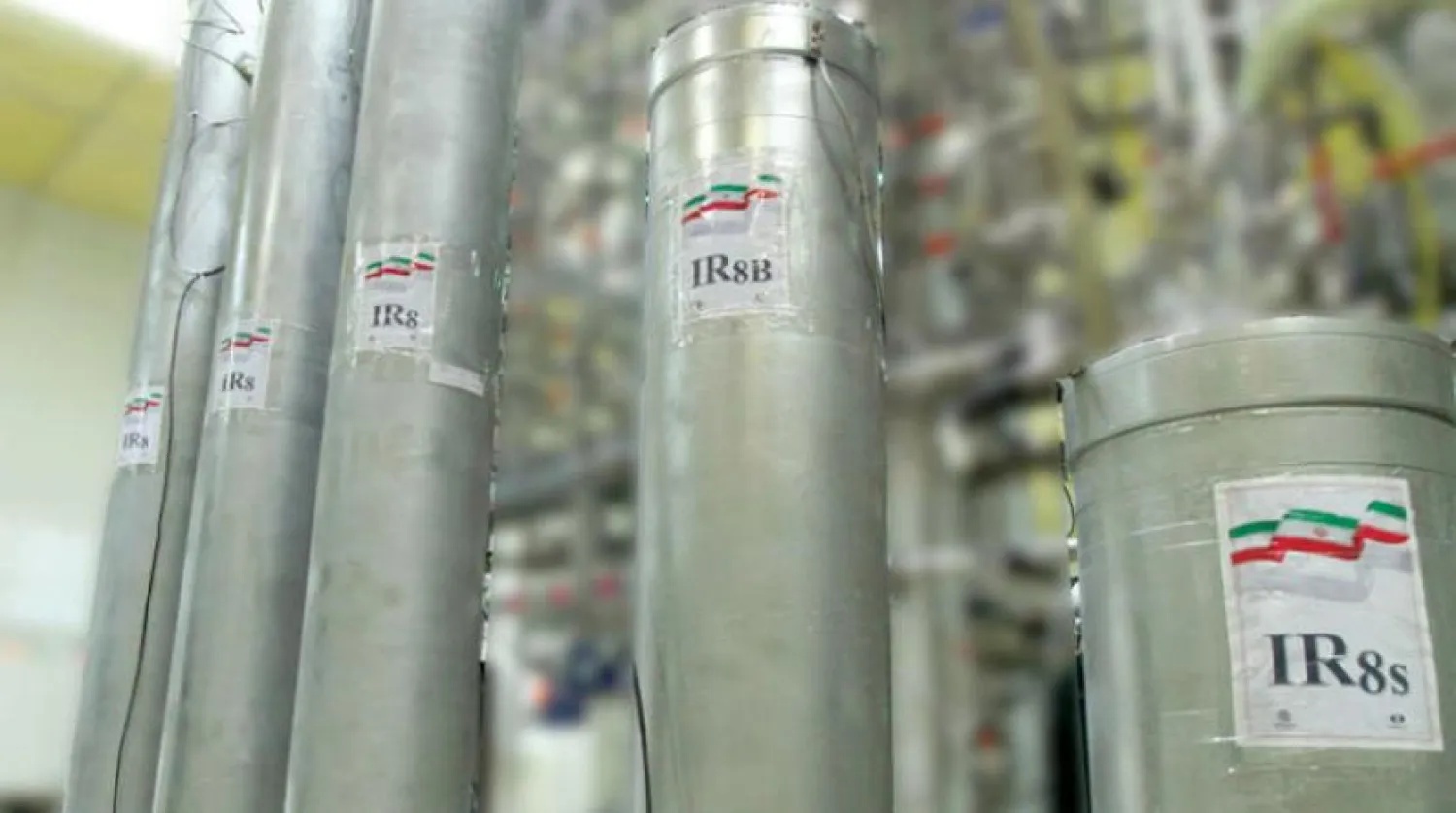

Iran's Nuclear Tactics Leave Biden with Tough Choices

A handout picture released by Iran's Atomic Energy Organization on November 4, 2019, shows the atomic enrichment facilities at Natanz nuclear research center, some 300 kilometers south of the capital Tehran. (AFP)
TT

Iran's Nuclear Tactics Leave Biden with Tough Choices

A handout picture released by Iran's Atomic Energy Organization on November 4, 2019, shows the atomic enrichment facilities at Natanz nuclear research center, some 300 kilometers south of the capital Tehran. (AFP)

A flare-up in tensions between the UN nuclear monitor and Iran this week has left US President Joe Biden in an increasingly tight jam.

The US leader opened his presidency with a pledge to return to the 2015 international agreement that aimed to prevent Tehran from building nuclear weapons, after predecessor Donald Trump unilaterally withdrew from it.

Negotiations to restore that agreement have been at an impasse for three months over the very last details.

Without a deal -- and Iran ever closer to nuclear "breakout" -- Biden has a tough choice: to make more concessions to Tehran, and be accused of weakness by Republican opponents ahead of midterm elections.

Rafael Grossi, head of the International Atomic Energy Agency, said Thursday that Tehran's removal this week of 27 cameras monitoring its nuclear sites could deal a "fatal blow" to negotiations.

"At this stage, things can go either way," AFP quoted Ali Vaez of the International Crisis Group as saying. "The tension of the past few days could potentially stir leadership in Tehran and Washington to take the deal that is on the table."

Or, he said, "It's the first step in another cycle of escalation, and from this point on it would only get worse."

"Worse" could mean Tehran moving ahead to build a nuclear weapon, and its opponents like Israel and US hardliners demanding hard action to prevent that.

The talks in Vienna between Iran and the major powers resumed last year at Biden's impetus, with the US willing to rescind sanctions in exchange for Tehran returning to full implementation of the 2015 Joint Comprehensive Plan of Action (JCPOA).

But at the edge of a deal three months ago, the talks stalled, due -- according to US officials -- to final demands by Iran unrelated to nuclear issues.

Meanwhile, officials say, Iran has pushed ahead with uranium enrichment operations that take it close to a weapons capability.

The situation deteriorated this week when members of the IAEA censured Iran for not cooperating. A day later Iran removed the 27 cameras.

Supporters say the deal is the only thing that has prevented Iran from building nuclear weapons, and that saving it is worth Biden giving Tehran some concessions.

But opponents -- Republicans, and strong supporters of Iran's nemesis Israel -- say Iran's lack of cooperation shows the agreement is not worth pursuing.

If Tehran's accelerated uranium enrichment operations "are not sufficient to get the Biden administration to change course, what will?" asked Behnam Ben Taleblu of the Foundation for Defense of Democracies think-tank, which has opposed the JCPOA.

"The time has come for a multilateral version of maximum pressure," he said, referring to Trump's approach.

Even among Biden's Democratic Party, some voices are growing impatient.

"At what point will the administration acknowledge that Iran's nuclear advances make a return to the 2015 JCPOA not in the United States' strategic interest?" said Senator Bob Menendez.

Vaez says that the Biden administration has settled into the situation of having neither an agreement nor a crisis over it.

"The developments of the past 48 hours have basically demonstrated to both sides that the status quo in the past three months of no deal, no crisis is really not sustainable," said Vaez.

Yet Washington hasn't set a deadline. On Thursday Secretary of State Antony Blinken only warned that the removal of the monitoring cameras threatened JCPOA restoration.

"The only outcome of such a path will be a deepening nuclear crisis and further economic and political isolation for Iran," Blinken said.

Instead of a hard line, the top US diplomat kept the door open.

Returning to the deal "would still achieve our most important and urgent nonproliferation goals and would be strongly in our national security interests," said a Blinken spokesperson.

Randa Slim, a researcher at the Middle East Institute in Washington, called the impasse a state of limbo "whereby everybody will assume that the Vienna talks have collapsed, but nobody will be willing to announce it."

That is Biden's dilemma, AFP quoted her as saying.

If they declare the talks over and conclude that Iran has imminent nuclear weapons capability, Washington could be forced into taking direct action against Iran, or supporting such action by Israel, said Slim.

"There are two clocks ticking .... putting a lot of pressure on the Biden administration," said Vaez.

One is the clock on Tehran's actual nuclear technology advances, he said.

"And then there's the political clock," of the congressional elections in November that could deeply erode Biden's political clout.



US Judge Blocks Deportation of Columbia University Palestinian Activist

Mohsen Mahdawi at a press conference in Vermont last year - Photo by Alex Driehaus/AP
TT

US Judge Blocks Deportation of Columbia University Palestinian Activist

Mohsen Mahdawi at a press conference in Vermont last year - Photo by Alex Driehaus/AP

A US immigration judge has blocked the deportation of a Palestinian graduate student who helped organize protests at Columbia University against Israel's war in Gaza, according to US media reports.

Mohsen Mahdawi was arrested by immigration agents last year as he was attending an interview to become a US citizen.

Mahdawi had been involved in a wave of demonstrations that gripped several major US university campuses since Israel began a massive military campaign in the Gaza Strip.

A Palestinian born in the occupied West Bank, Mahdawi has been a legal US permanent resident since 2015 and graduated from the prestigious New York university in May. He has been free from federal custody since April.

In an order made public on Tuesday, Judge Nina Froes said that President Donald Trump's administration did not provide sufficient evidence that Mahdawi could be legally removed from the United States, multiple media outlets reported.

Froes reportedly questioned the authenticity of a copy of a document purportedly signed by Secretary of State Marco Rubio that said Mahdawi's activism "could undermine the Middle East peace process by reinforcing antisemitic sentiment," according to the New York Times.

Rubio has argued that federal law grants him the authority to summarily revoke visas and deport migrants who pose threats to US foreign policy.

The Trump administration can still appeal the decision, which marked a setback in the Republican president's efforts to crack down on pro-Palestinian campus activists.

The administration has also attempted to deport Mahmoud Khalil, another student activist who co-founded a Palestinian student group at Columbia, alongside Mahdawi.

"I am grateful to the court for honoring the rule of law and holding the line against the government's attempts to trample on due process," Mahdawi said in a statement released by his attorneys and published Tuesday by several media outlets.

"This decision is an important step towards upholding what fear tried to destroy: the right to speak for peace and justice."


Fire Breaks out Near Iran's Capital Tehran, State Media Says

Smoke rises from a fire caused by an explosion in Tehran (File photo - Reuters)
TT

Fire Breaks out Near Iran's Capital Tehran, State Media Says

Smoke rises from a fire caused by an explosion in Tehran (File photo - Reuters)

A fire broke out in Iran's Parand near the capital city Tehran, state media reported on Wednesday, publishing videos of smoke rising over the area which is close to several military and strategic sites in the country's Tehran province, Reuters reported.

"The black smoke seen near the city of Parand is the result of a fire in the reeds around the Parand river bank... fire fighters are on site and the fire extinguishing operation is underway", state media cited the Parand fire department as saying.


Pakistan PM Sharif to Seek Clarity on Troops for Gaza in US Visit

US President Donald Trump looks at Pakistan's Prime Minister Shehbaz Sharif speaking following the official signing of the first phase of the Gaza ceasefire agreement between Israel and Hamas, during a world leaders' summit on ending the Gaza war, in Sharm El-Sheikh, Egypt, October 13, 2025. REUTERS/Evelyn Hockstein/File Photo
TT

Pakistan PM Sharif to Seek Clarity on Troops for Gaza in US Visit

US President Donald Trump looks at Pakistan's Prime Minister Shehbaz Sharif speaking following the official signing of the first phase of the Gaza ceasefire agreement between Israel and Hamas, during a world leaders' summit on ending the Gaza war, in Sharm El-Sheikh, Egypt, October 13, 2025. REUTERS/Evelyn Hockstein/File Photo

Before Pakistan commits to sending troops to Gaza as part of the International Stabilization Force it wants assurances from the United States that it will be a peacekeeping mission rather than tasked with disarming Hamas, three sources told Reuters.

Pakistan's Prime Minister Shehbaz Sharif is set to attend the first formal meeting of President Donald Trump's Board of Peace in Washington on Thursday, alongside delegations from at least 20 countries.

Trump, who will chair the meeting, is expected to announce a multi-billion dollar reconstruction plan for Gaza and detail plans for a UN-authorized stabilization force for the Palestinian enclave.

Three government sources said during the Washington visit Sharif wanted to better understand the goal of the ISF, what authority they were operating under and what the chain of command was before making a decision on deploying troops.

"We are ready to send troops. Let me make it clear that our troops could only be part of a peace mission in Gaza," said one of the sources, a close aide of Sharif.

"We will not be part of any other role, such as disarming Hamas. It is out of the question," he said.

Analysts say Pakistan would be an asset to the multinational force, with its experienced military that has gone to war with arch-rival India and tackled insurgencies.

"We can send initially a couple of thousand troops anytime, but we need to know what role they are going to play," the source added.

Two of the sources said it was likely Sharif, who has met Trump earlier this year in Davos and late last year at the White House, would either have an audience with him on the sidelines of the meeting or the following day at the White House.

Initially designed to cement Gaza's ceasefire, Trump sees the Board of Peace, launched in late January, taking a wider role in resolving global conflicts. Some countries have reacted cautiously, fearing it could become a rival to the United Nations.

While Pakistan has supported the establishment of the board, it has voiced concerns against the mission to demilitarize Gaza's militant group Hamas.