

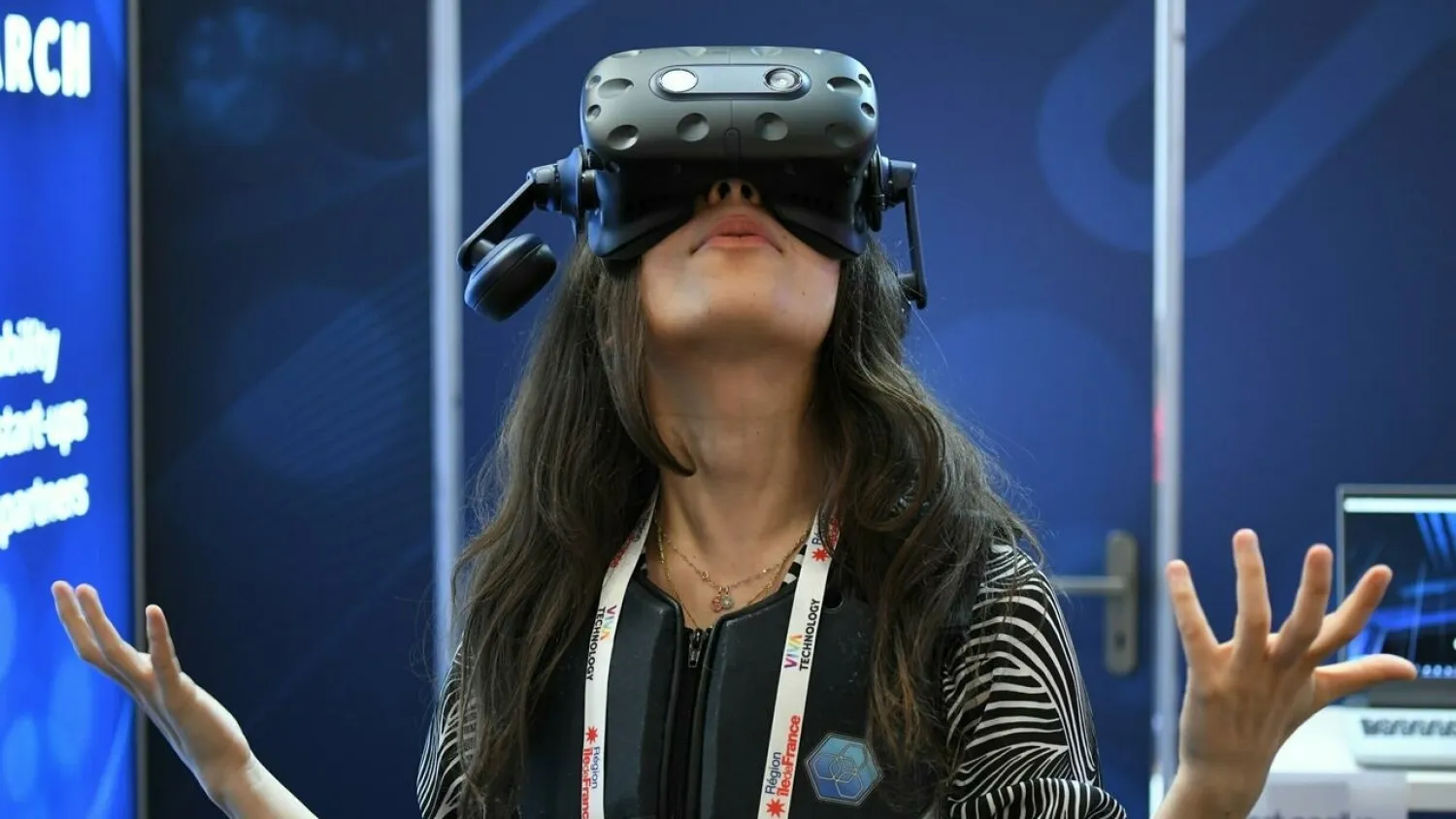

The Battle to Build a Child-friendly Metaverse

Campaigners and experts warn that the wider ecosystem of the metaverse needs to start acting to ensure child safety Eric PIERMONT AFP
TT

The Battle to Build a Child-friendly Metaverse

Campaigners and experts warn that the wider ecosystem of the metaverse needs to start acting to ensure child safety Eric PIERMONT AFP

As a young woman straps on her vest and headset and becomes immersed in a virtual world, Mainak Chaudhuri talks excitedly about the potential of the technology.

"This is the first step towards the metaverse," Chaudhuri of French start-up Actronika told AFP at this week's VivaTech trade show in Paris.

The vest can give users the sensation of being buffeted by the wind or even feel a monster's breath on their back, and it can be used to enhance movie watching, education or gaming, said AFP.

It is a family-friendly vision of the 3D immersive internet, now widely known as the metaverse, and sits well with some interactive experiences already widely available for children -- like virtual trips to museums.

But campaigners and experts are increasingly warning that the wider ecosystem needs to start acting on child safety to ensure the benign vision is realized.

"The biggest challenge is kids are getting exposed to content that is not intended for them," said Kavya Pearlman, whose NGO XR Safety Initiative campaigns to ensure immersive technology will be safe for everyone.

The problems she envisages range from children being exposed to sexual and violent material, to worries over young people being used as content creators or having inappropriate contact with adults.

Even though the metaverse has not yet been widely adopted and the technology is still in development, early users have already brought to light serious issues.

One woman's allegation that her avatar was sexually assaulted in the metaverse sparked global outrage.

Worries about the future of the technology have only grown as the economic opportunities have become clearer.

'Colossal' money
Metaverse-linked investments topped $50 billion last year, according to research firm McKinsey, which predicts the figure could more than double this year.

"We're talking about absolutely colossal amounts of money, that's three times more than the investment in artificial intelligence in 2017," McKinsey partner Eric Hazan told AFP.

Chief among the investors is tech giant Meta, which owns the likes of Instagram, Facebook and WhatsApp.

The firm has already rolled out measures to give parents more control over the content their children interact with while using VR headsets.

Meta and many of its competitors market immersive products with a lower age limit of 13 -- though it is widely accepted that younger children will use the tech.

Pearlman raises a broader concern that very little is known about the possible effects on young people's development.

"Organizations have not yet validated these experiences from a scientific perspective," she said.

"Yet they are allowing kids to be exposed to these new technologies, practically experimenting on children's developing brains."

The metaverse has shifted the paradigm, according to Valentino Megale, a neuropharmacologist who researches the issue.

While the public has so far merely consumed what others have created, in the metaverse "we are going to be part of the digital content", he said.

"This makes everything that we experience in that world more compelling," he told the RightsCon digital rights conference last week, adding that it was particularly true for children.

Experts worry that the industry needs scrutiny before the rot sets in.

'Ethical basis'
The solution, they argue, is to make sure the builders of these new virtual worlds instil child protection measures into the ethos of their work.

In other words, each piece of software and hardware should be constructed on the understanding that children might use it and will need safeguarding.

"We are potentially going to have a huge impact on their behavior, their identity, their emotions, their psychology in the exact moment when they are forming their personality," said Megale.

"You need to provide an ethical basis and safety by design from the beginning."

One of the most controversial areas of product design is the kind of suit that will allow users to feel all sorts of sensations -- even pain.

Such suits are already being manufactured, simulating pain through electric shocks.

The products are intended for military or other professional training.

Chaudhuri said the products developed by his firm Actronika use vibrations rather than electric shocks and were perfectly safe for anyone to use.

"We're about engaging the audience and not necessarily doing a real-time firefighting scenario or a battlefield scenario," he said.

"We don't cause pain."


Swiss Interior Minister Open to Social Media Ban for Children

A teenager poses holding a mobile phone displaying a message from TikTok as law banning social media for users under 16 in Australia takes effect, in Sydney, Australia, December 10, 2025. (Reuters)
TT

Swiss Interior Minister Open to Social Media Ban for Children

A teenager poses holding a mobile phone displaying a message from TikTok as law banning social media for users under 16 in Australia takes effect, in Sydney, Australia, December 10, 2025. (Reuters)

Switzerland must do more to shield children from social media risks, Interior Minister Elisabeth Baume-Schneider was quoted as saying on Sunday, signaling she was open to a potential ban on the platforms for youngsters.

Following Australia's recent ban on social media for under-16s, Baume-Schneider told SonntagsBlick newspaper that Switzerland should examine similar measures.

"The debate in Australia and the ‌EU is ‌important. It must also ‌be ⁠conducted in Switzerland. ‌I am open to a social media ban," said the minister, a member of the center-left Social Democrats. "We must better protect our children."

She said authorities needed to look at what should be restricted, listing options ⁠such as banning social media use by children, ‌curbing harmful content, and addressing ‍algorithms that prey on ‍young people's vulnerabilities.

Detailed discussions will begin ‍in the new year, supported by a report on the issue, Baume-Schneider said, adding: "We mustn't forget social media platforms themselves: they must take responsibility for what children and young people consume."

Australia's ban has won praise ⁠from many parents and groups advocating for the welfare of children, and drawn criticism from major technology companies and defenders of free speech.

Earlier this month, the parliament of the Swiss canton of Fribourg voted to prohibit children from using mobile phones at school until they are about 15, the latest step taken at ‌a local level in Switzerland to curb their use in schools.


Google Warns Staff with US Visas against International Travel

FILE PHOTO: The Google logo is displayed during a press conference in Berlin, Germany, November 11, 2025. REUTERS/Lisi Niesner/File Photo
TT

Google Warns Staff with US Visas against International Travel

FILE PHOTO: The Google logo is displayed during a press conference in Berlin, Germany, November 11, 2025. REUTERS/Lisi Niesner/File Photo

Alphabet's Google has advised some employees on US visas to avoid international travel due to delays at embassies, Business Insider reported on Friday, citing an internal email.

The email, sent by the company's outside counsel BAL Immigration Law on Thursday, warned staff who need a visa ⁠stamp to re-enter the United States not to leave the country because visa processing times have lengthened, the report said.

Google did not immediately respond to a Reuters request for comment.

Some US embassies and consulates face visa ⁠appointment delays of up to 12 months, the memo said, warning that international travel will "risk an extended stay outside the US", according to the report.

The administration of President Donald Trump this month announced increased vetting of applicants for H-1B visas for highly skilled workers, including screening social media accounts.

The H-1B visa program, widely used by the US ⁠technology sector to hire skilled workers from India and China, has been under the spotlight after the Trump administration imposed a $100,000 fee for new applications this year.

In September, Google's parent company Alphabet had strongly advised its employees to avoid international travel and urged H-1B visa holders to remain in the US, according to an email seen by Reuters.


AI Boom Drives Data-Center Dealmaking to Record High, Says Report

AI (Artificial Intelligence) letters and robot hand are placed on computer motherboard in this illustration created on June 23, 2023. REUTERS/Dado Ruvic/Illustration/File Photo
TT

AI Boom Drives Data-Center Dealmaking to Record High, Says Report

AI (Artificial Intelligence) letters and robot hand are placed on computer motherboard in this illustration created on June 23, 2023. REUTERS/Dado Ruvic/Illustration/File Photo

Global data-center dealmaking surged to a record high through November this year, driven by an insatiable demand for ​computing infrastructure to meet the boom in artificial intelligence usage.

Data from S&P Global Market Intelligence showed that there were more than 100 data center transactions during the period, with the total value sitting just under $61 billion.

WHY ‌IT'S IMPORTANT

Interest ‌in data centers ‌has ⁠swelled ​this ‌year as tech giants and AI hyperscalers have planned billions of dollars in spending to scale up infrastructure.

AI-related companies have powered much of the gains in US stocks this year, but concerns over lofty ⁠valuations and debt-fueled spending have also sparked worries ‌over how quickly corporates can ‍turn the investments ‍into profits.

BY THE NUMBERS

Including M&As, asset ‍sales and equity investments, data center investments hit nearly $61 billion through the end of November, already surpassing 2024's record high $60.81 billion.

Since ​2019, data center dealmaking in the US and Canada totaled about $160 billion, ⁠with Asia-Pacific reaching nearly $40 billion and Europe $24.2 billion.

GRAPHIC KEY QUOTE

"High interest comes from financial sponsors, which are attracted by the risk/reward profile of such assets. Private equity firms are eager buyers but are generally reluctant sellers, creating an environment where availability for sale of high-quality data center assets is scarce," said Iuri ‌Struta, TMT analyst at S&P Global Market Intelligence.
