


Afghanistan Quake Kills 1,000 People, Deadliest in Decades

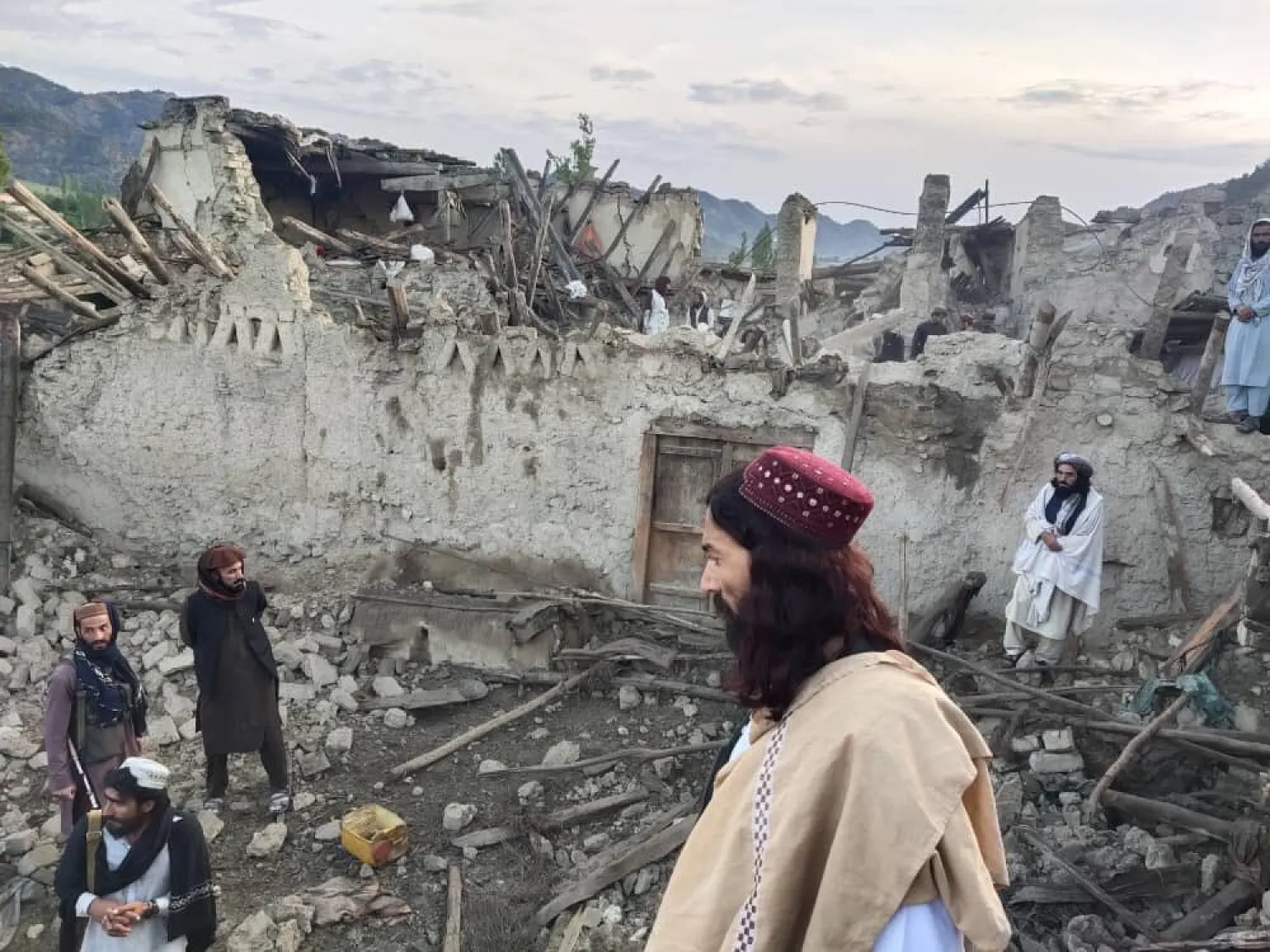
 In this photo released by a set-run news agency Bakhtar, Afghans look at destruction caused by an earthquake in the province of Paktika, eastern Afghanistan, Wednesday, June 22, 2022. (Bakhtar News Agency via AP)
In this photo released by a set-run news agency Bakhtar, Afghans look at destruction caused by an earthquake in the province of Paktika, eastern Afghanistan, Wednesday, June 22, 2022. (Bakhtar News Agency via AP)
TT

Afghanistan Quake Kills 1,000 People, Deadliest in Decades

 In this photo released by a set-run news agency Bakhtar, Afghans look at destruction caused by an earthquake in the province of Paktika, eastern Afghanistan, Wednesday, June 22, 2022. (Bakhtar News Agency via AP)
In this photo released by a set-run news agency Bakhtar, Afghans look at destruction caused by an earthquake in the province of Paktika, eastern Afghanistan, Wednesday, June 22, 2022. (Bakhtar News Agency via AP)

A powerful earthquake struck a rugged, mountainous region of eastern Afghanistan early Wednesday, killing at least 1,000 people and injuring 1,500 more in the country's deadliest quake in two decades, the state-run news agency reported. Officials warned that the already grim toll may still rise.

In the remote area near the Pakistani border, residents searched for survivors and the dead by digging with their bare hands through the rubble of collapsed stone and mudbrick houses, according to footage shown by the news agency Bakhtar. It was not immediately clear if major rescue equipment was being sent - or even if it could reach the area.

The extent of the destruction among the villages tucked among the mountains was still not known. Rutted roads - difficult to pass in the best of times - may have sustained significant damage, and a UNICEF official said landslides from recent rains have made access even more difficult. At least 2,000 homes were destroyed in the region, where on average every home has seven or eight people living in it, the UN Deputy Special Representative to Afghanistan Ramiz Alakbarov told reporters.

The disaster posed a major test for Afghanistan's Taliban government, which seized power nearly 10 months ago as the US and its NATO allies were carrying out their withdrawal from the country and has been largely shunned by the world community since.

Rescuers rushed to the area by helicopter, but the response is likely to be complicated since many international aid agencies left Afghanistan after the Taliban takeover in August. Moreover, most governments are wary of dealing directly with the group, a reluctance that could slow the deployment of emergency aid and teams.

In a rare move, the Taliban's reclusive supreme leader, Haibatullah Akhundzadah, who almost never appears in public, called for "the international community and all humanitarian organizations to help the Afghan people affected by this great tragedy and to spare no effort to help the affected people."

"We ask God to save our poor people from trials and harm," he said in a statement put out by the Taliban spokesman.

But in a sign of the muddled workings between the Taliban and the international community, Alakbarov said the Taliban have not formally requested that the UN mobilize international search and rescue teams. Afghan authorities have deployed a few dozen ambulances and several helicopters but have not asked the UN to obtain any more equipment or machinery from neighboring countries, he added, without elaborating.

The disaster only compounds the woes in Afghanistan, which is already deep in one of the world's worst humanitarian crises, with millions facing increasing hunger and poverty after the cutoff of international financing to the Taliban. That has prompted a massive aid program, but to avoid putting money in the Taliban's hands, the world has funneled funding through the UN and other humanitarian agencies - a system that may be too slow for an emergency response to the quake.

The 6.1 magnitude quake had its epicenter in Paktika province, some 50 kilometers (31 miles) southwest of the city of Khost, according to neighboring Pakistan’s Meteorological Department. Experts put the depth at just 10 kilometers (6 miles) - another factor that could lead to severe destruction.

The European seismological agency said the earthquake’s tremors were felt over 500 kilometers (310 miles) by 119 million people across Afghanistan, Pakistan and India.

Footage from Paktika showed men carrying people in blankets to a waiting helicopter. Others were treated on the ground. One resident could be seen receiving IV fluids while sitting in a plastic chair outside the rubble of his home and still more were sprawled on gurneys. Some images showed residents picking through clay bricks and other rubble from destroyed stone houses. The roofs or walls of others had caved in.

The death toll given by the Bakhtar News Agency was equal to that of a quake in 2002 in northern Afghanistan. Those are the deadliest since 1998, when an earthquake also 6.1 in magnitude and subsequent tremors in the remote northeast killed at least 4,500 people.

In most places in the world, an earthquake of that strength wouldn’t inflict such extensive devastation, said Robert Sanders, a seismologist with the US Geological Survey. But a quake’s death toll more often comes down to geography, building quality and population density.

"Because of the mountainous area, there are rockslides and landslides that we won’t know about until later reporting. Older buildings are likely to crumble and fail," he said. "Due to how condensed the area is in that part of the world, we’ve seen in the past similar earthquakes deal significant damage."

The Taliban are still trying to reconstitute government ministries abandoned by staff loyal to its previous Western-backed government, and it was not clear how officials arrived at the casualty tolls reported by Bakhtar.

But there were concerns that the figure could yet rise.

"The fear is that the victims will increase further, also because many people could be trapped under collapsed buildings," said Stefano Sozza, Afghanistan country director for Italian medical aid group Emergency.

Emergency was one of the organizations already distributing humanitarian help around Afghanistan that rushed resources to villages devastated by the quake. It sent seven ambulances and staff to the areas near the quake zone.

The children's agency UNICEF had health and nutrition teams in the area and sent trucks of blankets, tents and other supplies, Sam Mort, communications chief for UNICEF Afghanistan, told UK broadcaster Sky. Regional hospitals were already overwhelmed with injured, she said.

The quake "will only add to the immense humanitarian needs in Afghanistan, and it really has to be all hands on deck to make sure that we really limit the suffering that families, that women and children are already going through," said Shelley Thakral, the UN World Food Program spokesperson in Kabul.

Pakistan said it would send food, tents, blankets and other essential items as quickly as possible. The Afghan Red Crescent Society sent similar items as well as kitchen kits to the affected area, according to Bakhtar’s director-general, Abdul Wahid Rayan.

In Kabul, Prime Minister Mohammad Hassan Akhund convened an emergency meeting at the presidential palace to coordinate the relief effort.

"When such a big incident happens in any country, there is a need for help from other countries," said Sharafuddin Muslim, deputy minister of state for disaster management. "It is very difficult for us to be able to respond to this huge incident."

That may prove difficult given the renewed international isolation of Afghanistan under the Taliban following their takeover last year, two decades after the US-led invasion toppled the same insurgents in the wake of the 9/11 attacks. The new government has issued a flurry of repressive edicts curtailing the rights of women and girls and the press that hark to the Taliban's harsh rule from the late 1990s, despite promising that would not happen.

"This does add a lot to the daily burden of survival," Alakbarov, of the UN, said. "We are not optimistic today."



US Judge Blocks Deportation of Columbia University Palestinian Activist

Mohsen Mahdawi at a press conference in Vermont last year - Photo by Alex Driehaus/AP
TT

US Judge Blocks Deportation of Columbia University Palestinian Activist

Mohsen Mahdawi at a press conference in Vermont last year - Photo by Alex Driehaus/AP

A US immigration judge has blocked the deportation of a Palestinian graduate student who helped organize protests at Columbia University against Israel's war in Gaza, according to US media reports.

Mohsen Mahdawi was arrested by immigration agents last year as he was attending an interview to become a US citizen.

Mahdawi had been involved in a wave of demonstrations that gripped several major US university campuses since Israel began a massive military campaign in the Gaza Strip.

A Palestinian born in the occupied West Bank, Mahdawi has been a legal US permanent resident since 2015 and graduated from the prestigious New York university in May. He has been free from federal custody since April.

In an order made public on Tuesday, Judge Nina Froes said that President Donald Trump's administration did not provide sufficient evidence that Mahdawi could be legally removed from the United States, multiple media outlets reported.

Froes reportedly questioned the authenticity of a copy of a document purportedly signed by Secretary of State Marco Rubio that said Mahdawi's activism "could undermine the Middle East peace process by reinforcing antisemitic sentiment," according to the New York Times.

Rubio has argued that federal law grants him the authority to summarily revoke visas and deport migrants who pose threats to US foreign policy.

The Trump administration can still appeal the decision, which marked a setback in the Republican president's efforts to crack down on pro-Palestinian campus activists.

The administration has also attempted to deport Mahmoud Khalil, another student activist who co-founded a Palestinian student group at Columbia, alongside Mahdawi.

"I am grateful to the court for honoring the rule of law and holding the line against the government's attempts to trample on due process," Mahdawi said in a statement released by his attorneys and published Tuesday by several media outlets.

"This decision is an important step towards upholding what fear tried to destroy: the right to speak for peace and justice."


Fire Breaks out Near Iran's Capital Tehran, State Media Says

Smoke rises from a fire caused by an explosion in Tehran (File photo - Reuters)
TT

Fire Breaks out Near Iran's Capital Tehran, State Media Says

Smoke rises from a fire caused by an explosion in Tehran (File photo - Reuters)

A fire broke out in Iran's Parand near the capital city Tehran, state media reported on Wednesday, publishing videos of smoke rising over the area which is close to several military and strategic sites in the country's Tehran province, Reuters reported.

"The black smoke seen near the city of Parand is the result of a fire in the reeds around the Parand river bank... fire fighters are on site and the fire extinguishing operation is underway", state media cited the Parand fire department as saying.


Pakistan PM Sharif to Seek Clarity on Troops for Gaza in US Visit

US President Donald Trump looks at Pakistan's Prime Minister Shehbaz Sharif speaking following the official signing of the first phase of the Gaza ceasefire agreement between Israel and Hamas, during a world leaders' summit on ending the Gaza war, in Sharm El-Sheikh, Egypt, October 13, 2025. REUTERS/Evelyn Hockstein/File Photo
TT

Pakistan PM Sharif to Seek Clarity on Troops for Gaza in US Visit

US President Donald Trump looks at Pakistan's Prime Minister Shehbaz Sharif speaking following the official signing of the first phase of the Gaza ceasefire agreement between Israel and Hamas, during a world leaders' summit on ending the Gaza war, in Sharm El-Sheikh, Egypt, October 13, 2025. REUTERS/Evelyn Hockstein/File Photo

Before Pakistan commits to sending troops to Gaza as part of the International Stabilization Force it wants assurances from the United States that it will be a peacekeeping mission rather than tasked with disarming Hamas, three sources told Reuters.

Pakistan's Prime Minister Shehbaz Sharif is set to attend the first formal meeting of President Donald Trump's Board of Peace in Washington on Thursday, alongside delegations from at least 20 countries.

Trump, who will chair the meeting, is expected to announce a multi-billion dollar reconstruction plan for Gaza and detail plans for a UN-authorized stabilization force for the Palestinian enclave.

Three government sources said during the Washington visit Sharif wanted to better understand the goal of the ISF, what authority they were operating under and what the chain of command was before making a decision on deploying troops.

"We are ready to send troops. Let me make it clear that our troops could only be part of a peace mission in Gaza," said one of the sources, a close aide of Sharif.

"We will not be part of any other role, such as disarming Hamas. It is out of the question," he said.

Analysts say Pakistan would be an asset to the multinational force, with its experienced military that has gone to war with arch-rival India and tackled insurgencies.

"We can send initially a couple of thousand troops anytime, but we need to know what role they are going to play," the source added.

Two of the sources said it was likely Sharif, who has met Trump earlier this year in Davos and late last year at the White House, would either have an audience with him on the sidelines of the meeting or the following day at the White House.

Initially designed to cement Gaza's ceasefire, Trump sees the Board of Peace, launched in late January, taking a wider role in resolving global conflicts. Some countries have reacted cautiously, fearing it could become a rival to the United Nations.

While Pakistan has supported the establishment of the board, it has voiced concerns against the mission to demilitarize Gaza's militant group Hamas.