


Putin: 'No Problem' for Russia if Finland, Sweden Join NATO

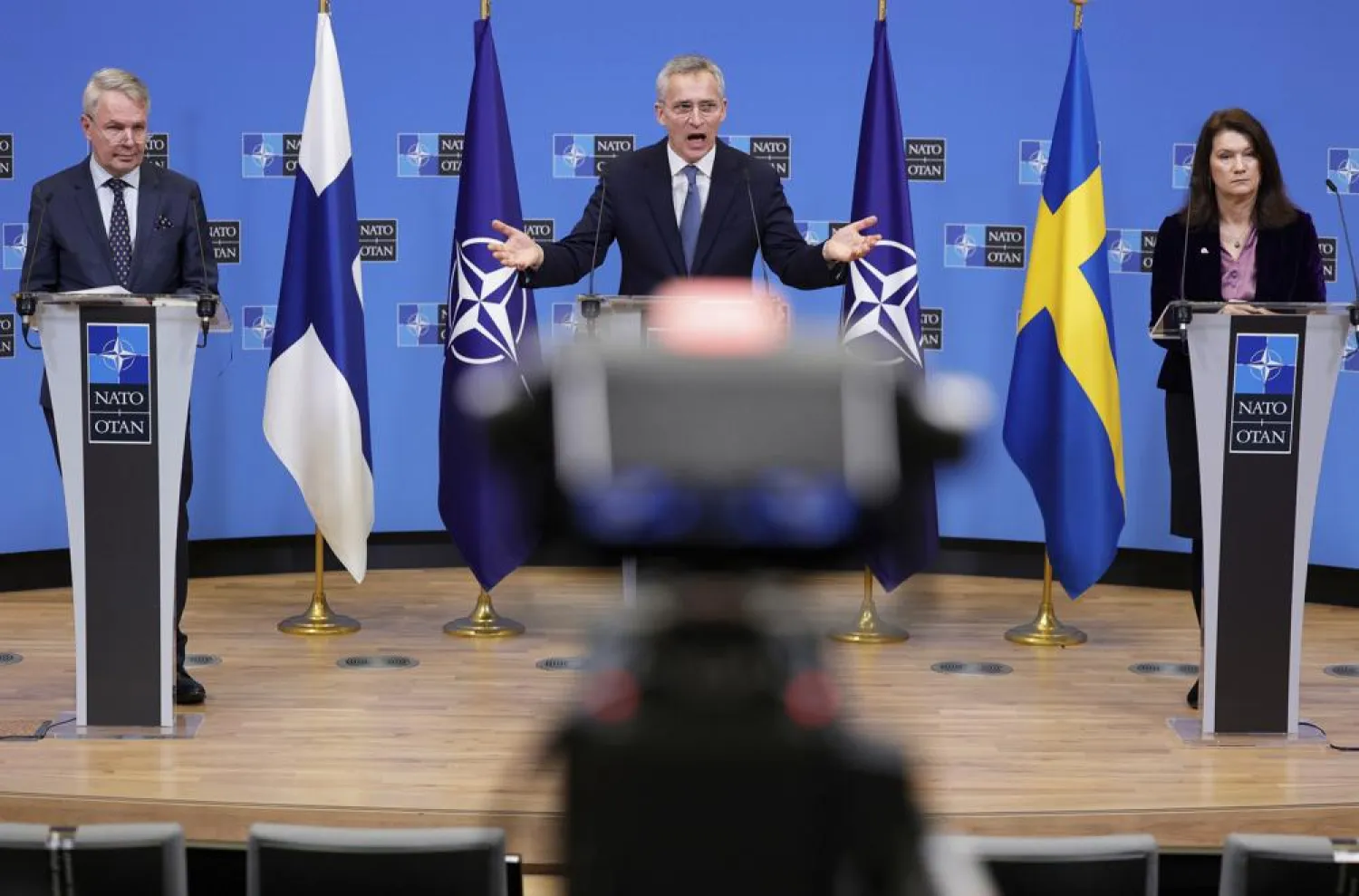
FILE - NATO Secretary General Jens Stoltenberg, center, participates in a media conference with Finland's Foreign Minister Pekka Haavisto, left, and Sweden's Foreign Minister Ann Linde, right, at NATO headquarters in Brussels, Jan. 24, 2022. (AP Photo/Olivier Matthys, File)
TT

Putin: 'No Problem' for Russia if Finland, Sweden Join NATO

FILE - NATO Secretary General Jens Stoltenberg, center, participates in a media conference with Finland's Foreign Minister Pekka Haavisto, left, and Sweden's Foreign Minister Ann Linde, right, at NATO headquarters in Brussels, Jan. 24, 2022. (AP Photo/Olivier Matthys, File)

Russia has "no problem" if Finland and Sweden join NATO, President Vladimir Putin said on Wednesday.

"We don't have problems with Sweden and Finland like we do with Ukraine," Putin told a news conference in the Turkmenistan capital of Ashgabat.

"We don't have territorial differences," the Russian leader continued.

"There is nothing that could bother us about Sweden and Finland joining NATO. If Finland and Sweden wish to, they can join. That's up to them. They can join whatever they want."

However, "if military contingents and military infrastructure were deployed there, we would be obliged to respond symmetrically and raise the same threats for those territories where threats have arisen for us," Putin said.

Sweden and Finland have both decided to apply to join NATO after Russia launched its military operation in pro-Western Ukraine on February 24, said AFP.

The formal process for membership was launched at the NATO summit in Madrid on Wednesday.

Until now, Russia had always been critical of the prospect of the two Nordic countries joining the alliance, saying it would be a "destabilizing factor" for international security.

Putin nevertheless condemned NATO's "imperial ambitions", accusing the alliance of seeking to assert its "supremacy" through the Ukraine conflict.

"Ukraine and the well-being of Ukrainian people is not the aim of the collective West and NATO but a means to defend their own interests," Putin said.

"The NATO countries' leaders wish to... assert their supremacy, their imperial ambitions," he added.

The Atlantic alliance and "above all the United States have long needed an external enemy around which they can unite their allies," the Russian leader said.

"Iran wasn't good for that. We've given them this opportunity... to gather the whole world around them."


Japan Overhauls Decades-Old Weapons Export Rules

Japan Ground Self-Defense Force (JGSDF) battle tanks take part in a live fire exercise at East Fuji Maneuver Area in Gotemba on May 27, 2023. (AFP)
TT

Japan Overhauls Decades-Old Weapons Export Rules

Japan Ground Self-Defense Force (JGSDF) battle tanks take part in a live fire exercise at East Fuji Maneuver Area in Gotemba on May 27, 2023. (AFP)

Japan will ease decades-old arms export rules, the government's top spokesman Minoru Kihara said on Tuesday, a policy shift that paves the way for the sale of lethal weapons overseas.

The new rules end Japan's self-imposed curb on sales of lethal arms as Tokyo seeks to enter the international arms market, hoping to bolster national defense as well as boost economic growth.

It comes as anxiety increases over China's escalating military activity in the region, as well as persistent security threats from North Korea and Russia.

"These decisions have been made at a time when changes in the security environment surrounding our country are occurring at an accelerating pace, and they serve to ensure Japan's security while contributing even more to peace and stability in the region and the international community," Kihara told a news conference.

"Today, no nation can safeguard its own peace and security by itself alone."

Exports had previously been limited to equipment classified under five categories: search and rescue, transportation, warning, surveillance and minesweeping.

However, Prime Minister Sanae Takaichi posted on X that "with this amendment, transfers of all defense equipment will in principle become possible".

Proponents of the policy shift argue that the change should further integrate Tokyo in the international defense supply chain, deepening defense, diplomatic and economic ties with partner nations as regional instability grows.

But the decision has caused unease among some members of the Japanese public, with critics accusing Takaichi of eroding the proud history of the nation's staunch pacifism.

The policy change has been approved by the Cabinet and the National Security Council, Kihara said.

Heigo Sato, an expert on defense issues and arms control at Takushoku University, said Japan must use this time of peace to ensure combat readiness by establishing "a system that ensures the smooth exchange of weapons and ammunition" between allies.

He told AFP that exports require routine maintenance, providing defense contractors with steady business while also strengthening ties with buyer nations.

By making the arms trade a two-way exchange, Japan might improve the chances of receiving help from allies in the event of an unexpected, prolonged conflict, he said.

- 'Turning point' -

The new rules are part of an incremental easing of the blanket export ban on weapons that was first introduced in 1976.

Takaichi said export "recipients will be limited to countries that pledge to use the equipment in a manner consistent with the United Nations Charter".

"There is absolutely no change in our commitment to the path and fundamental principles we have followed for more than 80 years as a pacifist nation since the end of the war," she said, referring to World War II.

However, the Japanese public appears uneasy about the prospect of exporting lethal arms.

A March survey by national broadcaster NHK showed that 53 percent of participants opposed the step, while only 32 percent supported it.

Peace activists have staged rallies across the nation over concerns that Takaichi's hawkish world views and open support for US President Donald Trump could drag Japan into conflicts. Some appeared to be protesting against the easing of arms export rules.

Veteran activist Koji Sugihara warned that the change was "a historic turning point", arguing that Japan's pacifist reputation has historically aided its diplomatic and business relations.

"People do not want Japanese-made products to be used to kill people in foreign countries," Sugihara said.

Japan previously exported bullets and military supplies to boost its economy, particularly during the Korean War in the 1950s, but adopted a conditional weapons export ban in 1967 before a total bar came in a decade later.

Tokyo has made exceptions to the rules in recent decades, especially when joining international weapons development projects, before it opened the door to exports in 2014 in the five non-lethal military product categories.

Five Japanese firms -- Mitsubishi Heavy Industries, NEC, Kawasaki Heavy Industries, Mitsubishi Electric and Fujitsu are among the world's top 100 arms companies, according to data from the Stockholm International Peace Research Institute.


Contenders to Head Crisis-Wracked UN Face Live Grillings

United Nations Trade and Development (UNCTAD) secretary-general Rebeca Grynspan speaks during a press conference, part of the 16th United Nations Trade and Development (UNCTAD) ministerial conference, in Geneva on October 22, 2025. (AFP)
TT

Contenders to Head Crisis-Wracked UN Face Live Grillings

United Nations Trade and Development (UNCTAD) secretary-general Rebeca Grynspan speaks during a press conference, part of the 16th United Nations Trade and Development (UNCTAD) ministerial conference, in Geneva on October 22, 2025. (AFP)

The four candidates vying to become the next United Nations secretary-general face live hearings on Tuesday and Wednesday on their bids to lead the troubled global organization from next year.

Chile's Michelle Bachelet, Argentina's Rafael Grossi, Costa Rica's Rebeca Grynspan and Senegal's Macky Sall are competing for a five-year term at the helm of the 193-member body, which can be extended for another five.

While they are the only declared candidates so far, others can join in the race in the coming months. The next UN leader will face an enormous task to revitalize an organization in crisis, whose stature has significantly diminished in recent years. Major powers, even as they increasingly flout long-held norms of international order, have pressed the UN to reform, slash costs, ‌and prove its ‌relevance.

First up for three hours of grilling at UN headquarters in New ‌York ⁠from member states ⁠and civil society representatives will be Bachelet and Grossi on Tuesday, followed by Grynspan and Sall on Wednesday. There are currently far fewer candidates for the role than in 2016, when incumbent Antonio Guterres of Portugal was chosen from a field of 13 contenders, seven of them women.

No woman has been chosen in the UN's 80-year history, despite growing calls to end this anomaly, and tradition has dictated that the role rotate between regions, with Latin America next in line.

Another unwritten rule is that a secretary-general never comes from among ⁠the five permanent members of the UN Security Council - Britain, China, France, Russia ‌and the United States - to avoid over-concentration of power, though ‌their backing is crucial in a lengthy and arcane selection process.

CRISIS REQUIRES 'PROACTIVE VISION'

"The need for a Secretary-General prepared ‌to defend a clear, proactive vision for the UN on peacemaking and crisis management could not be ‌more urgent," the International Crisis Group's Daniel Forti wrote recently.

"If candidates and member states miss this opportunity, there may be little left of the UN to defend."

Bachelet, 74, is a two-time president of Chile and a former UN High Commissioner for Human Rights.

In March, her own country withdrew its backing for her candidacy after a right-wing ‌shift in leadership, but she has retained support from Brazil and Mexico.

Bachelet has faced criticism from US conservatives for her pro-choice views and this ⁠month Washington's UN envoy ⁠appeared to torpedo her bid by saying he shared concerns about her suitability.

Grossi, a 65-year-old career diplomat and father of eight who speaks English, Spanish, French and Italian, has headed the UN nuclear watchdog for six years.

In his vision statement, Grossi declared that "even in times of division, multilateral institutions can deliver real, positive impact."

Grynspan, 70, a former vice president of Costa Rica who heads the UN Conference on Trade and Development, depicts herself as a reform-minded multilateralist with a lifelong belief in UN commitments to peace, development and human rights, who has battled gender barriers.

"I am not waiting for special treatment. I want equal treatment," she told Reuters.

Sall, 64, Senegal's president for 12 years until 2024, is a geologist and son of a peanut seller.

Soft-spoken and more comfortable in French than English, he has championed African development and support for debt-burdened countries.

"More than ever, a reinvented multilateralism remains the best way to respond to the challenges of a world in full transformation," he said on X.


Report: Dual-Use Items Likely Onboard Seized Iranian Ship

A view of Iranian-flagged cargo ship M/V Touska as the US Navy Arleigh Burke-class Aegis guided missile destroyer USS Spruance conducts its interception in a location given as the north Arabian Sea, in this screen capture from a video released April 19, 2026. (CENTCOM/Handout via Reuters)
TT

Report: Dual-Use Items Likely Onboard Seized Iranian Ship

A view of Iranian-flagged cargo ship M/V Touska as the US Navy Arleigh Burke-class Aegis guided missile destroyer USS Spruance conducts its interception in a location given as the north Arabian Sea, in this screen capture from a video released April 19, 2026. (CENTCOM/Handout via Reuters)

The Iranian-flagged container ship Touska, which was boarded and seized by US forces on Sunday, is likely to have what Washington deems dual-use items ‌that could be used by the military onboard, maritime security sources said on Monday, according to Reuters.

The small container ship, which is part of the Islamic Republic of Iran Shipping Lines (IRISL) group that has been hit with US sanctions, was boarded on Sunday off the coast of Iran's Chabahar port in the Gulf of Oman and last reported its position at 13:08 GMT, according to ship-tracking data on the Marine Traffic platform.

The US Central Command said Touska's crew failed to comply with repeated warnings over a six-hour period, and that the vessel was in violation of a US blockade.

The security sources, who declined to be identified, said their initial assessments were ⁠the vessel was likely to be carrying dual-use items after a voyage from Asia.

The vessel had previously transported items deemed as dual-use, one of the sources said.

The sources did not go into details on the items.

The US Central Command has listed metals, pipes and electronic components among other goods that could have a military, as well as an industrial use and could be captured.

The Iranian foreign ministry did not comment on the incident.

Iran's military said the ship had been travelling from China and accused the US of “armed piracy,” according to state media on Monday. They said they were ready to confront US forces over the “blatant aggression,” but were constrained by the presence of crew ‌members’ families ⁠on board.

Washington imposed sanctions on IRISL in late 2019, describing it as “the preferred shipping line for Iranian proliferators and procurement agents,” which included transporting items intended for Iran’s ballistic missile program.

The Touska's crew includes an Iranian captain and Iranian crew members, although it was not clear if the entire crew were Iranian nationals, one of the sources said.

IRISL ships are under the control of the Revolutionary Guards and their crew are typically made up mainly of Iranians and sometimes also use Pakistani seafarers, two other sources added.

The vessel was detected alongside at China’s Taicang port, ⁠which is north of Shanghai, on March 25 and arrived at China's southern Gaolan port on March 29-30, according to satellite analysis from data analytics specialists SynMax.

The vessel loaded containers onboard in Gaolan and then made a stop around the Port Klang anchorage in Malaysia on April 11-12 where it loaded further containers, according to SynMax analysis.

The vessel was laden with containers onboard ⁠when it reached the Gulf of Oman on Sunday.

China has expressed concern over the “forced interception” by the US of the Iranian-flagged cargo ship, a Chinese foreign ministry spokesperson said on Monday, urging relevant parties to abide by the ceasefire agreement in a responsible manner.

US President Donald Trump said in a post on the Truth Social platform on ⁠Sunday that the Touska was under US sanctions due to its “prior history of illegal activity,” adding that US forces were “seeing what’s on board.”

The US military widened its shipping blockade on Iran to include cargoes deemed contraband and any vessels suspected of trying to reach Iranian territory will be “subject to belligerent right to visit and search,” the US navy said in an advisory on Thursday.