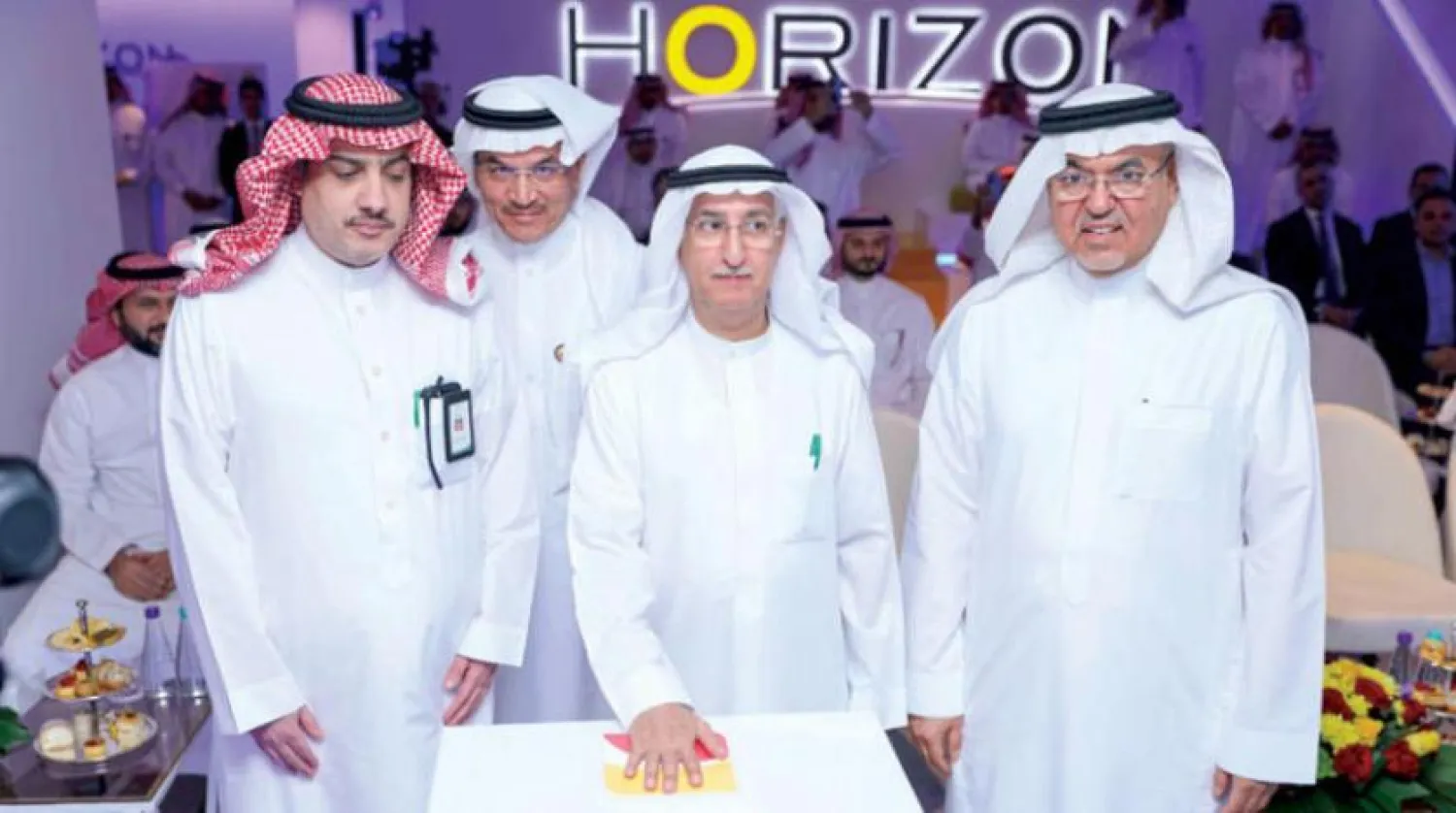
Saudi Banking Sector Stimulates FinTech, Entrepreneurship

SAMA Governor Fahad al-Mubarak inaugurated the new center. (Asharq Al-Awsat)
TT

Saudi Banking Sector Stimulates FinTech, Entrepreneurship

SAMA Governor Fahad al-Mubarak inaugurated the new center. (Asharq Al-Awsat)

The Saudi Central Bank inaugurated the HORIZON Center at al-Bilad Bank to create a coherent environment that ensures support for digital entrepreneurial projects.

Last May, the Saudi Cabinet adopted the financial technology strategy so that the Kingdom would be among the leading countries in the field of FinTech, with Riyadh becoming a global tech hub.

SAMA Governor Fahad al-Mubarak inaugurated the new center, which complies with international standards and includes advanced devices and technologies that will contribute to achieving the aspirations of the financial sector.

Chairman of the Board of Directors of al-Bilad Bank Nasser al-Subaie stressed that the center is in line with SAMA's strategy of strengthening the financial system, following the Financial Sector Development Program (FSDP) and its initiatives.

He explained that the center would enhance cooperation with FinTech companies, customers, and innovation partners and produce new financial services within a regulated innovative framework.

Subaie stressed that the Bank continually strives for digital transformation to reach the best competitive value and customer experiences to achieve the interests of customers, affiliates, investors, and society.

The center targets entrepreneurs and owners of digital ideas and is expected to contribute to establishing and developing emerging FinTech companies.

The new center will develop local capabilities in digital entrepreneurship, increase the adoption of emerging technologies applications, and support the use of modern technologies in emerging projects.

It also provides services to develop digital economic research projects and transform entrepreneurial ideas and projects into scalable digital business models.

It is included as a new pillar within the Saudi Vision 2030's Financial Sector Development Program (FSDP), aimed at developing the national economy, diversifying sources of income, and enabling financial institutions to support private sector growth by allowing new companies to provide financial services.


Chevron Eyes Argentina, Mediterranean for Global LNG Growth, Deal with India

Freeman Shaheen, the president of Chevron Global Gas, participates in a discussion at the Gastech conference in Houston, Texas, US, September 18, 2024. REUTERS/Callaghan O'Hare
TT

Chevron Eyes Argentina, Mediterranean for Global LNG Growth, Deal with India

Freeman Shaheen, the president of Chevron Global Gas, participates in a discussion at the Gastech conference in Houston, Texas, US, September 18, 2024. REUTERS/Callaghan O'Hare

Chevron is looking to expand its global gas portfolio from Argentina to the Mediterranean to meet growing demand from buyers concerned about energy security due to the crisis in the Middle East, President of Global Gas Freeman Shaheen said.

Global gas markets have experienced two major disruptions in the past four years as the Ukraine war in 2022 and the Iran conflict this year cut off supplies from top producers Russia and Qatar and drove liquefied natural gas prices higher.

"What we're seeing from this crisis is that it just reinforces the need for diversity — diversity of supply and diversity of different contracting structures," Shaheen said, adding, "and not leaving yourselves susceptible to a spot market that's not really as liquid ⁠as crude and ⁠products."

Chevron will have about 20 million metric tons per annum of LNG supply capacity comprising 16 million tons of net gas production from its projects and 4 million tons contracted from the US Gulf Coast that commenced in February this year and will ramp up over the next few years in line with agreements.

"We're looking to continue to expand that portfolio," Shaheen said in an interview on the sidelines of the Gastech conference in Bangkok.

"There's great prospects out of ⁠Argentina with the development of crude and gas in that marketplace. The East Mediterranean is a very exciting area for us as well."

He also sees further opportunities in Australia and Africa, provided the projects offer the right capital, fiscal and regulatory terms, adding that the US-Iran war has reinforced the need for a diversified gas portfolio.

Shaheen did not elaborate on where in Africa, Australia or the eastern Mediterranean the company might expand. In June, Chevron won approval to become operator and lead gas exploration in an offshore block off Greece, expanding its presence there.

However, these opportunities have to be weighed against Venezuela, where Chevron and its partners would invest more than $7 billion to more than double oil output by 2031.

"I've been hearing that ⁠Venezuela has a lot ⁠of capital that's going to have to go that way coming up," Shaheen told Reuters.

"Everything is going to get analyzed in our project queue and it gets ranked."

Chevron already has significant operations in Australia, running the country's largest LNG project, Gorgon, and the Wheatstone project. A large portion of its Australian supply goes to Japan.

"Japan continues to be our home base, and we have nice structural opportunities into Singapore," Shaheen said, adding that China and Korea remain attractive markets.

In Singapore, Chevron inked a deal in 2024 to supply Sembcorp Industries up to 0.6 million tons per annum of LNG from 2028.

LNG buyers are also changing the way they secure supply, he said, with state-backed importers increasingly willing to sign contracts with portfolio suppliers rather than relying on government-to-government arrangements.

"I'd love to have a deal in India. It's just they're very, very headline-price driven," Shaheen said. "I think India is still evolving. There's going to be great opportunities over time."


Maersk, Hapag-Lloyd Resume Further Services Through Suez Canal

FILE PHOTO: Shipping containers sit on a Maersk vessel docked at the port of Los Angeles in Long Beach, California, US, March 10, 2026. REUTERS/Caroline Brehman/File Photo
TT

Maersk, Hapag-Lloyd Resume Further Services Through Suez Canal

FILE PHOTO: Shipping containers sit on a Maersk vessel docked at the port of Los Angeles in Long Beach, California, US, March 10, 2026. REUTERS/Caroline Brehman/File Photo

Shipping group Maersk said on Monday it will resume four further of its container services with Germany's Hapag-Lloyd through the Suez Canal, as they gradually ⁠return to using the ⁠shortcut between Asia and Europe.

The Asia-Europe trade corridor through the Suez Canal was abandoned ⁠by most shippers earlier this decade after attacks in the Red Sea by Yemen's Houthis, forcing ships to take the much longer trip around Africa's Cape of Good Hope.

The two ⁠companies ⁠in early July and later again in August announced that they would resume some services connecting Asia, the Mediterranean and Europe through the Suez Canal.


Goldman Sachs, JP Morgan Expect September Fed Hike as Inflation Lingers

Federal Reserve building in Washington (Reuters)
TT

Goldman Sachs, JP Morgan Expect September Fed Hike as Inflation Lingers

Federal Reserve building in Washington (Reuters)

Goldman Sachs and J.P. Morgan now expect the US Federal Reserve to raise interest rates this week after a string of stronger-than-expected inflation readings challenged hopes that price pressures would continue to ease without additional policy tightening.

The Wall Street banks joined a growing number of forecasters turning more hawkish after data last week showed ‌US consumer ‌and producer prices rose more than expected in August, ‌while ⁠oil prices climbed ⁠above $100 a barrel due to renewed hostilities in the Middle East, reported Reuters.

In a note on Friday, Goldman Sachs abandoned its previous call for rates to remain unchanged and now expects a 25-basis-point increase at the US Fed's September 15-16 meeting. J.P. Morgan, meanwhile, forecasts quarter-point hikes in both September and December.

The latest data have revived concerns that progress toward the Fed's ⁠2% inflation target could stall after months of moderation.

"We ‌think that the FOMC will be ‌reluctant to surprise," Goldman Sachs economist David Mericle said.

J.P. Morgan struck a similarly ‌hawkish tone following the inflation reports.

"The week that saw rising ‌bond yields and energy prices and a firm enough set of inflation readings to make a rate hike at next week's FOMC meeting more likely than not," J.P. Morgan economists led by Michael Feroli said in a note.

The outlook ‌for further Fed tightening will be in focus this week as policymakers conclude their meeting on Wednesday, ⁠while investors ⁠also watch the Bank of Japan for policy signals.

J.P. Morgan said the latest inflation data cast doubt on a sustained disinflation trend, leading it to forecast another Fed rate hike this year and raise its estimate of the long-run policy rate to 3.25%.

Markets are pricing in an 87% chance of a quarter-point Fed rate hike this month, up from about 70% before the latest inflation data, with another increase expected in December, according to CME's FedWatch Tool.

In a separate note on Sunday, Goldman Sachs said it still expects two Fed rate cuts in 2027, though later than previously forecast, as it sees this week's expected hike as driven more by market pricing than inflation fundamentals.