


Review: Austen-Era Schemes, Dreams Fill ‘Mr. Malcolm’s List’

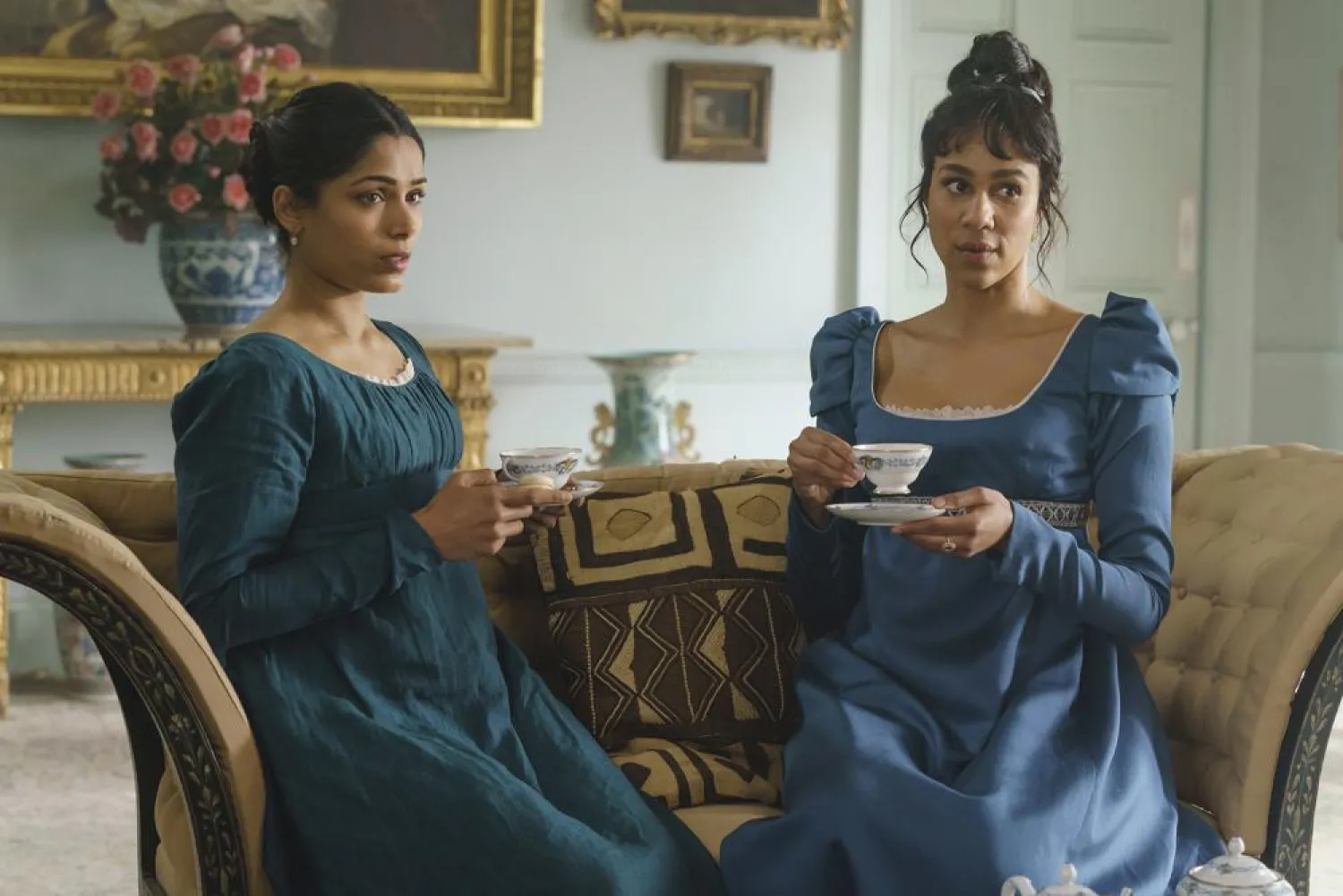
This image released by Bleecker Street shows Freida Pinto, left, and Zawe Ashton in a scene from "Mr. Malcolm's List." (Bleecker Street via AP)
TT

Review: Austen-Era Schemes, Dreams Fill ‘Mr. Malcolm’s List’

This image released by Bleecker Street shows Freida Pinto, left, and Zawe Ashton in a scene from "Mr. Malcolm's List." (Bleecker Street via AP)

“It is a truth universally acknowledged,” goes one of the more famous opening lines in English literature, “that a single man in possession of a good fortune, must be in want of a wife.”

That’s Jane Austen, beginning her 1813 “Pride and Prejudice.” Austen herself has nothing to do with “Mr. Malcolm’s List,” the clever, entertaining and delectably pretty new film starring Freida Pinto — but also everything. It’s our collective thirst for such Regency-era “comedies of manners,” examining the intense matchmaking activity of a certain level of British society, that has given rise to this, to TV’s “Bridgerton,” to the 2020 “Emma” adaptation with Anya Taylor-Joy, and other films too numerous to name.

Of course, you might ask, at a time of such turbulence in the world, what do 19th century upper-class romantic machinations have to do with, well, anything? To which we say: Whatever! Bring it on. Distract us with your lovely frocks flowing straight from the bosom, your exquisite bonnets with feathers, your real-estate porn in the countryside and your smart dinner-table repartee. We could do a lot worse.

There’s one key element in which “Mr. Malcolm’s List, “ a story of love, friendship and revenge served on a porcelain plate, diverges from previous Regency-era comedies (but aligns with “Bridgerton”): its diverse casting. Director Emma Holly Jones, working from a script (and novel) by Suzanne Allain, has said she was inspired by Broadway’s “Hamilton,” in which American history’s famous characters are portrayed by a non-white cast.

Here, the cast is led by British-Nigerian actor Sopé Dìrísù as the titular Mr. Malcolm, Zawe Ashton as the scheming Julia, and Pinto as the noble Selina, who serves as a reluctant pawn in this triangular tale. All three are excellent, but Ashton is particularly mesmerizing — to be fair, she gets the meatiest role by far, and it’s always better to play complicated than noble (though sometimes Julia veers dangerously into the downright mean). Supporting roles are ably filled, especially by an appealing Oliver Jackson-Cohen in the best-friend role as Julia’s cousin, and a ridiculously dashing Theo James as, well, a ridiculously dashing captain.

But let’s talk marriage, shall we?

Because marriage is the only goal here — and everyone knows it, even the child versions of Julia and Selina, whom we meet at boarding school in a brief prelude. Selina, the daughter of a country vicar, notes that she has little means to offer an eventual husband. Julia, ever the pragmatist, promises she will find Selina a mate — once her own marriage has been secured.

Sixteen years later, we’re in 1818 London and Julia’s on the hunt. She manages to wangle a date with wealthy Jeremy Malcolm, the town’s most eligible bachelor. But at the opera, he tests her knowledge. She knows nothing about opera, nor can she answer his question about the Corn Laws. He yawns, a development noticed across the theater in a box, where other young ladies snipe that after four unsuccessful “seasons” in the marriage market, Julia really should step aside.

Things really get bad for Julia when an unflattering comic sketch, or caricature, circulates in the press — a sort of Regency-era social media diss — showing her being spurned by Jeremy. “I am ruined,” she laments. She consults her cousin Cassidy, who’s friends with Jeremy and lets on that the wealthy bachelor has an actual list of qualifications for an eventual bride.

Ever more humiliated, Julia hatches a plan: She will groom a willing candidate to fit all Jeremy’s qualifications, and then, once he’s ready to propose, give the snobbish man a taste of his own medicine.

Enter Selina, who’s beautiful and intelligent if not wealthy. Julia brings her for an extended stay in London. Reluctantly, Selina agrees to the scheme, but soon discovers Jeremy is not the insufferable snob Julia has described. In fact, he’s a sweet and thoughtful man, justifiably wary of fortune-hungry schemers (rather like Julia).

So what’s a poor vicar’s daughter to do? Clearly, as the couple slowly falls in love, there will be tears and missed signals and misunderstandings.

There will also be walks in pristine gardens, cups of tea consumed in exquisitely appointed sitting rooms, parties and dancing. Also, a costume ball! Once we hear that, we know there’s going to an identity mix-up of vast proportions — and very nice garments.

But in an Austenesque world, matches are ultimately made, of course. Nobody is left out — everybody gets a spouse, as Oprah might say! Even the amusingly dry footman (Divian Ladwa) finds his match, as we learn in an ending credits sequence well worth sitting through.

It’s almost enough to make you forget that in the 21st century, getting married isn’t the panacea that’s presented here. But no matter. This is 1818, and it’s certainly relaxing to visit a time when things WERE so simple — at least, in screenplays. How calming to spend two hours absolutely knowing, to paraphrase an English writer of a different era, that all will be well that ends well.



Taylor Swift Bags Best-selling Artist of 2025 Award

FILE PHOTO: Taylor Swift poses at the red carpet during the 67th Annual Grammy Awards in Los Angeles, California, US, February 2, 2025. REUTERS/Daniel Cole/File Photo
TT

Taylor Swift Bags Best-selling Artist of 2025 Award

FILE PHOTO: Taylor Swift poses at the red carpet during the 67th Annual Grammy Awards in Los Angeles, California, US, February 2, 2025. REUTERS/Daniel Cole/File Photo

US pop star Taylor Swift was crowned the biggest-selling global artist of 2025, industry body IFPI announced Wednesday, the fourth consecutive year and sixth time she has claimed its annual prize.

The 36-year-old's success was turbo-charged by the October release of her latest album, "The Life of a Showgirl", which set several streaming records, as well as the release of a docuseries about her record-breaking The Eras tour.

"2025 was another landmark year (for Swift), driven by exceptional worldwide engagement across streaming, physical and digital formats with the release of her 12th album ... and the documentary of her tour," IFPI said.

The body, which represents the recorded music industry worldwide, noted Swift had now won its top annual artist prize as many times as all other artists combined over the past 10 years, AFP.

IFPI hands out the Global Artist of the Year Award after calculating an artist's or group's worldwide sales across streaming, downloads and physical music formats during the calendar year and covers their entire body of work.

Swift beat out Korean group Stray Kids, which came in second -- its highest-ever ranking and the third consecutive year in the global top five.

Fresh from his Super Bowl halftime show, Puerto Rican artist Bad Bunny placed fifth in the rankings, his sixth consecutive year in the chart.

American rapper Tyler, The Creator marked his first appearance on the chart, in 12th place, with IFPI noting he had "continued to generate strong vinyl sales across his catalogue".

Meanwhile Japanese rock band Mrs. Green Apple entered the rankings for the first time one place below him, following what IFPI called "the success of their anniversary album '10'".


Berlin Film Festival Rejects Accusation of Censorship on Gaza

Berlinale Festival Director Tricia Tuttle speaks during the Berlinale Camera award ceremony honoring British composer Max Richter during the 76th Berlin International Film Festival, in Berlin, Germany, 18 February 2026. (EPA)
TT

Berlin Film Festival Rejects Accusation of Censorship on Gaza

Berlinale Festival Director Tricia Tuttle speaks during the Berlinale Camera award ceremony honoring British composer Max Richter during the 76th Berlin International Film Festival, in Berlin, Germany, 18 February 2026. (EPA)

The director of the Berlin Film Festival on Wednesday rejected accusations from more than 80 film industry figures that the festival had helped censor artists who oppose Israel's actions in Gaza.

In an open letter published on Tuesday, Oscar-winning actors Javier Bardem and Tilda Swinton were among dozens who criticized the Berlinale's "silence" on the issue and said they were "dismayed" at its "involvement in censoring artists who oppose Israel's ongoing genocide against Palestinians in Gaza".

In an interview with Screen Daily, the Berlinale's director, Tricia Tuttle, said the festival backs "free speech within the bounds of German law".

She said she recognized that the letter came from "the depth of anger and frustration about the suffering of people in Gaza".

However, she rejected accusations of censorship, saying that the letter contained "misinformation" and "inaccurate claims about the Berlinale" made without evidence or anonymously.

The row over Gaza has dogged this year's edition of the festival since jury president Wim Wenders answered a question on the conflict by saying: "We cannot really enter the field of politics."

The comments prompted award-winning novelist Arundhati Roy, who had been due to present a restored version of a film she wrote, to withdraw from the festival.

Tuttle said the festival represents "lots of people who have different views, including lots of people who live in Germany who want a more complex understanding of Israel's positionality than maybe the rest of the world has right now".

German politicians have been largely supportive of Israel as Germany seeks to atone for the legacy of the Holocaust.

However, German public opinion has been more critical of Israeli actions in Gaza.

Commenting on the row to the Welt TV channel, German Culture Minister Wolfram Weimer defended Wenders and Tuttle from criticism, saying they were running the festival "in a very balanced way, very sensitively".

"Artists should not be told what to do when it comes to politics. The Berlinale is not an NGO with a camera and directors," Weimer said.

Gaza has frequently been a topic of controversy at the Berlinale in recent years.

In 2024, the festival's documentary award went to "No Other Land", which follows the dispossession of Palestinian communities in the Israeli-occupied West Bank.

German government officials criticized "one-sided" remarks about Gaza by the directors of that film and others at that year's awards ceremony.


Over 80 Berlin Film Festival Alumni Sign Open Letter Urging Organizers to Take Stance on Gaza 

12 February 2026, Berlin: President of the Berlinale jury Wim Wenders waves to the audience on the opening night of the 76th Berlin International Film Festival, before the premiere of the opening film "No Good Men" at the Berlinale Palast. (dpa)
TT

Over 80 Berlin Film Festival Alumni Sign Open Letter Urging Organizers to Take Stance on Gaza 

12 February 2026, Berlin: President of the Berlinale jury Wim Wenders waves to the audience on the opening night of the 76th Berlin International Film Festival, before the premiere of the opening film "No Good Men" at the Berlinale Palast. (dpa)

More than 80 actors, directors and other ‌artists who have taken part in the Berlin Film Festival, including Tilda Swinton and Javier Bardem, signed an open letter to the organizers published on Tuesday calling for them to take a clear stance on Israel's war in Gaza.

"We call on the Berlinale to fulfil its moral duty and clearly state its opposition to Israel's genocide, crimes against humanity and war crimes against Palestinians," said the open letter, which was published in full in entertainment industry magazine Variety.

Multiple human rights experts, scholars and a UN inquiry say Israel's assault on Gaza amounts to genocide. Israel calls its actions self-defense after Hamas' October 2023 attack on Israel.

"We are appalled by Berlinale's institutional silence," ‌said the letter, which ‌was also signed by actors Adam McKay, Alia Shawkat and ‌Brian ⁠Cox, and director ⁠Mike Leigh.

It said organizers had not met demands to issue a statement affirming Palestinians' right to life and committing to uphold artists' right to speak out on the issue.

"This is the least it can - and should - do," the letter said.

The festival did not immediately respond to an emailed request for comment.

THE MOST POLITICAL FESTIVAL

The Berlin Film Festival is considered the most political of its peers, Venice and Cannes, and ⁠prides itself on showing cinema from under-represented communities and young ‌talent. However, it has been repeatedly criticized by pro-Palestinian activists ‌for not taking a stand on Gaza, in contrast to the war in Ukraine ‌and the situation in Iran.

Calls have also previously been made for the ‌entertainment industry to take a stance on Gaza.

Last year, over 5,000 actors, entertainers, and producers, including some Hollywood stars, signed a pledge to not work with Israeli film institutions that they saw as being complicit in the abuse of Palestinians by Israel.

Paramount studio later condemned that ‌pledge and said it did not agree with such efforts.

ROY PULLS OUT

Tuesday's letter also condemned statements by this year's ⁠jury president, German director ⁠Wim Wenders, that filmmakers should stay out of politics, writing: "You cannot separate one from the other."

Wenders' comments prompted Indian novelist Arundhati Roy, winner of the Booker Prize in 1997 for her novel "The God of Small Things", to pull out of the festival earlier this week.

Roy, who had been due to present "In Which Annie Gives It Those Ones", a 1989 film which she wrote, in the Berlinale's Classics section, characterized Wenders' comments as "unconscionable."

In response, festival director Tricia Tuttle issued a note on Saturday defending artists' decision not to comment on political issues.

"People have called for free speech at the Berlinale. Free speech is happening at the Berlinale," she said.

"But increasingly, filmmakers are expected to answer any question put to them," she wrote, and are criticized if they do not answer, or answer "and we do not like what they say."