


UK’s Johnson Vows to Stay on Despite Top Tier Resignations

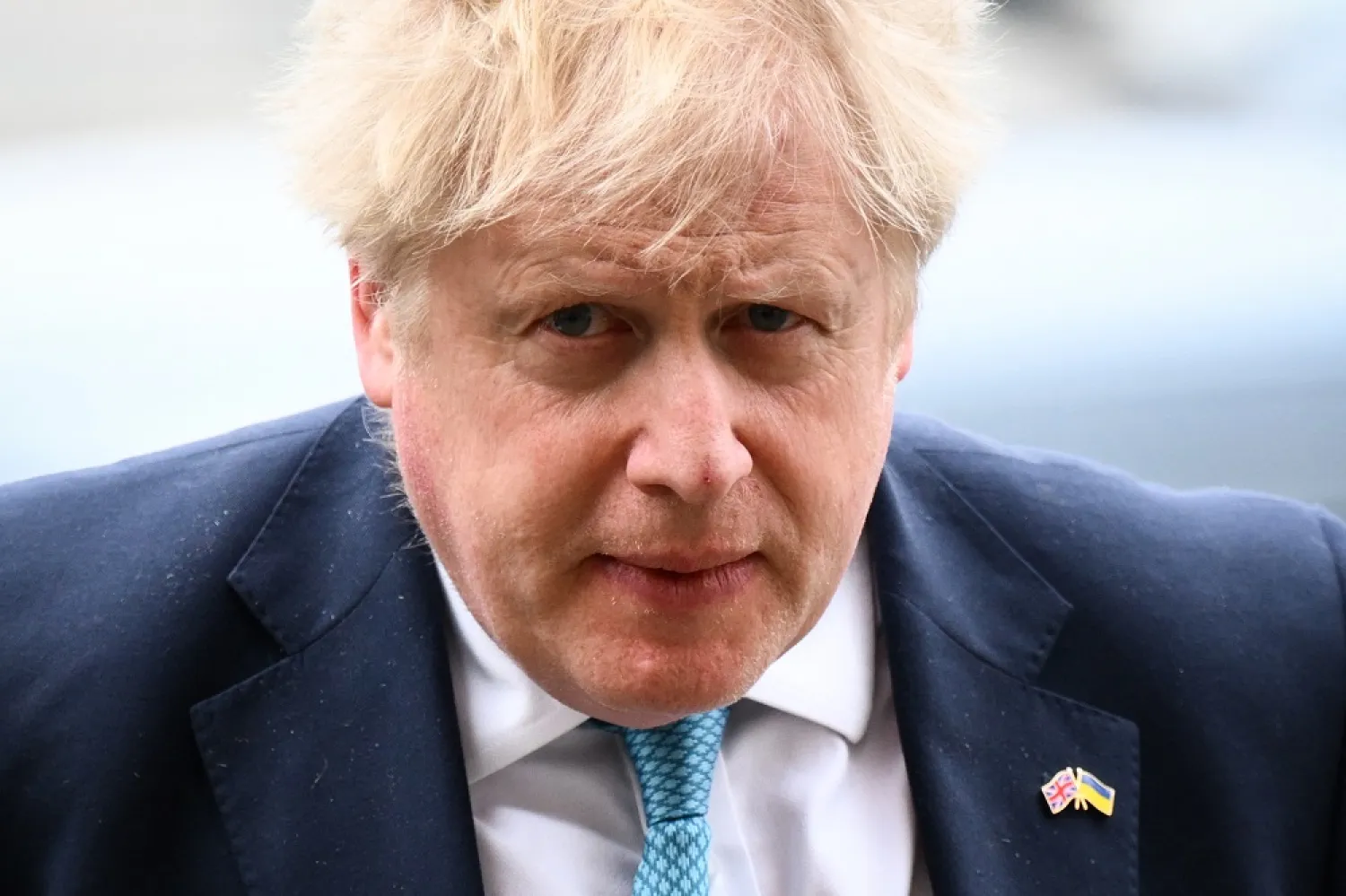
In this file photo taken on March 29, 2022 Britain's Prime Minister Boris Johnson arrives to attend a Service of Thanksgiving for Britain's Prince Philip, Duke of Edinburgh, at Westminster Abbey in central London. (AFP)
TT

UK’s Johnson Vows to Stay on Despite Top Tier Resignations

In this file photo taken on March 29, 2022 Britain's Prime Minister Boris Johnson arrives to attend a Service of Thanksgiving for Britain's Prince Philip, Duke of Edinburgh, at Westminster Abbey in central London. (AFP)

British Prime Minister Boris Johnson said he plans to stay in power despite the resignations of two top Cabinet ministers and a slew of more junior officials.

Johnson told lawmakers Wednesday that "the job of a prime minister in difficult circumstances when you’ve been handed a colossal mandate is to keep going."

Johnson’s hold on power has been shaken by the resignations of Treasury chief Rishi Sunak and Health Secretary Sajid Javid. They quit Tuesday saying they could no longer support Johnson because of his handling of ethics scandals including the case of a senior official accused of sexual misconduct.

Johnson quickly replaced the two men, but a string of junior ministers have also quit, and Johnson’s support inside his Conservative Party is shrinking rapidly.

Opponents hope to change party rules to allow a new no-confidence vote in Johnson. He survived one such vote last month, with 41% of lawmakers voting against him.

The most immediate challenge for the leader, who only narrowly survived a no-confidence vote last month, is to get through two public grilling sessions: the weekly Prime Minister’s Questions session in Parliament and a long-scheduled interrogation by a committee of senior lawmakers.

How he handles the tough questions could indicate whether a simmering rebellion in his Conservative Party can gather enough strength to oust him. Also on the horizon is a vote in a powerful party committee that could signal whether lawmakers have the appetite to push for another no-confidence vote.

Johnson is known for his uncanny ability to shrug off scandals, but a series of accusations of misdeeds have pushed him to the brink, and some of his fellow Conservative lawmakers now worry that the leader renowned for his affability could be a liability in elections.

Many are also concerned about the ability of a weakened Johnson to govern at a time of increasing economic and social strain.

Months of discontent over Johnson’s judgment and ethics within the governing Conservative Party erupted with the resignations of Treasury chief Rishi Sunak and Health Secretary Sajid Javid within minutes of each other on Tuesday evening. The two heavyweights of the Cabinet were responsible for tackling two of the biggest issues facing Britain - the cost-of-living crisis and the ongoing COVID-19 pandemic.

In a scathing letter, Sunak said "the public rightly expect government to be conducted properly, competently and seriously. … I believe these standards are worth fighting for and that is why I am resigning."

Javid said the party needed "humility, grip and a new direction" but "it is clear this situation will not change under your leadership."

Mindful of the need to shore up confidence, Johnson quickly replaced the two ministers, promoting Nadhim Zahawi from the education department to treasury chief and installing his chief of staff, Steve Barclay, as health secretary.

But a string of resignations late Tuesday and early Wednesday from more junior ministers - from both the liberal and right-wing branches of the Conservative Party - showed that danger to Johnson was far from over.

In the past few months, Johnson has been fined by police and slammed by an investigator’s report for government parties that flouted the COVID-19 restrictions they imposed on others; saw 41% of Conservative lawmakers vote to oust him in the no-confidence vote; and watched formerly loyal lieutenants urge him to resign.

Through it all, he has vowed to carry on governing - even suggesting he wanted to stay in office until the 2030s.

But former International Development Secretary Andrew Mitchell was among several members of the Conservative Party who told Johnson his time was up.

"It’s a bit like the death of Rasputin. He’s been poisoned, stabbed, he’s been shot, his body’s been dumped in a freezing river and still he lives," he told the BBC. "But this is an abnormal prime minister, a brilliantly charismatic, very funny, very amusing, big, big character. But I’m afraid he has neither the character nor the temperament to be our prime minister."

The final straw for Sunak and Javid was the prime minister’s shifting explanations about his handling of sexual misconduct allegations against a senior Conservative lawmaker.

Last week, Chris Pincher resigned as Conservative deputy chief whip after complaints he groped two men at a private club. That triggered a series of reports about past allegations leveled against Pincher and questions about what Johnson knew when he tapped Pincher for a senior job enforcing party discipline.

Johnson’s office initially said he wasn’t aware of the previous accusations when he promoted Pincher in February. By Monday, a spokesman said Johnson did know of the allegations - but they were "either resolved or did not progress to a formal complaint."

When a former top civil servant in the Foreign Office contradicted that, saying Johnson was briefed about a 2019 allegation that resulted in a formal complaint, Johnson’s office said the prime minister had forgotten about a briefing on the issue.

It was all too much for ministers who have been sent onto radio and TV to defend the government’s position, only to find it change.

Bim Afolami, who quit as Conservative Party vice chairman on Tuesday, said he had been willing to give Johnson the benefit of the doubt - until the Pincher affair.

"The difficulty is not overall the program of the government. … The government has done a lot of positive things that unite the Conservative Party," he said. "The problem is character and integrity in Downing Street, and I think that people in the Conservative party and people in the country know that."

But Paul Drexler, chair of the International Chambers of Commerce, warned that soaring food and energy prices are reaching crisis proportions and need to be addressed by a leader who isn't distracted.

"I would say the most important thing to do is to feed people who are hungry," he told the BBC. "I mean that is a burning platform at the moment. The poorest in our society are going to be starving to death the second half of this year. That needs to be addressed."

Johnson’s opponents in the party hope more Cabinet ministers will follow Sunak and Javid, though for now other top officials - including Foreign Secretary Liz Truss, Defense Secretary Ben Wallace and Home Secretary Priti Patel - are staying put.

Opponents are also trying to force another no-confidence vote over the prime minister. The existing rules require 12 months between such votes, but the rules are made by a party committee and can be changed. Elections for that committee’s executive are due in the next few weeks.



US Judge Blocks Deportation of Columbia University Palestinian Activist

Mohsen Mahdawi at a press conference in Vermont last year - Photo by Alex Driehaus/AP
TT

US Judge Blocks Deportation of Columbia University Palestinian Activist

Mohsen Mahdawi at a press conference in Vermont last year - Photo by Alex Driehaus/AP

A US immigration judge has blocked the deportation of a Palestinian graduate student who helped organize protests at Columbia University against Israel's war in Gaza, according to US media reports.

Mohsen Mahdawi was arrested by immigration agents last year as he was attending an interview to become a US citizen.

Mahdawi had been involved in a wave of demonstrations that gripped several major US university campuses since Israel began a massive military campaign in the Gaza Strip.

A Palestinian born in the occupied West Bank, Mahdawi has been a legal US permanent resident since 2015 and graduated from the prestigious New York university in May. He has been free from federal custody since April.

In an order made public on Tuesday, Judge Nina Froes said that President Donald Trump's administration did not provide sufficient evidence that Mahdawi could be legally removed from the United States, multiple media outlets reported.

Froes reportedly questioned the authenticity of a copy of a document purportedly signed by Secretary of State Marco Rubio that said Mahdawi's activism "could undermine the Middle East peace process by reinforcing antisemitic sentiment," according to the New York Times.

Rubio has argued that federal law grants him the authority to summarily revoke visas and deport migrants who pose threats to US foreign policy.

The Trump administration can still appeal the decision, which marked a setback in the Republican president's efforts to crack down on pro-Palestinian campus activists.

The administration has also attempted to deport Mahmoud Khalil, another student activist who co-founded a Palestinian student group at Columbia, alongside Mahdawi.

"I am grateful to the court for honoring the rule of law and holding the line against the government's attempts to trample on due process," Mahdawi said in a statement released by his attorneys and published Tuesday by several media outlets.

"This decision is an important step towards upholding what fear tried to destroy: the right to speak for peace and justice."


Fire Breaks out Near Iran's Capital Tehran, State Media Says

Smoke rises from a fire caused by an explosion in Tehran (File photo - Reuters)
TT

Fire Breaks out Near Iran's Capital Tehran, State Media Says

Smoke rises from a fire caused by an explosion in Tehran (File photo - Reuters)

A fire broke out in Iran's Parand near the capital city Tehran, state media reported on Wednesday, publishing videos of smoke rising over the area which is close to several military and strategic sites in the country's Tehran province, Reuters reported.

"The black smoke seen near the city of Parand is the result of a fire in the reeds around the Parand river bank... fire fighters are on site and the fire extinguishing operation is underway", state media cited the Parand fire department as saying.


Pakistan PM Sharif to Seek Clarity on Troops for Gaza in US Visit

US President Donald Trump looks at Pakistan's Prime Minister Shehbaz Sharif speaking following the official signing of the first phase of the Gaza ceasefire agreement between Israel and Hamas, during a world leaders' summit on ending the Gaza war, in Sharm El-Sheikh, Egypt, October 13, 2025. REUTERS/Evelyn Hockstein/File Photo
TT

Pakistan PM Sharif to Seek Clarity on Troops for Gaza in US Visit

US President Donald Trump looks at Pakistan's Prime Minister Shehbaz Sharif speaking following the official signing of the first phase of the Gaza ceasefire agreement between Israel and Hamas, during a world leaders' summit on ending the Gaza war, in Sharm El-Sheikh, Egypt, October 13, 2025. REUTERS/Evelyn Hockstein/File Photo

Before Pakistan commits to sending troops to Gaza as part of the International Stabilization Force it wants assurances from the United States that it will be a peacekeeping mission rather than tasked with disarming Hamas, three sources told Reuters.

Pakistan's Prime Minister Shehbaz Sharif is set to attend the first formal meeting of President Donald Trump's Board of Peace in Washington on Thursday, alongside delegations from at least 20 countries.

Trump, who will chair the meeting, is expected to announce a multi-billion dollar reconstruction plan for Gaza and detail plans for a UN-authorized stabilization force for the Palestinian enclave.

Three government sources said during the Washington visit Sharif wanted to better understand the goal of the ISF, what authority they were operating under and what the chain of command was before making a decision on deploying troops.

"We are ready to send troops. Let me make it clear that our troops could only be part of a peace mission in Gaza," said one of the sources, a close aide of Sharif.

"We will not be part of any other role, such as disarming Hamas. It is out of the question," he said.

Analysts say Pakistan would be an asset to the multinational force, with its experienced military that has gone to war with arch-rival India and tackled insurgencies.

"We can send initially a couple of thousand troops anytime, but we need to know what role they are going to play," the source added.

Two of the sources said it was likely Sharif, who has met Trump earlier this year in Davos and late last year at the White House, would either have an audience with him on the sidelines of the meeting or the following day at the White House.

Initially designed to cement Gaza's ceasefire, Trump sees the Board of Peace, launched in late January, taking a wider role in resolving global conflicts. Some countries have reacted cautiously, fearing it could become a rival to the United Nations.

While Pakistan has supported the establishment of the board, it has voiced concerns against the mission to demilitarize Gaza's militant group Hamas.