


Star Trek’s ‘Strange New Worlds’: In Defense of Episodic TV

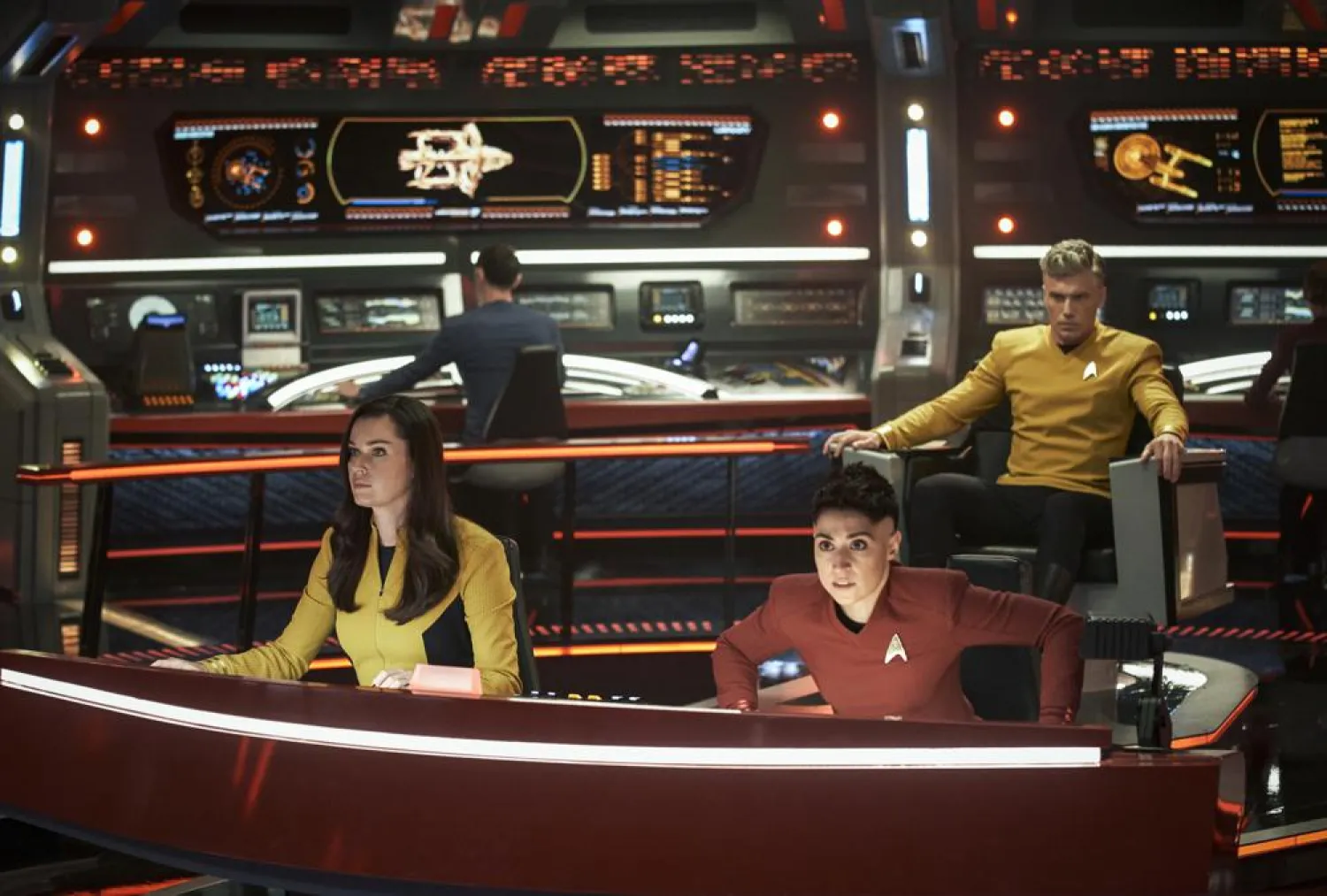
This image released by Paramount+ shows, from left, Rebecca Romijn as Una, Ethan Peck as Spock, background, Melissa Navia as Ortegas and Anson Mount as Pike in a scene from the series "Star Trek: Strange New Worlds." (Paramount+ via AP)
TT

Star Trek’s ‘Strange New Worlds’: In Defense of Episodic TV

This image released by Paramount+ shows, from left, Rebecca Romijn as Una, Ethan Peck as Spock, background, Melissa Navia as Ortegas and Anson Mount as Pike in a scene from the series "Star Trek: Strange New Worlds." (Paramount+ via AP)

Two generations after its 1966 debut, the universe of “Star Trek” has become a vast and sprawling mural in these heady days of streaming TV.

There’s the dark and bingeworthy “Star Trek: Picard,” a deep character study of an aging and beloved captain confronting his demons — and saving life as we know it twice in two seasons. There’s “Star Trek: Prodigy,” a rich, 3D-animated story aimed at kids and full of wonder. There’s the more traditionally animated “Star Trek: Lower Decks,” a wacky variation on the theme that unfolds on an also-ran starship and is brimming with fan-service moments.

And smack in the center of the mural sits “Star Trek Discovery,” the epic journey of a Federation starship and its crew across an entire millennium as it saves the galaxy not once (rogue AI!) , not twice (“The Burn!”), but three times (“The Dark Matter Anomaly!”) in four seasons and counting.

Intricate story arcs. Deep serialization. A requirement for sequential viewing and a serious attention span. That’s a lot of commitment, even for a binger. So what’s a planet-of-the-week fan of the original series and its episodic aesthetic to do?

The answer, of course, is “Star Trek: Strange New Worlds,” which is chronicling the voyages of the USS Enterprise before Kirk became its captain. Led by Capt. Christopher Pike (Anson Mount), the show is essentially a workplace drama in deep space — the intergalactic equivalent of looking in on a really interesting office and getting various tastes of what exactly it is that everyone does.

“Strange New Worlds,” whose first-season finale “airs” Thursday on Paramount+ in the United States, has been a true errand of mercy for those “Trek” fans who love old-fashioned, self-contained episodes, and want the opportunity to experience a Whitman’s Sampler of sci-fi from week to week.

So far, the show’s peregrinations — one-and-done plots, even as character development reaches across episodes — have been varied and wandering in the most satisfying of ways.

Season One has featured, among other genre journeys, forays into comedy, horror, submarine thriller, contagious-disease drama and full-on medieval fantasy. Each has been suffused with humanism, optimism and the complex moral questions and allegories that made “Star Trek” so relevant in that other period of unrelenting upheaval, the 1960s.

Viewers — not merely longtime fans — are eating it up. The show has a preposterously high rating of 99% on Rotten Tomatoes and seems to appeal to both traditionalists and newer acolytes. But why does this iteration of the “Trek” universe hit so rightly at this exact moment? As Spock might say, a number of possibilities present themselves.

First, consider the baseball card and the postage stamp — both fodder for collectors for a century and a half. People love them for many reasons, but they share a key trait: Each, when collected, is an assemblage of variants of an appealing form. And though the form is familiar and generally consistent, inside its borders anything goes.

What’s more, not every specimen has to be earth-shattering (or galaxy-shattering). For every rare 1909 Honus Wagner card or 1918 “Inverted Jenny” stamp, there are countless others that are simply small glimpses of the day-to-day — the journeyman infielder, the forever stamp with the flower on it. They’re not world-changers on their own, but each is a sterling example of the breed, and together — when collected — they form a larger tapestry.

When it comes to “Strange New Worlds,” though, the appeal runs even deeper than that. Oddly enough, it’s also about normalcy.

The creator of “Star Trek,” Gene Roddenberry, pitched it originally as “Wagon Train to the Stars,” pushing out onto the (final) frontier. But boiled down, the original series — and “Strange New Worlds,” on a 21st-century level — is a meditation on the workplace.

The coronavirus pandemic has taught us a lot about the workplace — both being in it and not being in it — and about the desire for the normal rhythms of existence. Lots of people are craving routine, day-to-day problems again, while navigating the blurring of barriers between work and home. “Strange New Worlds” is the Trek-verse iteration of all that.

The Enterprise is to “Strange New Worlds” what Grey-Sloan Memorial is to “Grey’s Anatomy” and Dunder Mifflin is to “The Office.” It’s a canvas. And behind all the fantastic allegories that the best of “Trek” has offered are more prosaic ones — ones that evoke our own workplaces and getting along with other departments and meeting cool new colleagues (talkin’ to you, Erica Ortegas) and, sometimes, dealing with a public that may occasionally seem downright alien.

Members of the Enterprise crew on “Strange New Worlds” are living their lives. They’re doing their jobs, even when their jobs really suck — like when they lose one of their own or are under attack. Like us, they find themselves in different moods from episode to episode, from scene to scene. They’re silly one moment, crisp and efficient the next, emotional the next and then, maybe, silly all over again. It all feels more like the cadence of actual life than one of these deep dives into a single, relentless story arc.

And while nothing is reset at the end of each week — characters evolve, pain endures, progress is made — to begin each episode with a new story feels strangely like an act of optimism. With humanity navigating such huge issues — climate change, guns, racism, abortion, war — why wouldn’t the chance for a narrative fresh start each week be immensely appealing?

Saving life as we know it? Sure, when it’s needed. That’s part of what sci-fi is all about. But DEALING with life as we know it? That’s the sweet and timely spot here, too. Aboard this version of the USS Enterprise, each is equally in play. And in these jumbled times, at the intersection of both, “Star Trek: Strange New Worlds” is thriving.


Eric Dane, who Played 'McSteamy' on 'Grey's Anatomy', Dies at 53

FILE - Actor Eric Dane, left, Katherine Heigl, center, and James Pickens Jr. from the show "Grey's Anatomy" arrive at the premiere of "Dreamgirls," in Beverly Hills, Calif., Dec. 11, 2006. (AP Photo/Matt Sayles, File)
TT

Eric Dane, who Played 'McSteamy' on 'Grey's Anatomy', Dies at 53

FILE - Actor Eric Dane, left, Katherine Heigl, center, and James Pickens Jr. from the show "Grey's Anatomy" arrive at the premiere of "Dreamgirls," in Beverly Hills, Calif., Dec. 11, 2006. (AP Photo/Matt Sayles, File)

Actor Eric ‌Dane, who played the handsome Dr. Mark Sloan on the hit television series "Grey's Anatomy," died on Thursday aged 53, his family said, less than a year after revealing that he suffered from amyotrophic lateral sclerosis, or ALS.

For 15 years, Dane played a plastic surgeon nicknamed "McSteamy" by female characters in the show. He also starred in the series "Euphoria," and said after the diagnosis he would still return to the set for ‌its third ‌season.

"Eric Dane passed on Thursday afternoon ‌following ⁠a courageous battle with ⁠ALS," his family said in a statement, according to People magazine and other media.

"He spent his final days surrounded by dear friends, his devoted wife, and his two beautiful daughters, Billie and Georgia, who were the center of his world."

ALS is a progressive ⁠disease in which a person’s brain ‌loses connection with the muscles. ‌It is also known as Lou Gehrig's disease after the ‌Hall of Fame baseball player who died from ‌it in 1941 at age 37.

"Throughout his journey with ALS, Eric became a passionate advocate for awareness and research, determined to make a difference for others facing the same ‌fight," Dane's family added, according to Reuters.

Dane and his wife, actor Rebecca Gayheart, the mother of their two ⁠children, ⁠separated in 2018 after 14 years of marriage.

But last March, just before Dane announced his diagnosis, Gayheart sought to dismiss her petition for divorce, People said, citing court documents.

Eric William Dane, the older of two brothers, was born on November 9, 1972, in San Francisco, to an architect father and homemaker mother, his biography on IMDB.com shows.

His first television role was in "The Wonder Years" in 1993, while 2005 brought his big break with "Grey's Anatomy." His big screen credits include "Marley & Me" and "X-Men: The Last Stand."


Taylor Swift Bags Best-selling Artist of 2025 Award

FILE PHOTO: Taylor Swift poses at the red carpet during the 67th Annual Grammy Awards in Los Angeles, California, US, February 2, 2025. REUTERS/Daniel Cole/File Photo
TT

Taylor Swift Bags Best-selling Artist of 2025 Award

FILE PHOTO: Taylor Swift poses at the red carpet during the 67th Annual Grammy Awards in Los Angeles, California, US, February 2, 2025. REUTERS/Daniel Cole/File Photo

US pop star Taylor Swift was crowned the biggest-selling global artist of 2025, industry body IFPI announced Wednesday, the fourth consecutive year and sixth time she has claimed its annual prize.

The 36-year-old's success was turbo-charged by the October release of her latest album, "The Life of a Showgirl", which set several streaming records, as well as the release of a docuseries about her record-breaking The Eras tour.

"2025 was another landmark year (for Swift), driven by exceptional worldwide engagement across streaming, physical and digital formats with the release of her 12th album ... and the documentary of her tour," IFPI said.

The body, which represents the recorded music industry worldwide, noted Swift had now won its top annual artist prize as many times as all other artists combined over the past 10 years, AFP.

IFPI hands out the Global Artist of the Year Award after calculating an artist's or group's worldwide sales across streaming, downloads and physical music formats during the calendar year and covers their entire body of work.

Swift beat out Korean group Stray Kids, which came in second -- its highest-ever ranking and the third consecutive year in the global top five.

Fresh from his Super Bowl halftime show, Puerto Rican artist Bad Bunny placed fifth in the rankings, his sixth consecutive year in the chart.

American rapper Tyler, The Creator marked his first appearance on the chart, in 12th place, with IFPI noting he had "continued to generate strong vinyl sales across his catalogue".

Meanwhile Japanese rock band Mrs. Green Apple entered the rankings for the first time one place below him, following what IFPI called "the success of their anniversary album '10'".


Berlin Film Festival Rejects Accusation of Censorship on Gaza

Berlinale Festival Director Tricia Tuttle speaks during the Berlinale Camera award ceremony honoring British composer Max Richter during the 76th Berlin International Film Festival, in Berlin, Germany, 18 February 2026. (EPA)
TT

Berlin Film Festival Rejects Accusation of Censorship on Gaza

Berlinale Festival Director Tricia Tuttle speaks during the Berlinale Camera award ceremony honoring British composer Max Richter during the 76th Berlin International Film Festival, in Berlin, Germany, 18 February 2026. (EPA)

The director of the Berlin Film Festival on Wednesday rejected accusations from more than 80 film industry figures that the festival had helped censor artists who oppose Israel's actions in Gaza.

In an open letter published on Tuesday, Oscar-winning actors Javier Bardem and Tilda Swinton were among dozens who criticized the Berlinale's "silence" on the issue and said they were "dismayed" at its "involvement in censoring artists who oppose Israel's ongoing genocide against Palestinians in Gaza".

In an interview with Screen Daily, the Berlinale's director, Tricia Tuttle, said the festival backs "free speech within the bounds of German law".

She said she recognized that the letter came from "the depth of anger and frustration about the suffering of people in Gaza".

However, she rejected accusations of censorship, saying that the letter contained "misinformation" and "inaccurate claims about the Berlinale" made without evidence or anonymously.

The row over Gaza has dogged this year's edition of the festival since jury president Wim Wenders answered a question on the conflict by saying: "We cannot really enter the field of politics."

The comments prompted award-winning novelist Arundhati Roy, who had been due to present a restored version of a film she wrote, to withdraw from the festival.

Tuttle said the festival represents "lots of people who have different views, including lots of people who live in Germany who want a more complex understanding of Israel's positionality than maybe the rest of the world has right now".

German politicians have been largely supportive of Israel as Germany seeks to atone for the legacy of the Holocaust.

However, German public opinion has been more critical of Israeli actions in Gaza.

Commenting on the row to the Welt TV channel, German Culture Minister Wolfram Weimer defended Wenders and Tuttle from criticism, saying they were running the festival "in a very balanced way, very sensitively".

"Artists should not be told what to do when it comes to politics. The Berlinale is not an NGO with a camera and directors," Weimer said.

Gaza has frequently been a topic of controversy at the Berlinale in recent years.

In 2024, the festival's documentary award went to "No Other Land", which follows the dispossession of Palestinian communities in the Israeli-occupied West Bank.

German government officials criticized "one-sided" remarks about Gaza by the directors of that film and others at that year's awards ceremony.