


Oil Minister Says Iraq to Act to Annul Kurdish Oil Deals

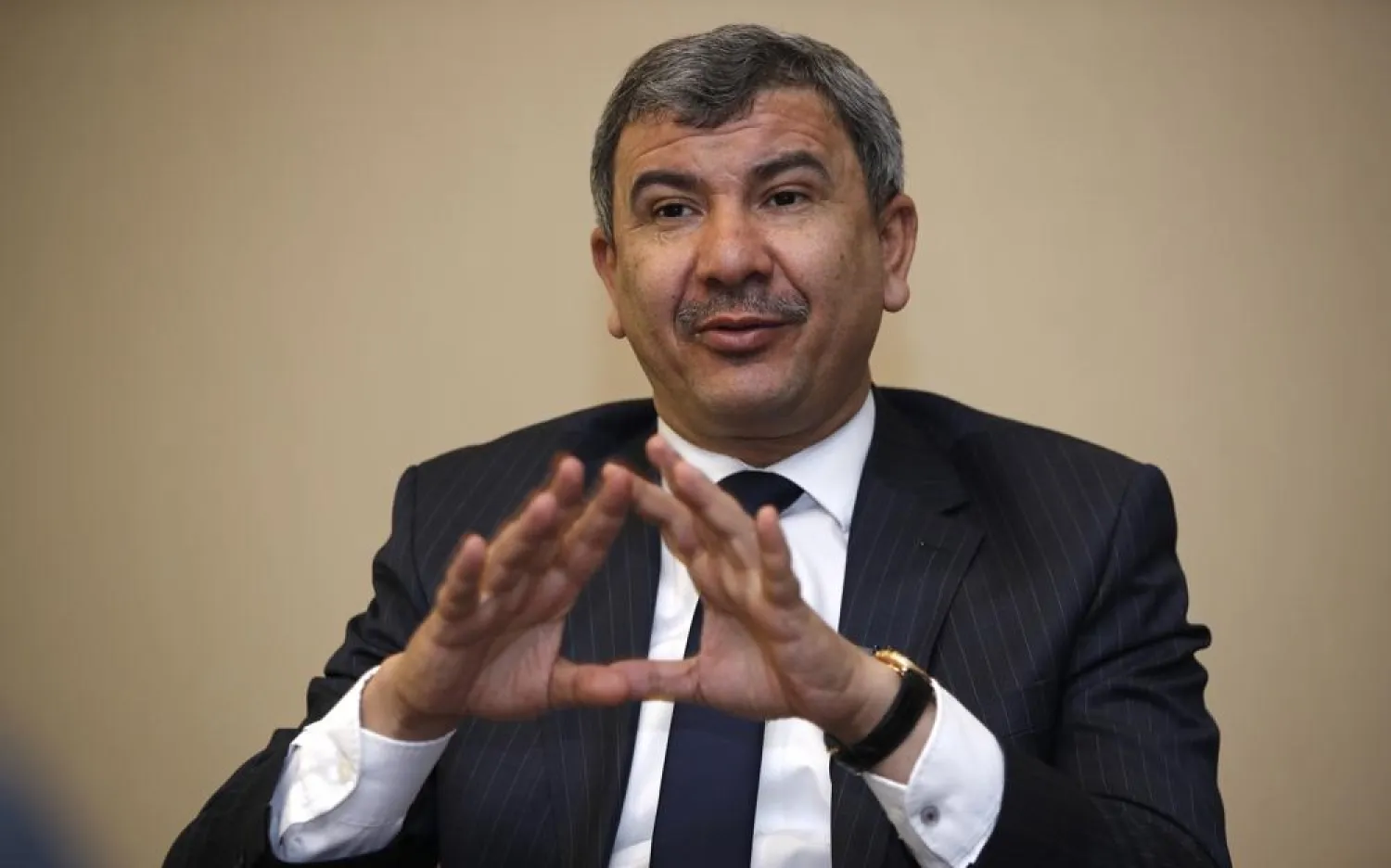
Ihsan Abdul-Jabbar Ismail, Iraq Oil minister speaks during an interview with The Associated Press in Baghdad, Iraq, Friday, June 11, 2021.(AP)
TT

Oil Minister Says Iraq to Act to Annul Kurdish Oil Deals

Ihsan Abdul-Jabbar Ismail, Iraq Oil minister speaks during an interview with The Associated Press in Baghdad, Iraq, Friday, June 11, 2021.(AP)

Iraq’s oil minister said on Thursday the government will take steps to enforce a recent court decision to annul oil contracts the semiautonomous northern Iraqi Kurdish region made with international companies.

The minister, Ihsan Abdul-Jabbar Ismail, told The Associated Press the deals, which circumvent the government in Baghdad, are illegal and amount to oil smuggling.

His remarks were the strongest yet by a senior government official since Iraq’s Supreme Federal Court issued a landmark ruling in February against the northern region’s independent oil sector. Ismail said in total 17 oil companies will be targeted for their dealings with the Iraqi Kurdish region.

Ismail said the international companies that have signed these deals would first receive a cautionary note.

"We will give them a soft message: ‘You are working in the smuggling of oil.' If they are a respectful company they will listen to us," Ismail told the AP in the exclusive interview.

Kurdish officials, including the ruling Kurdistan Democratic Party in Erbil, have dismissed the court ruling as politicized and claim the supreme court itself is unconstitutional.

The ruling came against the backdrop of political upheaval in Baghdad, where Iran-backed groups are pressuring Kurdish parties to join their efforts and proceed with the forming of a government after influential Shiite cleric Moqtada al-Sadr, the winner of the parliamentary elections last year, stepped down from the political process because he could not corral enough lawmakers in the 329-seat house. The Kurdistan Democratic Party was allied with Sadr.

The Iraqi Kurdish region has also faced a rising number of attacks targeting its energy infrastructure. Rocket and mortar fire repeatedly struck a gas field while others targeted a pumping station and refineries last month.

For years, Iraqi Kurdish authorities exploited a constitutional loophole, and managed to exports crude and maintain a modicum of financial independence from the federal government in Baghdad. They have kept details of their operations secret, including their production rates. Iraq Oil Report, an oil industry publication, estimates this to be 440,000 barrels per day.

Now, Baghdad officials are looking to close that door, Ismail said.

The February court ruling effectively rejected the Iraqi Kurdish oil law as a legal basis that the region had used to carry on with independent exports and contracts. Many questioned the timing of that ruling, given that it had been delayed for years. At the time, the Kurdistan Democratic Party and Sadr had tried to form a government without Iran-backed parties.

Ismail agreed the ruling came during a politically sensitive time but denied that it was a politicized decision. After the ruling, the Oil Ministry launched lawsuits against seven international companies, including Norway's DNO, Canada's Western Zagros and the UK-listed Gulf Keystone.

This week, Baghdad’s Commercial Court issued rulings invalidating four of the seven contracts, the oil minister said, with the other three to be decided on by the court at a July 17 session.

Ismail said the overall goal is to invalidate a total of 17 contracts. Some of the contracts are with companies from the United Arab Emirates, others are with Chinese and some with Russian companies, he said.

Caretaker Iraqi Prime Minister Mustafa al-Kadhimi has so far maintained distance from the recent developments, issuing conciliatory statements over the fraught relations between Baghdad and the Kurdish authorities.

But Ismail said the ministry has a plan to also act on the commercial court ruling and would give foreign companies the option to cancel their contracts, request that Iraq's federal government grant them a waiver - or transfer them from Kurdistan’s Ministry of Natural Resources to the federal government's Oil Ministry in Baghdad, he said.

He dismissed claims that it would be technically impossible to transfer contracts from one authority to another, saying it's a matter of "just paperwork.” The Kurdish region uses a production sharing contract model that is incompatible with the federal government's preference for technical service contracts.

If the companies do not comply, Ismail said the government would resort to "the law and banks” to enforce decisions.

"We also have the Oil Police, but we haven’t asked to use them,” he said.

Key oil service companies, including Baker Hughes, Haliburton and Schlumberger pledged to obey the ministry's blacklist policy and have said they will not seek new tenders with the Iraqi Kurdish authorities. For years, international companies have been operating in the Kurdish region with assurances from Kurdish officials that they would not face legal risks.

Oil companies contracted with the Kurdish region operate in territory de facto outside the federal government’s control. Sending federal police to physically shut down the operations in the Iraqi Kurdish region would amount to an unprecedented escalation.



Arab Parliament Affirms Support for Stability in Yemen, Unity Efforts in Sudan

Arab Parliament Affirms Support for Stability in Yemen, Unity Efforts in Sudan
TT

Arab Parliament Affirms Support for Stability in Yemen, Unity Efforts in Sudan

Arab Parliament Affirms Support for Stability in Yemen, Unity Efforts in Sudan

The Arab Parliament reiterated its strong and unwavering support for the security and stability of Yemen. It emphasized that prioritizing dialogue, understanding, and wisdom is essential to serve the best interests of the Yemeni people.

In a statement issued on Friday, the parliament highlighted the importance of making every effort to de-escalate the situation, address the crisis, and achieve a sustainable political solution that respects Yemen's sovereignty and the will of the Yemeni people, the Saudi Press Agency said.

The parliament expressed its full commitment to supporting all initiatives that enhance security, stability, and development in Yemen, as well as to fulfilling the legitimate aspirations of the Yemeni people for progress, stability, and prosperity.

The Arab Parliament also reiterated its strong and unwavering support for all initiatives aimed at resolving the Sudanese crisis and ensuring the security, stability, and unity of Sudan.

In a statement, the Arab Parliament congratulated the Sudanese people on the anniversary of Independence Day. It expressed hope that the next Independence Day will be celebrated with the crisis fully resolved, fulfilling the aspirations of the Sudanese people for security, stability and development.


Lebanon PM Pledges State Authority, Vows to End Israeli Attacks

An Israeli officer displays weapons seized by the army in Gaza, Lebanon and Syria during a media tour (AFP). 
TT

Lebanon PM Pledges State Authority, Vows to End Israeli Attacks

An Israeli officer displays weapons seized by the army in Gaza, Lebanon and Syria during a media tour (AFP). 

Lebanon’s Prime Minister Nawaf Salam has pledged to press ahead with reforms, extend the authority of the state, and work to end Israeli attacks and remove the occupation, even as Israel signals preparations for a “measured” military action against Hezbollah.

In a New Year message posted on X, Salam wished Lebanese a year marked by hope, continued state recovery, and restored public trust.

“We promise to continue together the path of reform and the extension of state authority,” he wrote. He added a renewed pledge “to keep working to end Israeli attacks, remove the occupation, and secure the return of our detainees,” saluting the Lebanese army and security forces deployed nationwide to safeguard public safety.

Lebanon has maintained diplomatic contacts with the sponsors of the ceasefire with Israel, which took effect in November 2024 and ended 66 days of fighting between Hezbollah and the Israeli army.

Beirut says diplomacy and steps by the Lebanese army have prevented a renewed war. Israel, however, still occupies five border points inside Lebanese territory, holds around 20 detainees, including civilians, and continues to violate the agreement through intermittent strikes and targeted killings inside Lebanon.

In parallel, Israeli media report heightened security readiness for possible action against Hezbollah, citing Israeli assessments that recent Lebanese measures fall short of ceasefire terms.

The daily Maariv said security chiefs are preparing to brief Prime Minister Benjamin Netanyahu on readiness levels, pointing to what Israel describes as Lebanon’s failure to dismantle Hezbollah’s military infrastructure south and north of the Litani River.

According to the report, Lebanon may soon declare the end of army operations to disarm Hezbollah south of the Litani without extending them northward, an outcome Israel deems a breach. Israeli assessments suggest this could prompt unilateral action if Lebanon is seen as unable or unwilling to comply.

Israel accuses Hezbollah of rebuilding capabilities, including precision missiles, and says recent airstrikes targeted training sites linked to the Radwan Forces. Israeli officials argue Hezbollah is currently in a weakened operational state, enabling “calibrated” options aimed at pressuring the group while preserving the ceasefire framework.


Türkiye Plans First Overseas Deepwater Drilling in Somalia Next Month

Türkiye Minister of Energy and Natural Resources Alparslan Bayraktar speaks during the conference 'Energy Security in the World and Türkiye: Risks and Solutions in Critical Minerals' at the Sabanci University Istanbul International Center for Energy and Climate (IICEC), in Istanbul, Türkiye, December 26, 2025. REUTERS/Umit Bektas
TT

Türkiye Plans First Overseas Deepwater Drilling in Somalia Next Month

Türkiye Minister of Energy and Natural Resources Alparslan Bayraktar speaks during the conference 'Energy Security in the World and Türkiye: Risks and Solutions in Critical Minerals' at the Sabanci University Istanbul International Center for Energy and Climate (IICEC), in Istanbul, Türkiye, December 26, 2025. REUTERS/Umit Bektas

Türkiye will send a drilling vessel to Somalia in February to carry out the country's first deepwater exploration project abroad, ‌Energy Minister ‌Alparslan Bayraktar ‌said.

He ‌said the operation with the Cagri Bey vessel will focus on offshore areas ⁠in Somali waters but did not ‍provide ‍details on targeted ‍reserves or investment size.

In 2024, Türkiye signed an energy exploration deal with Somalia. It has been ⁠seeking to diversify its energy sources and reduce reliance on imports, investing in exploration at home and overseas.