


Oil Minister Says Iraq to Act to Annul Kurdish Oil Deals

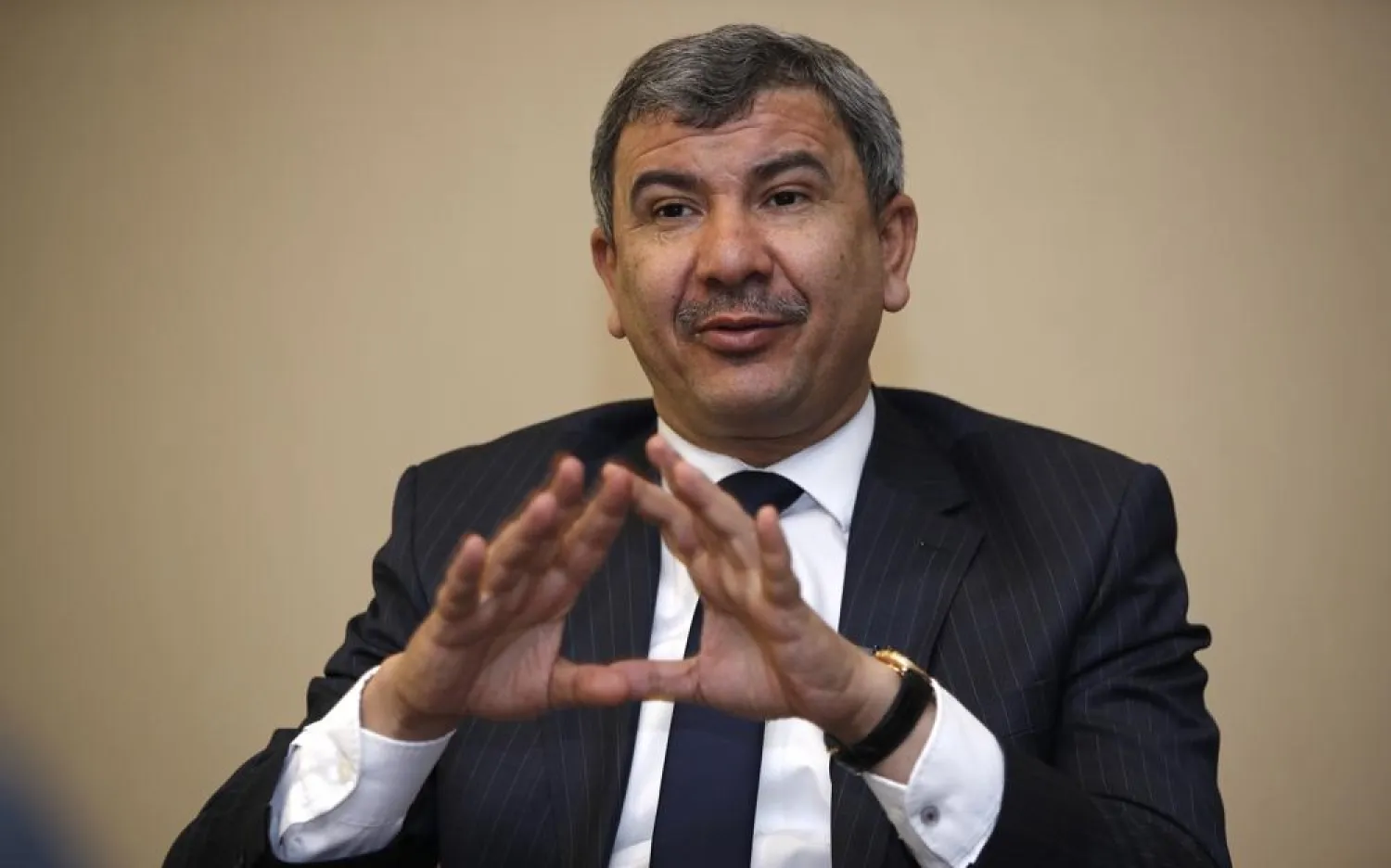
Ihsan Abdul-Jabbar Ismail, Iraq Oil minister speaks during an interview with The Associated Press in Baghdad, Iraq, Friday, June 11, 2021.(AP)
TT

Oil Minister Says Iraq to Act to Annul Kurdish Oil Deals

Ihsan Abdul-Jabbar Ismail, Iraq Oil minister speaks during an interview with The Associated Press in Baghdad, Iraq, Friday, June 11, 2021.(AP)

Iraq’s oil minister said on Thursday the government will take steps to enforce a recent court decision to annul oil contracts the semiautonomous northern Iraqi Kurdish region made with international companies.

The minister, Ihsan Abdul-Jabbar Ismail, told The Associated Press the deals, which circumvent the government in Baghdad, are illegal and amount to oil smuggling.

His remarks were the strongest yet by a senior government official since Iraq’s Supreme Federal Court issued a landmark ruling in February against the northern region’s independent oil sector. Ismail said in total 17 oil companies will be targeted for their dealings with the Iraqi Kurdish region.

Ismail said the international companies that have signed these deals would first receive a cautionary note.

"We will give them a soft message: ‘You are working in the smuggling of oil.' If they are a respectful company they will listen to us," Ismail told the AP in the exclusive interview.

Kurdish officials, including the ruling Kurdistan Democratic Party in Erbil, have dismissed the court ruling as politicized and claim the supreme court itself is unconstitutional.

The ruling came against the backdrop of political upheaval in Baghdad, where Iran-backed groups are pressuring Kurdish parties to join their efforts and proceed with the forming of a government after influential Shiite cleric Moqtada al-Sadr, the winner of the parliamentary elections last year, stepped down from the political process because he could not corral enough lawmakers in the 329-seat house. The Kurdistan Democratic Party was allied with Sadr.

The Iraqi Kurdish region has also faced a rising number of attacks targeting its energy infrastructure. Rocket and mortar fire repeatedly struck a gas field while others targeted a pumping station and refineries last month.

For years, Iraqi Kurdish authorities exploited a constitutional loophole, and managed to exports crude and maintain a modicum of financial independence from the federal government in Baghdad. They have kept details of their operations secret, including their production rates. Iraq Oil Report, an oil industry publication, estimates this to be 440,000 barrels per day.

Now, Baghdad officials are looking to close that door, Ismail said.

The February court ruling effectively rejected the Iraqi Kurdish oil law as a legal basis that the region had used to carry on with independent exports and contracts. Many questioned the timing of that ruling, given that it had been delayed for years. At the time, the Kurdistan Democratic Party and Sadr had tried to form a government without Iran-backed parties.

Ismail agreed the ruling came during a politically sensitive time but denied that it was a politicized decision. After the ruling, the Oil Ministry launched lawsuits against seven international companies, including Norway's DNO, Canada's Western Zagros and the UK-listed Gulf Keystone.

This week, Baghdad’s Commercial Court issued rulings invalidating four of the seven contracts, the oil minister said, with the other three to be decided on by the court at a July 17 session.

Ismail said the overall goal is to invalidate a total of 17 contracts. Some of the contracts are with companies from the United Arab Emirates, others are with Chinese and some with Russian companies, he said.

Caretaker Iraqi Prime Minister Mustafa al-Kadhimi has so far maintained distance from the recent developments, issuing conciliatory statements over the fraught relations between Baghdad and the Kurdish authorities.

But Ismail said the ministry has a plan to also act on the commercial court ruling and would give foreign companies the option to cancel their contracts, request that Iraq's federal government grant them a waiver - or transfer them from Kurdistan’s Ministry of Natural Resources to the federal government's Oil Ministry in Baghdad, he said.

He dismissed claims that it would be technically impossible to transfer contracts from one authority to another, saying it's a matter of "just paperwork.” The Kurdish region uses a production sharing contract model that is incompatible with the federal government's preference for technical service contracts.

If the companies do not comply, Ismail said the government would resort to "the law and banks” to enforce decisions.

"We also have the Oil Police, but we haven’t asked to use them,” he said.

Key oil service companies, including Baker Hughes, Haliburton and Schlumberger pledged to obey the ministry's blacklist policy and have said they will not seek new tenders with the Iraqi Kurdish authorities. For years, international companies have been operating in the Kurdish region with assurances from Kurdish officials that they would not face legal risks.

Oil companies contracted with the Kurdish region operate in territory de facto outside the federal government’s control. Sending federal police to physically shut down the operations in the Iraqi Kurdish region would amount to an unprecedented escalation.



Report: UN Chief Says He Is Cooperating with Trump’s Board of Peace on Gaza

UN Secretary General Antonio Guterres looks on after a family picture during the EU Summit at the EU headquarters in Brussels, on March 19, 2026. (AFP)
TT

Report: UN Chief Says He Is Cooperating with Trump’s Board of Peace on Gaza

UN Secretary General Antonio Guterres looks on after a family picture during the EU Summit at the EU headquarters in Brussels, on March 19, 2026. (AFP)

UN Secretary General Antonio Guterres welcomed the aim of Donald Trump's Board of Peace to fund and deliver the basics of a Gaza reconstruction plan to rebuild Palestinian homes and infrastructure, Politico reported on Saturday.

“There is an objective there that ‌was defined, ‌approved by the Security Council, ‌and ⁠we are cooperating ⁠actively with structures created by the Board of Peace,” Guterres told the news outlet in an interview.

Guterres saw no need for the board beyond Gaza's reconstruction. “This ⁠is not the effective way ‌to address ‌the dramatic problems that we have now,” he said.

“We need to be ‌clear about international law, to be clear about the values of the Charter of the United Nations. That is ‌essential in any peace initiative.”

He also called for an end to ⁠Iran's ⁠closure of the Strait of Hormuz, suggesting the UN could help protect the waterway and be part of a plan to de-escalate attacks.

Guterres said he had not spoken with Trump since the start of the war, although he has spoken to others in the administration.


Israel Says Targeting Hezbollah in Beirut as South Lebanon Struck

Debris cover the site of Hezbollah's Al-Manar TV headquarters after it was hit in an Israeli airstrike on Dahieh, a southern suburb of Beirut, Lebanon, Tuesday, March 3, 2026. (AP)
TT

Israel Says Targeting Hezbollah in Beirut as South Lebanon Struck

Debris cover the site of Hezbollah's Al-Manar TV headquarters after it was hit in an Israeli airstrike on Dahieh, a southern suburb of Beirut, Lebanon, Tuesday, March 3, 2026. (AP)

The Israeli military said it launched a wave of strikes on Beirut claiming to target the Iran-backed group Hezbollah early Saturday, while Lebanese state media reported strikes in the country's south.

Lebanon was pulled into the Middle East war when Hezbollah began firing rockets into Israel on March 2 to avenge the killing of Iran's supreme leader Ali Khamenei.

Israel has since launched strikes across Lebanon and sent ground troops into the country's south.

In a brief statement on Saturday, the Israeli military said its forces were "currently striking Hezbollah terrorist organization targets in Beirut".

A military spokesman earlier issued a warning to residents of Beirut's southern suburbs, a Hezbollah stronghold, to evacuate ahead of strikes.

Lebanon's official National News Agency (NNA) reported strikes on two neighborhoods in the area, without immediately saying what had been hit or whether there were any casualties.

In southern Lebanon, close to the border, the NNA said an Israeli airstrike hit a house in the town of Ghandouriyeh, killing at least one person and wounding two others.

The agency reported more strikes overnight and in the early morning on several areas of southern Lebanon, as well as an "extensive combing operation" carried out by Israeli troops in the area of Khiam town.

Hezbollah also said its fighters had targeted Israeli troops in six villages in southern Lebanon.

The group said it had also launched rockets across the border, where air raid sirens were activated, according to the Israeli military's Home Front Command.

The US ambassador to Lebanon, Michel Issa, gave his backing on Friday to a truce initiative proposed by Lebanese President Joseph Aoun, telling reporters that "matters are not resolved without talking".

He said, however, he believed Israel "has decided not to stop" striking Lebanon yet.

"That means Lebanon has to decide whether it can meet the Israelis in this case," the ambassador added.

Lebanon's health ministry says the war has killed more than 1,000 people in Lebanon and displaced more than one million more.

Two Israeli soldiers have been killed in southern Lebanon, according to the military.


After Pressure, Iraqi Factions Stop Attacks on US Embassy

The US Embassy headquarters in Baghdad's fortified "Green Zone" is pictured on March 18, 2026. (AFP)
TT

After Pressure, Iraqi Factions Stop Attacks on US Embassy

The US Embassy headquarters in Baghdad's fortified "Green Zone" is pictured on March 18, 2026. (AFP)

Political parties in Iraq have carried out intense efforts over the past two days to contain the escalation in the country in wake of increased attacks on the US embassy in Baghdad by pro-Iran factions, sources told Asharq Al-Awsat.

The efforts aim to also prevent Iraq from sliding into a broader conflict that may threaten its internal stability amid the US-Israeli conflict on Iran.

Government and political leaderships have exerted direct and indirect pressure on the leaders of the armed factions to cease the rocket and drone attacks against the embassy, saying they may have consequences on national security.

The judiciary has also warned that it will hold perpetrators accountable.

Washington, for its part, has delivered "firm" messages through official channels that it would take escalatory measures should its diplomatic missions and interests in Iraq continue to be attacked.

NATO quits Iraq

Meanwhile, NATO withdrew all of its troops from an advisory mission in Iraq, the military alliance said on Friday, as the repercussions of the Iran war spread across the Middle East.

"I would like to thank the Republic of Iraq and all the Allies ‌who assisted ‌in the safe relocation ‌of ⁠NATO personnel from Iraq," ⁠US Air Force Gen. Alexus Grynkewich, NATO's Supreme Allied Commander Europe, said in a statement.

The statement said the mission had relocated "all its personnel" from the Middle East to Europe. A ⁠NATO official, speaking on condition ‌of anonymity, said ‌that amounted to "several hundred" troops.

In recent ‌days, several countries including Poland, Spain and ‌Croatia have announced they have withdrawn troops from the Middle East, citing the conflict in Iran and the wider Gulf region.

NATO ‌said its mission would continue from a military headquarters in ⁠Naples, ⁠Italy. The mission does not have a combat role. It focuses on advising Iraqi security forces and helping them build up their capacities, according to NATO.

"I would also like to thank the dedicated men and women of NATO Mission Iraq, who continued their mission throughout this period. They are true professionals," Grynkewich said.

Undisclosed agreements

Signals on the ground point to undisclosed agreements being reached between Iraqi parties aimed at easing the escalation and ending attacks on the US embassy and the logistic support base at Baghdad airport.

Sources told Asharq Al-Awsat that separate meetings have been held in Baghdad’s Green Zone between Iraqi officials and representatives of the armed forces, and Iraqi officials with the US charge d’affaires, to discuss means to de-escalate the situation.

The Kataib Hezbollah announced a five-day truce on condition that attacks on its positions cease. It also called on Israel to stop its attacks on Beirut’s southern suburbs, that Washington commits to not attack residential areas in Iraq and that it reduces the number of its intelligence agents outside the embassy.

The sources said the US has not replied to the proposal.

On the ground, no drone buzzing or rocket fire was heard over Baghdad, a departure from previous days, meaning political efforts have somewhat succeeded in restoring calm. However, the US and Israel have continued to strike positions inside Iraq that are affiliated with the armed factions.

Western sources told Asharq Al-Awsat that Washington will continue to strike the Iran-backed factions in retaliation to their attacks in Iraq and to neutralize their threat.

Over 160 members of the Popular Mobilization Forces (PMF) were killed and injured in US-Israeli strikes, revealed Hadi al-Ameri, Secretary-General of the Badr Organization.