


Oil Minister Says Iraq to Act to Annul Kurdish Oil Deals

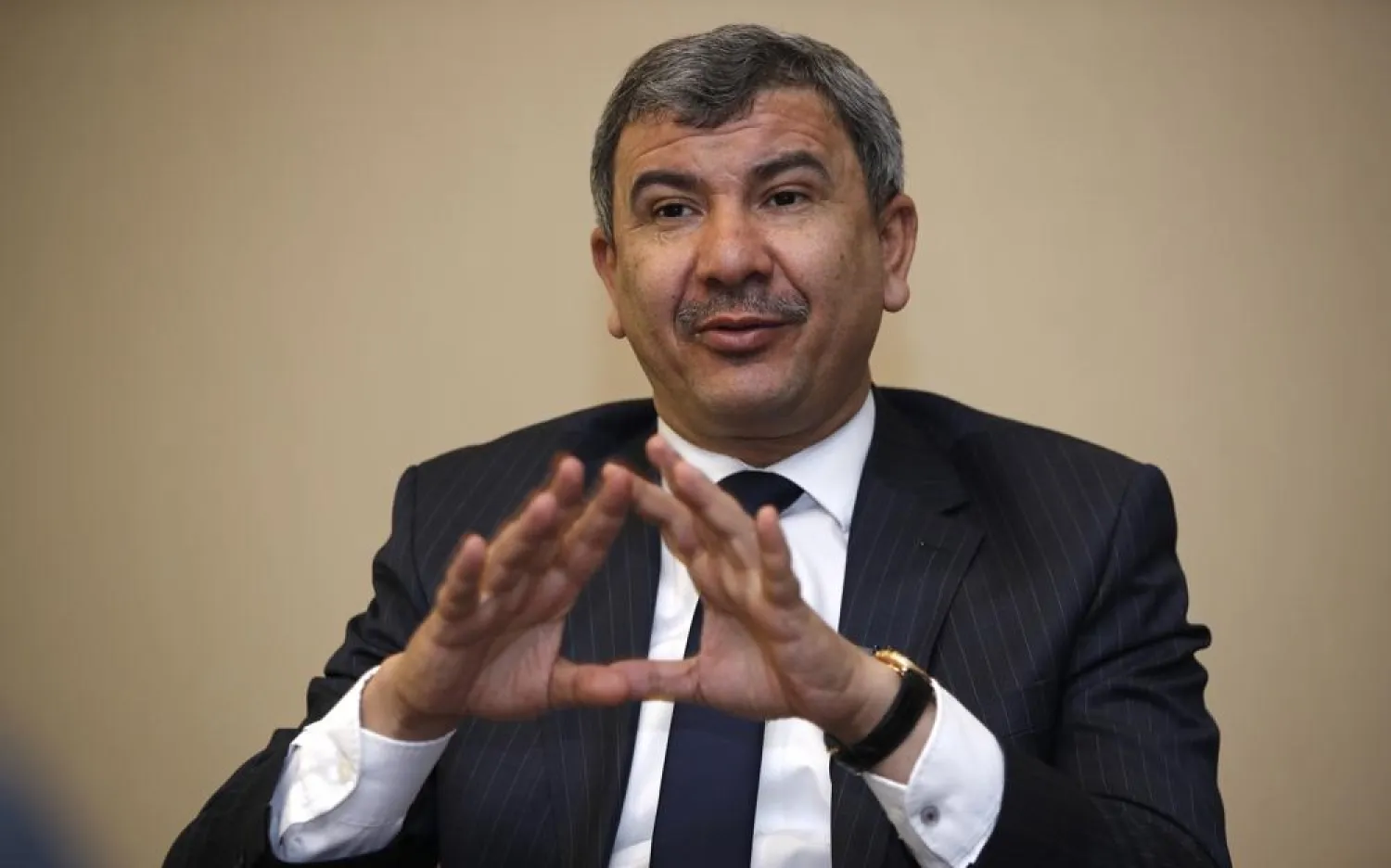
Ihsan Abdul-Jabbar Ismail, Iraq Oil minister speaks during an interview with The Associated Press in Baghdad, Iraq, Friday, June 11, 2021.(AP)
TT

Oil Minister Says Iraq to Act to Annul Kurdish Oil Deals

Ihsan Abdul-Jabbar Ismail, Iraq Oil minister speaks during an interview with The Associated Press in Baghdad, Iraq, Friday, June 11, 2021.(AP)

Iraq’s oil minister said on Thursday the government will take steps to enforce a recent court decision to annul oil contracts the semiautonomous northern Iraqi Kurdish region made with international companies.

The minister, Ihsan Abdul-Jabbar Ismail, told The Associated Press the deals, which circumvent the government in Baghdad, are illegal and amount to oil smuggling.

His remarks were the strongest yet by a senior government official since Iraq’s Supreme Federal Court issued a landmark ruling in February against the northern region’s independent oil sector. Ismail said in total 17 oil companies will be targeted for their dealings with the Iraqi Kurdish region.

Ismail said the international companies that have signed these deals would first receive a cautionary note.

"We will give them a soft message: ‘You are working in the smuggling of oil.' If they are a respectful company they will listen to us," Ismail told the AP in the exclusive interview.

Kurdish officials, including the ruling Kurdistan Democratic Party in Erbil, have dismissed the court ruling as politicized and claim the supreme court itself is unconstitutional.

The ruling came against the backdrop of political upheaval in Baghdad, where Iran-backed groups are pressuring Kurdish parties to join their efforts and proceed with the forming of a government after influential Shiite cleric Moqtada al-Sadr, the winner of the parliamentary elections last year, stepped down from the political process because he could not corral enough lawmakers in the 329-seat house. The Kurdistan Democratic Party was allied with Sadr.

The Iraqi Kurdish region has also faced a rising number of attacks targeting its energy infrastructure. Rocket and mortar fire repeatedly struck a gas field while others targeted a pumping station and refineries last month.

For years, Iraqi Kurdish authorities exploited a constitutional loophole, and managed to exports crude and maintain a modicum of financial independence from the federal government in Baghdad. They have kept details of their operations secret, including their production rates. Iraq Oil Report, an oil industry publication, estimates this to be 440,000 barrels per day.

Now, Baghdad officials are looking to close that door, Ismail said.

The February court ruling effectively rejected the Iraqi Kurdish oil law as a legal basis that the region had used to carry on with independent exports and contracts. Many questioned the timing of that ruling, given that it had been delayed for years. At the time, the Kurdistan Democratic Party and Sadr had tried to form a government without Iran-backed parties.

Ismail agreed the ruling came during a politically sensitive time but denied that it was a politicized decision. After the ruling, the Oil Ministry launched lawsuits against seven international companies, including Norway's DNO, Canada's Western Zagros and the UK-listed Gulf Keystone.

This week, Baghdad’s Commercial Court issued rulings invalidating four of the seven contracts, the oil minister said, with the other three to be decided on by the court at a July 17 session.

Ismail said the overall goal is to invalidate a total of 17 contracts. Some of the contracts are with companies from the United Arab Emirates, others are with Chinese and some with Russian companies, he said.

Caretaker Iraqi Prime Minister Mustafa al-Kadhimi has so far maintained distance from the recent developments, issuing conciliatory statements over the fraught relations between Baghdad and the Kurdish authorities.

But Ismail said the ministry has a plan to also act on the commercial court ruling and would give foreign companies the option to cancel their contracts, request that Iraq's federal government grant them a waiver - or transfer them from Kurdistan’s Ministry of Natural Resources to the federal government's Oil Ministry in Baghdad, he said.

He dismissed claims that it would be technically impossible to transfer contracts from one authority to another, saying it's a matter of "just paperwork.” The Kurdish region uses a production sharing contract model that is incompatible with the federal government's preference for technical service contracts.

If the companies do not comply, Ismail said the government would resort to "the law and banks” to enforce decisions.

"We also have the Oil Police, but we haven’t asked to use them,” he said.

Key oil service companies, including Baker Hughes, Haliburton and Schlumberger pledged to obey the ministry's blacklist policy and have said they will not seek new tenders with the Iraqi Kurdish authorities. For years, international companies have been operating in the Kurdish region with assurances from Kurdish officials that they would not face legal risks.

Oil companies contracted with the Kurdish region operate in territory de facto outside the federal government’s control. Sending federal police to physically shut down the operations in the Iraqi Kurdish region would amount to an unprecedented escalation.



Palestinians Say Five Injured in Israeli Settler West Bank Attack

TOPSHOT - Israeli soldiers patrol a street during a military operation in the Askar refugee camp in eastern Nablus, Israeli-occupied West Bank, on March 2, 2026. (Photo by Jaafar ASHTIYEH / AFP)
TT

Palestinians Say Five Injured in Israeli Settler West Bank Attack

TOPSHOT - Israeli soldiers patrol a street during a military operation in the Askar refugee camp in eastern Nablus, Israeli-occupied West Bank, on March 2, 2026. (Photo by Jaafar ASHTIYEH / AFP)

Israeli settlers injured five Palestinians, including two with gunshot wounds, in a fresh attack against a village in the occupied West Bank, a Palestinian official said Saturday, while the military reported a 'violent confrontation' in the area.

Palestinian news agency WAFA said a group of settlers attacked in the area of Rashayda, near the village of Kisan, "firing live ammunition".

Musa Abayat, the mayor of the area east of Bethlehem, told AFP that two people were hospitalized with gunshot wounds and three others beaten with sharp objects or hit by stones.

"The settlers also stole 100 sheep," Abayat said, decrying "daily attacks" by settlers in this part of the West Bank.

The Israeli military said there was a "violent confrontation" involving Israeli civilians who fired toward Palestinians.

"As a result of the incident, an Israeli civilian was injured and evacuated to the hospital for medical treatment," it said in a statement to AFP.

"Two additional Palestinians were evacuated by the Red Crescent for medical treatment."

Israeli police had detained two Israeli civilians who fired their weapons, while three Palestinians were also apprehended, the military added.

There has been a spike in deadly settler attacks in the West Bank in recent days, with at least five Palestinians killed since the start of March, according to Palestinian authorities and the United Nations.

Violence more broadly in the West Bank, which Israel has occupied since 1967, has also risen sharply since the October 7, 2023 Hamas attack on Israel triggered the Gaza war. It has continued despite a ceasefire since October 10.

Israeli troops or settlers have killed at least 1,045 Palestinians, many of them militants, but also scores of civilians, in the West Bank since the start of the Gaza war, according to an AFP tally based on Palestinian health ministry figures.

At least 45 Israelis, including both soldiers and civilians, have been killed in Palestinian attacks or during Israeli military operations, according to official Israeli figures.


Macron Urges Israel to Hold 'Direct Talks' with Lebanon amid More War Casualties

Firefighters and first aid responders work inside an apartment that was targeted by an Israeli airstrike in the Burj Hammoud area on the northern outskirts of Beirut on March 14, 2026. (Photo by IBRAHIM AMRO / AFP)
TT

Macron Urges Israel to Hold 'Direct Talks' with Lebanon amid More War Casualties

Firefighters and first aid responders work inside an apartment that was targeted by an Israeli airstrike in the Burj Hammoud area on the northern outskirts of Beirut on March 14, 2026. (Photo by IBRAHIM AMRO / AFP)

French President Emmanuel Macron on Saturday said Lebanon was ready to engage in "direct talks" with Israel and offered to host negotiations in Paris.

"The Lebanese government has signaled its willingness to engage in direct talks with Israel," he said on X.

"France is ready to facilitate these talks by hosting them in Paris," Macron said, adding he had spoken to the president and prime minister of Lebanon.

He called on Israel to "seize this opportunity ⁠to launch ceasefire discussions, to find a lasting solution and to allow the Lebanese authorities to put in place their engagements for Lebanon's sovereignty."

Macron also urged Israel ⁠to ⁠stop its offensive and on Hezbollah to stop its actions.

"Everything must be done to stop Lebanon from descending into chaos," he said.

A photograph shows the site of an overnight Israeli airstrike that targeted Beirut's southern suburbs, on March 14, 2026. (Photo by AFP)

At least 12 medical personnel were killed in an Israeli strike on a healthcare center in the town of Borj Qalaouiya in southern Lebanon, the Lebanese state news agency reported on Saturday, citing the health ministry.

The Israeli army said that a day earlier it struck Hezbollah operatives "who were bringing rockets into a weapons depot" in Majdal, around seven kilometers from Borj Qalaouiya.

Also, an Israeli strike hit an apartment building in a northern Beirut suburb that had been targeted a day earlier, Lebanese state media said.

The National News Agency said "an Israeli strike targeted the Nabaa-Burj Hammoud area for a second day."

The same building had been struck on Friday without causing casualties.

The NNA also reported on Friday that Israeli shells hit a United Nations base hosting Nepali peacekeepers in the southern border town of Mais al-Jabal.


Egypt Renews Call for Joint Arab Force, Warns of ‘Total Chaos’

Egyptian Foreign Minister Badr Abdelatty (Egyptian Foreign Ministry)
TT

Egypt Renews Call for Joint Arab Force, Warns of ‘Total Chaos’

Egyptian Foreign Minister Badr Abdelatty (Egyptian Foreign Ministry)

Egypt renewed calls to form a joint Arab force capable of effectively confronting threats and risks facing Arab states, warning of “the dangers of the conflict widening in the region and the possibility of sliding into comprehensive chaos.”

It also reaffirmed its solidarity with the Gulf states and rejected any attempt by non-Arab regional powers or actors outside the region to impose regional security arrangements on Arab countries.

The remarks came as Egyptian Foreign Minister Badr Abdelatty participated in the fourth joint ministerial meeting between Egypt and the Gulf Cooperation Council's foreign ministers, held virtually on Thursday evening.

The meeting was chaired by Bahraini Foreign Minister Abdullatif bin Rashid Al Zayani, the current chair of the GCC ministerial council, and attended by GCC Secretary-General Jassim Albudaiwi.

In a statement on Friday, Egyptian Foreign Ministry spokesman Tamim Khallaf said Abdelatty reaffirmed Egypt’s “firm and strong support” for the “brotherly Gulf states” and its solidarity with them in confronting the “unacceptable and unjustified attacks” they faced from Iran in recent days.

He stressed Egypt’s “categorical rejection of any pretexts aimed at undermining the sovereignty or capabilities of the brotherly Gulf states, Jordan and Iraq,” saying “the security of the Gulf states is an integral part of Egyptian and Arab national security, and Egypt stands by its brothers in this delicate regional moment.”

Abdelatty also stressed the “utmost importance” of de-escalation, calming tensions and prioritizing diplomacy and dialogue. He underlined the need to ensure freedom of international maritime navigation and voiced “complete rejection of any attempts to obstruct it,” warning such moves would pose a direct threat to regional stability and global trade flows.

Khallaf said Abdelatty also renewed calls to activate Arab national security frameworks and deepen joint cooperation, urging swift practical steps and new mechanisms to safeguard the security and sovereignty of Arab states, including Gulf countries. These steps include accelerating the activation of the Arab League’s 1950 Joint Defense and Economic Cooperation Treaty and forming a joint Arab force.

Abdelatty told a meeting of the Egyptian cabinet on Tuesday that Egypt is currently leading initiatives to establish a joint Arab force to protect Arab national security, according to Cairo News television.

GCC foreign ministers praised what they described as the “principled, strong and supportive positions” of the Egyptian leadership, particularly Cairo’s unequivocal condemnation of attacks targeting Gulf states and its declaration of full solidarity with them at this sensitive moment.

They also commended Egypt’s continued support for the Palestinian cause and its pivotal role in backing Arab issues, strengthening joint Arab action and safeguarding regional security and stability amid current challenges.

Khallaf said the ministers also reviewed institutional ties between Egypt and the GCC, praising the “qualitative leap” in relations since the signing of a memorandum of understanding on political consultations and the adoption of a joint action plan for 2024-2028.

They also highlighted momentum generated by the Egyptian-Gulf Trade and Investment Forum hosted by Cairo last November and discussed efforts to elevate relations to a comprehensive strategic partnership that would strengthen economic, trade and investment cooperation for the mutual benefit of the region’s peoples.