

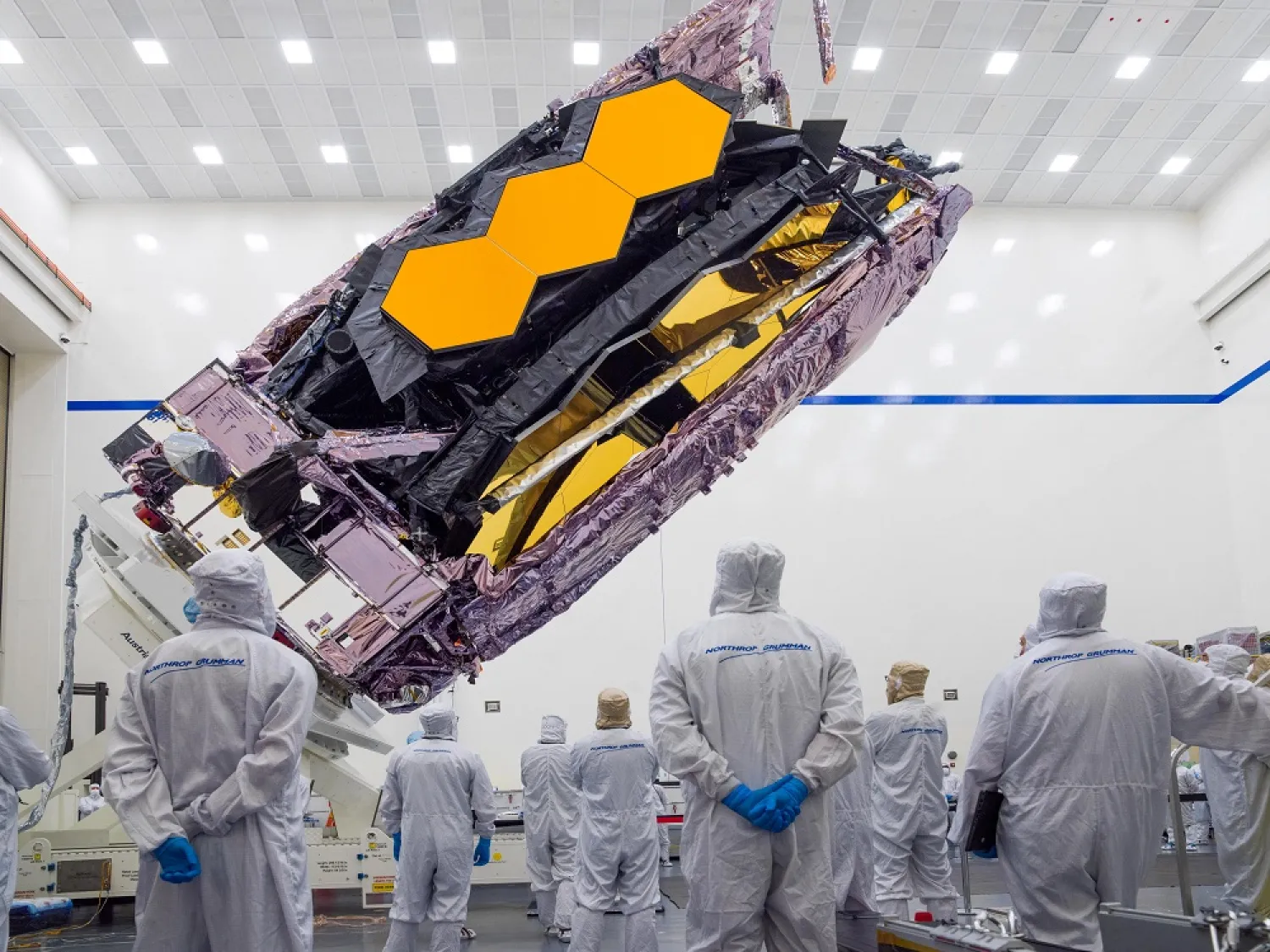

NASA to Showcase Webb Space Telescope’s First Full-Color Images

The James Webb Space Telescope is packed up for shipment to its launch site in Kourou, French Guiana in an undated photograph at Northrop Grumman's Space Park in Redondo Beach, California. (NASA/Handout via Reuters)
TT

NASA to Showcase Webb Space Telescope’s First Full-Color Images

The James Webb Space Telescope is packed up for shipment to its launch site in Kourou, French Guiana in an undated photograph at Northrop Grumman's Space Park in Redondo Beach, California. (NASA/Handout via Reuters)

Drawing back the curtain to a photo gallery unlike any other, NASA will soon present the first full-color images from its James Webb Space Telescope, a revolutionary apparatus designed to peer through the cosmos to the dawn of the universe.

The highly anticipated unveiling this week of pictures and spectroscopic data from the newly operational observatory follows a six-month process of remotely unfurling various components, aligning its mirrors and calibrating instruments.

With Webb now finely tuned and fully focused, astronomers will embark on a competitively selected list of science projects exploring the evolution of galaxies, the life cycles of stars, the atmospheres of distant exoplanets and the moons of our outer solar system.

The first batch of photos, which have taken weeks to process from raw telescope data, are expected to offer a compelling glimpse at what Webb will capture on the science missions that lie ahead.

NASA on Friday posted a list of the five celestial subjects chosen for its showcase debut of Webb, built for the US space agency by aerospace giant Northrop Grumman Corp.

Among them are two nebulae - enormous clouds of gas and dust blasted into space by stellar explosions that form nurseries for new stars - and two sets of galaxy clusters.

One of those, according to NASA, features objects in the foreground so massive that they act as "gravitational lenses," a visual distortion of space that greatly magnifies the light coming from behind them to expose even fainter objects farther away and further back in time. How far back and what showed up on camera remains to be seen.

NASA will also present Webb's first spectrographic analysis of an exoplanet - one roughly half the mass of Jupiter that lies more than 1,100 light years away - revealing the molecular signatures of filtered light passing through its atmosphere.

'Moved me as a scientist ... As a human being'

All five of the Webb's introductory targets were previously known to scientists. One of them, the galaxy group 290 million light-years from Earth known as Stephan's Quintet, was first discovered in 1877.

But NASA officials promise Webbs imagery captures its subjects in an entirely new light, literally.

"What I have seen moved me as a scientist, as an engineer and as a human being," NASA deputy administrator Pam Melroy, who has reviewed the images, told reporters during a June 29 news briefing.

One unspecified image from the collection will be unveiled on Monday evening by US President Joe Biden at a White House briefing with NASA chief Bill Nelson, the space agency said on Sunday.

The rest will be released as previously scheduled in a live broadcast and webcast on Tuesday from NASA's Goddard Space Flight Center in Greenbelt, Maryland, by NASA and its European and Canadian space agency collaborators.

The $9 billion infrared telescope, the largest and most complex astronomical observatory ever sent to space, was launched on Christmas Day from French Guiana, on the northeastern coast of South America.

A month later, the 14,000-pound (6,350-kg) instrument reached its gravitational parking spot in solar orbit, circling the sun in tandem with Earth nearly 1 million miles from home.

Webb, which views its subjects chiefly in the infrared spectrum, is about 100 times more sensitive than its 30-year-old predecessor, the Hubble Space Telescope, which orbits Earth from 340 miles (547 km) away and operates mainly at optical and ultraviolet wavelengths.

The larger light-collecting surface of Webb's primary mirror - an array of 18 hexagonal segments of gold-coated beryllium metal - enables it to observe objects at greater distances, thus further back in time, than Hubble or any other telescope.

Its infrared sensitivity allows it to detect light sources that would otherwise be hidden in the visible spectrum by dust and gas.

Taken together, these features are expected to transform astronomy, providing the first glimpse of infant galaxies dating to just 100 million years after the Big Bang, the theoretical flashpoint that set the expansion of the known universe in motion an estimated 13.8 billion years ago.

Webb's instruments also make it ideal to search for signs of potentially life-supporting atmospheres around scores of newly documented planets orbiting distant stars and to observe worlds much closer to home, such as Mars and Saturn's icy moon Titan.

Besides a host of studies already lined up for Webb, the telescope's most revolutionary findings may prove to be those that have yet to be anticipated.

Such was the case in Hubble's surprising discovery, through observations of distant supernovas, that the expansion of the universe is accelerating, rather than slowing down, opening a new field of astrophysics devoted to a mysterious phenomenon scientists call dark energy.



Artemis Astronauts to Study the Moon’s Surface Using Mainly Their Eyes

 This photo provided by NASA shows the moon seen from a window on the Orion spacecraft Integrity during the Artemis II mission on Friday, April 3, 2026. (NASA via AP)
This photo provided by NASA shows the moon seen from a window on the Orion spacecraft Integrity during the Artemis II mission on Friday, April 3, 2026. (NASA via AP)
TT

Artemis Astronauts to Study the Moon’s Surface Using Mainly Their Eyes

 This photo provided by NASA shows the moon seen from a window on the Orion spacecraft Integrity during the Artemis II mission on Friday, April 3, 2026. (NASA via AP)
This photo provided by NASA shows the moon seen from a window on the Orion spacecraft Integrity during the Artemis II mission on Friday, April 3, 2026. (NASA via AP)

More than 50 years after humans first flew around the Moon, Artemis astronauts will repeat the feat on Monday and use the most basic instrument to study it: their eyes.

Despite the technological advancements since the Apollo missions, NASA still relies on the eyesight of its astronauts to learn more about the Moon.

"The human eye is basically the best camera that could ever or will ever exist," Kelsey Young, the lead scientist for the Artemis 2 mission, told AFP.

"The number of receptors in the human eye far outweighs what a camera is able to do."

Although modern cameras may be superior to human eyesight in some respects, "the human eye is really good at color, and it's really good at context, and it's also really good at photometric observations," Young said.

Humans can understand how lighting changes surface details, like how angled lighting reveals texture but reduces visible color.

In just the blink of an eye, humans can detect a subtle color shift and understand how lighting changes the contours of a landscape like the Moon's surface, details which are scientifically useful but difficult to ascertain from photos or videos.

Artemis 2 astronaut Victor Glover, who pilots the Orion spacecraft, said before liftoff this week that eyes were a "magical instrument."

- Field scientists -

To ensure they made the most of their proximity to the Moon, the four Artemis 2 crew members underwent more than two years of training.

Young said the goal was to turn the astronauts into "field scientists" via a combination of classroom lessons, geological expeditions to Iceland and Canada, and multiple simulated flybys of the Moon, just like the mission they are on.

The three American astronauts -- commander Reid Wiseman, pilot Glover and mission specialist Christina Koch -- along with Canadian astronaut Jeremy Hansen, all had to memorize the Moon's "Big 15," or the 15 features of the Moon that will allow them to orient themselves.

Using an inflatable Moon globe, they practiced seeing how the angle of the sun changed the colors and textures of the lunar surface, honing their observation and note-taking skills for the big moment.

"I can tell you, they are excited and they are ready," Young said with a smile.

- 'About the size of a basketball' -

The Artemis astronauts' mission is to study certain lunar sites and phenomena as part of 10 objectives chosen by NASA and ranked in priority order based on scientific interest.

During the Moon flyby, which will last for several hours, the crew will have to observe the celestial body with their naked eyes, along with cameras they have on board.

Noah Petro, head of NASA's planetary geology lab, told AFP that the Moon will look to the astronauts "about the size of a basketball held at arm's length."

"The question I'm most interested in is, are they going to be able to see color on the lunar surface," Petro said.

"I don't mean rainbow colors, but you know, dark browns or tan colors because that tells us something about the composition, and that tells us something about the history of the Moon."

David Kring of the Lunar and Planetary Institute told AFP he is not expecting any earth-shattering discoveries because of the multiple lunar probes and high-resolution images of the Moon taken since the Apollo missions.

Nevertheless, "having astronauts describing what they're seeing... That is an occurrence that at least two generations of people on Earth have never heard before," he said.

The Artemis 2 flyby will be broadcast live by NASA, save for a period for when the spacecraft is behind the moon.

"Just listening to their practice descriptions in the mission simulations... It brings chills up my arms," Young said.

"I am absolutely confident that these four people are going to deliver some incredible descriptions."


Artemis Astronauts More than Halfway to Moon, Putting Earth in Rearview

This screengrab from a NASA live broadcast video shows (L-R) NASA astronaut and Artemis II Mission Specialist Christina Koch, NASA astronaut and Artemis II pilot Victor Glover, Canadian Space Agency astronaut Artemis II Mission Specialist Jeremy Hansen and NASA astronaut and Artemis II Commander Reid Wiseman during a press call as they travel to the Moon in the Orion spacecraft, on April 3, 2026.  (Photo by NASA / AFP)
This screengrab from a NASA live broadcast video shows (L-R) NASA astronaut and Artemis II Mission Specialist Christina Koch, NASA astronaut and Artemis II pilot Victor Glover, Canadian Space Agency astronaut Artemis II Mission Specialist Jeremy Hansen and NASA astronaut and Artemis II Commander Reid Wiseman during a press call as they travel to the Moon in the Orion spacecraft, on April 3, 2026. (Photo by NASA / AFP)
TT

Artemis Astronauts More than Halfway to Moon, Putting Earth in Rearview

This screengrab from a NASA live broadcast video shows (L-R) NASA astronaut and Artemis II Mission Specialist Christina Koch, NASA astronaut and Artemis II pilot Victor Glover, Canadian Space Agency astronaut Artemis II Mission Specialist Jeremy Hansen and NASA astronaut and Artemis II Commander Reid Wiseman during a press call as they travel to the Moon in the Orion spacecraft, on April 3, 2026.  (Photo by NASA / AFP)
This screengrab from a NASA live broadcast video shows (L-R) NASA astronaut and Artemis II Mission Specialist Christina Koch, NASA astronaut and Artemis II pilot Victor Glover, Canadian Space Agency astronaut Artemis II Mission Specialist Jeremy Hansen and NASA astronaut and Artemis II Commander Reid Wiseman during a press call as they travel to the Moon in the Orion spacecraft, on April 3, 2026. (Photo by NASA / AFP)

The Artemis 2 astronauts have passed the halfway point between Earth and the Moon on Saturday as they sped toward a planned lunar flyby, with NASA releasing initial images of Earth taken from inside the Orion spacecraft.

Astronaut Christina Koch said the crew had a collective "expression of joy" upon being told of the milestone, which was hit around two days, five hours and 24 minutes after the spacecraft blasted off from the Kennedy Space Center in Florida, AFP said.

"We can see the Moon out of the docking hatch right now, it is a beautiful sight," Koch said around 11 pm (0400 GMT) Friday, according to the space agency's official live broadcast.

NASA's online dashboard showed early Saturday that the Orion spacecraft carrying the astronauts was more than 229,000 kilometers (142,000 miles) from Earth.

The space agency earlier released images from Orion that included a full portrait of Earth, featuring its deep blue oceans and billowing clouds.

After a flurry of high-stakes activity including a dramatic blast-off and an engine firing that catapulted them on their historic trajectory to circle the Moon, the four astronauts aboard were able to catch their breath, even as they continued to perform a variety of equipment checks and tests.

"There has been a tremendous amount of disbelief for me, it's just so extraordinary," said Canadian Jeremy Hansen during a Q&A session with press late Thursday.

"I really like it up here," said Hansen, on his first ever journey to space. "The views are extraordinary."

"It's really fun to be floating around" in zero gravity, he added. "It just makes me feel like a little kid."

Hansen is on the crew with Americans Koch, Victor Glover and Reid Wiseman.

They are due to loop around the Moon early next week -- a feat not accomplished in more than 50 years.

NASA official Lakiesha Hawkins praised the photographs taken by commander Wiseman, calling them "amazing" during a briefing Friday.

"We continue to learn all about our spacecraft as we operate it in deep space with crew for the first time," Hawkins said.

"It's important to remind ourselves of that as we learn a little bit more day by day."

- 'Great spirits' -

Friday's to-do list includes a CPR demonstration and medical kit checks, the US space agency said, as well as preparation for the scientific observations they'll need to document when they are closest to the Moon on day six of their journey.

NASA officials reported Friday that all systems were performing well, and that the astronauts were in "great spirits" and had spoken to their families.

The next major milestone of the approximately 10-day journey is expected overnight Sunday into Monday, at which point the astronauts will enter the "lunar sphere of influence" -- when the Moon's gravity will have stronger pull on the spacecraft than Earth's.

If all proceeds smoothly, as Orion whips around the Moon the astronauts could set a record by venturing farther from Earth than any human before.

"There is nothing normal about this," said mission commander Wiseman late Thursday.

"Sending four humans 250,000 miles away is a Herculean effort, and we are now just realizing the gravity of that."

The Artemis 2 mission is part of a longer-term plan to repeatedly return to the Moon, with the goal of establishing a permanent lunar base that will offer a platform for further exploration.


'Breathtaking': Artemis Astronauts Blast towards Moon

This image taken from video provided by NASA shows the Earth, left, from NASA's Orion spacecraft as it fired its engines heading toward the moon Thursday, April 2, 2026. (NASA via AP)
TT

'Breathtaking': Artemis Astronauts Blast towards Moon

This image taken from video provided by NASA shows the Earth, left, from NASA's Orion spacecraft as it fired its engines heading toward the moon Thursday, April 2, 2026. (NASA via AP)

Four Artemis astronauts were zooming towards the Moon late Thursday after a major engine firing, a milestone that commits NASA to the first crewed lunar flyby in more than half a century.

With enough thrust to accelerate a stationary car to highway driving speed in less than three seconds, the Orion capsule engine blasted the astronauts on their trajectory towards the Moon, which they now will loop as part of the 10-day Artemis 2 mission, reported AFP.

In the moments that followed what the US space agency dubbed a "flawless" firing that lasted just under six minutes, astronaut Jeremy Hansen said that "humanity has once again shown what we are capable of."

The astronauts said they were "glued to the window" taking pictures, and later passed a floating microphone back and forth as they took questions from US television networks.

They said the spacecraft was a little chilly and they were still making it a home, but the crew was all smiles.

"There's nothing that prepares you for the breathtaking aspect of seeing your home planet both lit up bright as day, and also the Moon glow on it at night with the beautiful beam of the sunset," said Christina Koch.

Thursday's nudge came one day after the enormous orange-and-white Space Launch System (SLS) rocket carrying the Orion capsule launched from Kennedy Space Center in Florida for the long-anticipated journey around the Moon.

The astronauts are now on a "free-return" trajectory, which uses the Moon's gravity to slingshot around it before heading back towards Earth without propulsion.

"From this point forward, the laws of orbital mechanics are going to carry our crew to the Moon, around the far side and back to Earth," NASA official Lori Glaze said.

The astronauts are wearing suits that also serve as "survival systems" -- in the unlikely case of a cabin depressurization or leak, they'll maintain oxygen, temperature controls and the correct pressure for up to six days.

The astronauts -- Americans Reid Wiseman, Victor Glover and Koch along with Canadian Hansen -- spent their first hours in space performing checks and troubleshooting minor problems on the spacecraft that has never carried humans before, including a communications issue and a malfunctioning toilet.

Queried on the toilet situation, Koch said she was "proud to call myself the space plumber.

"I like to say that it is probably the most important piece of equipment on board," she said. "So we were all breathing a sigh of relief when it turned out to be just fine."

- 'Herculean' -

Crewmembers also had their first workouts of the mission on the spacecraft's "flywheel exercise device" -- each astronaut will carve out 30 minutes a day for fitness, a bid to minimize the muscle and bone loss that happens without gravity.

The 10-day mission is aimed at paving the way for a Moon landing in 2028.

Artemis 2 marks a series of historic accomplishments: sending the first person of color, the first woman and the first non-American on a lunar mission.

If all proceeds smoothly, the astronauts could also set a record by venturing farther from Earth than any human before.

"There is nothing normal about this," said Wiseman. "Sending four humans 250,000 miles away is a Herculean effort, and we are now just realizing the gravity of that."

The Artemis 2 mission is part of a longer-term plan to repeatedly return to the Moon, with the goal of establishing a permanent base that will offer a platform for further exploration.

The current era of American lunar investment has frequently been portrayed as an effort to compete with China, which aims to land humans on the Moon by 2030.

Asked about division closer to home and what message they had for Americans, Glover said from his vantage point, "You look amazing. You look beautiful."

"From up here, you also look like one thing," he added. "We're all one people."