

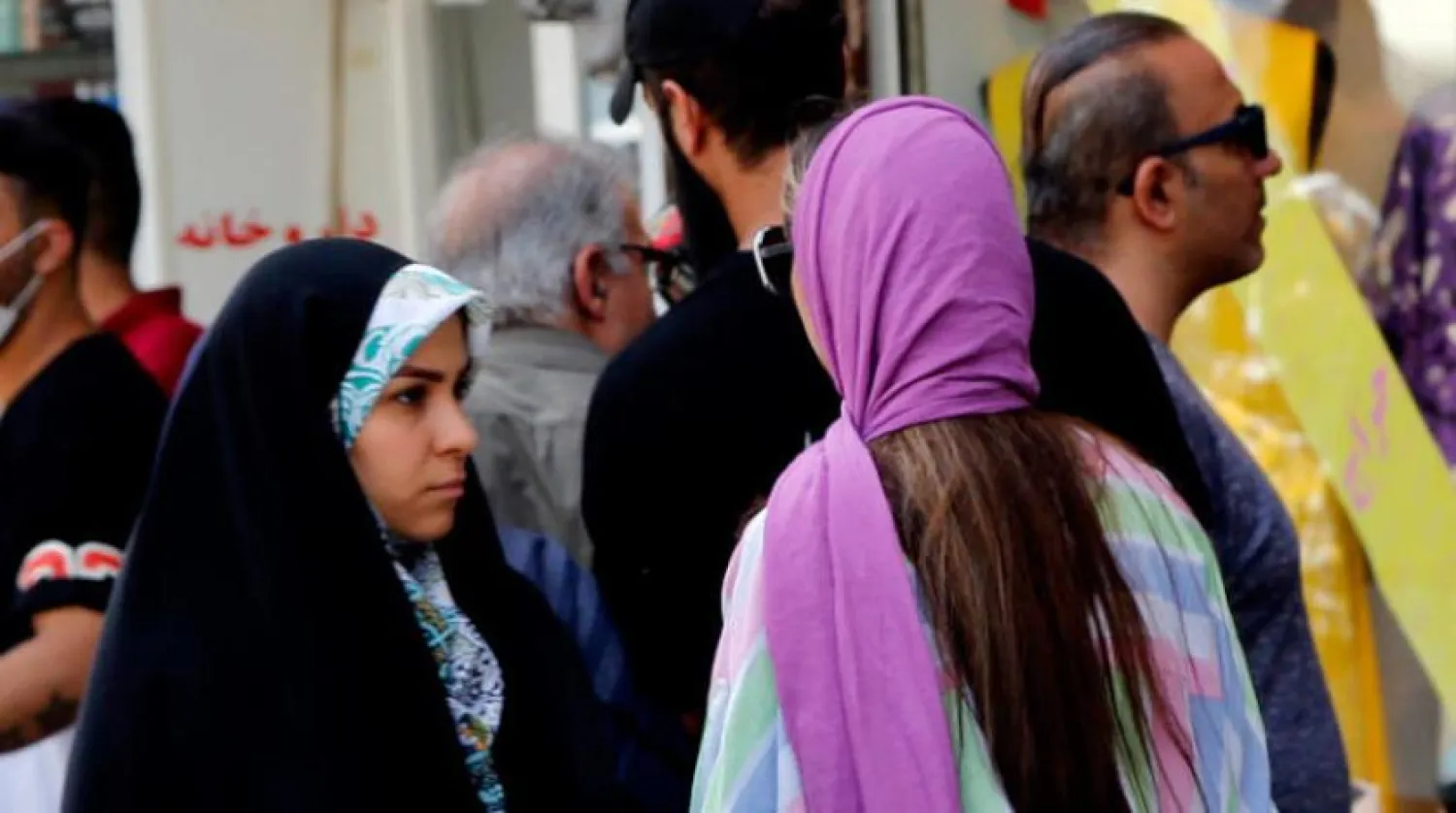

Tightening Hijab Restrictions Sparks Debate between Civil Society, Iranian Authorities

Women in Tehran on Tuesday. (EPA)
TT

Tightening Hijab Restrictions Sparks Debate between Civil Society, Iranian Authorities

Women in Tehran on Tuesday. (EPA)

Iran’s celebration of the “National Day of Hijab and Chastity” on Tuesday, as part of a campaign launched by the authorities to restore strict rules on women, has sparked a widespread popular debate.

Iranian rights activists have urged women to publicly remove their veils on the day, risking arrest for defying the Islamic dress code as the country’s hardline rulers crack down on “immoral behavior,” Reuters reported.

After the 1979 revolution, Iranian authorities forced women to cover their hair and wear long, loose-fitting clothes to disguise their figures. Violators face public rebuke, fines or arrest.

But decades after the revolution, clerical rulers still struggle to enforce the law, with many women of all ages and backgrounds wearing tight-fitting, thigh-length coats and brightly colored scarves pushed back to expose plenty of hair.

Critics and activists see the establishment’s stepped-up efforts to enforce hijab compliance as part of a wider clamp-down on dissent amid deepening resentment over economic hardship at home and growing Western pressure on Iran over its disputed nuclear program.

“The National Day of Hijab and Chastity is only an excuse to target women and launch a new wave of repression against Iranian people and in particular women,” dozens of prominent women’s rights activists said in a joint statement on Monday.

In a display of civil disobedience, the hashtag #No2Hijab was widely promoted for days on social media by Iranians outside and inside the country.

Videos of women removing their hijab as they walked in the streets or resisting the morality police flooded social media.

“I should have the right to decide what I want to wear and not be imprisoned because of my choice. #No2Hijab,” tweeted a female user.

Some women who voluntarily wear the veil and men have also joined the campaign.

“I don’t have a veil to remove. But I will come to the street to support and defend the women and girls of my land. #No2Hijab,” tweeted @mashmolak.

The New York-based International Campaign for Human Rights in Iran (ICHRI) said on Monday there were “serious concerns over more potential violence and detentions on July 12.”

Several people were arrested on Monday, Reuters reported, quoting Iran’s semi-official Fars news agency.

The #No2Hijab campaign coincided with months of protests by teachers, retirees, workers and government employees over unpaid wages, low pensions and sky-rocketing food prices that have hurt the establishment. Protesters have called for political change.

“This is like pouring fuel on fire. People are already angry because of high inflation and rising prices. They are very frustrated,” said a former Iranian government official. “Coercion has never worked.”

Hijab protests have hit the clerical establishment in the past years. In 2014, rights activist Masih Alinejad started a Facebook campaign “My Stealthy Freedom,” where she shared pictures of unveiled Iranian women sent to her.

It was followed by a campaign in 2017 for women to wear white headscarves on Wednesdays and the hijab protests in 2018 when women took to the streets holding their veils aloft.

Dozens of women have been jailed in Iran for their activism against forced veiling, according to rights groups.

“The establishment fears a revolution by women that has already started today,” Alinejad told Reuters.

On Friday, representatives of Iranian Supreme Leader, Ali Khamenei, attacked the leniency in imposing veil restrictions.

Hardliner Ahmad Alamolhoda, the Friday prayer Imam of Mashhad and President Ebrahim Raisi’s father-in-law, praised the city’s attorney general for issuing new orders on tightening the veil restrictions.

The official had ordered a ban on women entering the subway if they do not strictly abide by hijab rules.



Turkish Police Detain Deutsche Welle Journalist over Social Media Posts

19 February 2026, Canada: Deutsche Welle (DW) logo is seen displayed on a smartphone screen. Photo: Thomas Fuller/SOPA Images via ZUMA Press Wire/dpa
TT

Turkish Police Detain Deutsche Welle Journalist over Social Media Posts

19 February 2026, Canada: Deutsche Welle (DW) logo is seen displayed on a smartphone screen. Photo: Thomas Fuller/SOPA Images via ZUMA Press Wire/dpa

Turkish police have detained investigative journalist Alican Uludag on suspicion of insulting President Recep Tayyip Erdogan and spreading misinformation, sparking outrage among journalism groups.
Uludag, who works for German broadcaster Deutsche Welle’s Turkish service, was taken from his home in Ankara late Thursday as part of an investigation into social media posts. The Istanbul Chief Prosecutor’s Office said he is suspected of “insulting the president” and “disseminating misleading information.”
The journalist, whose reporting focuses mainly on the judiciary and on corruption cases, was later transferred to Istanbul for questioning.
His detention drew sharp condemnation from press freedom advocates, who described it as an attack on media independence and democratic norms, The Associated Press said.
Deutsche Welle’s director‑general, Barbara Massing, demanded his release, calling the arrest “a deliberate act of intimidation.”
On Friday, journalists gathered outside Istanbul’s Çaglayan Courthouse to protest Uludag’s detention and to call for his immediate release.
The advocacy group, Reporters Without Borders considers Türkiye to be one of the most repressive countries for journalists, nothing that most media organizations are under government control and journalists face frequent legal pressure or intimidation.
At least 14 journalists or media sector workers are currently in prison, according to the Turkish Journalists Syndicate.


South Korea’s Ex-President Yoon Apologizes After Life Sentence Over Martial Law 

South Korean President Yoon Suk Yeol  delivers a speech to declare martial law in Seoul, South Korea, December 3, 2024. (The Presidential Office/Handout via Reuters/File Photo)
South Korean President Yoon Suk Yeol delivers a speech to declare martial law in Seoul, South Korea, December 3, 2024. (The Presidential Office/Handout via Reuters/File Photo)
TT

South Korea’s Ex-President Yoon Apologizes After Life Sentence Over Martial Law 

South Korean President Yoon Suk Yeol  delivers a speech to declare martial law in Seoul, South Korea, December 3, 2024. (The Presidential Office/Handout via Reuters/File Photo)
South Korean President Yoon Suk Yeol delivers a speech to declare martial law in Seoul, South Korea, December 3, 2024. (The Presidential Office/Handout via Reuters/File Photo)

Former ‌South Korean President Yoon Suk Yeol apologized on Friday for his short-lived declaration of martial law in December 2024, a day after a Seoul court sentenced him to life in prison for masterminding an insurrection.

In a statement released by his lawyers, Yoon said that while he was sorry for the "frustration and hardship" brought upon the people by his martial law decree, he stood behind the "sincerity and purpose" behind his actions.

The Seoul Central District Court's decision ‌to hand him ‌a life sentence on Thursday was "predetermined," he ‌said, ⁠adding that the verdict ⁠against him was political retaliation.

"Forces that seek to smear a decision made to save the nation as an 'insurrection' and to use it beyond political attacks as an opportunity to purge and eliminate their opponents will only grow more rampant going forward," he said.

Yoon also questioned ⁠whether an appeal would have meaning ‌in what he described as an ‌environment where judicial independence could not be guaranteed, while telling ‌supporters to "unite and rise."

His lawyers separately said the statement ‌did not amount to an intention to forgo an appeal.

Yoon's martial law declaration lasted around six hours before being voted down by parliament, but it sent shockwaves through the country and ‌sparked street protests.

The court found Yoon guilty of subverting constitutional order by deploying troops ⁠to storm ⁠parliament and move to detain opponents, capping a dramatic fall that saw him stripped of office and end up behind bars.

Yoon, a former career prosecutor, denied the charges, arguing he had presidential authority to declare martial law and his action was aimed at sounding the alarm over opposition parties' obstruction of government.

A special prosecutor had sought the death penalty for Yoon, though South Korea has not carried out an execution since 1997.

A prosecutor said on Thursday the team had some "regret" over the sentencing, but declined to say whether they planned to appeal.


Russia Hits Ukraine's Oil, Gas Infrastructure in Poltava Region, Naftogaz Says

FILE PHOTO: A Ukrainian service member of the 14th Unmanned Aerial Systems Regiment prepares a deep strike unmanned aerial vehicle before its launch toward Russian territory, amid Russia's attack on Ukraine, in an undisclosed location in Ukraine, undisclosed date, 2025. REUTERS/Valentyn Ogirenko/File Photo
TT

Russia Hits Ukraine's Oil, Gas Infrastructure in Poltava Region, Naftogaz Says

FILE PHOTO: A Ukrainian service member of the 14th Unmanned Aerial Systems Regiment prepares a deep strike unmanned aerial vehicle before its launch toward Russian territory, amid Russia's attack on Ukraine, in an undisclosed location in Ukraine, undisclosed date, 2025. REUTERS/Valentyn Ogirenko/File Photo

Russian drones hit Ukraine's oil and gas infrastructure in the central Poltava region, causing ‌damage ‌and a ‌fire, ⁠the state energy company ⁠Naftogaz said on Friday.

"This is yet another targeted ⁠attack on ‌our ‌oil and ‌gas infrastructure. ‌Since the beginning of the year, the ‌enemy has attacked Naftogaz Group facilities ⁠more ⁠than 20 times," Sergii Koretskyi, Naftogaz CEO said in a post on Facebook.