


Hezbollah Shifts Strategy from 'Defense' to Threatening Israel with Escalation

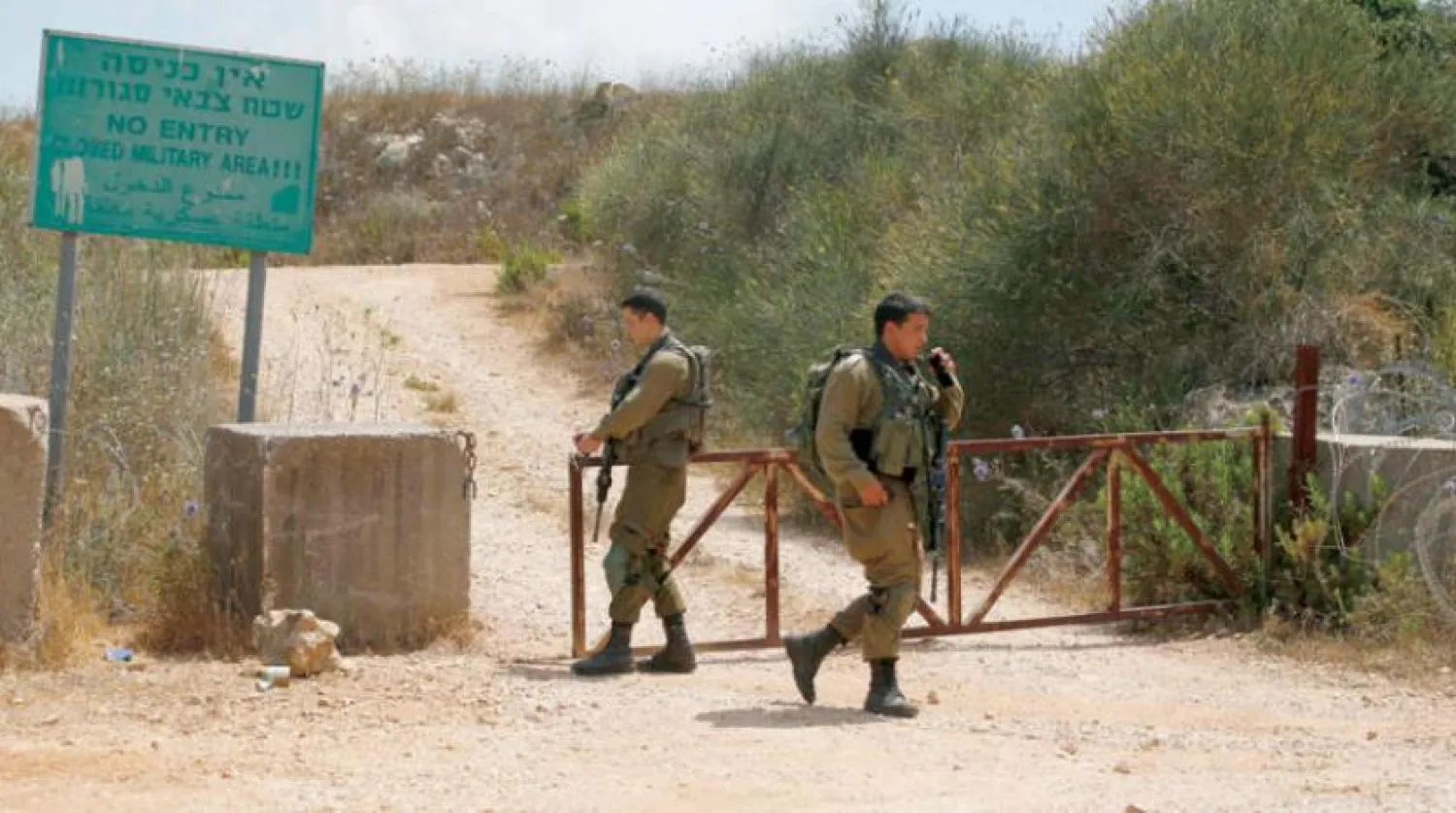
Israeli soldiers at the Shtula settlement near Lebanon's border (AFP)
TT

Hezbollah Shifts Strategy from 'Defense' to Threatening Israel with Escalation

Israeli soldiers at the Shtula settlement near Lebanon's border (AFP)

The maritime border dispute between Lebanon and Israel shifted Hezbollah's strategy from "commitment to defense" to threatening Tel Aviv with an attack.

Hezbollah Sec-Gen Hassan Nasrallah warned of the outbreak of war if Lebanon was banned from extracting oil and gas from its water.

The official statements of the party's prominent leaders have always been limited to the threat of retaliation if Israel launches a war on Lebanon, but this is the first time in at least ten years that the party announced its readiness to initiate a war with Israel.

In a televised speech on Wednesday evening, Nasrallah warned: "If you do not give us our rights that are demanded by the state and if you don't allow companies to extract (oil), God knows what we will do."

He indicated that threatening and even going to war is better than living in the dire economic condition that exacerbates the Lebanese suffering.

The Sec-Gen warned that sending unarmed drones over the Karish gas field in the Mediterranean earlier this month was "a modest beginning to where the situation could be heading."

Nasrallah said the new equation is "Karish and beyond Karish."

"If you want to get to a formula where this country is barred from taking advantage (of these fields), then no one will be allowed to extract gas or oil, and no one will be able to sell gas or oil," Nasrallah said.

The expert on Islamic movements, Kassem Kassir, believes Nasrallah escalated his warnings to boost Lebanon's position in the negotiations and, at the same time, opened the possibility of an escalation if they reached a dead-end.

He told Asharq Al-Awsat that the threats are not related to the Iranian nuclear issue but linked exclusively to demarcation.

Kassir, an expert on Hezbollah matters, confirmed that the party "changed its strategy from defense to attack."

However, Lebanese political analyst Tony Abi Najm opposes Kassir, saying Hezbollah is one of the primary arms of Iran's Revolutionary Guard Corps (IRGC), and all the recent developments prompted Nasrallah to say that.

He was referring to the visits of US President Joe Biden to the Middle East, President Russian Vladimir Putin to Iran, and the Israeli drills.

Speaking to Asharq Al-Awsat, Abi Najm said he believed the circumstances on July 12, 2006, and today are "similar."

He explained that in 2006, the party initiated a military operation, contrary to Nasrallah's promises at the national dialogue held three months earlier.

He believes the previous war was launched according to Iran's timing when the military operation took place in parallel with nuclear negotiations to distract the world's attention.

Abi Najm believes the previous war benefited Iran, adding that the party "turned the country into an arena of Iran."

He linked Nasrallah's escalatory rhetoric with regional meetings, saying he does not rule out the possibility of a strike where Iran uses the weakest area to deliver its messages, adding that they may create tensions after the previous attempts failed.

Since last month, developments related to the demarcation of Lebanon's maritime border have accelerated, following the arrival of a production and storage vessel near the Karish field, which Beirut says is in a disputed area.

The US mediated negotiations with Israel to delineate a shared maritime border that would help determine which oil and gas resources belong to which country.

Hezbollah launched three unarmed drones towards the field, which Israel intercepted.

Iran is seeking to partner in the negotiations, and Russia will not allow substituting its gas to Europe from the Mediterranean, said Abi Najem, adding that this increases the chances of war, especially in October when the need for gas in Europe increases.

He stated that Nasrallah created an escalation in the region amid a global economic situation that usually leads to wars or significant settlements, noting that Europe and the US do not want war but may be forced to enter one if they are unable to extract gas from the Mediterranean to secure an alternative to Russian gas.

Lebanon called on the US mediator, Amos Hochstein, to resume negotiations after a vessel to extract oil arrived in the Karish field.

Lebanon also made a new offer to demarcate the border that did not include Karish, but it didn't reach any result.



Israel Military Says Soldier Killed in Gaza 

A drone view shows the destruction in a residential neighborhood, after the withdrawal of the Israeli forces from the area, amid a ceasefire between Israel and Hamas in Gaza, in Gaza City, October 21, 2025. (Reuters)
TT

Israel Military Says Soldier Killed in Gaza 

A drone view shows the destruction in a residential neighborhood, after the withdrawal of the Israeli forces from the area, amid a ceasefire between Israel and Hamas in Gaza, in Gaza City, October 21, 2025. (Reuters)

The Israeli military announced that one of its soldiers had been killed in combat in southern Gaza on Wednesday, but a security source said the death appeared to have been caused by "friendly fire".

"Staff Sergeant Ofri Yafe, aged 21, from HaYogev, a soldier in the Paratroopers Reconnaissance Unit, fell during combat in the southern Gaza Strip," the military said in a statement.

A security source, however, told AFP that the soldier appeared to have been "killed by friendly fire", without providing further details.

"The incident is still under investigation," the source added.

The death brings to five the number of Israeli soldiers killed in Gaza since a ceasefire took effect on October 10.


Syria: SDF’s Mazloum Abdi Says Implementation of Integration Deal May Take Time

People sit outdoors surrounded by nature, with the Tigris river flowing in the background, following a long atmospheric depression, near the Syrian-Turkish border in Derik, Syria, February 16, 2026 REUTERS/Orhan Qereman
TT

Syria: SDF’s Mazloum Abdi Says Implementation of Integration Deal May Take Time

People sit outdoors surrounded by nature, with the Tigris river flowing in the background, following a long atmospheric depression, near the Syrian-Turkish border in Derik, Syria, February 16, 2026 REUTERS/Orhan Qereman

Mazloum Abdi, commander of the Syrian Democratic Forces, said the process of merging the SDF with Syrian government forces “may take some time,” despite expressing confidence in the eventual success of the agreement.

His remarks came after earlier comments in which he acknowledged differences with Damascus over the concept of “decentralization.”

Speaking at a tribal conference in the northeastern city of Hasakah on Tuesday, Abdi said the issue of integration would not be resolved quickly, but stressed that the agreement remains on track.

He said the deal reached last month stipulates that three Syrian army brigades will be created out of the SDF.

Abdi added that all SDF military units have withdrawn to their barracks in an effort to preserve stability and continue implementing the announced integration agreement with the Syrian state.

He also emphasized the need for armed forces to withdraw from the vicinity of the city of Ayn al-Arab (Kobani), to be replaced by security forces tasked with maintaining order.


Israeli Far-Right Minister to Push for ‘Migration’ of West Bank, Gaza Palestinians 

A Palestinian man checks leather belts as people prepare for Ramadan, in the old city of Hebron in the Israeli-occupied West Bank, February 17,2026. (Reuters)
TT

Israeli Far-Right Minister to Push for ‘Migration’ of West Bank, Gaza Palestinians 

A Palestinian man checks leather belts as people prepare for Ramadan, in the old city of Hebron in the Israeli-occupied West Bank, February 17,2026. (Reuters)

Israel's far-right Finance Minister Bezalel Smotrich said he would pursue a policy of "encouraging the migration" of Palestinians from the occupied West Bank and Gaza Strip, Israeli media reported Wednesday.

"We will eliminate the idea of an Arab terror state," said Smotrich, speaking at an event organized by his Religious Zionism Party late on Tuesday.

"We will finally, formally, and in practical terms nullify the cursed Oslo Accords and embark on a path toward sovereignty, while encouraging emigration from both Gaza and Judea and Samaria.

"There is no other long-term solution," added Smotrich, who himself lives in a settlement in the West Bank.

Since last week, Israel has approved a series of measures backed by far-right ministers to tighten control over the West Bank, including in areas administered by the Palestinian Authority under the Oslo Accords, in place since the 1990s.

The measures include a process to register land in the West Bank as "state property" and facilitate direct purchases of land by Jewish Israelis.

The measures have triggered widespread international outrage.

On Tuesday, the UN missions of 85 countries condemned the measures, which critics say amount to de facto annexation of the Palestinian territory.

"We strongly condemn unilateral Israeli decisions and measures aimed at expanding Israel's unlawful presence in the West Bank," they said in a statement.

"Such decisions are contrary to Israel's obligations under international law and must be immediately reversed.

"We underline in this regard our strong opposition to any form of annexation."

UN Secretary-General Antonio Guterres on Monday called on Israel to reverse its land registration policy, calling it "destabilizing" and "unlawful".

The West Bank would form the largest part of any future Palestinian state. Many on Israel's religious right view it as Israeli land.

Israeli NGOs have also raised the alarm over a settlement plan signed by the government which they say would mark the first expansion of Jerusalem's borders into the occupied West Bank since 1967.

The planned development, announced by Israel's Ministry of Construction and Housing, is formally a westward expansion of the Geva Binyamin, or Adam, settlement situated northeast of Jerusalem in the West Bank.

The current Israeli government has fast-tracked settlement expansion, approving a record 52 settlements in 2025.

Excluding Israeli-annexed east Jerusalem, more than 500,000 Israelis live in West Bank settlements and outposts, which are illegal under international law.