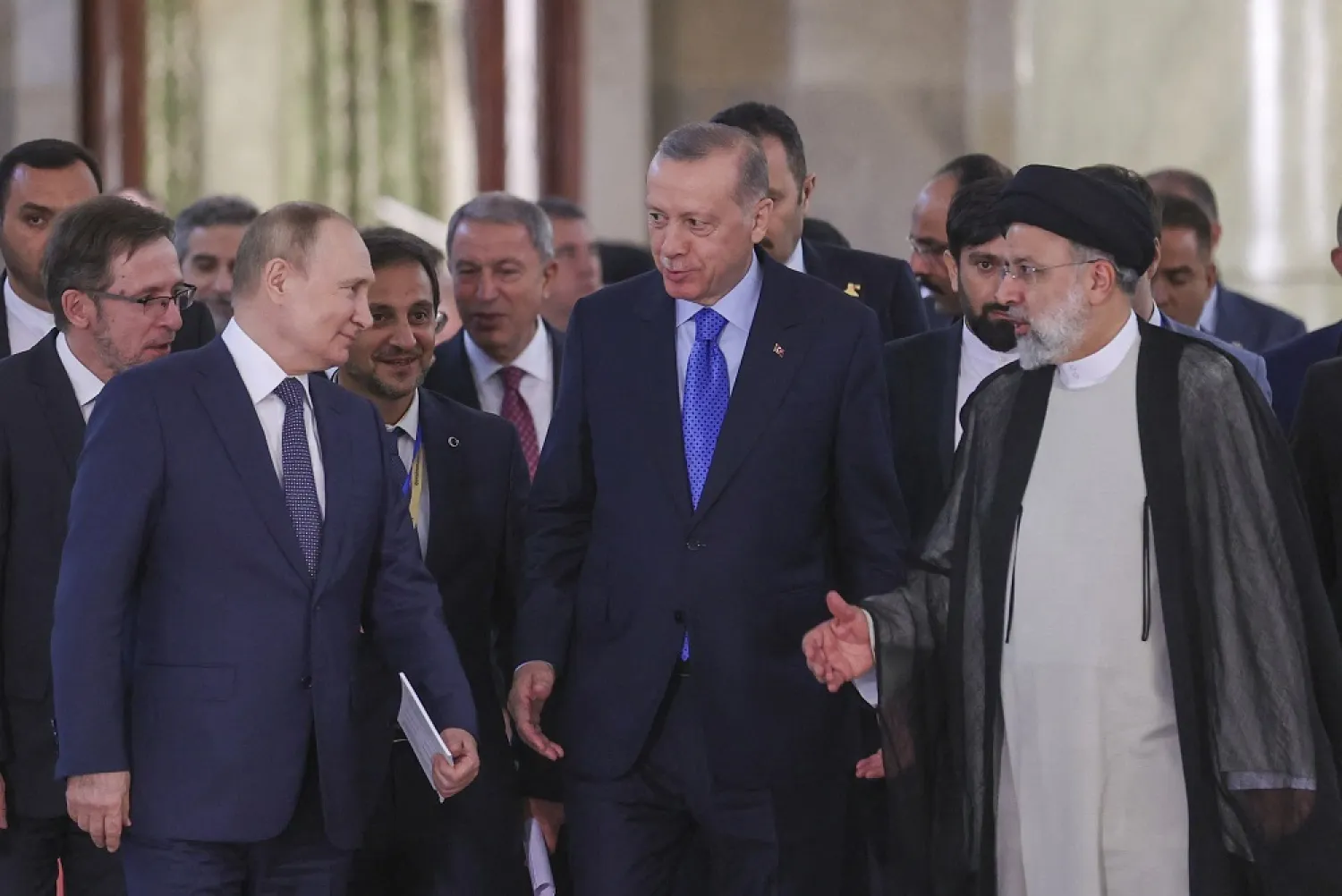
Putin, in Tehran, Gets Strong Support from Iran over Ukraine

This handout picture taken and released by the Turkish Presidency on July 19, 2022 shows Turkish President Recep Tayyip Erdogan (C), Iranian President Ebrahim Raisi (R) and Russian President Vladimir Putin (L) arriving for a joint news conference after at the end of the Astana Trilateral Summit at the Tehran International Conference Hall in Tehran. (AFP/Turkish Presidency)
TT

Putin, in Tehran, Gets Strong Support from Iran over Ukraine

This handout picture taken and released by the Turkish Presidency on July 19, 2022 shows Turkish President Recep Tayyip Erdogan (C), Iranian President Ebrahim Raisi (R) and Russian President Vladimir Putin (L) arriving for a joint news conference after at the end of the Astana Trilateral Summit at the Tehran International Conference Hall in Tehran. (AFP/Turkish Presidency)

Putin, in Tehran, gets strong support from Iran over Ukraine

Russian President Vladimir Putin won staunch support from Iran on Tuesday for his country’s military campaign in Ukraine, with Supreme Leader Ali Khamenei saying the West opposes an "independent and strong" Russia.

Khamenei said that if Russia hadn’t sent troops into Ukraine, it would have faced an attack from NATO later, a statement that echoed Putin's own rhetoric and reflected increasingly close ties between Moscow and Tehran as they both face crippling Western sanctions. NATO allies have bolstered their military presence in Eastern Europe and provided Ukraine with weapons to help counter the Russian attack.

"If the road would have been open to NATO, it will not recognize any limit and boundary," Khamenei told Putin. Had Moscow not acted first, he added, the Western alliance "would have waged a war" to return the Crimean Peninsula that Russia seized from Ukraine in 2014 back to Kyiv's control.

In only his second trip abroad since Russia launched the military action in February, Putin conferred with Iranian President Ebrahim Raisi and Turkish President Recep Tayyip Erdogan on the conflict in Syria, and he used the trip to discuss a UN-backed proposal to resume exports of Ukrainian grain to ease the global food crisis.

Turkey, a NATO member, has found itself opposite Russia in bloody conflicts in Syria and Libya. It has even sold lethal drones that Ukrainian forces have used to attack Russian troops. But Ankara hasn't imposed sanctions on the Kremlin, making it a sorely needed partner for Moscow. Grappling with runaway inflation and a rapidly depreciating currency, Turkey also relies on the Russian market.

Erdogan made Putin wait for nearly a minute before entering the room for talks and then praised what he described as Russia’s "very, very positive approach" during last week’s grain talks in Istanbul. He voiced hope a deal will be made, and "the result that will emerge will have a positive impact on the whole world."

Speaking to Erdogan as their meeting began, Putin thanked him for his mediation to help "move forward" a deal on Ukrainian grain exports. "Not all the issues have been resolved yet, but it's good that there has been some progress," Putin added.

He later told reporters that Moscow would accept a deal to facilitate Ukrainian grain shipments if the West lifts restrictions on Russian grain exports.

"We have reached a preliminary agreement on that with international organizations, which have taken the labor to turn it all into a package," Putin said. "Let's see how it all evolves in the nearest time."

He noted that "the Americans have effectively lifted the restrictions on Russian fertilizer supplies to global markets," adding that "if they sincerely want to improve the situation in the global food market, I hope they will do the same with Russian grain exports."

UN, Russian, Ukrainian and Turkish officials had reached a tentative agreement on some aspects of a deal to ensure the export of 22 million tons of desperately needed grain and other agricultural products trapped in Ukraine’s Black Sea ports by the fighting. Reaching the agreement would mark a major step toward alleviating a food crisis that has sent prices of vital commodities like wheat and barley soaring.

Asked whether the talks with Ukraine on a political settlement could resume, Putin said that Russia was grateful to Erdogan and other international mediators but noted that "we are seeing that Kyiv's authorities have no such desire."

The trip to Tehran has symbolic meaning for Putin’s domestic audience as well, showing off Russia’s international clout even as it grows increasingly isolated and plunges deeper into confrontation with the West. It comes just days after US President Joe Biden’s visited Israel and Saudi Arabia.

From Jerusalem and Jeddah, Biden urged Israel and Arab countries to push back on Russian, Chinese and Iranian influence that has expanded with the perception of America’s retreat from the region.

It was a tough sell. Israel maintains good relations with Putin, a necessity given Russian presence in Syria, Israel's northeastern neighbor and frequent target of its airstrikes.

But all the countries - despite their long-standing rivalries - could agree on drawing closer to counter Iran, which has rapidly advanced its nuclear program since former US President Donald Trump abandoned Tehran's atomic accord with world powers and reimposed crushing sanctions. Talks to restore the deal have hit a deadlock.

Backed into a corner by the West and its regional rivals, the Iranian government is ramping up uranium enrichment, cracking down on dissent and grabbing headlines with optimistic, hard-line stances intended to keep the Iranian currency, the rial, from crashing. Without sanctions relief in sight, Iran's tactical partnership with Russia has become one of survival, even as Moscow appears to be undercutting Tehran in the black market oil trade.

"Iran is (the) center of dynamic diplomacy," Iranian Foreign Minister Hossein Amirabdollahian wrote on Twitter, adding the meetings will "develop economic cooperation, focus on security of the region ... and ensure food security."

Fadahossein Maleki, a member of the Iranian parliament's influential committee on national security and foreign policy, described Russia as Iran's "most strategic partner" on Monday. His comments belied decades of animosity stemming from Russia’s occupation of Iran during World War II - and its refusal to leave afterward.

In a sign of increasingly close military cooperation, Russian officials in recent weeks visited an airfield in central Iran at least twice to review Tehran’s weapons-capable drones for possible use in Ukraine, the White House has alleged.

Putin hailed the importance of close ties between Moscow and Tehran at his meetings with the Iranian leaders.

"Our relations are developing at a good pace," Putin said at the start of the meeting with Raisi, adding that they two countries have worked to "strengthen their cooperation on international security and contribute significantly to the Syrian settlement."

In a closing statement, he offered strong support to Tehran over the deadlocked nuclear deal, calling for its full revival and a complete lifting of sanctions against Iran to allow a "free development of cooperation in any areas without any discrimination."

During their trilateral talks, the presidents discussed the decade-old conflict in Syria, where Iran and Russia have backed President Bashar Assad’s government, while Turkey has supported armed opposition factions. Russia intervened in the conflict in 2015, pooling efforts with Iranian forces and using its air power to shore up Assad’s fledgling military.

Erdogan focused on Turkey's action to push from its borders US-backed Syrian Kurdish fighters, following up on previous threats of a new military offensive in northern Syria. The planned operation is part of Turkey's efforts to create a safe zone along its border with Syria that would encourage the voluntary return of Syrian refugees.

Erdogan said Turkey was determined to "drive out the centers of evil" that target Turkey’s security.

He said Ankara expects Russia and Iran "to support Turkey in this fight," adding that the regions of Tel Rifaat and Manbij - where Turkey has said it planned to send its troops - had turned into a "terror bed."

"The greatest favor that would be made to the Syrian people would be the complete removal of the separatist terrorist organization from territories that it occupies," Erdogan said.

In an apparent reference to Turkey's concerns, the three presidents said in a joint statement that they "rejected all attempts to create new realities on the ground under the pretext of combating terrorism, including illegitimate self-rule initiatives, and expressed their determination to stand against separatist agendas."

At the same time, in an earlier, separate meeting with Erdogan, Khamenei sternly warned against the planned Turkish incursion.

"Any sort of military attack in northern Syria will definitely harm Turkey, Syria and the entire region, and will benefit terrorists," Iran's top leader said, stressing the need to "bring the issue to an end through talks."

Humanitarian issues in Syria have also come into focus since Russia used its veto power at the UN Security Council last week to restrict aid deliveries to 4.1 million people in Syria’s rebel-held northwest after six months, instead of a year. Erdogan stressed that six months weren't enough.

Raisi said all parties urged expelling American forces from Syria. In a reference to the US military, Putin denounced what he described as "attempts to cement unlawful foreign military presence and foment separatist sentiments," and emphasized that all areas east of the Euphrates River should return to Syrian government control.


Le Pen Says France Will No Longer Aid Ukraine ‘Financially’ if Elected

Marine Le Pen (C), the far-right National Rally (RN) party's candidate for the 2027 French presidential election, visits the "Made in France" fair at the Porte de Versailles exhibition center in Paris, France, 13 November 2026. (EPA)
TT

Le Pen Says France Will No Longer Aid Ukraine ‘Financially’ if Elected

Marine Le Pen (C), the far-right National Rally (RN) party's candidate for the 2027 French presidential election, visits the "Made in France" fair at the Porte de Versailles exhibition center in Paris, France, 13 November 2026. (EPA)

Marine Le Pen on Monday said that France would provide no further financial aid to Ukraine if she is elected president next year, after a meeting with Kyiv's ambassador in Paris.

"The state of France's public finances would no longer allow the country to provide financial assistance to Ukraine in the coming months," Le Pen said in a statement, while insisting France would honor existing commitments, including toward a 90-billion-euro ($100-billion) European Union loan.

Le Pen is currently ahead in polls in the race to succeed President Emmanuel Macron next year, as the war sparked by Russia's 2022 full-scale invasion of Ukraine grinds towards its fifth anniversary.

She has faced criticism over past links to Russia, which included a 2017 meeting in the Kremlin with President Vladimir Putin and her party taking a loan from a Russian bank that it paid off in full in 2023.

But she has opposed the invasion and, at her talks in Paris with Ukrainian ambassador Vadym Omelchenko, Le Pen made clear her "unwavering support for Ukraine since the beginning of the conflict".

The statement said the talks -- the first such between Le Pen and the Ukrainian ambassador -- were "cordial".

While financial aid would be cut, Le Pen told the ambassador that "France would continue to support Ukraine through donations of equipment, humanitarian aid and much more active diplomacy".

The statement said there was a "frank discussion" on the future of the conflict, with Le Pen stressing that "the pursuit of peace -- though a difficult goal to achieve -- must remain a priority for all".

She also asked the ambassador to tell President Volodymyr Zelensky she is ready to meet in "either Paris or Brussels". However, there was no mention of the candidate making the journey to Kyiv after Zelensky invited her to visit the Ukrainian capital.

Le Pen's opponents have expressed alarm that by emphasizing the importance of ending the war swiftly, she could force Ukraine to capitulate on unfavorable terms.

"If Russia imposes its will on a European nation through brutality, all of Europe is weakened," Macron wrote on Facebook at the weekend.

Taking aim at Le Pen, he said: "Let us be clear: those who seek to limit the resources available to Ukraine are, in effect, pushing for an unjust peace -- one that would leave Ukraine permanently vulnerable, and, by extension, leave Europe vulnerable as well."


Trump Says He Might Meet with North Korea’s Kim Jong Un in China

US President Donald Trump and North Korean leader Kim Jong Un shake hands before their one-on-one chat during the second US-North Korea summit at the Metropole Hotel in Hanoi, Vietnam February 27, 2019. (Reuters)
TT

Trump Says He Might Meet with North Korea’s Kim Jong Un in China

US President Donald Trump and North Korean leader Kim Jong Un shake hands before their one-on-one chat during the second US-North Korea summit at the Metropole Hotel in Hanoi, Vietnam February 27, 2019. (Reuters)

US President Donald Trump said on Monday he might meet with North Korean leader Kim Jong Un in China this week, an announcement that could dramatically reshape his upcoming trip through East Asia if it occurs.

The president, who met the North Korean leader several times during his 2017-2021 term, including once in the Korean Demilitarized Zone, has previously expressed ‌interest in ‌another meeting during his current term. Senior ‌US ⁠officials, however, have previously ⁠said he has no immediate plans to do so.

Moreover, Trump has repeatedly previewed meetings with Kim that never took place, including during a trip to Asia last year. North Korea, whose mission to the United Nations did not immediately respond to a ⁠request for comment, has publicly indicated it ‌has no intention of ‌meeting with the US president at this time.

Trump told reporters ‌while departing the White House en route to ‌the Philippines and China that any meeting would occur in China, and that the North Korean leader's presence was ultimately up to Chinese President Xi Jinping.

"(Xi) was here a ‌month ago, and we're also going to meet with (Russian) President Putin, and we ⁠may ⁠meet with Kim Jong Un also," Trump said.

"So that'll be good. We have a chance to accomplish a lot."

Trump has indicated he will meet with Putin and Xi during his trip, but US officials and analysts have played down the possibility of a meaningful agreement emerging from any trilateral sit-down.

Among the possible topics of conversation, Trump and others have said, are Russia's invasion of Ukraine, counterproliferation and the war in Iran.


Third US Aircraft Carrier Arrives in Middle East

This US Navy handout photograph released by US Naval Forces Central Command on November 4, 2026, shows the Nimitz-class aircraft carrier USS Theodore Roosevelt (CVN 71) sails alongside Royal Australian Navy Supply-class replenishment oiler HMAS Stalwart (A304). (AFP / NAVCENT Public Affairs / US Navy)
TT

Third US Aircraft Carrier Arrives in Middle East

This US Navy handout photograph released by US Naval Forces Central Command on November 4, 2026, shows the Nimitz-class aircraft carrier USS Theodore Roosevelt (CVN 71) sails alongside Royal Australian Navy Supply-class replenishment oiler HMAS Stalwart (A304). (AFP / NAVCENT Public Affairs / US Navy)

The USS Theodore Roosevelt aircraft carrier arrived in the Middle East on Sunday, media reports said, bringing the number of American carrier strike groups in the region to three.

The deployment, which was reported by the National News and Axios journalist Barak Ravid, comes as fighting reignites in the region, with Iran claiming a drone attack on Bahrain on Sunday, ending a lull in strikes in the war.

Iran also fired drones at Bahrain on Friday -- the first strikes since September against countries in the energy-rich Gulf, which has been targeted several times in the conflict that erupted in February.

US President Donald Trump plans to discuss the war at a trilateral meeting with his Chinese and Russian counterparts Xi Jinping and Vladimir Putin this week, an official said Friday.

Months of diplomacy have failed to resolve the war, which began with US-Israeli strikes that killed Iran's supreme leader Ali Khamenei.